
Why Is My Jeep Clicking but Not Starting?

That frustrating clicking sound when you turn your Jeep’s key usually points to a starting system issue, most commonly a weak battery or a faulty starter motor/solenoid. While a dead battery is the prime suspect, corroded connections, a bad starter, or even a seized engine can cause the same symptom. Always prioritize safety—if you’re unsure, consult a professional mechanic to diagnose and fix the problem correctly.
You’re all set for a weekend adventure in your trusty Jeep Wrangler or Grand Cherokee. You slide into the driver’s seat, turn the key, and instead of the familiar roar of the engine, you hear a rapid, insistent click-click-click-click. The dash lights might come on, but the engine refuses to crank. That sinking feeling is all too familiar for many Jeep owners. This distinct symptom—Jeep clicking but not starting—is one of the most common, and thankfully, often one of the most diagnosable, starting problems you’ll face. It means your starting system is getting a signal to engage, but something is preventing the actual engine turnover. Let’s pop the hood and figure out what’s going on.
First, it’s crucial to understand what that clicking sound is. It’s the sound of your starter solenoid—a heavy-duty electrical switch—trying to do its job. When you turn the key (or press the start button), a small current from the ignition switch flows to the solenoid. The solenoid then does two things: it pushes a gear (the Bendix drive) to mesh with the engine’s flywheel, and it closes a massive circuit to send battery power to the starter motor itself. The click is the solenoid’s internal contacts closing. If you hear the click but the engine doesn’t crank, it means the solenoid activated, but either:
1. The battery is too weak to spin the starter motor.
2. The starter motor itself is faulty and won’t spin.
3. There’s a high-resistance break in the circuit between the battery and starter, starving it of power.
4. The engine is physically seized (mechanical lock-up), preventing the starter from turning it over.
In this complete guide, we’ll walk through every potential cause, from the simplest fix you can do in your driveway to the more complex issues that need a pro. We’ll focus on the legendary Jeep Wrangler (JK, JL, TJ), Cherokee (XJ, KL), Grand Cherokee (WK, WL), and even older CJ models, as their starting systems share similar principles. Let’s get your Jeep back on the trail.
Key Takeaways
- The “click” is almost always an electrical issue: The sound comes from the starter solenoid engaging but not turning the engine, typically due to insufficient power.
- A weak or dead battery is the #1 culprit: It cannot provide the high cranking amps needed to spin the engine, even if it powers the dashboard lights.
- Corroded or loose battery terminals are a common fix: A simple cleaning and tightening of the connections can often solve the problem instantly.
- A faulty starter motor or solenoid is the next likely cause: If the battery is strong, the starter itself may have failed mechanically or electrically.
- Never ignore the problem: Driving a Jeep with a failing starting system can leave you stranded and may cause further damage to the engine or electrical components.
- Diagnosis requires systematic testing: Start with the simplest, cheapest checks (battery voltage, connections) before moving to more complex components.
📑 Table of Contents
1. The Usual Suspect: Battery & Connection Problems
Over 50% of all “Jeep clicking but not starting” cases trace back to the battery and its connections. It’s the foundation of your entire starting and charging system. A battery can read a “normal” 12.6 volts at rest (enough to light the dome light) but still fail utterly when asked to deliver the 200-400+ Cranking Amps (CCA) required to spin a Jeep’s engine. The clicking sound is the solenoid’s desperate attempt to draw that massive current.
1.1. The Weak or Dead Battery
Jeep batteries take a beating. They endure extreme heat under the hood in summer and brutal cold in winter, both of which sap their power. Parasitic drains from aftermarket accessories (winches, light bars, stereo systems) or a faulty module can slowly kill it overnight. The classic sign is a slow, labored click or a series of clicks that get weaker each time you try. The dash lights may dim dramatically with each click.
What to do: The first and most important test is a voltage check. Use a multimeter set to DC volts. A healthy, fully charged battery should read 12.6 volts or higher at the terminals with the engine off. Now, have a helper turn the key to the “start” position while you watch the voltage. If it drops below 9.6 volts, the battery is weak or dead and needs a charge or replacement. If it drops to near zero, you have a severe connection issue or a short. Jump-starting with a strong donor vehicle or a high-quality jump starter pack is the best immediate test. If the Jeep starts and runs after a jump, the battery is the problem and needs to be load-tested or replaced. Remember, a battery that dies frequently has likely outlived its 3-5 year lifespan.
1.2. Corroded or Loose Battery Terminals
This is the sneaky, often-overlooked cause. Corrosion (a white, blue, or green powdery crust) on the battery posts and cable clamps creates a high-resistance barrier. It can prevent the massive starter current from flowing even though a small amount of power can still reach the dash. Loose clamps have the same effect. This is incredibly common on Jeeps due to humidity, road salt, and battery acid fumes. You might even see the negative cable terminal is nearly eaten away.
What to do: Always disconnect the NEGATIVE (-) cable first. Remove both terminal clamps. Clean the posts and the inside of the clamps thoroughly with a battery terminal brush and a baking soda/water solution to neutralize acid. Rinse with clean water and dry completely. Reinstall the clamps, starting with the POSITIVE (+) cable, and tighten them firmly with a wrench (usually 10mm or 13mm). A little dielectric grease on the posts after cleaning can help prevent future corrosion. This simple 15-minute job is the most common fix for a clicking Jeep. For more general battery-related no-start issues across different vehicles, you can read about similar problems in other models here.
2. Starter Motor & Solenoid Failure
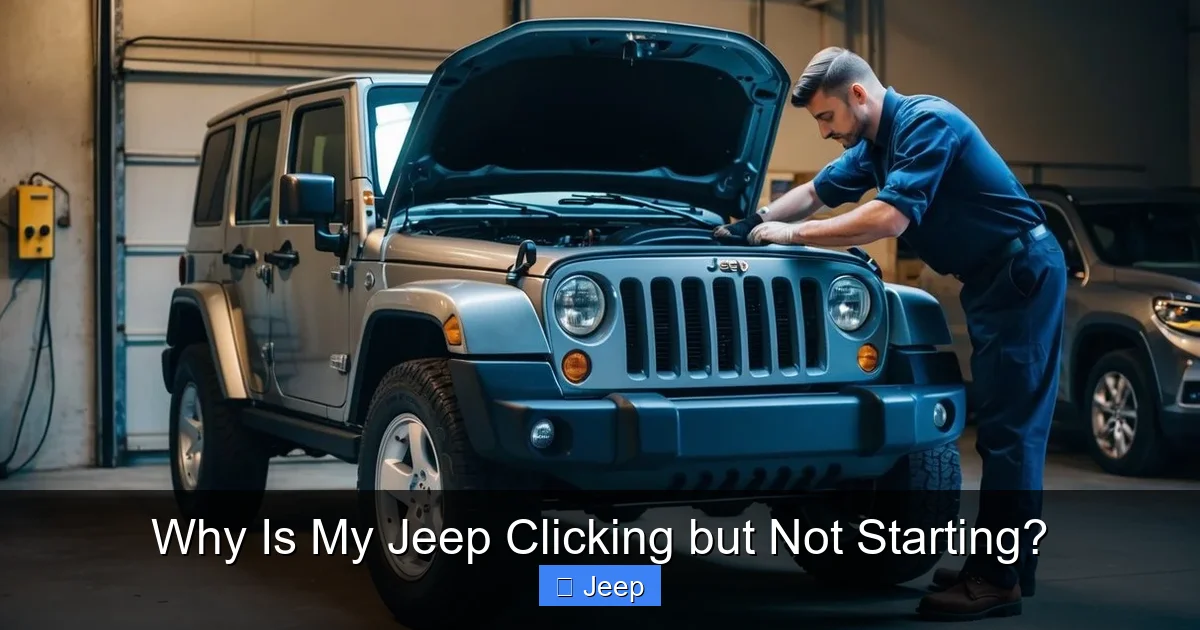
If your battery is strong (12.6V+ at rest, >10V while cranking) and the terminals are clean and tight, the starter assembly itself is the next suspect. The starter is a powerful electric motor. The solenoid is either mounted on top of it (common on many Jeeps) or integrated inside it. A failure in either component will result in the click without crank.
Visual guide about Why Is My Jeep Clicking but Not Starting?
Image source: koala.sh
2.1. The Faulty Starter Solenoid
The solenoid can fail in two ways. First, its internal contacts can burn out from years of high-current switching. They weld together or become so pitted that they can’t conduct power to the starter motor, even though you hear the solenoid’s coil click. Second, the solenoid’s magnetic coil can fail open, meaning it never actually engages the contacts at all—you might hear a faint click from the relay in the fuse box instead. A failing solenoid often gets hot and may smoke.
Diagnosis: With a strong battery and clean connections, you can perform a simple “solenoid tap” test. Have a helper turn the key to “start” while you firmly tap the body of the starter motor/solenoid assembly with a hammer or the handle of a socket wrench. Do this carefully and ensure the vehicle is in Park/Neutral with the parking brake set. If the engine suddenly cranks or starts, the solenoid or starter motor has dead spots and is failing. This is a classic, temporary fix that confirms the starter is bad and needs replacement.
2.2. The Worn-Out Starter Motor
Inside the starter, brushes wear down, windings can short out, and the armature can become grounded. A mechanically failed starter might have a seized bearing or a damaged gear (Bendix drive) that won’t engage the flywheel properly. You might hear a single loud click followed by silence, or the solenoid click but zero movement from the starter. Sometimes, a failing starter will draw excessive current, causing the voltage to plummet and the solenoid to disengage rapidly, creating a rapid-fire clicking sound.
Diagnosis: This requires more advanced testing. You can perform a voltage drop test across the starter terminals while cranking (if it tries to crank) to check for internal resistance. The most definitive test is to remove the starter and have it bench-tested at an auto parts store. Given the starter’s location on many Jeeps (often near the exhaust manifold, making it a hot, grimy job), many owners opt for replacement by a professional.
3. Electrical System Faults & Wiring
The path from your ignition switch to the starter solenoid is a highway of wires, fuses, relays, and switches. A break or high-resistance point anywhere along this path can interrupt the high-current flow needed to crank the engine, leaving you with just the solenoid’s click.
Visual guide about Why Is My Jeep Clicking but Not Starting?
Image source: shunauto.com
3.1. Ignition Switch Issues
The ignition switch does more than just turn on the radio; it’s the control point for the starter circuit. Over years of use, the internal contacts for the “start” position can wear out, become pitted, or accumulate dirt. This prevents the full current from reaching the solenoid. You might notice the switch feels loose or requires jiggling to start. In many Jeeps, the ignition switch is also part of the steering column lock mechanism.
Diagnosis: This can be tricky to test without a wiring diagram. A professional will check for battery voltage at the “start” signal wire on the starter solenoid when the key is turned. If voltage is present there, the switch and wiring up to that point are likely good, pointing to the starter itself. If no voltage is present, the fault is in the switch, the wiring, or a relay/fuse.
3.2. Neutral Safety Switch / Clutch Interlock Switch
This is a critical safety switch. On automatics, it’s the Neutral Safety Switch (NSS) on the transmission. On manuals, it’s the Clutch Pedal Switch. Its job is to prevent the engine from starting unless the transmission is in Park/Neutral (or the clutch is depressed on a manual). If this switch fails open, it breaks the circuit to the starter solenoid. The result is exactly what you’re experiencing: you turn the key, the ignition switch sends power, but the circuit is interrupted at the safety switch. You’ll hear a click from the solenoid or the starter relay, but nothing else.
Diagnosis: For an automatic, ensure the shifter is firmly in Park. Try wiggling it while turning the key. Sometimes adjusting the shift linkage or the switch itself can fix it. For a manual, ensure the clutch pedal is fully depressed. You can often test this switch with a multimeter for continuity when in the correct position. This is a very common failure point on older Jeeps with high mileage.
3.3. Blown Fuse or Faulty Relay
Your Jeep’s Power Distribution Center (PDC) under the hood contains high-amperage fuses and relays for the starter circuit. A partially blown fuse or a failed starter relay can allow just enough signal through to click the solenoid but not enough heavy current to spin the starter. Check your owner’s manual for the exact location and amperage of the starter fuse and relay. Swapping the starter relay with an identical one from another circuit (like the horn relay) is a quick, free test.
4. Other Potential (But Less Common) Causes
While battery, starter, and electrical issues are the big three, two other scenarios can produce a clicking sound.
Visual guide about Why Is My Jeep Clicking but Not Starting?
Image source: i.redd.it
4.1. Seized Engine (Hydrolock or Mechanical Failure)
This is the worst-case scenario. If your engine has ingested water (hydrolock) or has suffered a catastrophic internal failure (thrown rod, seized bearings), it will be physically impossible to turn over. When you engage the starter, the gear might try to mesh, but the engine won’t budge. The starter will draw maximum current, the voltage will plummet, and the solenoid will disengage, creating a rapid, distressed clicking. This is often preceded by strange noises or a sudden stop while driving.
Diagnosis: This requires professional assessment. A mechanic will try to manually turn the engine over with a socket on the crankshaft bolt. If it doesn’t budge, the engine is locked up and requires major repair or replacement.
4.2. Aftermarket Accessory Drains or Faulty Modules
Modern Jeeps are full of computers (modules). A short in any module or a poorly installed aftermarket device (like an alarm system, winch, or stereo) can create a parasitic drain that kills the battery overnight. It can also sometimes interfere with the starter signal. If the clicking problem seems to appear after installing a new accessory, that’s your prime suspect.
5. A Systematic Diagnostic Approach: How to Find the Problem
Don’t just start replacing parts. Follow this logical flowchart to pinpoint the issue efficiently and save money.
Step 1: The Battery & Connection Check (Do This First!)
- Visual: Open the hood. Look for severe corrosion, loose, or damaged cables.
- Clean & Tighten: Clean terminals as described in section 1.2. Ensure clamps are snug.
- Voltage Test: Check resting voltage. Should be 12.6V+.
- Load Test: Attempt to jump-start. If it starts with a jump, the battery is bad. If it doesn’t start with a jump, proceed to Step 2.
Step 2: Listen and Locate
Have a helper turn the key to “start.” Put your ear near the engine compartment. Where is the click coming from?
- From the engine bay, near the transmission bellhousing: That’s the starter solenoid. The starter is likely at fault.
- From under the dash, near the steering column: That’s the ignition switch or a relay in the fuse box.
- A faint click from the fuse box area: Could be a starter relay or a general electrical issue.
Step 3: The Solenoid Tap Test
If you located the click at the starter, perform the gentle tap test. If it starts, the starter is failing. If not, move on.
Step 4: Check Safety Switches & Fuses
- Confirm transmission is firmly in Park (try wiggling shifter). For manual, clutch pedal must be flat on the floor.
- Locate and inspect the starter fuse and relay in the PDC. Swap the relay with a known good one.
Step 5: Professional Diagnosis
If you’ve made it this far without a solution, the problem is likely deep in the wiring, a failed ignition switch, or a seized engine. At this point, it’s time to call a trusted mechanic with the proper diagnostic tools (wiring diagrams, multimeters, scan tools to check for related TCM/PCM fault codes). They can also check for any Technical Service Bulletins (TSBs) specific to your Jeep model and year. For instance, some Jeep models have known issues with starter motor mounts or wiring harness chafing that are worth investigating. You might also find that similar, non-starting issues in other brands like Toyota or Nissan share diagnostic steps here.
6. Model-Specific Considerations for Jeep Owners
While the principles are universal, here are some nuggets for popular models:
- Jeep Wrangler (JL/JK/TJ): The TJ (1997-2006) is famous for starter solenoid failures on the 4.0L inline-six. The starter is accessible from the top. The JL and JK (2007-2018) have the starter lower, near the exhaust, making it a hotter, dirtier job. Both are susceptible to battery terminal corrosion.
- Jeep Cherokee (XJ): The legendary XJ (1984-2001) often suffers from a failing Neutral Safety Switch on the transmission column. The starter is relatively accessible. Ground straps from the engine to the chassis can also corrode and cause starting issues.
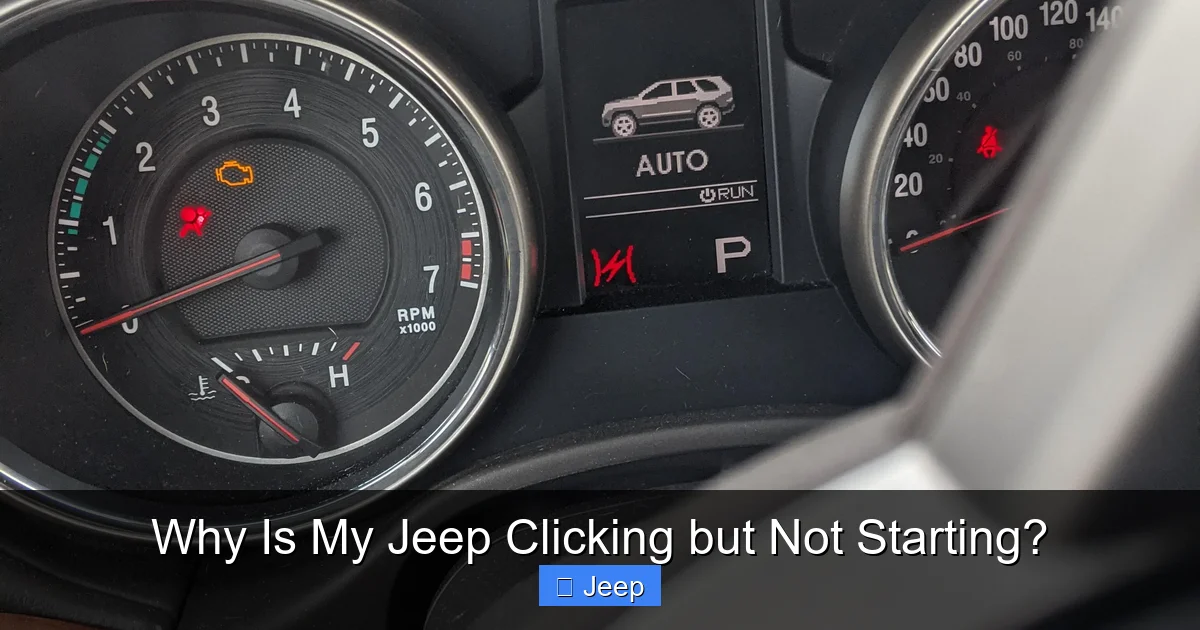
- Jeep Grand Cherokee (WK2/WL): These have more complex integrated systems. The key fob battery being dead can sometimes cause a no-start in keyless entry models (though usually you get a different message). Pay close attention to any dashboard warning lights before the click. A flashing mileage light can sometimes be related to security system issues that prevent starting; more on that here.
- Jeep CJ & Older Models: These are simpler. Focus 90% on the battery, connections, starter solenoid, and ignition switch. Parts are generally inexpensive and easy to find.
Conclusion
That dreaded Jeep clicking but not starting sound is your vehicle’s way of saying, “I’m trying, but I can’t.” In the vast majority of cases, the solution lies within the first 30 minutes of your diagnostic journey: check the battery health and clean those terminals. It’s the automotive equivalent of “did you try turning it off and on again?”—but it works surprisingly often. If a strong battery and pristine connections don’t solve it, the starter motor/solenoid assembly is the next most likely offender. Remember to always practice safety: set the parking brake, ensure the transmission is in Park/Neutral, and disconnect the battery when working on starters or electrical components.
Jeeps are built for durability and adventure, but even the toughest rigs need maintenance. By understanding this common symptom, you’re empowered to diagnose it yourself or have an informed conversation with your mechanic. Don’t let a clicking starter keep you from the trail. Get it diagnosed, get it fixed, and get back to enjoying the capability and freedom that only a Jeep can provide. If the problem persists after these checks, it’s a clear sign to seek professional help to avoid misdiagnosis and costly unnecessary repairs.
Frequently Asked Questions
Is it safe to drive my Jeep if it clicks before starting?
No. A clicking Jeep indicates a failing component in the starting system. While it might start after several attempts, you risk being stranded at any moment. Driving it could also cause the failing part to fail completely and potentially damage the flywheel or other components.
How do I know if it’s the battery or the starter?
First, try a jump start. If it starts with a jump, the battery is dead. If it still only clicks with a solid jump, the starter is likely faulty. A multimeter test showing voltage below 9.6V while cranking points to the battery; a good voltage (above 10V) while clicking points to the starter.
Can a bad alternator cause a clicking sound?
Not directly. A bad alternator won’t charge the battery, leading to a weak battery that causes the clicking symptom. However, the clicking sound itself is not caused by the alternator. If the battery is dead because the alternator failed, you’ll need to replace both.
What’s the difference between a slow crank and a rapid click?
A slow, labored crank usually means a weak battery that can provide *some* power to turn the engine slowly. A rapid, consistent click means the battery has enough power to activate the solenoid (making the click) but not enough to spin the starter motor at all. Both point to a power issue, but the rapid click is often a more severe battery or connection failure.
My Jeep’s dashboard lights are bright, but it still only clicks. What gives?
This is a classic sign of a problem downstream from the battery. The dashboard lights use a tiny amount of current. The starter needs hundreds of amps. A severely corroded terminal, a broken main cable, or a failed starter can allow the small current for lights to flow but block the massive current needed for starting.
How much does it cost to fix a clicking Jeep?
It varies wildly. Cleaning terminals is free (or $20 for a brush kit). A new battery costs $150-$300 installed. A new starter motor/solenoid assembly for a Jeep typically runs $200-$500 for parts, plus $200-$500 in labor depending on the model and accessibility. Always get a proper diagnosis first.
