
Why Is My Mileage Flashing on My Jeep?

A flashing mileage display on your Jeep is often a warning sign of a serious issue, such as a failing instrument cluster, faulty speed sensor, or low battery voltage. Ignoring it can lead to inaccurate readings, warning light malfunctions, or even drivability problems. Prompt diagnosis by a qualified mechanic is crucial to prevent further electrical complications and ensure your vehicle’s systems operate safely and reliably.
Key Takeaways
- Flashing mileage often signals a fuel system issue: Check fuel pressure and injectors immediately.
- Low fuel can trigger the warning: Refuel promptly to avoid engine performance problems.
- Faulty sensors may cause false alerts: Inspect and replace the fuel level or oxygen sensor if needed.
- Electrical glitches can disrupt readings: Scan for error codes using an OBD2 tool.
- Regular maintenance prevents false warnings: Keep fuel and electrical systems clean and up to date.
📑 Table of Contents
- Why Is My Mileage Flashing on My Jeep?
- What Does a Flashing Mileage Display Actually Mean?
- Top Causes of a Flashing Mileage Display in Jeeps
- Jeep Models Most Affected by Mileage Flashing
- How to Diagnose and Fix the Issue
- Prevention Tips to Avoid Future Flashing
- Real-World Example: My Jeep’s Mileage Started Flashing After a Jump-Start
- Summary Table: Common Causes and Fixes for Flashing Mileage
- Final Thoughts: Don’t Ignore the Flash
Why Is My Mileage Flashing on My Jeep?
You’re cruising down the highway in your trusty Jeep, windows down, music up, feeling that familiar sense of freedom only a Wrangler or Grand Cherokee can deliver. Then—bam. Out of nowhere, your mileage display starts flashing. Not just a quick flicker, but a persistent, rhythmic blink that makes you wonder: What in the world is going on?
Don’t panic. You’re not alone. Thousands of Jeep owners have stared at that blinking odometer or fuel economy readout, scratching their heads and wondering if it’s a sign of impending doom or just a quirky quirk of their beloved off-roader. The truth? It’s usually not as scary as it looks. But it is a signal—your Jeep’s way of saying, “Hey, something needs your attention.” Whether it’s a minor glitch or a warning about a deeper issue, understanding what that flashing mileage means can save you time, money, and a whole lot of stress.
In this guide, we’ll walk you through the most common reasons your Jeep’s mileage display is flashing, what each cause might mean, and—most importantly—what you can do about it. From simple fixes you can try at home to situations where you’ll want to visit a mechanic, we’ve got you covered. So grab a cup of coffee, settle in, and let’s decode that blinking mystery together.
What Does a Flashing Mileage Display Actually Mean?
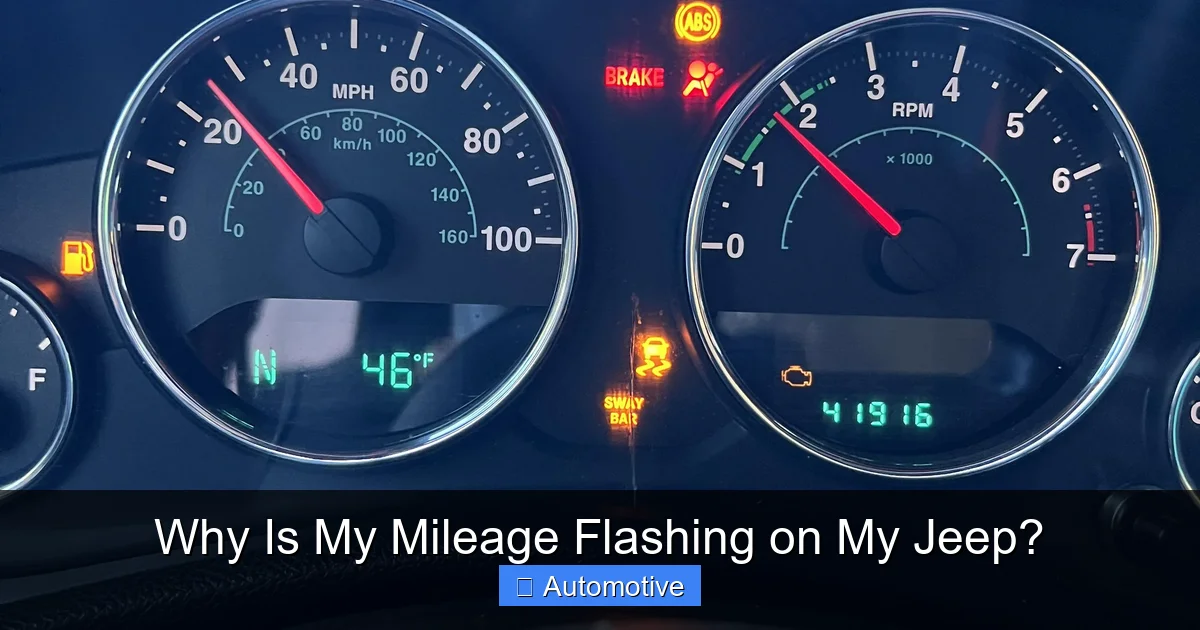
Before we dive into fixes, let’s clarify what we’re talking about. When we say “mileage flashing,” we’re usually referring to one of two things: either your odometer (the total miles your Jeep has traveled) is blinking, or your trip meter or fuel economy display (like MPG or average mileage) is flickering or flashing intermittently.
Visual guide about Why Is My Mileage Flashing on My Jeep?
Image source: i.redd.it
The odometer is the digital readout that shows your total mileage—the number that increases every time you drive. The trip meter, on the other hand, tracks shorter distances and can be reset. Fuel economy displays show real-time or average miles per gallon. When any of these start flashing, it’s your Jeep’s onboard computer trying to communicate something important.
Is It a Warning or Just a Glitch?
Most of the time, a flashing mileage display isn’t a sign of catastrophic failure. Think of it like your phone’s low battery icon—it’s not broken, but it’s telling you to plug it in. In the same way, your Jeep uses the flashing display to alert you to a condition that needs attention. It could be a sensor issue, a software hiccup, or even a maintenance reminder.
That said, it’s not something you should ignore. While it might be harmless today, the underlying issue could worsen over time. For example, a flashing odometer due to a faulty sensor might eventually lead to inaccurate fuel readings, which could affect your driving habits and fuel efficiency.
Common Scenarios Where Mileage Flashes
- After a battery replacement or jump-start: The system may reset or lose calibration, causing temporary flashing.
- During cold starts in extreme weather: Temperature fluctuations can affect electrical components.
- After driving through deep water or mud: Moisture can interfere with sensors or wiring.
- When the vehicle is in limp mode: A serious issue may trigger reduced performance and flashing displays.
- After installing aftermarket electronics: Poorly installed accessories can disrupt the CAN bus system.
Understanding these scenarios helps you narrow down the cause. For instance, if your mileage started flashing right after you replaced the battery, it’s likely a calibration issue. But if it began after a weekend of off-roading in the desert, moisture or dirt might be the culprit.
Top Causes of a Flashing Mileage Display in Jeeps
Now that we know what the flashing means, let’s explore the most common reasons it happens. While every Jeep model (Wrangler, Cherokee, Grand Cherokee, Gladiator, etc.) has slight differences, the underlying causes are often similar across the lineup.

Visual guide about Why Is My Mileage Flashing on My Jeep?
Image source: wljeepforum.com
1. Faulty or Dirty Speed Sensor
The speed sensor—also known as the vehicle speed sensor (VSS)—is a critical component that tells your Jeep how fast it’s going. It sends data to the engine control unit (ECU), which then calculates fuel delivery, transmission shifts, and, yes, your mileage readings.
If the speed sensor is dirty, damaged, or failing, it can send erratic signals. This confuses the ECU, leading to inaccurate or flashing mileage displays. In some cases, the odometer may even stop working entirely.
Example: You notice the flashing starts after driving through a muddy trail. Mud or debris may have coated the sensor, blocking its ability to read wheel rotation accurately.
Tip: The speed sensor is usually located on the transmission or transfer case. If you’re comfortable with basic maintenance, you can inspect it for dirt or damage. Cleaning it with electrical contact cleaner might solve the problem. But if it’s cracked or corroded, replacement is the best option.
2. Weak or Failing Battery
Your Jeep’s electrical system relies on a stable power supply. When the battery is weak, dying, or has been recently replaced, voltage fluctuations can disrupt the instrument cluster and ECU communication.
A flashing mileage display is a classic symptom of low voltage. The system may not have enough power to maintain consistent readings, causing the display to blink or reset.
Example: You jump-started your Jeep last week, and now the mileage flashes every time you start it. This is a common occurrence after a jump-start, especially if the battery wasn’t fully charged afterward.
Tip: Use a multimeter to check your battery voltage. A healthy battery should read around 12.6 volts when the engine is off and 13.7–14.7 volts when running. If it’s below 12.4 volts, consider charging or replacing the battery. Also, ensure the terminals are clean and tight.
3. Software Glitch or ECU Reset
Modern Jeeps rely heavily on software to manage everything from fuel injection to dashboard displays. Sometimes, the software gets confused—especially after a power interruption like a dead battery or jump-start.
This can cause the instrument cluster to behave erratically, including flashing mileage, incorrect fuel levels, or warning lights that don’t make sense.
Example: You disconnected the battery to replace a headlight, and now the mileage display won’t stay steady. The ECU may need to relearn certain parameters.
Tip: Try a soft reset by turning the ignition to “ON” (without starting the engine) for 10–15 seconds, then turning it off. Repeat this 2–3 times. This can help the system re-sync. For more persistent issues, a professional scan tool may be needed to reset the ECU or update the software.
4. Damaged or Loose Wiring
Electrical connections are the backbone of your Jeep’s dashboard system. Over time, wires can become loose, corroded, or damaged—especially in older models or vehicles that have seen heavy off-road use.
If the wiring between the speed sensor, ECU, and instrument cluster is compromised, signals can be interrupted, leading to flashing or missing data.
Example: You’ve been driving on bumpy terrain, and now the mileage flickers when you hit potholes. Vibration may have loosened a connector or worn through insulation.
Tip: Inspect the wiring harness near the transmission, under the dashboard, and behind the instrument cluster. Look for frayed wires, loose plugs, or corrosion. Use electrical tape or heat shrink tubing to repair minor damage. For major issues, consult a mechanic.
5. Instrument Cluster Malfunction
In rare cases, the problem isn’t with the sensors or wiring—it’s the instrument cluster itself. The cluster contains microchips and displays that can fail over time, especially in extreme temperatures or due to moisture exposure.
A failing cluster might show flashing mileage, dead segments, or erratic behavior across multiple gauges.
Example: The mileage flashes, the fuel gauge jumps around, and the temperature light comes on randomly. This points to a cluster issue rather than a single sensor.
Tip: If other gauges are also acting up, the cluster may need repair or replacement. Some owners opt for refurbished units, which can be more affordable than new ones. Always back up your mileage before replacing the cluster, as it affects resale value.
Jeep Models Most Affected by Mileage Flashing
While any Jeep can experience a flashing mileage display, certain models and years are more prone to specific issues. Knowing your model’s tendencies can help you diagnose the problem faster.
Visual guide about Why Is My Mileage Flashing on My Jeep?
Image source: carnewsbox.com
Jeep Wrangler (TJ, JK, JL)
The Wrangler is beloved for its ruggedness, but its open design makes it more vulnerable to moisture and dirt. The speed sensor and wiring are often exposed, increasing the risk of damage.
Owners of older TJ and JK models frequently report flashing mileage after off-roading or heavy rain. The JL (2018+) has improved sealing, but issues can still occur.
Jeep Grand Cherokee (WK2, WL)
The Grand Cherokee’s advanced electronics make it susceptible to software glitches. WK2 models (2011–2017) have had reports of instrument cluster failures, especially in humid climates.
The WL (2022+) uses a fully digital cluster, which is sleek but can be more complex to diagnose and repair.
Jeep Cherokee (KL)
The KL Cherokee has had isolated reports of ECU communication errors, particularly after software updates. Some owners noticed flashing displays after visiting the dealership for routine service.
Always check for Technical Service Bulletins (TSBs) related to your model. These are manufacturer-issued notices about known issues and fixes.
Jeep Gladiator (JT)
As a newer model, the Gladiator shares many components with the JL Wrangler. However, its heavier use in towing and off-roading can stress the electrical system, leading to sensor or wiring issues.
Owners should pay extra attention to the wiring harness near the rear axle, where the speed sensor is located.
How to Diagnose and Fix the Issue
Now that you know the possible causes, let’s talk about how to diagnose and fix the problem. The good news? Many of these fixes are DIY-friendly. The bad news? Some require tools or expertise.
Step 1: Check for Obvious Issues
Start simple. Look for loose wires, dirty sensors, or signs of water damage. Pop the hood and inspect the battery terminals. Are they corroded? Are the connections tight?
Next, check under the vehicle. Is the speed sensor covered in mud? Is there a puddle of water near the wiring harness? These visual clues can save you hours of troubleshooting.
Step 2: Use an OBD2 Scanner
An OBD2 (On-Board Diagnostics) scanner is a small device that plugs into your Jeep’s diagnostic port (usually under the dashboard). It reads error codes from the ECU and can pinpoint issues like a faulty speed sensor or communication errors.
Even basic scanners (under $50) can read common codes. Look for codes like P0500 (Vehicle Speed Sensor Malfunction) or U0155 (Lost Communication with Instrument Panel Cluster).
Tip: Clear the codes after reading them. If the flashing stops and doesn’t return, it may have been a temporary glitch. If it comes back, the issue is likely persistent.
Step 3: Test the Battery and Charging System
Use a multimeter to check your battery voltage. If it’s low, charge it fully and test again. If the alternator isn’t charging properly, the battery will drain, causing electrical issues.
A healthy charging system should maintain voltage between 13.7 and 14.7 volts while the engine is running. Anything outside that range could indicate a problem with the alternator or voltage regulator.
Step 4: Inspect and Clean the Speed Sensor
Locate the speed sensor (refer to your owner’s manual or online guides). Remove it carefully and inspect for dirt, rust, or damage. Clean it with electrical contact cleaner and a soft brush.
Reinstall it securely. If the sensor is cracked or the magnet is damaged, replace it. Aftermarket sensors are affordable and widely available.
Step 5: Reset the System
After making repairs, reset the ECU by disconnecting the battery for 10–15 minutes. This clears temporary memory and allows the system to relearn parameters.
Reconnect the battery, start the engine, and drive for 10–15 minutes to allow the system to recalibrate. Monitor the mileage display to see if the flashing stops.
When to See a Mechanic
If you’ve tried the above steps and the flashing persists, it’s time to consult a professional. A certified Jeep technician can perform advanced diagnostics, including:
- Checking CAN bus communication
- Testing the instrument cluster
- Updating or reprogramming the ECU
- Replacing complex components
Don’t ignore persistent flashing—it could indicate a deeper electrical issue that worsens over time.
Prevention Tips to Avoid Future Flashing
An ounce of prevention is worth a pound of cure. Here’s how to reduce the chances of your mileage display flashing again.
Keep Your Battery Healthy
Replace your battery every 3–5 years, even if it seems fine. Extreme temperatures shorten battery life. Use a battery tender if you don’t drive often.
Protect Electrical Components
After off-roading, rinse under the vehicle to remove mud and debris. Use dielectric grease on connectors to prevent corrosion.
Use Quality Parts
When replacing sensors or wiring, choose OEM or high-quality aftermarket parts. Cheap components are more likely to fail.
Update Software Regularly
Visit your dealership or use a professional scan tool to check for software updates. Manufacturers often release patches for known issues.
Monitor Warning Signs
Pay attention to other symptoms like rough shifting, poor fuel economy, or dashboard warning lights. These can indicate related problems.
Real-World Example: My Jeep’s Mileage Started Flashing After a Jump-Start
Let me share a quick story. Last winter, my 2016 Jeep Wrangler wouldn’t start—dead battery, thanks to leaving the lights on overnight. I jumped it, got it running, and drove to work. But the next morning, the mileage display was flashing like a disco ball.
I panicked at first. Was the ECU fried? Did I damage something? Then I remembered: low voltage can cause temporary glitches. I charged the battery fully, reset the system by turning the ignition on and off a few times, and within a day, the flashing stopped.
The lesson? Don’t assume the worst. Many flashing mileage issues are temporary and fixable with simple steps. But always monitor the situation—if it comes back, dig deeper.
Summary Table: Common Causes and Fixes for Flashing Mileage
| Cause | Symptoms | DIY Fix | Professional Help Needed? |
|---|---|---|---|
| Faulty Speed Sensor | Flashing odometer, erratic speedometer | Clean or replace sensor | No (if accessible) |
| Weak Battery | Flashing after jump-start, dim lights | Charge or replace battery | No |
| Software Glitch | Flashing after battery disconnect | Reset ECU, update software | Sometimes |
| Loose Wiring | Flashing worsens with bumps | Inspect and secure connections | Maybe |
| Instrument Cluster Failure | Multiple gauges malfunctioning | None (requires replacement) | Yes |
Final Thoughts: Don’t Ignore the Flash
A flashing mileage display on your Jeep isn’t just annoying—it’s a signal. Whether it’s a simple fix like cleaning a sensor or a more complex issue like a failing cluster, addressing it early can prevent bigger problems down the road.
Remember, your Jeep is built to handle tough conditions, but even the toughest machines need care. Regular maintenance, attention to electrical health, and a little troubleshooting know-how go a long way.
So the next time your mileage starts flashing, take a deep breath. Check the battery, inspect the sensor, and reset the system. Most of the time, that’s all it takes. And if it doesn’t? Don’t hesitate to get help. Your Jeep—and your peace of mind—will thank you.
Drive safe, stay curious, and keep exploring. After all, that’s what Jeeps are for.
Frequently Asked Questions
Why is my mileage flashing on my Jeep?
A flashing mileage display on your Jeep typically indicates a detected issue with the vehicle’s emissions system or engine performance. This warning often appears when the onboard diagnostic system (OBD-II) has identified a problem that could affect fuel efficiency or emissions.
What does it mean when the odometer flashes on a Jeep?
When the odometer or mileage display flashes, it’s usually a signal from the vehicle’s computer that a fault has been detected. This could be related to the fuel system, oxygen sensors, or catalytic converter, and should be checked promptly to avoid further damage.
Can a flashing mileage light indicate a problem with the fuel system?
Yes, a flashing mileage display can point to fuel system issues such as a faulty fuel injector, low fuel pressure, or a clogged fuel filter. These problems can reduce engine efficiency and trigger the warning light to alert the driver.
Is it safe to drive my Jeep when the mileage is flashing?
Driving with a flashing mileage warning is not recommended, as it may indicate a serious engine or emissions issue. Continuing to drive could lead to increased emissions, reduced fuel economy, or even engine damage if the underlying problem isn’t addressed.
How do I reset the flashing mileage on my Jeep?
You can’t simply reset a flashing mileage warning without diagnosing the root cause first. Use an OBD-II scanner to read the trouble codes, then repair the issue—such as replacing a faulty sensor—before the system will stop flashing.
Why does my Jeep’s mileage flash only when I accelerate?
If the mileage display flashes during acceleration, it may signal a misfire or a problem with the ignition system, such as bad spark plugs or coils. These issues disrupt combustion and trigger the warning, especially under load.