
What Is Sport Mode on a Jeep Grand Cherokee?

Sport Mode on a Jeep Grand Cherokee is a driver-selectable setting that transforms the vehicle’s personality for a more responsive, engaging driving experience. It sharpens throttle response, holds gears longer, tightens steering, and often firms the suspension. It’s perfect for spirited driving on curvy roads or highway merging, but isn’t meant for severe off-roading or maximum fuel economy.
Key Takeaways
- Sport Mode reprograms the Grand Cherokee’s computer: It alters throttle mapping, transmission shift points, steering weight, and sometimes suspension damping to prioritize performance and driver feedback over comfort and efficiency.
- It makes the vehicle feel quicker and more connected: You’ll notice immediate accelerator response, the transmission downshifts more readily, and the steering feels heavier and more precise.
- Use it for dynamic driving situations: Ideal for highway merging, navigating twisty back roads, or when you simply want a more engaging commute. It is not a winter or severe off-road mode.
- Fuel economy will suffer: Because the engine and transmission work harder and at higher RPMs, expect a noticeable decrease in MPG when Sport Mode is engaged.
- Availability varies by model year and trim: Most modern Grand Cherokees (WK2 generation 2011-2021 and WL 2022+) have it, but the specific implementation (e.g., adaptive suspension) depends on the trim level and optional packages.
- It’s safe for daily use but not a “race mode”: The changes are calibrated for public roads. It won’t harm the engine or transmission, but it’s not designed for track use or extreme conditions.
📑 Table of Contents
Unleashing the Beast: What Exactly Is Sport Mode?
So, you’re sitting in your Jeep Grand Cherokee, you’ve got the climate control set just right, your favorite playlist is queued up, and you see that little button or the “S” on the drive mode selector. It’s labeled “Sport.” But what does it actually do? Is it just a placebo, a fancy sticker that makes you feel faster? Or does it genuinely transform your family-friendly SUV into something more akin to a sport wagon?
The short answer is: it does real, tangible things. Sport Mode on a Jeep Grand Cherokee is a pre-programmed setting that tells the vehicle’s brain—its multiple computer modules—to change its behavior. Think of it as giving your Grand Cherokee a double espresso. In its normal “Auto” or “Comfort” setting, it’s relaxed, efficient, and smooth. It wants to sip fuel and glide over bumps. Engage Sport Mode, and it becomes alert, responsive, and eager to please the driver behind the wheel. It’s the same physical hardware—the same V6 or V8 engine, the same ZF 8-speed automatic transmission, the same Quadra-Lift or Quadra-Trac system—but with the software parameters rewritten for performance.
The Core Concept: Software Over Hardware
This is the most important thing to understand. You are not bolting on new parts when you press the Sport button. You are simply instructing the Engine Control Unit (ECU), Transmission Control Unit (TCU), and Electric Power Steering (EPS) module to operate on a different set of rules. The ECU makes the throttle plate open more for a given pedal position (sharper response). The TCU ignores early upshift commands and keeps the engine in its power band longer. The EPS adds more assist at low speeds for ease but increases steering effort and feedback at higher speeds for a ” Sportier” feel. On models with adaptive suspension (like those with the Quadra-Lift air suspension or certain trims with the optional performance suspension), the dampers firm up to reduce body roll during cornering. It’s a holistic, system-wide tweak.
Evolution in the Grand Cherokee
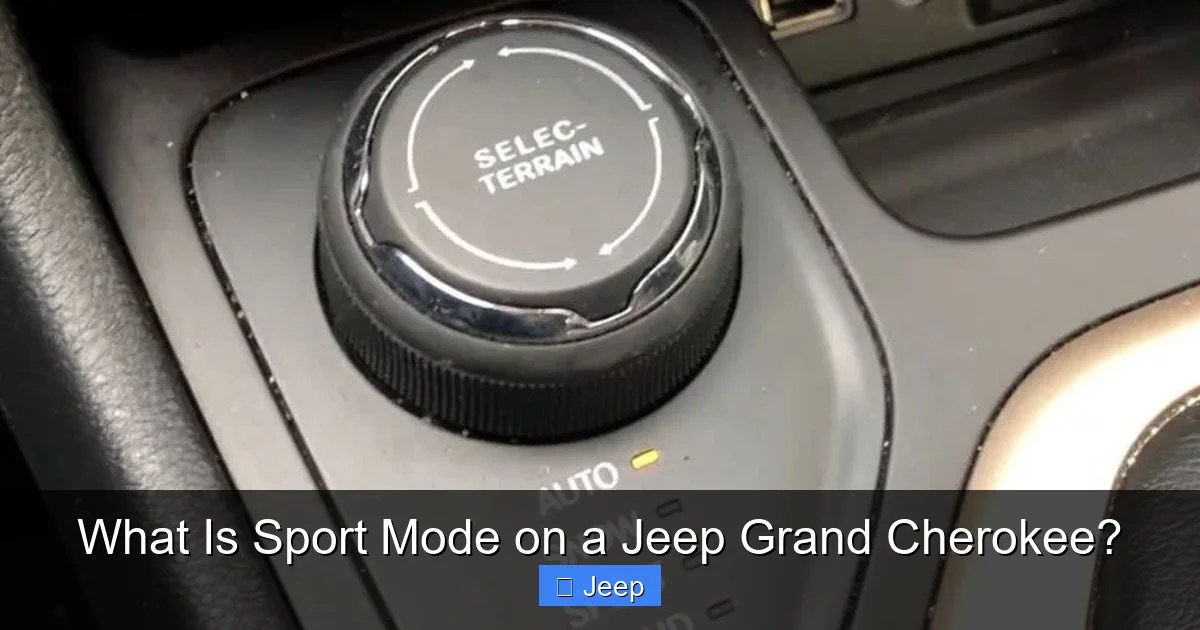
Sport Mode hasn’t been around forever in the Grand Cherokee lineage. It became a mainstream, expected feature with the WK2 generation that launched in 2011. Early implementations were simpler—primarily affecting throttle and transmission. As technology advanced, especially with the introduction of more sophisticated electric power steering and available adaptive suspensions in the 2014-2021 models, the effect became more pronounced and multi-faceted. The current WL generation (2022+) integrates Sport Mode even more seamlessly, often as part of the broader Selec-Terrain system’s “Auto” setting or as a standalone button, with even sharper tuning and, on higher trims, integration with the electronic limited-slip differential.
Under the Hood: How Sport Mode Transforms Your Driving Experience
Let’s break down exactly what changes you can feel and hear when you tap that Sport button. This is where the magic (or science, rather) happens.
Visual guide about What Is Sport Mode on a Jeep Grand Cherokee?
Image source: vehiclesphere.com
Throttle Response: The “Go” Pedal Gets Attitude
In normal mode, the throttle is often “dull” or “linear” by design. This promotes smooth, fuel-efficient driving. Press the pedal 20%, and the throttle plate might only open 15%. This is to prevent jerky starts and help you drive gently. Sport Mode rewrites this relationship. Now, pressing the pedal 20% might open the throttle 25% or more. The result is immediate, urgent acceleration. The engine responds to your right foot like it’s been insulted. This makes the Grand Cherokee feel significantly quicker off the line and more eager to pass on the highway, even if the peak horsepower number hasn’t changed.
Transmission Behavior: Holding the Power
This is one of the most noticeable changes. In normal driving, the ZF 8-speed transmission is a hyper-efficient, clever device that upshifts at low RPMs to save fuel. In Sport Mode, it becomes a partner in performance. It will:
- Delay upshifts: It will let the revs climb higher before changing gears, keeping the engine in its optimal power band.
- Downshift more aggressively: A slight lift of the throttle or a touch of the brake will prompt a downshift to prepare for acceleration or engine braking.
- Hold gears during cornering: It won’t prematurely upshift mid-corner, which can upset the car’s balance.
- Rev-match downshifts (on some models): For smoother, faster downshifts when you brake.
The transmission feels “awake” and in sync with your intentions. The shifts can also feel slightly firmer and more deliberate.
Steering Weight and Feedback
Modern Jeeps use electric power steering, which is great for efficiency but can feel numb or over-assisted. Sport Mode typically increases the steering effort, especially at highway speeds. The wheel becomes heavier to turn, which many drivers interpret as more “feedback” or a more connected feel to the road. It doesn’t magically create more mechanical feedback, but the increased effort gives a psychological sense of control and sportiness. Low-speed maneuvers (like parking) remain easy, as the system still provides assist.
Suspension and Dynamics (Where Available)
This is the cherry on top for Grand Cherokees equipped with adaptive dampers (often part of the Quadra-Lift air suspension system or a separate performance package). In Sport Mode, these electronically controlled shocks firm up significantly. They reduce the compliance and floatiness of the normal setting, which does two key things: it reduces body roll during hard cornering, making the SUV feel more planted and agile, and it improves steering response by reducing the delay from the suspension compressing. The ride can become noticeably firmer and less forgiving on rough pavement—a trade-off for better control. If your Grand Cherokee does not have adaptive dampers, the suspension geometry remains the same; the changes are limited to throttle, transmission, and steering.
When to Engage Sport Mode: Practical Scenarios
Knowing what it does is one thing. Knowing when to use it is the key to getting the most out of the feature. Sport Mode is a tool for specific situations.
Visual guide about What Is Sport Mode on a Jeep Grand Cherokee?
Image source: jeepmodified.com
1. Highway Merging and Passing
This is perhaps its most useful daily application. You’re on a 65 mph road, and you need to merge onto a busy interstate where traffic is flowing at 75. In normal mode, you press the pedal, wait for the transmission to think about downshifting, and then… you lurch. In Sport Mode, the transmission is already anticipating your need for power. A firm press of the pedal produces an immediate downshift and a surge of acceleration, making merging safer and less stressful. The same applies to passing a slow-moving vehicle on a two-lane road.
2. Enjoying a Curvy Back Road
Got a favorite scenic route with a series of S-curves or a fun mountain pass? Sport Mode is your friend. The sharper throttle response lets you control your speed with the pedal more precisely between corners. The transmission holds gears so you’re always in the power band to power out of a turn. The firmer steering and suspension (if equipped) inspire confidence, reducing the feeling of body roll and making the vehicle feel more agile through the bends. It transforms a relaxing drive into an engaging one.
3. Towing (With Caution)
If you’re towing a trailer, especially a heavier one, Sport Mode can be beneficial on hilly terrain. The transmission’s reluctance to upshift means it will hold a lower gear climbing a grade, preventing constant hunting between gears and keeping engine RPMs stable. The increased throttle response can also help with getting a heavy load moving from a stop. However, be aware that engine braking will be much stronger, so you may need to adjust your brake usage on descents. Also, fuel economy will plummet even more than usual while towing in Sport Mode.
When NOT to Use Sport Mode
- Deep Snow, Ice, or Mud: The sharp throttle and aggressive transmission shifts can easily break traction on low-grip surfaces. Use “Snow” mode (if equipped) or stay in normal mode with very gentle inputs.
- Severe Off-Road Trails: For rock crawling or deep water fording, you want predictable, smooth power delivery. Sport Mode’s abruptness is counterproductive. Use “4Lo” and “Off-Road” modes (or the appropriate Selec-Terrain setting) instead.
- When Fuel Economy is the Priority: City commuting in heavy traffic? Stick to normal mode. The constant high RPMs and aggressive shifts will drain your tank much faster.
- On Very Poor Road Surfaces: The firmer suspension (if active) and sharper steering can make potholes and broken pavement feel more jarring and harsh.
Sport Mode Across Generations: A Model Year Guide
The experience isn’t identical from a 2012 Grand Cherokee to a 2024 model. Here’s a general overview of how it’s evolved.
Visual guide about What Is Sport Mode on a Jeep Grand Cherokee?
Image source: vehiclesphere.com
WK2 Generation (2011-2021)
This was the generation that mainstreamed the feature. On base models, Sport Mode was typically a button on the center console or shifter that altered throttle and shift points. As you moved up to trims like Limited, Overland, and Summit, the feature became more sophisticated. Models equipped with the available Quadra-Lift air suspension saw their damping rates change in Sport Mode, creating a more dramatic difference between Comfort and Sport. The 2014-2021 SRT models, of course, had their own dedicated “Track” mode, but their standard “Sport” mode was already very aggressive, with the SRT-specific performance-tuned components always active.
WL Generation (2022-Present)
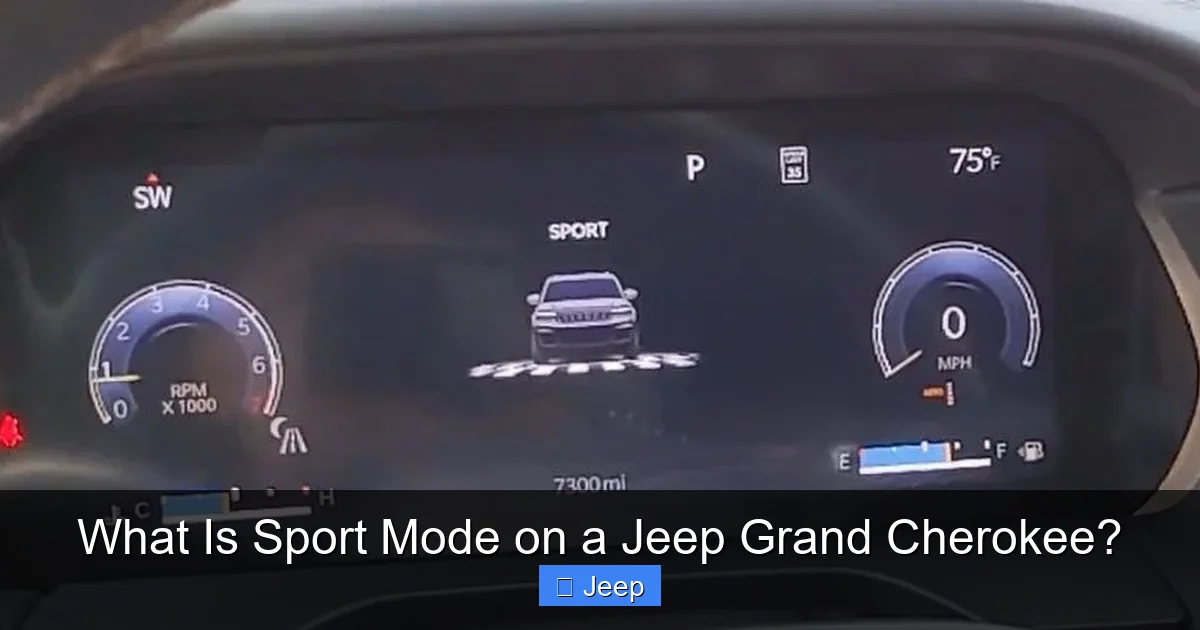
The current Grand Cherokee refined the system. The drive mode selector is now a rotary knob on the center console (on most trims). “Sport” is a distinct setting alongside Auto, Snow, Sand/Mud, and Rock. The integration is tighter. The changes to throttle, transmission, and steering are more pronounced and better calibrated. For models with the available electronic limited-slip differential (eLSD), it becomes more active in Sport Mode, helping to put power down more effectively through corners. The available air suspension (Quadra-Lift) still firms up, but the tuning is aimed at balancing on-road performance with the Grand Cherokee’s legendary capability. The overall effect is more seamless and sophisticated than in earlier generations.
Debunking Myths: What Sport Mode Is NOT
Let’s clear up some common misconceptions that can lead to confusion or misuse.
Myth 1: “It Will Destroy My Engine or Transmission”
Absolutely not. The engineers at Stellantis design these modes to be used regularly. The engine will rev higher and more often, which means it’s operating under more load and will experience more wear over time than if you always drove gently in Eco mode. But this is normal wear and tear, not abuse. The transmission is designed to handle the more aggressive shift schedules. You are simply using the vehicle in a way it was engineered for. The real danger comes from abusing any mode—like aggressive launching or redlining constantly—not from the mode itself.
Myth 2: “It’s Just a Gimmick; It Doesn’t Do Anything”
If you have a Grand Cherokee without adaptive suspension, the changes are primarily to throttle and transmission. If you’re a very sensitive driver, you might not feel a huge difference in steering weight. But for most people, the difference in accelerator pedal urgency and transmission behavior is immediately and obviously noticeable. It makes the vehicle feel more alive. Calling it a gimmick ignores the real software work that goes into tuning these different maps.
Myth 3: “It’s the Same as Putting My Car in a Lower Gear Manually”
There’s overlap, but it’s not identical. Manually selecting a lower gear (using the paddle shifters or the shift lever) gives you absolute, direct control over the gear you’re in. Sport Mode is an automatic, pre-set strategy. It will still automatically shift up when you reach the redline. The benefit of Sport Mode is that it’s a set-and-forget system that anticipates your needs without you having to manually intervene every time you want a quick burst of power. It’s a convenience and a holistic system change, not a manual mode.
Myth 4: “It’s a Winter Driving Mode”
This is a critical safety point. Sport Mode is the opposite of a winter mode. Its sharp throttle and eager downshifts are a recipe for wheel spin on ice and snow. Always use the dedicated “Snow” mode (if your vehicle has Selec-Terrain) or simply drive very carefully in normal mode during winter conditions. The “Snow” mode softens the throttle response and starts the vehicle in 2nd gear from a stop to minimize torque and wheel spin.
Conclusion: Embracing the Dual Personality
Sport Mode on a Jeep Grand Cherokee is a fantastic example of how modern software can give a single vehicle multiple personalities. It allows your capable, comfortable, and spacious family SUV to transform into a more engaging, responsive, and driver-focused machine at the simple push of a button. It’s not about turning your Grand Cherokee into a track weapon—that’s what the SRT models are for. It’s about extracting more of the inherent fun and capability that’s already baked into the platform. You get sharper feedback, more control, and a more connected feel to the road, all while retaining the legendary ground clearance, interior space, and utility that make a Grand Cherokee a Grand Cherokee.
So, the next time you’re on a clear, dry road with a fun stretch ahead, don’t be afraid to hit that “S.” Feel the steering weight increase in your hands, listen to the engine note change as it holds a gear, and enjoy the more immediate response to your touch. Just remember to switch back to Auto for your daily commute or when the weather turns sour. Understanding and using this feature properly is all part of the joy of owning a modern, versatile vehicle like the Jeep Grand Cherokee. It gives you the best of both worlds: civilized efficiency when you need it, and spirited performance when you want it.
Frequently Asked Questions
Will using Sport Mode damage my Jeep Grand Cherokee’s engine or transmission?
No. Sport Mode is an engineered driving setting designed for regular use. While it causes the engine to rev higher and the transmission to shift more aggressively than in normal mode, this is within the design parameters of the components. Normal wear and tear increases compared to gentle driving, but it will not cause damage if used as intended.
Does Sport Mode use more gas?
Yes, significantly. Because the engine operates at higher RPMs and the transmission holds gears longer to maximize power, fuel efficiency drops. You can expect a decrease of 1-3 MPG or more depending on your driving style and conditions. It prioritizes performance over economy.
Can I use Sport Mode for off-roading or in the snow?
No, you should not. Sport Mode’s sharp throttle response and aggressive downshifts make it easy to lose traction on low-grip surfaces like snow, ice, mud, or rocks. For winter driving, use the “Snow” mode in Selec-Terrain if available. For severe off-roading, use “4Lo” and the appropriate terrain mode (Sand/Mud or Rock) for smooth, controlled power delivery.
Do all Jeep Grand Cherokee models have Sport Mode?
Almost all modern Grand Cherokees (WK2 generation from 2011 onward and WL generation from 2022 onward) include a form of Sport Mode. However, the extent of its effects varies. Base models typically only adjust throttle and transmission. Higher trims with adaptive suspension (Quadra-Lift) will also firm the ride. It’s nearly universal but check your owner’s manual for your specific model year and trim.
How is Sport Mode different from the “Track” mode on a Grand Cherokee SRT?
Sport Mode on standard Grand Cherokees is a calibrated setting for spirited on-road driving. The SRT “Track” mode is far more extreme. It disables traction control and stability systems more aggressively, optimizes the performance suspension and all-wheel-drive system for maximum cornering, and is intended for closed-course track use only. It is not suitable for public roads.
Can I manually shift gears while in Sport Mode?
Yes. Engaging Sport Mode does not prevent you from using the paddle shifters or the manual shift gate (if equipped). You can still take manual control of the transmission. Sport Mode simply provides a more aggressive automatic baseline if you choose not to intervene. Many drivers use Sport Mode for its steering and suspension changes but still manually select gears for ultimate control. If you’re considering a lease or purchase, checking current lease deals can help you get into a model with the full suite of drive modes.