
Do Tesla Chargers Need Gfci Protection?

Yes, GFCI protection is generally required for Tesla chargers installed in garages, outdoors, or in damp locations according to the National Electrical Code (NEC). However, Tesla’s Wall Connector and Mobile Connector have built-in GFCI circuitry, which can sometimes satisfy the requirement depending on your local jurisdiction’s interpretation. Always check with your local AHJ (Authority Having Jurisdiction) and hire a licensed electrician to ensure your installation is both safe and code-compliant, as rules can vary by region and specific installation scenario.
So, you’ve taken the plunge and joined the electric vehicle revolution with a Tesla. Fantastic choice! Now comes the practical part: setting up your charging station at home. You’ve probably heard about GFCI protection—those outlets with the little “test” and “reset” buttons you see in bathrooms and kitchens. But does your shiny new Tesla charger need one? It’s a deceptively simple question with a surprisingly complex answer that sits at the intersection of national electrical codes, Tesla’s brilliant engineering, and your local city inspector’s interpretation. Let’s plug in and break it down, friend-to-friend.
First, a quick primer. A GFCI, or Ground Fault Circuit Interrupter, is a life-saving device. It monitors the electrical current flowing through a circuit. If it detects even a tiny imbalance—as little as 4 or 5 milliamps—it assumes electricity is leaking somewhere, possibly through a person, and it cuts the power almost instantly (within a fraction of a second). For a device that can draw 40, 50, or even 80 amps of power to charge your car, that protection isn’t just a good idea; it’s a critical safety net against electrocution, especially in areas where water or moisture might be present.
Here’s the core of the confusion: Tesla’s charging equipment is incredibly smart. Both the Tesla Wall Connector (the hardwired, permanent station) and the Tesla Mobile Connector (the portable cord that comes with the car) have sophisticated internal GFCI circuitry built right into their electronics. This isn’t just a simple mechanical switch; it’s a digital monitor that’s part of the charger’s core safety system. So, if the charger itself has GFCI, why would you need another one on the circuit? That’s the million-dollar question, and the answer lives in the pages of the National Electrical Code® (NEC).
Key Takeaways
- NEC Typically Requires GFCI: The 2020 and 2023 NEC mandates GFCI protection for EVSEs (Electric Vehicle Supply Equipment) in garages, accessory buildings, and outdoors.
- Tesla’s Built-In GFCI May Suffice: Both the Tesla Wall Connector and Mobile Connector incorporate internal GFCI protection, which many AHJs accept as compliant.
- Location is the Deciding Factor: A charger in a dry, dedicated interior room far from water sources may not need GFCI, but garages and outdoors almost always do.
- Local Codes Override General Guidance: Your city or county’s electrical inspector has the final say. Their interpretation of the code is what matters for your permit.
- Safety is the Primary Goal: GFCI protection prevents severe electrical shock by cutting power during a ground fault, a critical safety feature for high-amperage EV charging.
- Breaker vs. Receptacle GFCI: GFCI can be provided by a GFCI circuit breaker in your panel or a GFCI receptacle. The Wall Connector’s internal GFCI often eliminates the need for a separate GFCI receptacle.
- Retrofits Have Different Rules: Upgrading an existing circuit for a Tesla charger may have different GFCI requirements than a new installation, depending on the work scope.
📑 Table of Contents
- The NEC Rulebook: What the National Electrical Code Actually Says
- Inside Your Tesla Charger: Why Its Own GFCI is a Big Deal
- Garage, Carport, or Outdoors? Your Installation Location is Key
- The Permit and Inspection Process: Where Theory Meets Reality
- Debunking Myths and Addressing Common Concerns
- The Bottom Line: Your Action Plan
- Conclusion: Safety First, Code Compliant Always
The NEC Rulebook: What the National Electrical Code Actually Says
The NEC is the model code adopted (with local amendments) by states and municipalities across the U.S. It’s the bible for electrical safety. For years, EV chargers (officially called EVSEs – Electric Vehicle Supply Equipment) existed in a gray area. But as EVs became mainstream, the code caught up.
The 2020 NEC Update: A Clearer mandate
The 2020 edition of the NEC made a significant and explicit change. Article 625, which covers EVSEs, now clearly states that GFCI protection is required for EVSEs installed in the following locations:
- Garages and accessory buildings (this includes most residential garages, whether attached or detached).
- Outdoors.
- In damp or wet locations.
- In crawl spaces.
The logic is sound. Garages store cars that can track in water and snow. Outdoors is, well, outdoors. These are environments where a ground fault is more likely. The code aims to provide a double layer of safety.
The 2023 NEC Update: Refinements and Clarifications
The 2023 NEC, adopted in more jurisdictions now, further refines this. It introduces a concept called “listed EVSE”. A listed EVSE is one that’s certified by a recognized testing lab (like UL) to meet specific safety standards, which includes having internal GFCI protection. The 2023 code permits the internal GFCI of a listed EVSE to satisfy the GFCI requirement for the locations listed above. This is a huge win for Tesla owners, as both their Wall Connector and Mobile Connector are UL-listed devices with internal GFCI.
However, there’s a crucial catch: the final authority is your local AHJ (Authority Having Jurisdiction). This is typically your city or county electrical inspector. They interpret the code for your specific area. Some AHJs, still working off older mental models or local amendments, may insist on a GFCI breaker or receptacle regardless of the EVSE’s internal protection. Others, embracing the 2020/2023 language, will approve plans that rely solely on the charger’s built-in safety.
Inside Your Tesla Charger: Why Its Own GFCI is a Big Deal
Let’s talk about what makes Tesla’s solution so elegant. The internal GFCI in a Tesla charger isn’t an afterthought; it’s integrated into the vehicle communication and power delivery system.
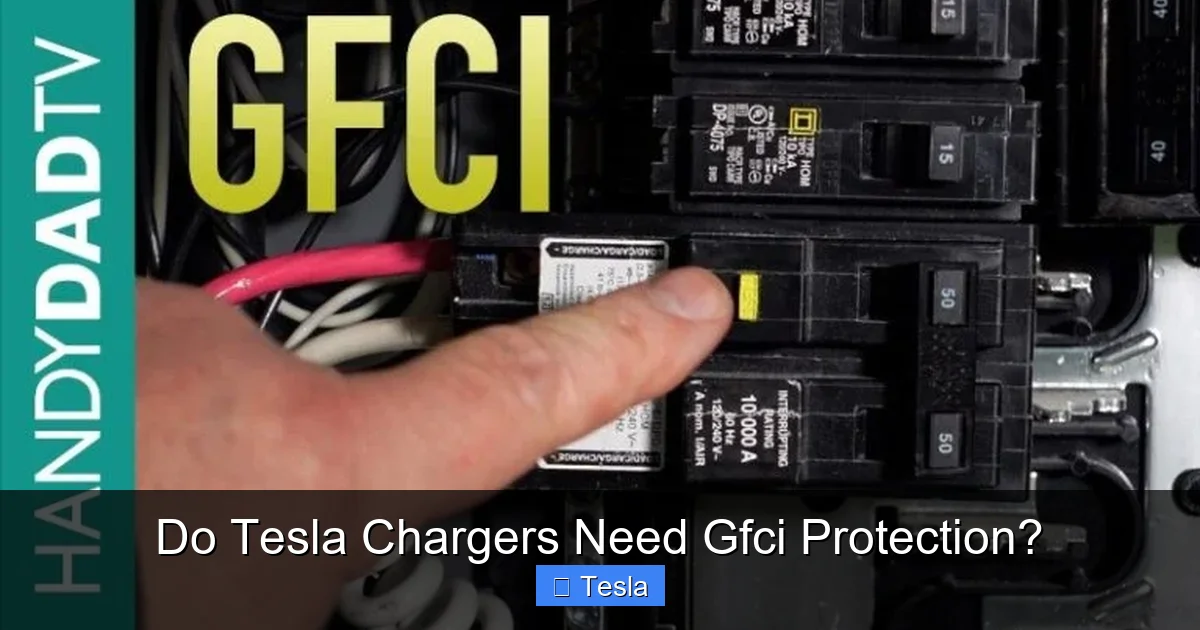
Visual guide about Do Tesla Chargers Need Gfci Protection?
Image source: motor.elfotograma.com
How It Works Differently Than a Standard GFCI Outlet
A standard GFCI outlet or breaker monitors the hot and neutral conductors. If the current on the hot doesn’t exactly match the current on the neutral (indicating some is leaking to ground), it trips. Tesla’s system, particularly in the Wall Connector, is more sophisticated. It monitors the entire charging circuit, including the pilot communication signal between the charger and the car. It can detect minute imbalances that might indicate a fault in the charger itself, the charging cable, or even the car’s inlet. This system is designed to be highly reliable and is tested as part of the UL listing process.
The Practical Implication: No “Nuisance Tripping”
Anyone who’s used a GFCI outlet with a high-draw appliance like a freezer or a power tool knows the frustration of “nuisance tripping.” The slight, normal leakage current of some electronics can fool a less sensitive GFCI. This is a major concern for EV chargers. A 48-amp Wall Connector tripping every time it rains or due to normal leakage would be incredibly inconvenient and could leave you stranded. Tesla’s internal GFCI is engineered to be selective and robust, minimizing false trips while maintaining maximum safety. This engineered precision is why the NEC change to accept listed EVSEs was so important.
Garage, Carport, or Outdoors? Your Installation Location is Key
This is the single most important factor in your GFCI requirement. Let’s walk through the common scenarios.
Visual guide about Do Tesla Chargers Need Gfci Protection?
Image source: shunauto.com
The Attached or Detached Garage (The Most Common Case)
If you’re installing your Wall Connector on the wall of your garage, the 2020/2023 NEC almost certainly requires GFCI protection. A garage is explicitly listed. However, because your Tesla Wall Connector is a listed EVSE with internal GFCI, you are very likely in compliance if your AHJ accepts the 2023 code’s provision. Your electrician should present the charger’s UL listing documentation (which highlights its GFCI function) to the inspector. The key is that the GFCI function is “provided as part of the listed EVSE”. You would typically install this on a standard (non-GFCI) circuit breaker.
The Outdoor Installation
Mounting the Wall Connector on the exterior wall of your house? GFCI is non-negotiable. Outdoors is another explicit location in the NEC. Again, the internal GFCI in your Tesla unit is designed to meet this requirement. You must ensure the entire installation—from the panel to the connector—is rated for outdoor use (weatherproof covers, conduit, etc.). The inspector will want to see the listing documentation for the charger’s GFCI capability.
The “Dry, Dedicated Interior Room” Scenario
This is the potential exception. If you have a dedicated, dry utility room—think a finished basement room with no plumbing, no concrete floor, no chance of moisture—that is not considered a garage, carport, or damp location, the general GFCI requirements for “dwelling unit 125-volt, 15- and 20-ampere” outlets (which is what most people think of) do not automatically apply to a 240-volt, 40-80 amp EV charger circuit. In this specific, rare scenario, a GFCI might not be mandated by the basic NEC rules for that location. However, you must still get a permit and have it inspected. The inspector may still require GFCI based on local amendments or simply as a best practice. Never assume a basement is “dry enough” without confirmation.
The Mobile Connector (aka “the mobile charger”)
This one is trickier because it’s portable and plugs into a 240-volt receptacle (like a NEMA 14-50). The NEC rules for receptacles are strict. A 250-volt, 50-amp receptacle in a garage must be GFCI protected according to the 2020/2023 NEC. This means the GFCI protection must be upstream of the receptacle—either at the breaker (a 50-amp GFCI breaker) or via a preceding GFCI device. You cannot rely on the Mobile Connector’s internal GFCI alone to protect the *receptacle* itself, because the receptacle is a permanent part of your home’s wiring. For a permanent NEMA 14-50 installation for your Mobile Connector, you will almost certainly need a GFCI breaker. For temporary use (like at a friend’s house), you’re using their outlet, and their home’s protection (or lack thereof) is what’s in play.
The Permit and Inspection Process: Where Theory Meets Reality
This is the step where most confusion gets resolved—or created. Skipping the permit is a false economy that risks insurance denial and dangerous, non-compliant wiring.
Visual guide about Do Tesla Chargers Need Gfci Protection?
Image source: evcharger.news
Step 1: The Electrician and the Plan
Hire a licensed electrician experienced with EV chargers. They will assess your panel capacity, run the appropriate wire (e.g., 6 AWG copper for a 50-amp circuit), and install the dedicated circuit. A good electrician will know the local AHJ’s tendencies. They will ask: “Do we need a GFCI breaker?” The answer depends on the AHJ. They should also have the Tesla charger’s installation manual and UL listing sheet handy, which explicitly states its internal GFCI protection.
Step 2: The Permit Application
When you or your electrician pull the permit, you’ll often fill out an application describing the work. Be precise: “Installation of a UL-listed Tesla Wall Connector (Model X) on a dedicated 60-amp circuit. The EVSE provides internal GFCI protection per NEC 625.41 and UL 2594.” This language shows you’ve done your homework and are citing the code that allows the internal GFCI.
Step 3: The Inspection – The Moment of Truth
The inspector will come. They will check the wiring, the connection, the clearances, and they will ask about GFCI. This is the pivotal conversation. Show them the Tesla’s documentation. If your jurisdiction has formally adopted the 2023 NEC (or even the 2020 with its clear intent), they should accept the internal GFCI. If they are on an older code cycle or have a local amendment requiring GFCI breakers for all 240V loads, they may insist on a GFCI breaker. Their word is final. Arguing is rarely productive. The cost of a GFCI breaker ($100-$300) is cheap compared to a failed inspection, rework, or the risk of a dangerous installation.
It’s also worth noting that some early Tesla Wall Connectors (Gen 2) had a known issue with nuisance tripping when used with certain GFCI breakers. Tesla addressed this in later firmware and hardware revisions, but the historical anecdote makes some electricians and inspectors cautious about combining GFCI breakers with Tesla chargers, further fueling the debate. Using the charger’s own internal GFCI avoids this potential conflict entirely.
Debunking Myths and Addressing Common Concerns
Let’s clear the air on some persistent rumors.
Myth: “GFCI Breakers Always Trip on EV Chargers.”
This was more common with older EVSEs and first-generation Tesla Wall Connectors. Modern, UL-listed chargers like Tesla’s are designed to work harmoniously with GFCI protection, whether internal or at the breaker. However, the combination of a GFCI breaker and an EVSE with internal GFCI can sometimes create a “double GFCI” scenario that is more sensitive and prone to tripping from minor leakage. This is why the code move to allow the EVSE’s own GFCI is so valuable. It provides one, properly calibrated layer of protection.
Myth: “My Garage is Too Dry to Need GFCI.”
Per the NEC text, the location “garage” triggers the requirement, regardless of how dry you think it is. The code treats all garages as potential damp locations because of vehicle ingress. Don’t try to argue “it’s a conditioned space.” The classification is based on use, not humidity levels.
Myth: “I Can Just Use a GFCI Outlet for My Mobile Connector.”
Technically, you could install a 50-amp GFCI receptacle. But these are enormous, expensive, and rare. The standard, code-compliant method for a permanent NEMA 14-50 circuit is a 50-amp GFCI breaker. For a Mobile Connector, many people simply use a standard 14-50 receptacle on a 50-amp non-GFCI breaker and rely on the Mobile Connector’s internal GFCI. This is a major code violation in a garage. The receptacle itself must be GFCI-protected. You cannot rely on a downstream device (the charger) to protect the permanent outlet. This is a key distinction.
The Bottom Line: Your Action Plan
So, what do you actually do? Here is a step-by-step guide.
- Start with Your AHJ. Before buying anything or hiring an electrician, call your city/county building department. Ask: “For a Tesla Wall Connector installed in an attached garage, what is the requirement for GFCI protection under the currently adopted NEC? Will the internal GFCI in the UL-listed Wall Connector satisfy the requirement, or is a GFCI breaker mandatory?” Get the answer in writing if possible (email). This single step saves endless debate.
- Hire a Pro. Use a licensed electrician with specific experience in Tesla or EV charger installations. Show them the response from your AHJ.
- Specify the Equipment. Tell the electrician you are installing a Tesla Wall Connector (provide model) and that it has internal GFCI per its UL listing. Your AHJ’s stance will determine if they install a standard breaker or a GFCI breaker.
- Get the Permit. Never skip this. The permit process ensures an inspection, which protects you, your home, and your insurance.
- Be Prepared for the Cost. A standard 60-amp breaker is cheap. A 60-amp GFCI breaker can cost $200-$400 more. Factor this into your budget if your AHJ requires it.
- For Mobile Connector Users: If you want a permanent NEMA 14-50 outlet in your garage for your Mobile Connector, you must install it on a GFCI-protected circuit (usually a GFCI breaker). The outlet itself requires the protection. If you use the Mobile Connector on a standard outlet in a garage, that circuit is technically non-compliant, though it’s a common and low-risk practice for temporary use. For a permanent solution, a Wall Connector is simpler and more code-friendly.
Ultimately, the trend is clear: the NEC recognizes that modern, listed EVSEs like Tesla’s have excellent, integrated safety systems. The goal is to avoid “GFCI stacking” and the nuisance trips it can cause while maintaining the highest safety standard. By understanding the code, your local rules, and the technology in your charger, you can have a safe, reliable, and fully compliant home charging setup that fuels your Tesla adventures for years to come.
Conclusion: Safety First, Code Compliant Always
The question “Do Tesla chargers need GFCI protection?” leads us down a path of codes, technology, and local authority. The definitive, practical answer is this: Yes, the circuit feeding your Tesla charger in a garage or outdoors must have GFCI protection as mandated by the NEC. However, for a Tesla Wall Connector, that required protection is almost certainly provided by the charger’s own sophisticated, UL-listed internal GFCI system, eliminating the need for a separate GFCI breaker or receptacle—provided your local inspector agrees with the current NEC’s acceptance of listed EVSEs.
For the Tesla Mobile Connector plugged into a permanent 240V outlet, the outlet itself must be GFCI-protected, meaning a GFCI breaker is required for that circuit. The Mobile Connector’s internal GFCI is a secondary layer of safety but does not make the permanent receptacle code-compliant on its own.
The path forward is straightforward: consult your AHJ, hire a knowledgeable electrician, pull a permit, and use the Tesla’s own documentation to argue for the simplest, most elegant solution—the charger’s built-in safety. This approach prioritizes the ultimate goal: a shock-free charging experience that is as reliable as it is powerful, keeping you, your family, and your Tesla safe and charged up.
Frequently Asked Questions
Does the Tesla Wall Connector need a GFCI breaker?
Usually, no. Because the Wall Connector is a UL-listed EVSE with internal GFCI protection, it typically satisfies the NEC requirement for GFCI in a garage or outdoors. However, your local AHJ may still mandate a GFCI breaker. Always confirm with your inspector before installation.
What about the Tesla Mobile Connector (the portable charger)?
If you install a permanent NEMA 14-50 receptacle for your Mobile Connector in a garage, that receptacle circuit must have GFCI protection, typically via a GFCI breaker. The Mobile Connector’s internal GFCI protects the charger and car, but not the permanent home outlet itself.
My garage is finished and dry. Is GFCI still required?
Yes. The NEC requirement is based on the location’s classification (“garage”), not its humidity level. All garages, whether attached, detached, finished, or unfinished, are required to have GFCI protection for EVSE circuits under the 2020/2023 NEC.
Can I use a GFCI receptacle instead of a breaker?
For a 240V, 40-60 amp EV charger circuit, a GFCI receptacle of that amperage is impractical and not standard. The correct method is a GFCI circuit breaker in your panel. For a standard 120V outlet (like for a Mobile Connector on 120V), a GFCI receptacle is required in a garage.
My electrician says we don’t need GFCI. Should I be worried?
Possibly not, if they are relying on the Tesla’s internal GFCI and your AHJ has adopted the 2023 NEC language accepting listed EVSEs. However, you should verify this stance with your local building department yourself to avoid a failed inspection later.
What if my city hasn’t adopted the 2020 or 2023 NEC?
If your jurisdiction is on an older code cycle (like 2017 or earlier), the rules for EVSEs were less clear, and many AHJs defaulted to requiring GFCI breakers for all 240V outlets in garages. In this case, you will almost certainly need a GFCI breaker, regardless of the charger’s internal protection.
