
Can You Charge Your Tesla in the Rain?

Absolutely, you can charge your Tesla in the rain. Tesla’s charging system is engineered with multiple layers of weatherproofing, including high IP ratings for the port and connector, to ensure safe operation in wet conditions. The vehicle and charger communicate continuously, only allowing power flow when a secure, dry connection is confirmed. This design means you don’t need to panic during a sudden downpour—your Tesla is built to handle it.
Key Takeaways
- Understanding Can You Charge Your Tesla in the Rain?: Provides essential knowledge
📑 Table of Contents
- Putting the Worry to Rest: Yes, You Can Charge in the Rain
- The Engineering Marvel: Tesla’s Weatherproof Charging Architecture
- Understanding the IP Code: Your Waterproofing Report Card
- The Plug-and-Play Safety: How the Charging Process Actually Works
- Practical Tips for the Rainy-Day Charger
- Debunking Common Myths and Fears
- Conclusion: Confidence in Every Forecast
Putting the Worry to Rest: Yes, You Can Charge in the Rain
One of the most common questions new Tesla owners ask, and a major concern for anyone considering an electric vehicle, is: “Can you charge your Tesla in the rain?” The image of plugging a high-voltage cable into your car while water is falling or pooling around you can feel instinctively dangerous. We’re taught from a young age to fear the combination of electricity and water. But here’s the critical truth: your Tesla is not a conventional car, and its charging system is not a conventional electrical outlet. It is a meticulously engineered, communication-based system built from the ground up with safety in wet conditions as a core requirement. You can charge your Tesla in the rain, and understanding why is key to using your vehicle with complete confidence, no matter the forecast.
The anxiety is understandable. Traditional gasoline cars have you opening a fuel cap, a process completely unrelated to electricity. With an EV, you’re physically connecting to the car’s high-voltage battery system. However, Tesla, and the entire modern EV industry, has solved this problem with redundant safety systems, rigorous international protection standards (IP ratings), and clever mechanical design. This article will walk you through every layer of that protection, explaining in simple terms why a rainy day is not a charging day disaster.
The Engineering Marvel: Tesla’s Weatherproof Charging Architecture
To understand why charging in the rain is safe, you must first appreciate that Tesla treats the entire charging ecosystem—the car’s port, the connector on the cable, and the charger itself—as a single, sealed system. It’s not an afterthought; it’s a fundamental design principle. Every component that could potentially be exposed to the elements has been sealed, shielded, and tested to meet or exceed the highest international standards for dust and water resistance.
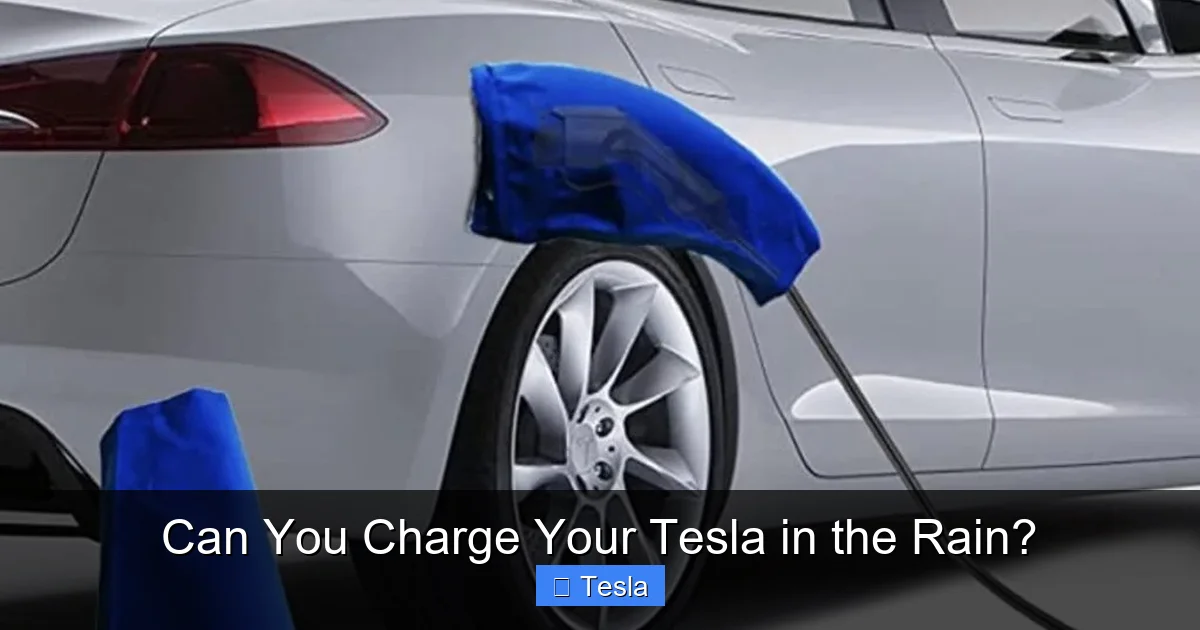
Visual guide about Can You Charge Your Tesla in the Rain?
Image source: thatteslachannel.com
The Fort Knox of Charging Ports
Let’s start with the hole in your car: the charging port. This is the most obvious point of potential vulnerability. Tesla’s engineers designed it like a submarine hatch. When the vehicle is unlocked, a small plastic flap automatically covers the port. This isn’t just a dust cover; it’s a critical first line of defense. When you insert the charger connector, the connector’s body pushes this flap aside and creates a tight, continuous seal around the entire circumference of the opening. The port itself is rated to IP67. What does that mean? The “IP” stands for Ingress Protection. The first digit (6) means it’s completely dust-tight. The second digit (7) means it can withstand immersion in water up to 1 meter deep for 30 minutes. So, the port housing itself is designed to keep water out even if submerged. The connector’s seal, combined with the port’s shutter, creates a watertight chamber the moment they mate.
The Smart, Sealed Connector
Now look at the end of your Tesla connector (the part you hold). It’s not a simple plug. It’s a complex assembly with a soft, rubberized seal around its perimeter. This seal is compressed against the port’s surface when you push the connector in, forming that all-important watertight barrier. The connector is independently rated to IP54. The “5” means it’s protected against low-pressure water jets from any direction, and the “4” means it’s protected against splashing water. This rating applies to the connector *when it’s not plugged in*. Once it’s mated with the IP67 port, the combined system’s protection is even higher. Furthermore, the connector has no exposed electrical contacts until it is fully inserted and locked into the port. The pins are recessed behind a small shroud, preventing any stray water droplets or debris from making contact.
Onboard Safety Systems: The Electronic Gatekeepers
This is perhaps the most important safety layer. Your Tesla’s charging system is not a simple “on/off” switch. It’s a constant, encrypted conversation between the charger and the vehicle. Before a single watt of power flows, several things happen:
- Authentication: The car verifies the charger is a genuine Tesla device or an authorized adapter.
- Connection Check: The system checks for a complete, locked mechanical connection. If the connector isn’t fully seated and the locking tab is engaged, it won’t proceed.
- Ground & Proximity Circuits: The system monitors for any abnormal electrical path (like a ground fault) or the presence of moisture/contamination that could cause a short. This is a Ground Fault Circuit Interrupter (GFCI) on steroids, specific to the high-voltage charging circuit.
If any of these checks fail, or if they fail at any point during the charging session, power is cut off instantly. This means that even if, theoretically, water were to somehow breach the physical seals and cause a short, the electronic safety systems would detect the anomaly and stop the flow of electricity in microseconds, long before any danger could arise. For a fascinating look at how vehicles manage electrical safety in challenging conditions, you can read about the protocols involved in a car jump-start in the rain, which highlights similar principles of isolating electrical systems from the environment.
Understanding the IP Code: Your Waterproofing Report Card
The Ingress Protection (IP) rating is a standardized international code that defines how well electrical enclosures are sealed against solids and liquids. For EV charging, it’s the most important spec to look at. Let’s decode it specifically for Tesla’s system.
Visual guide about Can You Charge Your Tesla in the Rain?
Image source: wxresearch.org
IP67: The Gold Standard for the Port
IP67 is a formidable rating.
- First Digit (Solid Objects): 6 = “Dust Tight.” No ingress of dust; complete protection against contact.
- Second Digit (Liquids): 7 = “Immersion.” Ingress of water in harmful quantity shall not be possible when the enclosure is immersed in water under defined conditions of pressure and time (up to 1 meter for 30 minutes).
This means your car’s charging port, when the flap is closed, can handle being temporarily submerged in a deep puddle without water entering the internal electronics. The test involves actually dunking the component in water. This is far beyond what a rainy day or even a heavy downpour can produce.
IP54: Reliable Protection for the Connector
The connector you handle is rated IP54.
- First Digit (Solid Objects): 5 = “Dust Protected.” Ingress of dust is not entirely prevented, but it must not enter in sufficient quantity to interfere with the operation of the equipment.
- Second Digit (Liquids): 4 = “Splashing Water.” Water splashing against the enclosure from any direction shall have no harmful effect.
This rating ensures that if you’re holding the connector in light rain or if it’s sitting on a wet surface, water won’t penetrate it. It’s designed for the real-world handling of an external device. The combined system (IP54 connector + IP67 port) creates a highly robust barrier once mated.
Why This Matters More Than You Think
These aren’t just marketing numbers. They are the result of rigorous, standardized testing by independent labs. Tesla designs to these standards because they sell cars globally, in markets with vastly different weather conditions, from the rainy Pacific Northwest to the monsoon seasons of Asia. The IP rating is a guarantee that the system has been physically tested and proven to keep water out under specific, defined conditions. It’s engineering proof, not just a claim.
The Plug-and-Play Safety: How the Charging Process Actually Works
Now let’s walk through the actual act of plugging in during a drizzle. This process is identical to charging in dry weather, and that’s by design.
Visual guide about Can You Charge Your Tesla in the Rain?
Image source: autogeek.com.ua
Step 1: Approach and Unlock
You approach your car with the connector. As you get close, the car unlocks (via your phone, key card, or key fob). You press the button on the charge port cover, or it may pop open automatically if you have that setting enabled. The small plastic flap inside the port flips up. At this stage, the port is open, but no power is present. The internal contacts are isolated.
Step 2: Insertion and Sealing
You push the connector into the port. You’ll feel a firm resistance and then a distinct “clunk” as the connector’s locking tab engages. As you push, the rubber seal on the connector is compressed against the smooth plastic rim of the port. This creates the watertight seal. Water that may be on the outside of the connector or port is simply pushed aside and beads up on the outer surfaces; it cannot be forced into the mating interface. The design is such that any minor surface moisture is expelled outward, not sucked inward.
Step 3: The Electronic Handshake
Once the connector is fully inserted and the car senses it is locked in place, the “conversation” begins. The charger and the vehicle’s onboard charging system exchange digital signals. They confirm:
- Compatibility (correct charger type, correct voltage/current settings).
- A secure, complete physical connection (the lock sensor is triggered).
- No fault conditions present (ground fault, overcurrent, etc.).
Only after all these “green lights” does the car send a command to the charger to begin delivering high-voltage DC power to the battery. This entire sequence takes 1-2 seconds. If you’re plugging in while it’s sprinkling, by the time power flows, you’ve likely already walked away. The system is designed so that power is never present at the connector pins unless a perfect, dry, and locked connection is confirmed.
Step 4: Charging and Unplugging
During the charge session, the system constantly monitors. If heavy rain were to somehow cause a fault (an extremely unlikely scenario given the seals), it would trip instantly. When you’re done, you press the button on the connector or in the car to unlock, pull the connector out, and the port flap automatically closes, resealing the opening. You then return the connector to its cradle or hang it up. The connector may be wet on the outside from the rain, but that’s fine—its IP54 rating handles that. There is no need to wipe it down before storing, though it’s good practice for cleanliness.
Practical Tips for the Rainy-Day Charger
While the system is inherently safe, a few common-sense practices can make the experience smoother and provide extra peace of mind.
1. Wipe the Connector (Optional but Helpful)
Before plugging in, give the connector’s tip a quick wipe with a dry cloth if it’s visibly wet or has been sitting in a puddle. This isn’t for safety—the seals work with water on the outside—but it removes any potential dirt or debris that might interfere with the seal. It also just feels cleaner.
2. Check for Puddles Around the Port
Be aware of your surroundings. If your car is parked in a large puddle that is actually lapping at the base of the charge port, try to move it to a slightly higher spot if possible. While the port is IP67, prolonged submersion at the *base* of the port (where the cable entry is) isn’t the intended design scenario, though the seals there are also robust. This is more about avoiding water infiltration into the vehicle’s interior through other pathways than the port itself.
3. Ensure a Full, firm Connection
Push the connector in until you hear or feel the definite click/lock. Don’t just assume it’s in. A partially inserted connector might not establish the seal or trigger the lock sensor, and the car will not allow charging. The car’s UI will clearly show if it’s not charging and why.
4. Supercharger vs. Home Charger: No Difference in Safety
This safety protocol is identical whether you’re using a Tesla Wall Connector at home, the Mobile Connector (the portable one that comes with the car), or a V3 Supercharger on a road trip. The communication protocol and safety interlocks are standardized across all Tesla charging equipment. You can pull into a Supercharger during a thunderstorm with the same confidence as plugging into your garage outlet in a drizzle.
5. Trust the Vehicle’s Feedback
Your Tesla will tell you if something is wrong. If the charge port icon on the screen or app is red or shows an error, it means the system has detected a fault and stopped charging. Do not ignore this. Unplug, check the connector and port for obvious debris or damage, wipe them, and try again. If the error persists, contact Tesla service.
6. General Electrical Safety Still Applies
While the system is safe, avoid creating unnecessary risk. Don’t stand in a deep puddle while handling the connector. Don’t try to charge if you see obvious damage to the cable or connector. This is the same common sense you’d apply to any electrical equipment outdoors.
Debunking Common Myths and Fears
Let’s address some persistent internet rumors and owner anxieties head-on.
Myth 1: “Water will get inside and short the battery!”
This is the core fear. As explained, the multiple physical seals and the pre-power electronic verification make this virtually impossible. The high-voltage battery is deep inside the car, behind additional layers of protection. The charging port leads to the onboard charger, which is also sealed. There is no direct, unsealed pathway from the outside port to the battery. The system is designed so that even if water *somehow* got past the connector seal (which requires defeating the IP67/54 ratings), the ground fault detection would kill power before a short could damage anything.
Myth 2: “You need to cover the port with a bag or special cover.”
You do not. The port’s built-in flap is sufficient. After unplugging, the flap closes automatically. Adding a bag can trap moisture inside against the port seal, which is counterproductive. The system is designed to be uncovered and operational in all weather. This is a testament to its engineering.
Myth 3: “Charging will be slower in the rain.”
No. The charging speed is determined by the charger’s power rating (e.g., 7.2kW for a home charger, 250kW for a Supercharger) and the battery’s state of charge and thermal management. The weather does not affect the electrical throughput if the connection is good. The car’s thermal management system might work slightly harder to keep the battery at its optimal temperature in cold rain, but this doesn’t reduce the charging *power*; it just uses some of that power for heating.
Myth 4: “It’s fine for the car, but what about the charger/cable getting ruined?”
The Tesla connector and cable are built for the outdoors. They are UV-resistant and have the IP54 rating. They are meant to be used in all conditions. The cable is robust and flexible. Normal rain will not damage it. Of course, don’t store a damaged cable, but regular exposure to rain is part of its expected use case.
Conclusion: Confidence in Every Forecast
The question “Can you charge your Tesla in the rain?” is ultimately a question about trust in engineering. The answer is a resounding, evidence-based yes. Tesla’s charging system is a masterclass in defensive design, combining physical barriers (IP67/IP54 seals) with intelligent electronic gatekeeping (the pre-power handshake and constant monitoring). This layered approach means that the scenario of a dangerous electrical fault due to rain is not just unlikely—it’s engineered out of the system.
You can go about your life without rearranging your charging schedule based on the weather report. If you need to charge and it’s raining, simply plug in. The car and charger will do the rest, ensuring a safe and efficient transfer of energy. This inherent safety is one of the quiet advantages of the EV platform, removing a whole category of weather-related anxiety that comes with traditional vehicles (like worrying about fuel cap seals or exhaust fumes in enclosed spaces). So next time dark clouds roll in, remember: your Tesla is ready to charge, come rain or shine. It’s not just a car that runs on electricity; it’s a car that understands electricity’s relationship with the elements, and manages it flawlessly.
Frequently Asked Questions
Is it actually safe to plug in my Tesla during a heavy downpour?
Yes, it is completely safe. The charging port and connector are sealed to IP67 and IP54 standards respectively, and power only flows after a secure, verified connection is made. The system is designed to prevent any water ingress that could cause a hazard.
What happens if water gets on the connector or inside the charge port?
A small amount of surface water is normal and is pushed aside during insertion. The seals are designed to exclude it. If water were to enter the port cavity while unplugged, the port’s IP67 rating means it can handle temporary submersion. The system will simply not allow charging if the connection isn’t dry and secure, as verified by its sensors.
Does rain slow down the charging speed?
No. Charging speed is determined by the charger’s power output and the vehicle’s battery management system, not by ambient weather conditions. The electrical connection and power transfer are unaffected by rain.
Do I need to dry the charge port or connector before plugging in?
No, you do not need to. The system is designed to work with wet surfaces. However, for optimal seal engagement and cleanliness, a quick wipe of a very wet connector with a dry cloth is a harmless good practice, not a safety requirement.
Can I use a Tesla Supercharger in the rain just like at home?
Absolutely. The safety protocols and IP ratings are identical across all Tesla charging equipment, including the high-speed V3 Superchargers. The process and level of protection are the same.
Will my warranty cover any damage if I charge in the rain?
Charging in normal rainy conditions is an intended use case and is fully covered under the vehicle and charging equipment warranties. Damage would only be a concern if it resulted from misuse, such as forcing a damaged connector or submerging the equipment in deep water beyond its design specifications. For general maintenance queries, understanding when to check your car’s oil is important, but it’s unrelated to EV charging safety.
