Can a Tesla Jump Another Car?

Contents
- 1 Key Takeaways
- 2 📑 Table of Contents
- 3 The Fundamentals of Jump-Starting: A Quick Refresher
- 4 Inside a Tesla: A Completely Different Electrical Philosophy
- 5 Why Jump-Starting Another Car with Your Tesla is a Terrible Idea
- 6 The Official Tesla Stance and Owner’s Manual Guidance
- 7 What To Do Instead: The Safe and Correct Way to Help
- 8 Special Cases: What About Jump-Starting Another Tesla?
- 9 Conclusion: Be Informed, Be Safe
- 10 Frequently Asked Questions

Car Window Tint Film

Portable Work Light
Car Phone Holder

Tire Repair Kit
No, you should never use a Tesla to jump-start a conventional gasoline car. Tesla’s 12-volt battery and electrical architecture are not designed for the high current draw of jump-starting another vehicle, and attempting it can cause serious damage to your Tesla’s sensitive electronics. The safest and recommended method is to use a dedicated portable jump starter or call for professional roadside assistance. Always consult your Tesla owner’s manual for the correct procedure.
Picture this: You’re at a coffee shop, and you see someone struggling with a dead car battery. They’re looking for a jump. You drive a Tesla, a car with immense power and cutting-edge tech. Your first thought might be, “Perfect! I can help!” But before you pop the hood and break out the jumper cables, you need to stop. The answer to the question “Can a Tesla jump another car?” is a definitive and important no. Using your electric vehicle as a jump starter for a traditional gasoline-powered car is not just ineffective; it’s a recipe for potentially thousands of dollars in damage to your Tesla. This article will break down exactly why, how Tesla’s electrical system works, and what you should do instead to be a helpful and safe driver on the road.
Key Takeaways
- Tesla’s 12V battery is for auxiliary power only: It runs the car’s computers, lights, and infotainment but is not engineered to deliver the massive cranking amps needed to start another car’s engine.
- Attempting a jump can fry your Tesla’s electronics: The reverse current from a dead battery can damage the Tesla’s Battery Management System (BMS) and other costly components.
- Never connect jumper cables to a Tesla’s 12V battery terminals directly: The specific location and design require following the precise, manual-listed jump points to avoid damage.
- The high-voltage traction battery is completely separate and cannot be used: It powers the drivetrain and is inaccessible for jump-starting; attempting to access it is extremely dangerous.
- Use a portable jump starter instead: A self-contained jump starter is the safe, effective tool for helping others without risking your Tesla. You can learn more about this method here.
- Tesla-to-Tesla jump-starting is also not recommended: While some models have a designated “jump” mode for the 12V battery, it’s intended for a completely dead Tesla, not for assisting another vehicle.
📑 Table of Contents
- The Fundamentals of Jump-Starting: A Quick Refresher
- Inside a Tesla: A Completely Different Electrical Philosophy
- Why Jump-Starting Another Car with Your Tesla is a Terrible Idea
- The Official Tesla Stance and Owner’s Manual Guidance
- What To Do Instead: The Safe and Correct Way to Help
- Special Cases: What About Jump-Starting Another Tesla?
- Conclusion: Be Informed, Be Safe
The Fundamentals of Jump-Starting: A Quick Refresher
To understand why a Tesla is the wrong tool for the job, let’s quickly review what a jump-start actually is. A conventional gasoline car starts when the starter motor cranks the engine. That starter motor requires a huge burst of power, measured in “cranking amps” (CA) or “cold cranking amps” (CCA). This power comes solely from the car’s 12-volt lead-acid or AGM battery. When that battery is dead, the car won’t turn over.
A jump-start provides that missing power from a donor car’s healthy 12V battery. The jumper cables create a direct, high-amperage connection, essentially letting the donor battery power the dead car’s starter motor long enough for the engine to fire up and then run on its own alternator. It’s a simple, brute-force transfer of electrical energy between two similar 12V systems.
Key Requirement: Matching Systems
The critical point is that both vehicles must have compatible 12-volt systems. The donor battery must be capable of supplying the extreme current (often 300-1000 amps) without its own voltage collapsing. This is why a large truck battery can jump-start a small car, but a small car battery might struggle to jump-start a large truck. The systems are designed to talk to each other in this specific, high-current way.
Inside a Tesla: A Completely Different Electrical Philosophy
This is where everything changes. A Tesla is not a conventional car with an electric motor instead of a gas engine; its entire electrical architecture is fundamentally different. There are two separate and distinct electrical systems in every Tesla:

Visual guide about Can a Tesla Jump Another Car?
Image source: vehicleanswers.com
- The High-Voltage traction battery pack: This is the large, powerful battery (400V or 800V) under the floor that stores the energy for driving. It powers the giant electric motors. It is completely isolated from the 12V system and cannot be used to jump-start anything. Accessing it is not possible for this purpose and is incredibly hazardous.
- The 12-volt auxiliary battery: This is a smaller, traditional 12V battery (usually lead-acid or lithium-ion in newer models) that powers all the car’s “accessory” systems: the computer, touchscreen, lights, power windows, door locks, and climate control. It is not designed to crank an engine because a Tesla doesn’t have an engine to crank.
The Role of the 12V Battery in a Tesla
In a Tesla, the 12V battery is charged by a DC-to-DC converter, which steps down power from the main high-voltage battery. Its job is to act as a stable power source for the car’s electronics, much like the battery in your phone or laptop. It provides a steady, low-to-moderate current for hours, not a massive, instantaneous jolt for a few seconds. Its capacity and discharge profile are optimized for this specific role, not for jump-starting.
Why Jump-Starting Another Car with Your Tesla is a Terrible Idea
Now that we understand the systems, let’s connect the dots on why connecting your Tesla to a dead gas car’s battery is a dangerous gamble.
Visual guide about Can a Tesla Jump Another Car?
Image source: cdn.motor1.com
Risk of Catastrophic Electronic Damage
This is the biggest danger. When you connect jumper cables, you create a direct electrical pathway. A dead 12V battery in the stranded car can be in a severely compromised state—shorted cells, sulfated plates, or even an internal short circuit. This can cause it to behave like a massive, unpredictable load or even a drain. The reverse current and potential voltage spikes can surge back through the cables and into your Tesla’s 12V system. Tesla’s sensitive Battery Management System (BMS), body control modules, and infotainment computer are not designed to handle this. The result can be fried circuits, requiring expensive replacements. A simple jump could turn into a $5,000+ repair bill for your “donor” Tesla.
Insufficient Power Delivery
Even if you got lucky and didn’t damage anything, the Tesla’s 12V battery likely couldn’t do the job anyway. It’s smaller and has a lower reserve capacity (RC) and cold cranking amp (CCA) rating than the battery in a typical truck or SUV designed for jump-starting. The dead car’s starter motor would simply suck the Tesla’s 12V battery dry in seconds, leaving both vehicles with dead batteries and you stranded.
Incorrect Physical Connections
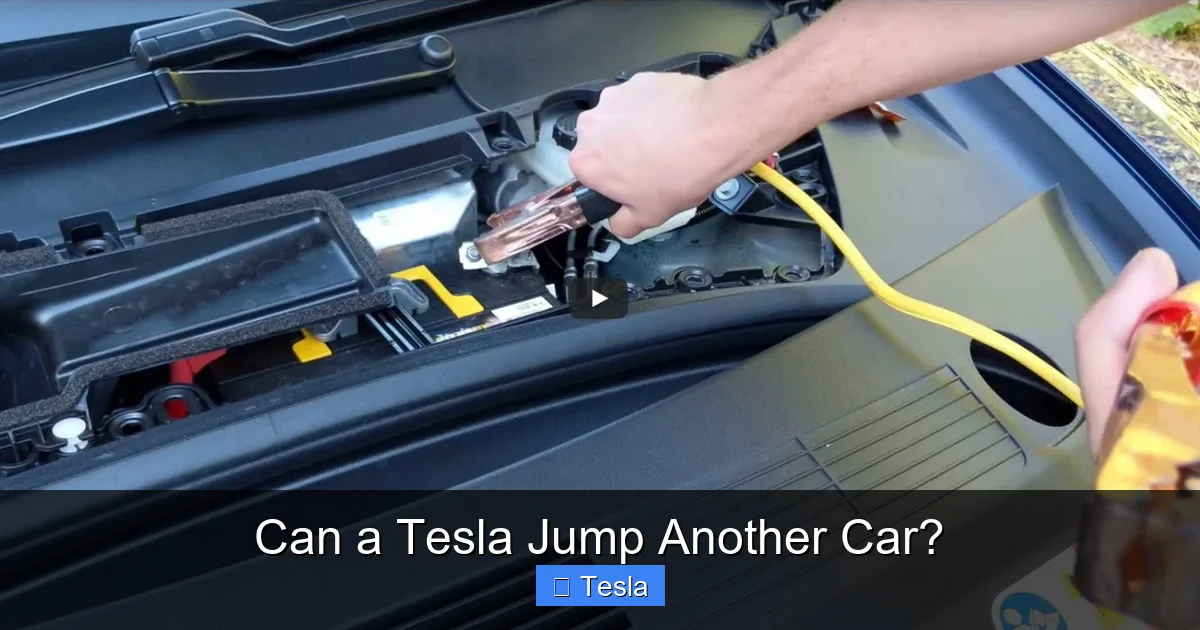
Jump-starting a car isn’t just about finding any battery terminal. You must connect to the correct terminals: positive to positive, negative to a solid, unpainted metal ground point on the engine block or chassis of the dead car. Tesla’s 12V battery is located in a specific, often hard-to-reach place (like the front trunk/boot in Model S/3/X/Y). More importantly, Tesla explicitly warns in the owner’s manual that you must use the designated jump post terminals (usually red positive and black negative posts located near the 12V battery or in the front trunk) and never connect directly to the 12V battery terminals themselves. Connecting to the wrong points can cause sparks, damage, or even a battery explosion.
The Official Tesla Stance and Owner’s Manual Guidance
Tesla is very clear about this in their owner’s manuals. They state that the 12V battery system is not intended for jump-starting other vehicles. The manual provides instructions for receiving a jump-start if the Tesla’s own 12V battery is dead (using the designated posts), but it does not provide any procedure for giving a jump to another vehicle. This is a critical distinction. The system is a one-way street: it can be helped, but it is not designed to help others in this manner. Ignoring this guidance voids any warranty coverage for related electrical damage.
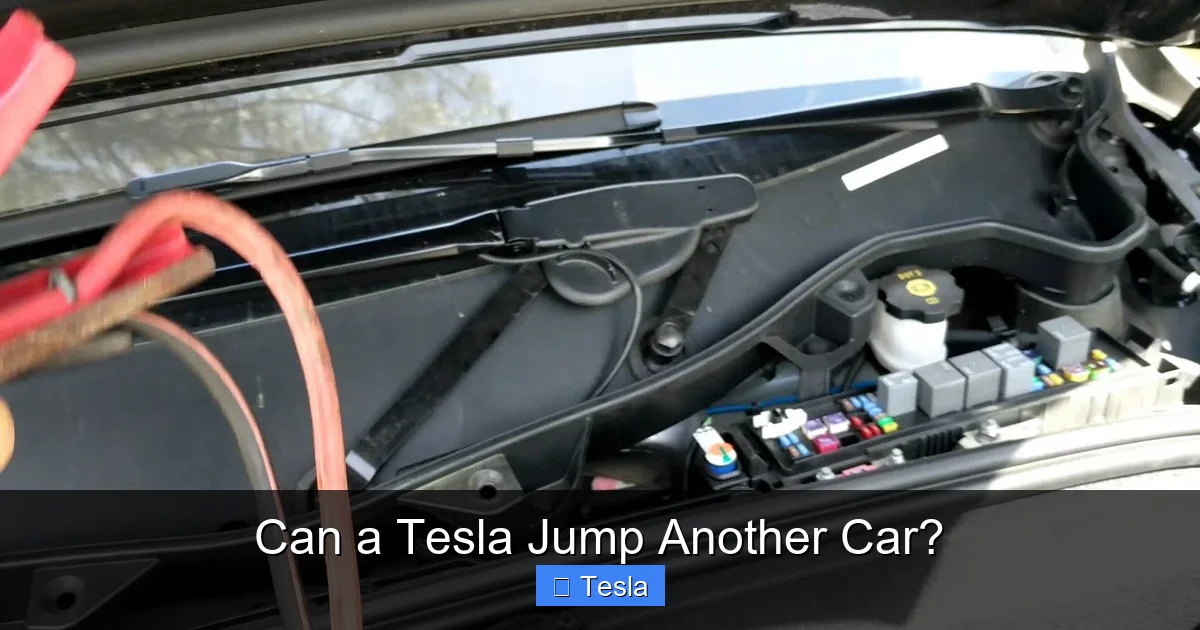
Visual guide about Can a Tesla Jump Another Car?
Image source: i.ytimg.com
What To Do Instead: The Safe and Correct Way to Help
So, you’re a good person and want to help. How do you do it safely without risking your $50,000+ investment?
Option 1: Use a Portable Jump Starter (The Best Solution)
This is the modern, safe, and independent way to be a hero. A portable jump starter (also called a battery booster or power pack) is a self-contained unit with its own internal battery and smart circuitry. You simply connect it directly to the dead car’s battery (following its instructions) and start the car. It requires no other vehicle, so your Tesla stays completely out of the electrical equation. It’s compact, safe, and eliminates all risk to your car. Every driver, especially EV owners, should consider keeping one in their trunk. For a detailed guide on how to use these devices properly, check out this comprehensive article.
Option 2: Call for Professional Roadside Assistance
Your Tesla purchase likely includes a period of Tesla Roadside Assistance or you may have coverage through your insurance or an organization like AAA. Call them. They have the correct equipment and training. It’s the simplest, zero-risk solution. If the stranded driver doesn’t have coverage, offering to call for them or sharing the cost of a service is still a huge help.
Option 3: If You MUST Use Your Tesla (Not Recommended)
If you are in a remote area with no other options and accept full responsibility for any damage, you would theoretically need to follow Tesla’s exact instructions for receiving a jump in reverse. This means connecting the donor cables to the Tesla’s designated jump post terminals (not the battery), not the other car’s battery. However, this is extremely risky due to the power mismatch and potential for feedback damage. It is strongly advised against. If the other car’s battery is so dead that it won’t accept a charge from a proper jump starter, it likely has a deeper problem (like a bad alternator). In that case, a jump won’t help anyway. You can read more about why a bad alternator can complicate a jump-start here.
Special Cases: What About Jump-Starting Another Tesla?
Can you use one Tesla to jump-start another Tesla that has a dead 12V battery? The answer is still no, not in the traditional sense. While both vehicles have similar 12V systems, Tesla does not endorse this practice. The correct procedure for a dead Tesla is to use another Tesla as a 12V power supply by connecting the two vehicles’ designated jump posts and putting the donor Tesla into a specific “jump” or “tow” mode (check your manual). This allows the donor’s DC-to-DC converter to power the recipient’s 12V system, much like a very long, heavy-duty USB cable. It is a slow, trickle-type charge to bring the 12V battery up to a minimum voltage so the car can power up and start its own DC-to-DC converter. It is not a high-current jump-start for an engine. This is a very specific procedure for a very specific problem (a dead 12V battery in a Tesla), not a general-purpose jumping method.
Conclusion: Be Informed, Be Safe
The desire to help a fellow motorist is commendable. But with a Tesla, that help must be given in the right way. Your Tesla is a marvel of engineering with a delicate and complex electrical system. Its 12V battery is a support player, not a workhorse. Attempting to use it as a jump starter risks causing severe, expensive damage to your vehicle while likely failing to start the other car anyway. The takeaway is clear: do not connect jumper cables from your Tesla to another car’s battery. Instead, invest in a quality portable jump starter or rely on professional roadside services. This keeps you, your Tesla, and the person you’re trying to help safe and on the road. Understanding this key difference between electric and conventional vehicles is an essential part of modern EV ownership.
Frequently Asked Questions
Can I use my Tesla’s jumper cables to start a regular car?
No. Tesla’s 12V system is not designed for the high current draw of jump-starting another vehicle. Doing so can cause serious damage to your Tesla’s Battery Management System and other electronics.
What happens if I accidentally try to jump a car with my Tesla?
Even if the connection is brief, there is a significant risk of damaging your Tesla’s sensitive 12V electrical components. The dead battery in the other car can feed reverse current or voltage spikes into your Tesla’s system, potentially frying modules and costing thousands to repair.
Where are the jump terminals on a Tesla?
They are not for giving jumps. The designated jump post terminals (usually a red positive and black negative) are located in specific areas (like the front trunk) and are only for receiving a jump-start if your Tesla’s own 12V battery is completely dead. Never connect to the 12V battery terminals directly.
Can a portable jump starter start any car, including Teslas with a dead 12V?
Yes, a properly sized portable jump starter can be used on most conventional 12V systems, including a Tesla’s 12V auxiliary battery (connected to the correct jump posts). It’s the safest tool for the job as it isolates your vehicle from any risk.
Is there any scenario where a Tesla can provide power to another car?
The only safe scenario is using a Tesla as a 12V power supply for another Tesla with a dead 12V battery, following the precise “jump” mode procedure in the owner’s manual. It is a low-current support function, not a jump-start for a gasoline engine.
Why is Tesla’s 12V battery different from a normal car battery?
A Tesla’s 12V battery only needs to run computers and accessories for hours, not provide a massive 1000+ amp burst to crank an engine. It’s optimized for steady, lower-current draw and is charged by a converter from the main battery, making it unsuitable for the high-load task of jump-starting.