
Jeep Gladiator Models Explained

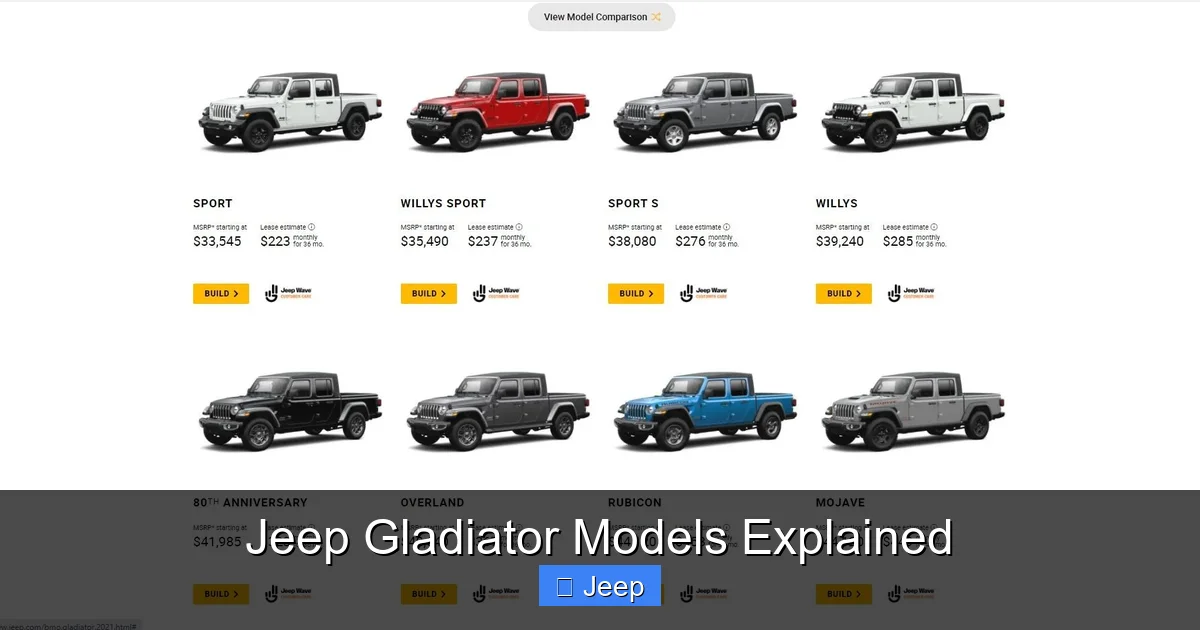
Choosing the right Jeep Gladiator model can be confusing with six distinct trim levels, each tailored for a different driver. This guide breaks down every Gladiator model—from the value-focused Sport to the off-road king Rubicon and desert-runner Mojave—so you can understand the key differences in capability, comfort, and technology. We’ll help you match a trim to your budget and lifestyle, whether that’s daily commuting, serious rock crawling, or everything in between.
Key Takeaways
- The Gladiator lineup has six core trims: Sport, Sport S, Overland, Rubicon, Mojave, and the limited-run High Altitude, each with a distinct personality and price point.
- The Rubicon is the ultimate off-road machine: It comes standard with front/rear locking differentials, a heavy-duty 44:1 transfer case, and 33-inch tires, making it trail-ready out of the box.
- The Mojave is built for high-speed desert runs: It features a unique, reinforced front axle and Fox race-ready shocks, prioritizing speed and stability over the Rubicon’s low-range crawling prowess.
- Overland offers a comfortable, on-road-focused ride: It adds premium leather, a refined infotainment system, and 20-inch wheels, making it the most “civilized” Gladiator for daily driving.
- Sport and Sport S are the value leaders: They provide the essential Jeep experience at the lowest starting prices, with the Sport S adding key comfort and tech upgrades like air conditioning and a Uconnect 5 system.
- Engine and transmission choices are uniform: All Gladiators use the 3.6L V6 engine, with the option for the torquey 3.0L EcoDiesel V6. An 8-speed automatic is available; a 6-speed manual is standard on most trims except Overland.
[FEATURED_IMAGE_PLACEHOLDER]
📑 Table of Contents
- Introduction: The Gladiator’s Unique Promise
- The Foundation: Sport & Sport S – Value and Versatility
- The Refined Road Tripper: Overland
- The Off-Road King: Rubicon
- The Desert Runner: Mojave
- Comparing the Core Trims: A Side-by-Side Look
- Making Your Final Decision: Practical Advice
- Conclusion: There’s a Gladiator for Every Journey
Introduction: The Gladiator’s Unique Promise
When Jeep unleashed the Gladiator, it didn’t just add a truck to its lineup—it created an entirely new category. It’s the only open-air, mid-size pickup with genuine Jeep DNA, offering the legendary Wrangler’s off-road capability and removable doors/roof, combined with a versatile 5-foot bed. But that core DNA branches into six very different personalities. Understanding the Jeep Gladiator models explained is the first step to finding the one that won’t just meet your needs, but will excite you every time you walk up to it. The wrong trim can mean overpaying for features you don’t need, or worse, missing out on a capability you later wish you had. Let’s cut through the marketing and break down each model by its true purpose, standard gear, and who it’s for.
The Foundation: Sport & Sport S – Value and Versatility
Sport: The Essential Jeep Truck
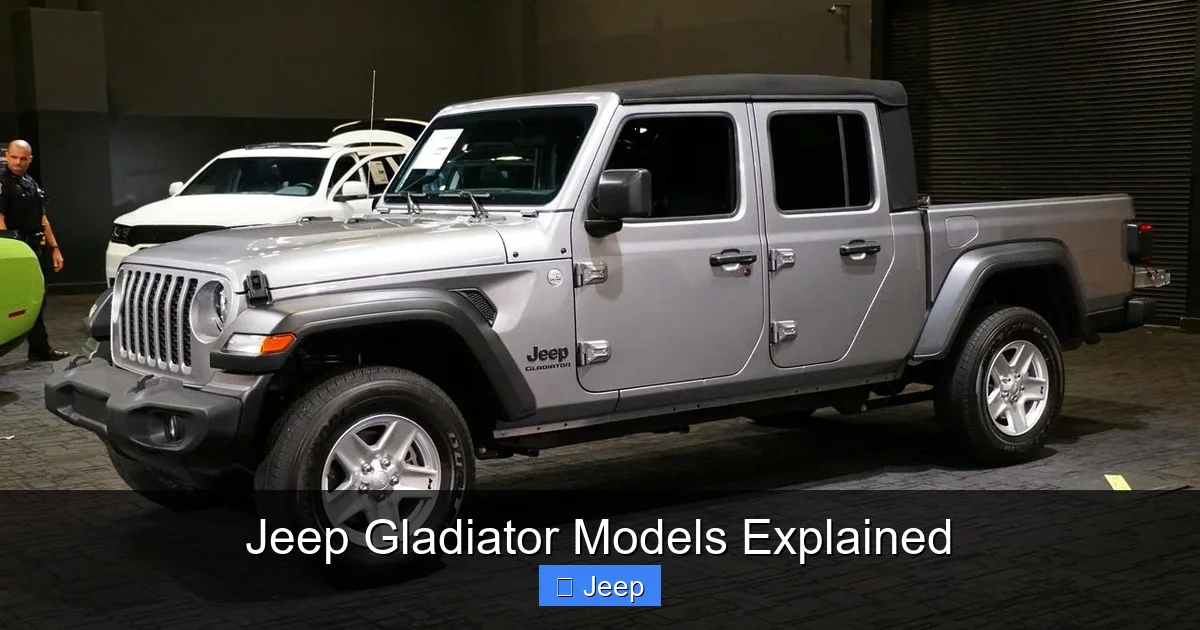
The Sport is your entry point into the Gladiator world. It’s raw, functional, and focused on delivering the core Jeep experience without unnecessary fluff. Think of it as the blueprint—everything that makes a Gladiator a Gladiator is here.
Visual guide about Jeep Gladiator Models Explained
Image source: assets-global.website-files.com
Standard Highlights: 17-inch steel wheels, a manual 6-speed transmission, a basic Uconnect 3 infotainment system with a 5-inch display, and a rear window that opens separately from the tailgate. The interior is Spartan, with durable but utilitarian cloth seats. It comes with the standard Command-Trac 4×4 system with a 2.72:1 low-range transfer case, but no locking differentials.
Who it’s for: The purist on a budget, the off-road newbie who wants to build their own rig, or the practical buyer who needs a capable, simple truck. It’s the blank canvas. If your plan is to add a lift kit and aftermarket bumpers, starting with a Sport saves money for those customizations.
Sport S: The Smart Sweet Spot
The Sport S is arguably the most popular Gladiator model. It takes the solid foundation of the Sport and adds a bundle of comfort and convenience features that make daily life significantly better, all for a modest price increase.
Key Additions Over Sport: Air conditioning (a huge deal in a removable-top Jeep), an upgraded Uconnect 5 system with an 8.4-inch touchscreen, Apple CarPlay/Android Auto, a seven-speaker Alpine audio system, and power windows/locks. It also adds body-color fender flares and a premium cloth interior. Crucially, it still offers the manual transmission as standard.
Who it’s for: The vast majority of buyers. You get the essential tech and comfort for modern life while retaining the option for a manual transmission and saving thousands over the higher trims. It’s the ideal balance of value and livability.
The Refined Road Tripper: Overland
The Overland takes a sharp turn toward on-road comfort and premium styling. It’s the Gladiator for someone who loves the Jeep look and occasional light trails but primarily wants a luxurious, comfortable, and quiet pickup for road trips and daily driving.
Visual guide about Jeep Gladiator Models Explained
Image source: jeepgladiatorforum.com
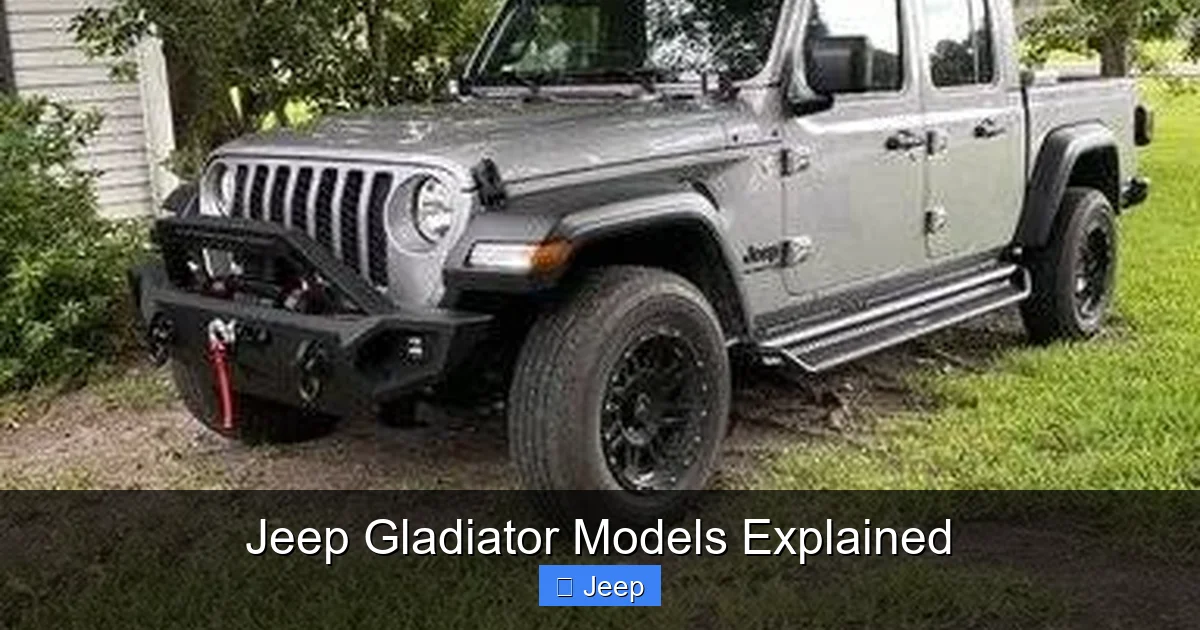
What Sets Overland Apart: It’s the only Gladiator that does not offer a manual transmission—the 8-speed automatic is mandatory. It comes standard with 20-inch polished aluminum wheels and all-season tires, which prioritize ride comfort and road noise reduction over off-road traction. The interior is upgraded to premium leather-trimmed seats with heating and ventilation for the front. You also get a 9-speaker Alpine system with a subwoofer, a leather-wrapped steering wheel, and body-color rock rails. The front grille and exterior accents get a unique “Overland” badging and darker finishes.
The Trade-Off: You lose some off-road prowess. The Overland uses the standard Command-Trac 4×4 system (no locking diffs) and has a lower ground clearance due to its larger wheels and street-focused tires. It’s perfectly capable on dirt roads and moderate trails but is not the choice for serious rock crawling.
Who it’s for: The driver who values highway manners, a plush interior, and sophisticated styling. Think of it as a luxury SUV with a truck bed. For those who prioritize a serene cabin for long drives, the Overland’s sound insulation and refined ride are worth the premium.
The Off-Road King: Rubicon
This is the name that echoes through the Jeep world. The Rubicon is the most factory-capable Wrangler-based vehicle ever built, and that translates directly to the Gladiator. It’s engineered to dominate the toughest trails straight from the dealer lot.
Visual guide about Jeep Gladiator Models Explained
Image source: s1.cdn.autoevolution.com
Rubicon-Exclusive Off-Road Hardware: This is where the magic happens. It includes the Rock-Trac 4×4 system with a 4:1 low-range transfer case (massively slower, more controlled crawling than the 2.72:1 in other trims). It also adds front and rear electronic locking differentials and a disconnecting front anti-roll bar for maximum wheel articulation. Underneath, you get heavy-duty Dana 44 axles with a 4.10 gear ratio, 33-inch (255/75R17) BF Goodrich All-Terrain tires on 17-inch black alloy wheels, and steel skid plates.
Other Rubicon Perks: It features the standard 6-speed manual but can be paired with the robust 8-speed automatic. Inside, you get rugged, supportive cloth seats with the “Rubicon” logo, a leather-wrapped steering wheel with a red centering stripe, and a 7-inch digital gauge cluster. The front bumper is a unique, aggressive design with integrated fog lights and a standard tow hook.
Who it’s for: The serious enthusiast. The person who plans to tackle Moab’s Rubicon Trail or the local rock garden. If your primary goal is maximum off-road performance and you’re willing to accept a firmer ride and more road noise as a trade-off, the Rubicon is your only logical choice. Owners often pair their Rubicon with a suspension lift and larger tires for even more capability.
The Desert Runner: Mojave
For the 2021 model year, Jeep introduced the Mojave, a trim born from the demands of high-speed, desert-style off-roading. It shares the Rubicon’s off-road focus but engineers its systems for a different kind of terrain—sand, silt, and fast, rocky washes where stability at speed is key.
Mojave’s Unique Formula: It uses the same 4:1 Rock-Trac transfer case as the Rubicon, but crucially, it has a unique, reinforced front axle (a Dana 44 with a different housing) designed to handle higher-speed impacts. The star of the show is the FOX race-ready, 2.5-inch internal bypass shocks. These are performance shocks tuned for damping control during high-speed runs, not just slow crawling. The Mojave also has a 1-inch factory lift and comes standard on 33-inch tires.
What It Lacks (Compared to Rubicon): The Mojave does not have front or rear locking differentials. Instead, it relies on its electronic limited-slip differential (the same as in the Rubicon) and its superior suspension to maintain momentum. It also does not have the Rubicon’s electronic front sway bar disconnect. Its approach and departure angles are slightly less aggressive due to its unique front bumper.
Who it’s for: The driver who adventures in the desert southwest, who enjoys speeds of 40-50 mph over whoops and rocks, or who wants a more on-road-friendly ride than the Rubicon without sacrificing serious trail credibility. It’s the “sport” model in the off-road lineup.
Comparing the Core Trims: A Side-by-Side Look
Capability vs. Comfort: Where Each Model Shines
To make the decision crystal clear, let’s contrast the primary trims head-to-head.
- Rubicon vs. Mojave: Rubicon = technical rock crawler (lockers, disconnect). Mojave = high-speed desert runner (stronger axle, race shocks). For most challenging rock obstacles, the Rubicon’s lockers give it an edge. For whoops and sand, the Mojave’s shocks provide a smoother, more controlled ride.
- Overland vs. Rubicon: Overland = on-road luxury. Rubicon = off-road tool. The Overland’s 20-inch wheels and street tires are terrible off-road but great for mpg and comfort. The Rubicon’s 33-inch ATs are noisy on pavement but essential off it. The choice is stark.
- Sport S vs. Overland: Both can be daily drivers. The Sport S is simpler, more utilitarian, and offers a manual. The Overland is a premium, automatic-only cruiser with leather. The price gap is significant.
Engine and Transmission: The Common Heart
It’s important to note that powertrain choices are largely independent of trim. The standard 3.6L V6 (285 hp, 260 lb-ft) is available on every model. The excellent 3.0L EcoDiesel V6 (260 hp, 442 lb-ft of torque) is an option on Sport S, Overland, Rubicon, and Mojave—a fantastic choice for towing and low-end grunt. The 6-speed manual is standard on Sport, Sport S, Rubicon, and Mojave. The 8-speed automatic is optional on those and standard on Overland. Your choice here affects drivability and towing capacity more than your trim level does.
Making Your Final Decision: Practical Advice
Ask Yourself These Questions
Before you walk into a dealership, be honest about your answers:
- What is my primary use? 90% pavement? Look at Overland or Sport S. 50/50? Sport S or Mojave. 90% trails? Rubicon.
- Do I need a manual transmission? If yes, your choices are Sport, Sport S, Rubicon, or Mojave. Overland is automatic-only.
- What’s my budget, including potential mods? It’s often smarter to buy a Sport S and add a lift, wheels, and tires than to pay for a Rubicon’s factory parts you might replace anyway. However, the Rubicon’s axles, transfer case, and lockers are expensive to add aftermarket.
- How important is interior luxury? If you want leather, heated seats, and a quiet cabin, Overland is your only true option. The Rubicon and Mojave have rugged, functional interiors.
The “Accessorize Later” Strategy
Many buyers get caught up in trim levels for features they can easily add later. Remember: locking differentials and a 4:1 transfer case cannot be added aftermarket for anywhere near the cost of the Rubicon package. They are the defining, non-negotiable features of that trim. However, things like a dash cam, a bed liner, or a bed cover are simple, affordable upgrades you can and should do yourself on any trim. Don’t overpay for a higher trim just to get a factory-fitted accessory you can buy and install better for less money.
Conclusion: There’s a Gladiator for Every Journey
The Jeep Gladiator lineup is a masterclass in segmentation. There’s no “best” model—only the best model for you. The Sport and Sport S are fantastic values for budget-conscious buyers and builders. The Overland redefines comfort in a Jeep truck. The Rubicon remains the undisputed king of the rocks, a no-compromise trail bruiser. And the Mojave offers a thrilling, high-speed alternative for those who chase desert horizons.
Your decision should flow from your real-world use case, not from a desire for the highest badge. Test drive a Rubicon on the street, then an Overland. Feel the difference. Picture yourself loading up the bed for a camping trip or removing the doors on a summer evening. The right Gladiator model won’t just be a vehicle you own; it will be a partner in the adventures you choose to have. Now that you have the Jeep Gladiator models explained, you can walk into the dealership with confidence, knowing exactly which trim will unlock your perfect blend of capability, comfort, and style.
Frequently Asked Questions
What is the biggest difference between the Gladiator Rubicon and Mojave?
The Rubicon is built for slow, technical rock crawling with its locking front and rear differentials and electronic front sway bar disconnect. The Mojave is built for high-speed off-roading in desert terrain, featuring a reinforced front axle and FOX race-ready shocks, but it does not have locking differentials.
Can I add a lift kit and bigger tires to a non-Rubicon Gladiator?
Yes, you can. Many owners of Sport S and Overland models add lifts and larger tires. However, you will not gain the Rubicon’s Dana 44 axles, 4:1 transfer case, or locking differentials, which are the core, non-negotiable off-road hardware that cannot be replicated cost-effectively aftermarket.
Which Gladiator model is best for daily driving and commuting?
The Overland is specifically designed for this, with its 20-inch wheels, all-season tires, premium leather interior, and enhanced sound insulation. The Sport S with the automatic transmission is also a very comfortable and practical daily driver at a lower cost, though it has more road noise and a firmer ride than the Overland.
Is the manual transmission available on all Gladiator models?
No. The 6-speed manual is standard on the Sport, Sport S, Rubicon, and Mojave. It is not available at all on the Overland trim, which comes standard with the 8-speed automatic transmission.
Do I need a Rubicon if I only do light off-roading?
Probably not. For dirt roads, forest service roads, and moderate trails, a Sport S or Mojave with all-terrain tires is more than capable. The Rubicon’s advanced hardware is overkill for light use and comes with a stiffer ride and more road noise. Save the money or put it towards other accessories.
Which Gladiator has the best towing capacity?
Towing capacity is primarily determined by engine and drivetrain, not trim. The 3.0L EcoDiesel V6 engine provides the highest towing capacity (up to 7,700 lbs) across compatible trims (Sport S, Overland, Rubicon, Mojave). The 3.6L V6 is rated for 4,000 lbs. The transmission (manual vs. automatic) can also slightly affect the rating.
