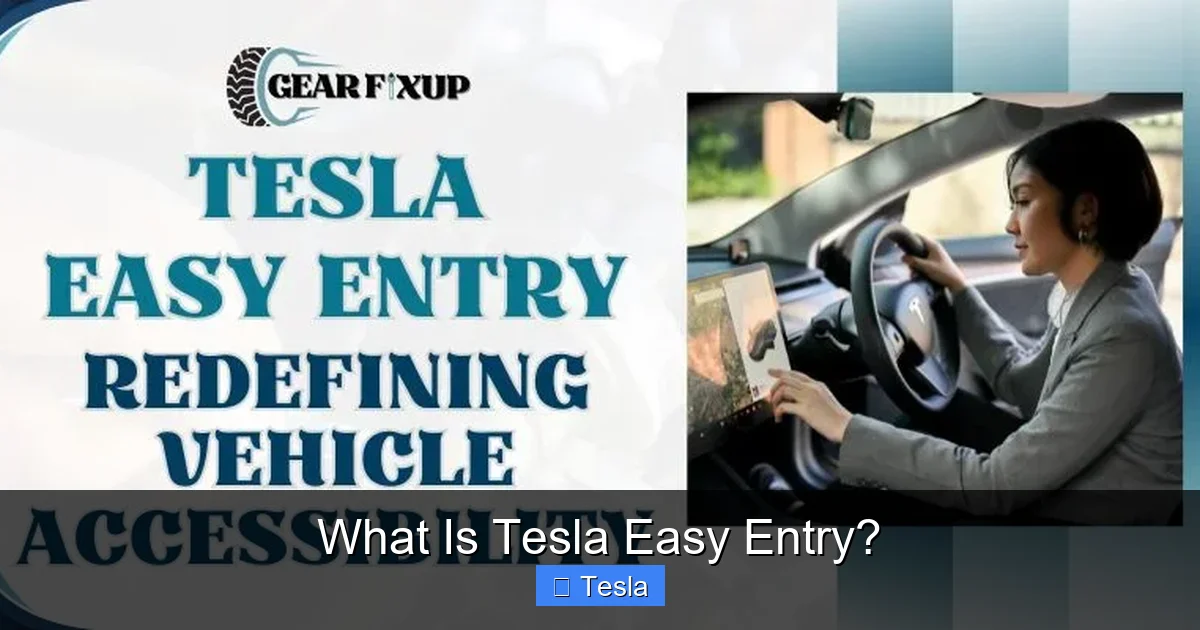
What Is Tesla Easy Entry?

Contents
- 1 Key Takeaways
- 2 📑 Table of Contents
- 3 How Tesla Easy Entry Works: The Tech Behind the Magic
- 4 Setting Up Your Tesla Easy Entry: A Step-by-Step Guide
- 5 The Unbeatable Benefits: Why You’ll Love Easy Entry
- 6 Troubleshooting: When Tesla Easy Entry Doesn’t Behave
- 7 Comparing Tesla Easy Entry to Traditional Key Systems
- 8 The Future of Keyless Access: Where Tesla Easy Entry Goes Next
- 9 Conclusion: Embracing the Seamless Drive
- 10 Frequently Asked Questions

Interior Cleaner Spray

LED Indicator Light

Tire Repair Kit
Side Window Sunshade
Tesla Easy Entry is a keyless entry and start system that replaces your physical car key with your smartphone or a paired Tesla key card. It uses encrypted Bluetooth Low Energy (BLE) and Near Field Communication (NFC) technology to automatically unlock the car as you approach and enable driving once you’re inside. This system offers unparalleled convenience but requires proper setup and awareness of potential connectivity or software-related hiccups.
Gone are the days of fumbling in your pocket or bag for a physical key fob. Welcome to the era of digital convenience, where your car knows you’re coming. If you’ve ever wondered, “What is Tesla Easy Entry?”, you’re about to discover one of the most elegantly simple yet profoundly impactful features in modern automotive design. It’s not just a keyless entry system; it’s a seamless, almost magical transition from sidewalk to driver’s seat that redefines your daily interaction with your vehicle. This isn’t a minor gadget; it’s a core component of the Tesla ownership experience, deeply integrated into the vehicle’s software and philosophy.
At its heart, Tesla Easy Entry is the brand’s implementation of passive keyless entry and start (PKE/PKS). However, Tesla has executed it with a consumer-friendly polish that makes the technology feel utterly intuitive. Instead of carrying a dedicated fob, your authenticated smartphone becomes the key. There’s no button to press. As you walk toward your parked Tesla with your phone in your pocket or bag, the car’s sensors detect the unique Bluetooth signal from your paired device. The handles automatically present themselves (on Model S and X with the door handle presentation feature), the doors unlock, and you simply get in and drive away—no pushing buttons, no inserting keys. It’s a frictionless flow that, once experienced, makes every other car feel archaic. For those who prefer a physical object or need a backup, the slim Tesla key card serves the same purpose via a quick tap.
Understanding Tesla Easy Entry means appreciating the sophisticated dance of hardware and software happening beneath the surface. It’s a system that relies on a constant, low-energy conversation between your phone and the car, all secured by military-grade encryption. But it’s not without its quirks and considerations. Battery life, Bluetooth interference, software updates, and even Tesla’s own server status can play a role in its reliability. This article will pull back the curtain on everything you need to know. We’ll dive into the underlying technology, walk through the setup for both phones and key cards, explore the real-world benefits and occasional frustrations, and provide clear troubleshooting steps. By the end, you’ll not only know what Tesla Easy Entry is but how to master it, ensuring this fantastic feature works flawlessly for you every single time.
Key Takeaways
- Understanding What Is Tesla Easy Entry?: Provides essential knowledge
📑 Table of Contents
- How Tesla Easy Entry Works: The Tech Behind the Magic
- Setting Up Your Tesla Easy Entry: A Step-by-Step Guide
- The Unbeatable Benefits: Why You’ll Love Easy Entry
- Troubleshooting: When Tesla Easy Entry Doesn’t Behave
- Comparing Tesla Easy Entry to Traditional Key Systems
- The Future of Keyless Access: Where Tesla Easy Entry Goes Next
- Conclusion: Embracing the Seamless Drive
How Tesla Easy Entry Works: The Tech Behind the Magic
To truly grasp Tesla Easy Entry, we need to demystify the technology that makes hands-free access possible. It’s a layered system combining several wireless protocols, each with a specific job, all wrapped in a robust security framework. Think of it as a multi-factor authentication system for your car, where the factors are proximity, device identity, and cryptographic proof.
The Primary Channel: Bluetooth Low Energy (BLE)
The workhorse of the passive entry experience is Bluetooth Low Energy, or BLE. Unlike classic Bluetooth used for streaming music, BLE is designed for short-range, low-power communication. Your paired Tesla phone key constantly broadcasts a tiny, unique signal. The car’s multiple internal antennas are always listening for this specific signal. When the signal strength (RSSI – Received Signal Strength Indicator) reaches a predetermined threshold, indicating you’re within about 3-6 feet, the car’s computer recognizes the device. It then performs a cryptographic handshake using a rolling code algorithm. This handshake verifies that the signal is genuine, hasn’t been intercepted and replayed (a “replay attack”), and comes from a device that has been explicitly authorized by the car. This entire process happens in milliseconds, invisible to you. The car’s software then commands the door handles to present (if applicable) and unlocks the doors. The same BLE communication confirms you’re inside the vehicle, allowing you to press the brake pedal and shift into drive without ever needing to press a start button.
The Backup & Manual Tap: Near Field Communication (NFC)
BLE is fantastic, but it can be finicky. Thick pockets, metal objects, or a phone with a completely dead battery can block the signal. This is where the Tesla key card and the NFC capability of many smartphones come in. NFC is a very short-range (a few centimeters) technology. The Tesla key card contains a passive NFC chip. To use it, you simply tap the flat side of the card against the card reader location, which is hidden in the center console’s trim on the driver’s side (often marked with a small card icon). This tap manually triggers the unlock or start sequence, bypassing the need for BLE connectivity. Many modern smartphones (like iPhones with Apple’s Express Mode or Android phones with NFC) can also be set up as a “NFC key card” within the Tesla app. This allows you to use your phone as a physical card by tapping it to the same reader, a crucial backup if your phone’s Bluetooth is off or the battery is critically low. This dual-path approach (automatic BLE + manual NFC) is what makes the system so resilient.
The Security Fortress: Rolling Codes & Cryptography
This is the most critical part. Old remote key fobs used static codes that could be captured and replayed by thieves. Tesla Easy Entry uses a dynamic, rolling code system. Every time your phone and car communicate, they generate a new, unique, one-time-use cryptographic token. This token is validated by both devices using secret keys stored securely. Even if a malicious actor somehow intercepted one signal, it would be useless because the system would already be expecting a different, next-in-sequence code. The communication is also encrypted. The Tesla mobile app and vehicle use Tesla’s own API infrastructure, which requires authentication. When you add a phone key, the app generates a unique, cryptographically signed credential that is transferred to the car via a secure Bluetooth pairing process. The car stores this credential in its secure module. This layered security—proximity detection, device-specific credentials, and rolling encryption—is what makes Tesla’s system one of the most secure keyless systems on the market, far surpassing many traditional key fobs.
Setting Up Your Tesla Easy Entry: A Step-by-Step Guide
Getting started with Tesla Easy Entry is refreshingly simple, but the steps differ slightly between adding a smartphone and using the provided key card. The process is managed entirely through the large touchscreen in your Tesla and the companion mobile app on your phone.

Visual guide about What Is Tesla Easy Entry?
Image source: evehiclepro.com
Adding Your Smartphone as a Key (The Preferred Method)
This is the setup you’ll do first, and it’s the key to the full hands-free experience. Before you begin, ensure your phone has Bluetooth turned on, location services enabled for the Tesla app, and that the Tesla app is logged into your account and paired with your vehicle. Your phone should be inside the car for the initial pairing.
- Step 1: On the Tesla touchscreen, navigate to Controls > Locks.
- Step 2: Tap + next to “Phone Key.” The screen will instruct you to “Place phone in center console.”
- Step 3: Physically place your unlocked phone (with the Tesla app open or in the background) into the center console cup holder or on the flat surface. The car will detect it via Bluetooth and NFC.
- Step 4: The touchscreen will confirm it has detected a phone. You’ll be prompted to name the key (e.g., “John’s iPhone”) and optionally assign it to a driver profile.
- Step 5: Press “Confirm” on the screen. The pairing is complete. You can now remove your phone.
Test it! Lock the car using the Tesla app or the screen, then walk away with your phone. Return, and the handles should present and unlock automatically. If you have a Model 3/Y with door handles that don’t present, simply pull the handle; it should unlock as you grasp it.
Setting Up and Using the Tesla Key Card
The key card is your physical backup and primary key for anyone else you lend the car to. It’s also essential if your phone’s battery dies.
- Activation: The key card comes pre-paired to your vehicle from the factory. You can see it listed in Controls > Locks as “Key Card.” If you ever need to delete and re-pair it (e.g., after a factory reset), you would tap “Delete” next to the card and then follow the on-screen instructions to tap it to the card reader in the center console.
- Using for Unlock/Start: To unlock, simply tap the flat side of the key card to the driver’s side B-pillar (the area where the door latch is, often with a small Tesla “T” logo) or to the card reader in the center console. The car will unlock. To start, after entering, you must tap the key card to the card reader again before shifting into drive. This tap confirms your presence and authorizes the drive.
- Important: The key card does not work passively. You must consciously tap it. It also does not automatically lock the car when you walk away; you must use the Tesla app, the screen, or the physical lock button on the door handle.
Adding Additional Phone Keys for Family Members
Sharing your Tesla is easy. The process for adding a second person’s phone is identical to adding your own, with one crucial prerequisite: the second person must have the Tesla app installed on their phone, be logged into their own Tesla account (they need to be added as a driver in your Tesla account via the Tesla app first), and have “Mobile App” access permissions granted. Once they are an authorized driver in your account, they can perform the pairing procedure from their own app while sitting in the car. This creates a separate, secure key credential on their device linked to their Tesla account, not yours. This is fantastic for spouses, adult children, or friends, as each person uses their own Tesla app login to access the car.
The Unbeatable Benefits: Why You’ll Love Easy Entry
Once you’ve experienced Tesla Easy Entry, going back to a traditional key feels like a step backward into the dark ages. The advantages extend far beyond mere novelty into tangible improvements in daily life and safety.

Visual guide about What Is Tesla Easy Entry?
Image source: evehiclepro.com
Frictionless Convenience in Every Scenario
Imagine your hands full of groceries, a squirming toddler, or an armful of packages. With a traditional car, you must put everything down, dig for your key, unlock the door, then pick everything up again. With Easy Entry, you simply walk to the car, pull the handle (which is already unlocked), and load your items directly into the car. The same applies when leaving a store in the rain, carrying a briefcase to a meeting, or returning from a workout. The key is literally always with you, in your pocket or bag, requiring zero conscious effort to use. This “passive” convenience is its greatest strength. It also eliminates the “key fob battery dead” panic. While your phone battery is a new consideration, the key card provides a perfect, slim backup that never needs charging.
Enhanced Security Over Traditional Fobs
As discussed, the rolling code encryption is vastly superior to the static codes of many older key fobs, which are vulnerable to “code-grabbing” replay attacks. Furthermore, because the key is tied to your personal Tesla account via the app, you have granular control. If you sell the car or lend it to someone, you can instantly delete their phone key from the Controls > Locks menu remotely via the Tesla app. There’s no need to retrieve a physical key fob. You can also see a log of when and where the car was unlocked and driven, adding a layer of accountability and security.
Seamless Integration with Driver Profiles
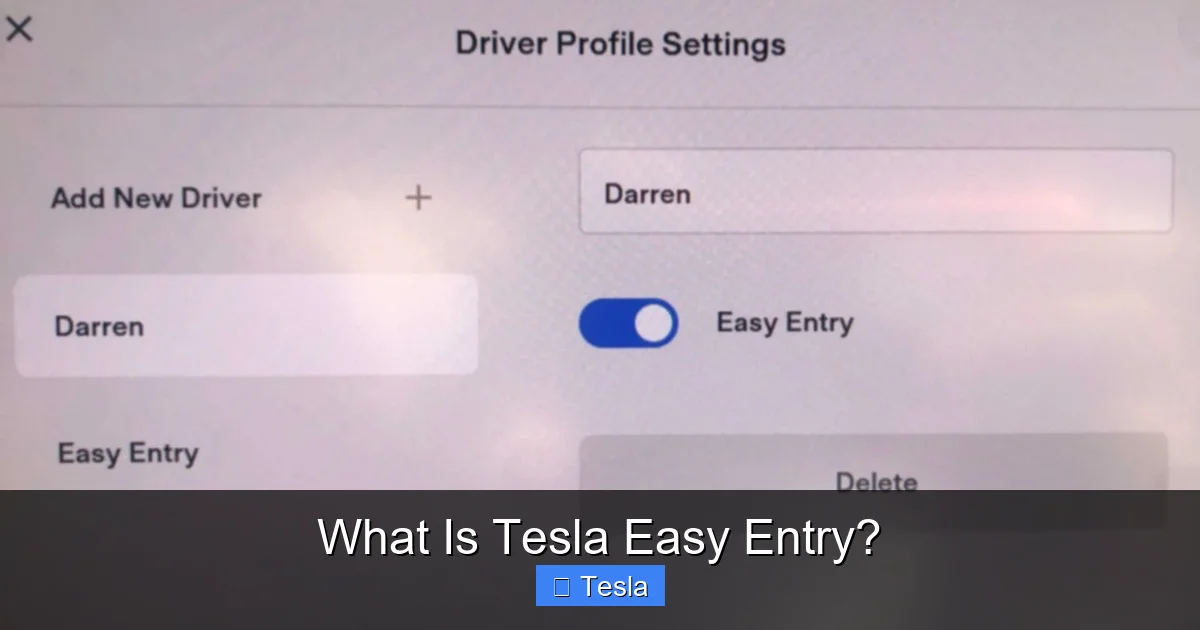
When you set up your phone key, you can link it to your Tesla driver profile (the seat, mirror, steering wheel, and climate control settings). As you approach the car, it not only unlocks but also prepares itself for you. By the time you sit down, your seat is in position, your mirrors are adjusted, and your preferred temperature is engaged. This creates a deeply personalized experience from the moment you touch the door. If multiple phones are linked to different profiles, the car can automatically switch profiles based on which phone is present, a feature that feels incredibly sophisticated.
Troubleshooting: When Tesla Easy Entry Doesn’t Behave
For a system that aims to be flawless, it’s remarkably reliable. However, its dependence on Bluetooth, phone settings, and software means occasional hiccups can occur. Knowing how to diagnose these issues saves immense frustration.
Visual guide about What Is Tesla Easy Entry?
Image source: evehiclepro.com
My Phone Key Isn’t Working! (The Common Issues)
This is the most frequent complaint. Start with these checks in order:
- Bluetooth is Off: This seems obvious, but it’s the #1 cause. Ensure Bluetooth is enabled on your phone. The Tesla app must also have permission to use Bluetooth (check your phone’s app settings).
- Phone is Locked/Screen Off: For security and battery life, some phones restrict Bluetooth communication when the screen is off and the device is locked. This is usually a power-saving setting. Try keeping your phone unlocked in your pocket (not recommended for security) or adjust your phone’s Bluetooth/Location settings to allow communication while locked. iPhones with “Express Mode” for Apple Wallet typically avoid this issue.
- Location Services for Tesla App are Disabled: The Tesla app often requires “While Using” or “Always” location permission to facilitate the phone key function. Go to your phone’s settings > Tesla app > Location and ensure it’s enabled.
- Phone is in a Signal-Blocking Case or Location: Thick metal cases, wallets with RFID blocking, or placing your phone deep in a bag can attenuate the BLE signal. Try holding your phone near the door handle or removing it from the case temporarily to test.
- Vehicle Software Needs a Reboot: Like any computer, the car’s infotainment and security modules can get into a weird state. Hold down both scroll wheels on the steering wheel to force a reboot of the main screen. Wait for it to fully restart and test again.
- Phone Key Needs Re-pairing: If all else fails, delete the phone key from the car’s menu (Controls > Locks > [Your Phone Name] > Delete) and go through the setup process again from scratch. This resolves most persistent pairing glitches.
What About Server Issues? The 503 Error Connection
Here’s where Tesla’s cloud-dependent nature can surface. Your phone key credential is validated through Tesla’s servers. During periods of scheduled server maintenance or unexpected outages, the car might temporarily lose the ability to verify your phone key against Tesla’s authentication servers. You might see a message on your screen or in the app about a 503 Server Maintenance Error. This is a standard HTTP status code meaning the service is temporarily unavailable. During these brief windows, your phone key may fail, but your physical key card will always work because it uses direct NFC communication with the car, bypassing the internet entirely. This is why carrying the key card is non-negotiable. Once Tesla’s servers are back online, your phone key should resume normal function without any action needed on your part. You can learn more about these temporary service disruptions and what they mean for your vehicle’s connectivity features by reading about What Is 503 Server Maintenance On Tesla and the specific 503 Server Maintenance Error On Tesla.
Phone Battery is Dead: The Ultimate Test
This is the scenario the key card was built for. If your phone’s battery is completely dead, Bluetooth and NFC (in phone-based mode) will not work. You must use your key card. Tap it to the B-pillar or center console reader to unlock and start. This is why it’s paramount to always have the key card with you, either in your wallet or a dedicated spot in the car. A pro tip: some Tesla owners keep the key card in their wallet so it’s always with them, independent of their phone’s state. Once you charge your phone and power it on, it should reconnect automatically when you’re back in the car’s vicinity.
Comparing Tesla Easy Entry to Traditional Key Systems
To appreciate the innovation, let’s stack Tesla’s system against the conventional key fob and even other brands’ keyless systems.
vs. The Traditional Key Fob & Remote
Old-school keys require you to physically insert a key or press a button on a fob. They are mechanical, can break, wear out, and have fixed, cloneable codes. The fob battery dies, and you’re stuck. Tesla’s system is digital, software-updatable (meaning improvements can be pushed over-the-air), and uses dynamic encryption. The convenience of passive entry—just walking up—is a quantum leap. The only downside is the new dependency on phone battery and settings, which the key card perfectly mitigates.
vs. Other Brands’ Keyless Entry & Push-Button Start
Many luxury brands (BMW, Mercedes, Audi, etc.) now offer “comfort access” or similar keyless entry and start systems. They function very similarly, using a key fob with a BLE chip. The fundamental principle is the same. However, Tesla’s integration is different in two key ways: 1) The primary key is your personal smartphone, an object you virtually never forget, versus a dedicated fob you can misplace. 2) The entire system is part of a unified software platform. Features like automatically switching driver profiles or the ability to revoke access remotely via an app are more seamlessly integrated because it’s all one ecosystem. Other brands treat the key fob as a separate hardware accessory, while Tesla treats the phone as an extension of the car’s computer.
The Future of Keyless Access: Where Tesla Easy Entry Goes Next
As Tesla continues to refine its vehicles through over-the-air software updates, the Easy Entry experience will only get smarter and more integrated. We can anticipate developments that leverage the car’s ever-improving sensor suite and AI.
One logical evolution is biometric integration. While the phone is the key today, the car’s interior camera (currently used for driver monitoring in Full Self-Driving beta) could eventually recognize the driver’s face and automatically adjust settings and grant driving permission, even without a phone present (for authorized users). This would be a true “keyless” future, where you are the key.
Another frontier is ultra-wideband (UWB) technology. Current BLE has a range of a few meters but isn’t precise. UWB, like that used in AirTag tracking, can pinpoint a device’s location within centimeters. This could enable even more granular control: unlocking only the specific door you’re approaching, automatically popping the trunk as you stand behind the car with your hands full, or disabling the alarm if your authorized phone is inside the car but you’re locking it from outside. UWB’s precision and resistance to interference make it the next step in passive entry.
Furthermore, as Tesla expands its ecosystem (Solar, Powerwall, Apps), your Tesla key could become a universal authenticator. Imagine using your Tesla phone key to securely access your home garage (if integrated with your home automation system) or to verify your identity for Tesla service appointments. The “key” becomes a digital identity token tied to your Tesla account, usable across a range of physical and digital touchpoints.
Conclusion: Embracing the Seamless Drive
Tesla Easy Entry is far more than a neat party trick. It is a foundational piece of the user experience that embodies Tesla’s philosophy: use software to solve real-world problems and eliminate unnecessary friction. By transforming your smartphone—a device you already carry everywhere—into a secure, intelligent car key, Tesla has removed a daily annoyance that most drivers never questioned. The blend of passive Bluetooth convenience and active NFC reliability, backed by strong encryption, creates a system that is both incredibly easy and highly secure.
Mastering it involves understanding its dependencies: keep Bluetooth on, ensure app permissions are correct, and always carry the physical key card as your ultimate failsafe. Recognize that as a cloud-connected feature, it can be momentarily affected by Tesla’s server status, a small price to pay for a system that can be improved and hardened against new threats via software updates. When you get it right, the result is a driving experience that feels perfectly calibrated to the 21st century. You approach your car, it recognizes you, welcomes you, and gets you on your way without a single extra step. That’s not just convenience; that’s the future, today. So go ahead, set up that phone key, stash the key card in your wallet, and enjoy the sublime simplicity of never having to think about your car keys again.
Frequently Asked Questions
Can I use Tesla Easy Entry if my phone’s Bluetooth is turned off?
No, the passive “walk-up and unlock” feature requires Bluetooth to be active. However, if your phone’s Bluetooth is off but NFC is enabled, you can use your phone as a manual key card by tapping it to the reader in the center console. The physical Tesla key card also uses NFC and will work regardless of Bluetooth.
Is Tesla Easy Entry more secure than a traditional key fob?
Yes, it is generally considered more secure. It uses rolling, encrypted codes that change with every use, making it nearly impossible to clone via signal replay attacks that work on many older static-code key fobs. The digital credential is also tied to your personal Tesla account, allowing remote revocation if needed.
What happens to my phone key if I sell my Tesla?
You must manually delete your phone key before completing the sale. Go to Controls > Locks on the touchscreen, find your phone key, and tap “Delete.” You should also remove the car from your Tesla mobile app account. This revokes your digital credential and prevents the new owner from using your old phone as a key.
Can someone else use my Tesla if they have my phone but not my Tesla app login?
No. The phone key credential is cryptographically linked to your specific Tesla account. If your phone is locked with a passcode/biometrics, they couldn’t open the Tesla app to pair it with another car. If they had your unlocked phone, they could use it to unlock and drive your paired Tesla, but they couldn’t add it as a key to a different vehicle. The security is tied to the account and the device’s unique pairing with your specific car.
Why might my Tesla Easy Entry stop working after a software update?
Occasionally, a major software update can reset or conflict with the Bluetooth pairing between your phone and the car. If your phone key stops working after an update, the first step is to delete the key from the car’s menu and re-pair it from scratch using the setup process. This re-establishes the secure connection with the new software version.
If Tesla’s servers are down (503 error), will my key card still work?
Absolutely. The physical Tesla key card uses direct NFC communication with the car’s internal reader and does not require any connection to Tesla’s servers to function. During any server outage or maintenance period, the key card remains a fully reliable backup for unlocking and starting your vehicle. Your phone key’s ability to work passively may be impaired during such events because it relies on server-side credential validation.