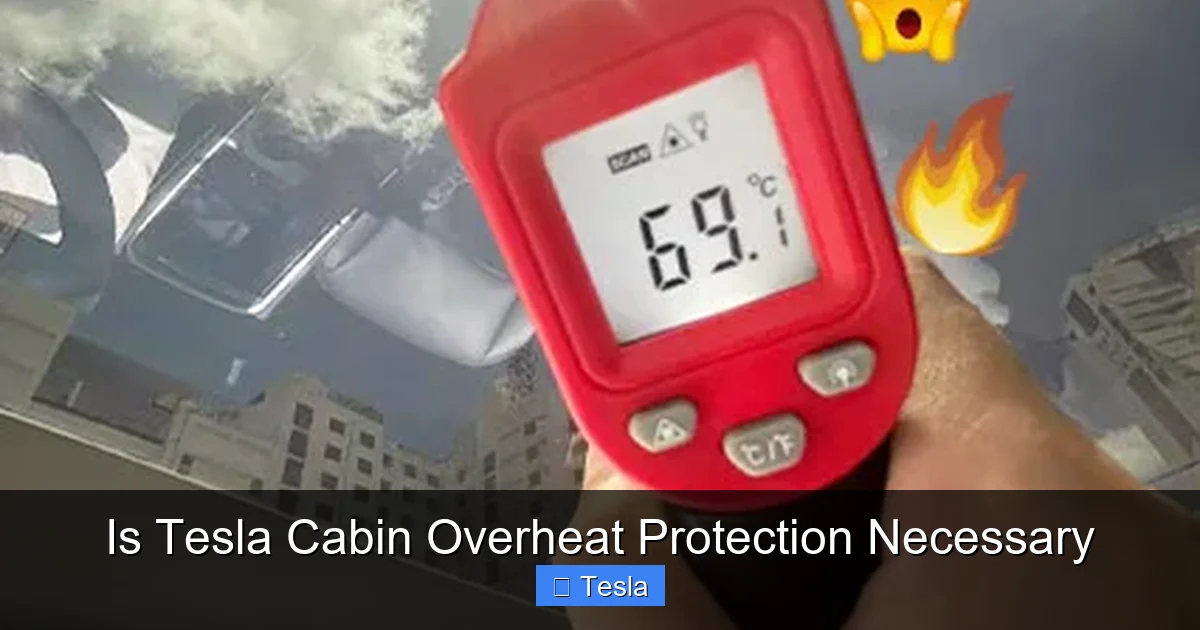
Is Tesla Cabin Overheat Protection Necessary

Contents
- 1 Key Takeaways
- 2 📑 Table of Contents
- 3 Introduction: The Hot Seat Dilemma
- 4 What Exactly is Tesla Cabin Overheat Protection?
- 5 How Does the Magic (and Science) Happen?
- 6 Is It Necessary? The Pros and Cons Breakdown
- 7 Who Needs It Most? A Personal Assessment
- 8 Costs, Activation, and Model Specifics
- 9 Alternatives and Complementary Strategies
- 10 Conclusion: Making the Decision for You
- 11 Frequently Asked Questions



Tesla’s Cabin Overheat Protection is a software feature that automatically activates the HVAC system to prevent dangerously high interior temperatures when parked. While highly beneficial for pet owners, families, and those in extreme climates, its necessity depends on your climate, usage patterns, and willingness to pay for the subscription or one-time fee. For many, it’s a valuable safety net, but not an absolute essential if you employ alternative cooling strategies.
Key Takeaways
- It’s a Safety Feature, Not Just Comfort: The primary goal is to prevent cabin temperatures from reaching life-threatening levels (above 105°F/40°C) for children, pets, or vulnerable adults left accidentally in the car.
- It Works Automatically When Parked: The system uses internal sensors and algorithms to decide when to turn on fans (and A/C in some models) without any driver input, conserving energy where possible.
- Availability and Cost Vary by Model & Year: It’s a standard, free feature on newer Model S and X but requires a monthly or one-time fee for Model 3 and Y, making its “necessity” a financial consideration.
- It Has a Real, But Manageable, Energy Impact: While it uses battery power, Tesla designs it to be efficient. The trade-off is between a small range loss and a massive safety gain.
- It’s Not a Substitute for Smart Habits: The feature is a last-resort safety net. It should never replace basic practices like not leaving living beings in parked cars and using sunshades.
- Climate and Parking Matter Most: If you regularly park in direct sunlight in hot climates (e.g., Arizona, Florida), the feature’s value increases dramatically compared to a temperate region with shaded parking.
- Physical Cabin Protection Complements It: Using a high-quality sunshade or considering a Tesla Model 3 wrap in a reflective color can significantly reduce initial heat buildup, working alongside the software feature.
📑 Table of Contents
- Introduction: The Hot Seat Dilemma
- What Exactly is Tesla Cabin Overheat Protection?
- How Does the Magic (and Science) Happen?
- Is It Necessary? The Pros and Cons Breakdown
- Who Needs It Most? A Personal Assessment
- Costs, Activation, and Model Specifics
- Alternatives and Complementary Strategies
- Conclusion: Making the Decision for You
Introduction: The Hot Seat Dilemma
You’ve just finished a long drive in your Tesla, the summer sun beating down. You park, lock the doors, and head into the store or office. Minutes later, you remember you left your laptop on the seat. You rush back, and as you open the door, a wave of hot air hits you. The interior is an oven. This is a universal car owner’s woe, but in an electric vehicle, it sparks a specific question: do I need to pay for software to prevent this?
Tesla’s Cabin Overheat Protection has been a topic of discussion, debate, and sometimes confusion since its introduction. For some, it’s an indispensable safety feature they wouldn’t own a Tesla without. For others, it’s a paywalled solution to a problem that can be managed with a $20 sunshade. So, is Tesla Cabin Overheat Protection necessary? The answer, like most things in the automotive world, is not a simple yes or no. It’s a nuanced equation of climate, lifestyle, vehicle model, and personal risk tolerance. Let’s break down exactly what this feature is, how it works, what it costs, and help you decide if it earns a permanent spot in your Tesla’s feature list.
What Exactly is Tesla Cabin Overheat Protection?
Let’s start with a clear definition. Cabin Overheat Protection is a software-driven safety system designed to prevent the temperature inside your Tesla’s cabin from reaching dangerously high levels when the vehicle is parked and unoccupied. It’s part of Tesla’s broader suite of “Sentry Mode” and cabin-centric safety features.
Visual guide about Is Tesla Cabin Overheat Protection Necessary
Image source: gearfixup.com
The Core Mission: Safety First
The most critical point to understand is that this feature is primarily a safety system, not a mere comfort convenience. Its official threshold is to keep the cabin temperature below 105°F (approximately 40°C). Why that number? Medical experts warn that temperatures above 105°F can cause heatstroke, organ damage, and even death in children and pets within minutes. For a pet, especially a dog, temperatures can become fatal even faster. The system is Tesla’s automated guardian against these tragic, all-too-common scenarios.
How It’s Different From Pre-Conditioning
Do not confuse Cabin Overheat Protection with the climate pre-conditioning feature you use before a drive. Pre-conditioning is a driver-initiated command (via app or scheduled) that cools or heats the cabin to your set temperature before you get in. Cabin Overheat Protection is autonomous, activates only when the car is parked and locked, and has a single, non-negotiable goal: prevent the cabin from exceeding 105°F. It doesn’t aim for a comfortable 72°F; it aims to keep you below the danger zone. This fundamental difference in purpose is key to understanding its value.
How Does the Magic (and Science) Happen?
The feature sounds high-tech, and it is, but its execution is elegantly simple. It relies on a combination of hardware and intelligent software.
Visual guide about Is Tesla Cabin Overheat Protection Necessary
Image source: i2.wp.com
The Sensor Network and Smart Algorithm
Your Tesla is already littered with temperature sensors. For Cabin Overheat Protection, the primary sensor is the cabin temperature monitor, typically located near the center console or rearview mirror. The car’s computer constantly runs an algorithm that checks this sensor. When the vehicle is in “Park,” locked, and the cabin temperature begins to climb toward the 105°F threshold, the system decides to act. Crucially, it also considers the battery’s state of charge (SOC). It won’t activate if the battery is critically low, preserving enough energy for you to drive to a charger.
The HVAC Response: Fans First, Then Cold Air
The system’s response is tiered to be as energy-efficient as possible while achieving its safety goal.
- Stage 1: Fan-Only Mode. Initially, the system will blast the fans at maximum speed, circulating air through the cabin. This alone can remove a significant amount of hot air and delay the need for active cooling.
- Stage 2: Active Cooling (A/C Engagement). If fan-only mode proves insufficient to stabilize or lower the temperature, the system will engage the air conditioning compressor. This is the energy-intensive part. The A/C will run just enough to keep the temperature from crossing the 105°F line, then cycle off.
You might hear this activity—the fans roaring to life minutes after you’ve walked away from the car. It’s the system doing its job. In newer models with the “Heat Pump” HVAC system (like most Model 3s and Ys post-2020), this process is even more energy-efficient.
Is It Necessary? The Pros and Cons Breakdown
Now, the heart of the matter. Is it necessary? Let’s weigh the arguments.
Visual guide about Is Tesla Cabin Overheat Protection Necessary
Image source: gearfixup.com
The Unquestionable Pros: Peace of Mind
1. A Critical Safety Net for the Unthinkable. This is the number-one reason to consider it essential. Humans make mistakes. A moment of distraction, a change in plans, a sleeping child in the back seat—Cabin Overheat Protection is the automated failsafe that could prevent a nightmare. For pet owners who occasionally need to run a quick errand (though you should never plan to leave a pet unattended), it provides a layer of protection.
2. Protection for Your Cabin Interior. While secondary to safety, preserving your Tesla’s beautiful minimalist interior is a valid concern. Prolonged exposure to extreme heat can dry out and crack leather, damage the dashboard materials, and degrade electronics over time. The feature helps maintain a more stable interior environment, potentially extending the life of your car’s finishes. If you’ve invested in paint protection film (PPF) or a wrap for the exterior, you’ll likely want to protect the interior as well.
3. Convenience and Comfort (A Happy Side Effect). Coming back to a car that isn’t a blast furnace is a genuine quality-of-life improvement. While not its primary goal, the feature often means your cabin will be more tolerable when you return, reducing that initial sweltering wait for the A/C to catch up during your drive.
The Cons and Considerations: Cost and Context
1. The Paywall (For Most Models). This is the biggest hurdle. For Model 3 and Model Y owners, Cabin Overheat Protection is a paid feature—either a $10/month subscription or a one-time $2,500 purchase. For new Model S and X buyers, it’s included. This financial barrier immediately makes it a “luxury” or “optional” software feature for the masses. You must decide if the safety benefit is worth that recurring or lump-sum cost.
2. Battery Drain is Real, But Quantifiable. Yes, running fans and the A/C compressor uses battery power. Tesla states the impact is minimal—likely in the range of a few miles of range per activation cycle. However, if you live in a consistently hot climate and your car is parked in the sun all day, it could activate multiple times, leading to a small but noticeable “parasitic drain” over several days. This is a trade-off: a few miles of range vs. catastrophic safety risk.
3. It’s a System, Not a Miracle. The feature has limits. In an extreme, prolonged heatwave with the car parked for days on end without any intervention, the battery will eventually deplete, and the system will shut down. It’s designed for typical daily parking scenarios (a few hours to a day), not indefinite abandonment. It also cannot overcome a fundamentally broken HVAC system. If your A/C is already malfunctioning, this feature won’t work, which highlights the need for regular maintenance.
Who Needs It Most? A Personal Assessment
Let’s get practical. Your need for this feature can be plotted on a simple graph with two axes: Climate Severity and Personal Risk Profile.
The High-Need Group: “Absolutely Necessary”
If you live in a hot, sunny climate (Southwest US, Southeast US, parts of Australia, Middle East), this feature moves from “nice-to-have” to “must-have.” The ambient temperatures and solar radiation are so intense that a car’s interior can hit lethal levels in under an hour. Combine that with a lifestyle where you might have young children or pets, and the argument becomes very strong. For these users, the $10/month is a tiny price for a monumental peace of mind. It’s akin to having a digital babysitter for your car’s interior.
The Moderate-Need Group: “Highly Recommended, But…”
This includes people in temperate climates with hot summers (like much of Europe, the Northeast US) who occasionally face dangerous heatwaves. It also includes anyone with small children or pets, regardless of climate, because the risk exists even on a “mild” 80°F day if the car is in direct sun—interior temps can still rocket past 100°F. For this group, the decision hinges more on the subscription cost versus their personal risk aversion. They might also consider the one-time fee if they plan to keep the car for many years, as the subscription eventually exceeds the purchase price.
The Low-Need Group: “Probably Not Essential”
If you live in a cool, cloudy, or consistently mild climate (Pacific Northwest, parts of the UK, Scandinavia), the external conditions rarely push cabin temps into the danger zone. If you also have a dedicated, shaded, or indoor parking spot (garage, covered parking), the solar gain is minimal. If you have no children or pets and are the sole, very responsible driver, your personal risk is near zero. For this group, a simple, effective sunshade is a far more economical solution. They can likely forgo the feature without significant concern, saving the subscription fee for something else, like a Tesla Model 3 registration in California or other ownership costs.
Costs, Activation, and Model Specifics
Understanding the financial and technical specifics is crucial for making an informed choice.
The Pricing Structure: Subscription vs. Lifetime
As of now, Tesla offers two paths for Model 3/Y owners:
- Monthly Subscription: $9.99/month (often shown as $10). This is flexible; you can cancel if you sell the car or feel you no longer need it. Over 25 months, you’ll have paid the equivalent of the one-time fee.
- One-Time Purchase: $2,500. This is a permanent unlock tied to the vehicle, not the owner. It’s a better deal if you plan to keep the car for more than 4 years. However, it’s a significant upfront cost for a software feature.
For used Model 3/Y buyers, this is a key negotiation point. Does the car have it? If not, the new owner must pay to enable it. It’s become a standard expectation in the used market, similar to Toyota’s protection packages for some buyers.
What’s Included in the Package?
The “Cabin Overheat Protection” package typically includes two core software features:
- Cabin Overheat Protection: The automatic temperature management we’ve discussed.
- Dog Mode: The more famous, user-controlled feature that maintains a set cabin temperature (with a clear dashboard display telling passersby the A/C is on) when you’re away. This is for intentional, monitored pet stays.
You cannot buy one without the other. They are bundled. So, your assessment should also consider if you want the convenience of Dog Mode for those times you *do* plan to leave your pet in the car for a short, safe period.
Model Year and Hardware Requirements
The feature requires the vehicle to have the necessary HVAC hardware (which all modern Teslas do) and the appropriate computer (MCU). It is generally available on all Model 3s and Ys from 2019 onward. For older vehicles, a hardware upgrade might be needed, but this is rare. Always check your specific vehicle’s software purchase menu in the car to see availability and pricing for your VIN.
Alternatives and Complementary Strategies
Relying solely on a software feature is a strategy, but a robust approach combines technology with smart, low-tech habits.
The Low-Tech Arsenal: Sunshades and Ventilation
Never underestimate the power of a simple reflective sunshade. A high-quality, well-fitted sunshade for the windshield can block the majority of solar radiation before it even enters the cabin, dramatically reducing the heat load. This is the cheapest and most effective first line of defense. Similarly, slightly cracking the windows (if safe and legal in your area) can allow hot air to escape, reducing the workload on the HVAC system. Combining a sunshade with Cabin Overheat Protection is a powerful one-two punch.
The “Pre-Cool” Strategy
If you know you’ll be parking in the sun, use the Tesla app to pre-cool the cabin to a low temperature (e.g., 65°F) just before you leave. This gives the interior a thermal head start. It uses more energy upfront, but it means the Cabin Overheat Protection system may not need to activate at all, or will have a much easier job, saving battery in the long run. This is a proactive use of the climate controls.
Parking Smart: Location, Location, Location
The best way to prevent cabin heat is to avoid it. Always seek shade. Parking under a tree, in a covered parking structure, or even facing away from the sun (so the rear window gets the sun instead of the windshield) can make a 20-30°F difference. If you have a garage, use it. This is the single most effective “free” strategy. For those without, considering a high-quality UV-protective car cover could be an option, though it’s less convenient than a sunshade.
Understanding the Bigger Protection Picture
Your Tesla’s cabin is an ecosystem. Just as you might consider paint protection film for the exterior against road debris and sun, you should think about interior protection. Cabin Overheat Protection is your digital shield against thermal damage. Sunshades are your physical barrier. Smart parking is your tactical avoidance. Using all three creates a comprehensive defense strategy for your vehicle’s interior and its occupants.
Conclusion: Making the Decision for You
So, is Tesla Cabin Overheat Protection necessary? The final verdict depends entirely on your individual circumstances. It is objectively necessary if you are a pet owner or parent in a hot climate, as it provides a critical, automated safety layer that no amount of vigilance can 100% guarantee. The small cost or subscription fee is a profound investment in peace of mind against a catastrophic risk.
For those in milder climates with secure, shaded parking and no vulnerable occupants, it is subjectively less necessary. A disciplined routine of sunshade use and strategic parking can manage the heat effectively without the software cost. However, even for this group, the convenience of never worrying about a scorching cabin and the added interior preservation might make it a worthwhile luxury.
Think of it not as a yes/no question, but as a risk-management calculation. What is the potential cost of a tragedy versus the known cost of the feature? For many, the math is simple. For others, the trade-off isn’t as clear. The power of Tesla’s approach is giving you the choice. You can decide based on your life, your location, and your car. But if you ever find yourself second-guessing that decision while rushing back to a parked car on a 100-degree day, you’ll understand the true value of having that digital guardian on duty.
Frequently Asked Questions
Does Cabin Overheat Protection use a lot of battery?
It uses some battery, but Tesla designs it to be efficient. The system prioritizes fan-only mode and only engages A/C as needed to stay under 105°F. Expect a potential range loss of 1-3 miles per activation cycle in hot conditions, which is a minimal trade-off for the safety benefit.
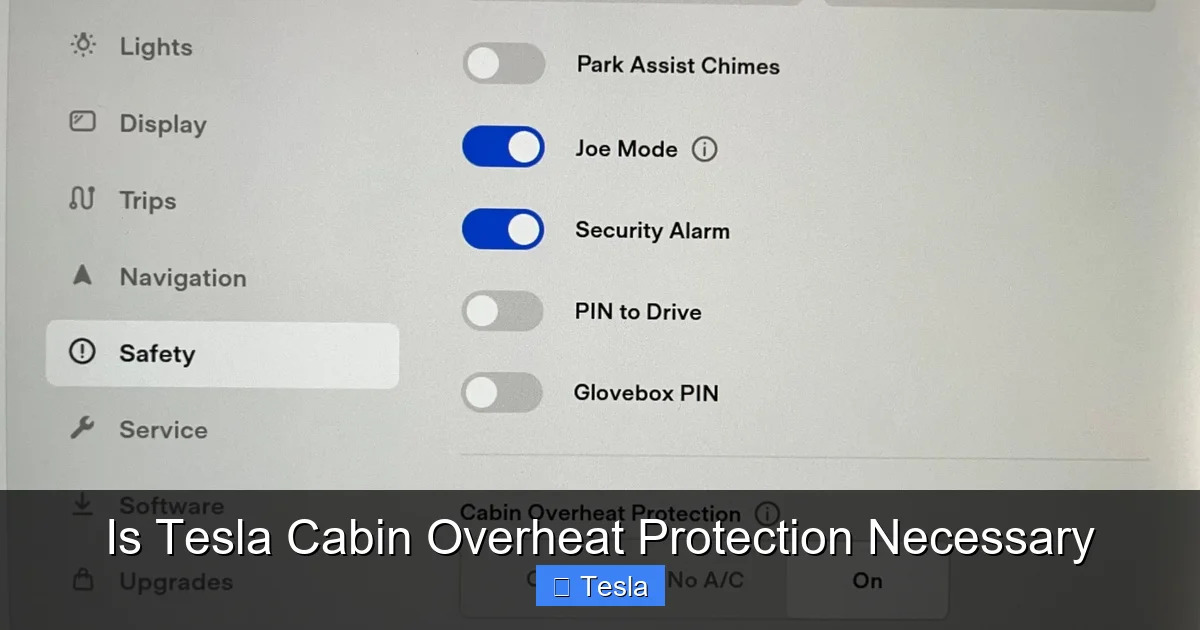
Can I manually turn Cabin Overheat Protection off?
Yes, you can disable it in your Tesla’s touchscreen under Controls > Safety & Security. However, Tesla strongly advises against this, as it removes a critical safety feature. The setting is there for extreme cases, like if your battery is very low and you need to preserve all range for driving.
Is Cabin Overheat Protection the same as Dog Mode?
No, they are different but bundled. Dog Mode is a user-activated feature where you set a temperature and leave your pet in the car with the A/C on, with a dashboard display for bystanders. Cabin Overheat Protection is automatic, activates only when the car is parked and locked, and has a fixed upper temperature limit (105°F) for safety, not comfort.
Does it work on all Tesla models?
It is standard and free on all new Model S and Model X vehicles. For Model 3 and Model Y, it is a paid subscription or one-time purchase feature, regardless of model year (as long as the car has the required hardware, which most from 2019 onward do).
What happens if my Tesla’s battery gets too low?
The system is designed to be fail-safe. If the battery’s state of charge drops below a certain threshold (typically around 20%), Cabin Overheat Protection will deactivate to preserve enough energy for you to drive to a charging location. It prioritizes your ability to move the vehicle.
Is it effective in extreme desert heat?
Yes, it is designed to work in extreme conditions. In prolonged, extreme heat with the car parked for several days, the battery will eventually deplete, and the system will shut down. However, for typical daily parking (a few hours to a day), it is highly effective at maintaining a safe cabin temperature even in desert climates, though it may run the A/C more frequently, using more energy.