How to Open a Tesla Glove Box Without a Pin

Contents
- 1 Key Takeaways
- 2 📑 Table of Contents
- 3 Understanding Tesla Glove Box Security and PIN Protection
- 4 The Emergency Mechanical Release: Your Primary Solution
- 5 Leveraging the Tesla Mobile App for Access
- 6 Service Mode and Professional Assistance
- 7 What NOT to Do: Avoiding Costly Damage
- 8 Preventative Measures and Best Practices
- 9 When to Call Tesla Service: Your Final Resort
- 10 Conclusion: Knowledge is the Key
- 11 Frequently Asked Questions

Car Seat Cover (Universal Fit)

Jack Stands

Car Interior LED Light

Liquid Car Polish
Facing a locked Tesla glove box with a forgotten PIN? You can still access it through a hidden mechanical release, your connected Tesla app, or service mode. Never force it open, as this causes costly damage. This guide details safe, model-specific methods for all Tesla vehicles.
You’re standing beside your sleek Tesla, ready to grab the charger cable or your important documents from the glove box. You tap the touchscreen to unlock it, enter your PIN… and get an error. Or worse, you can’t even remember the PIN you set months ago. Panic sets in. That secure, convenient storage compartment has just become a frustrating, inaccessible vault. But before you imagine the costly repair bill for a broken latch, take a deep breath. Tesla, in its design wisdom, anticipated this exact scenario. Every single Tesla model on the road today incorporates a manual, mechanical bypass. This isn’t a secret hack; it’s a built-in emergency feature. This comprehensive guide will walk you through every legitimate method to open your Tesla glove box without a PIN, from the simple hidden pull-cord to the more technical service menu. We’ll cover all models, highlight critical pitfalls to avoid, and give you peace of mind for next time.
Understanding why this happens is the first step. The glove box PIN is part of Tesla’s “Valet Mode” and general security settings. It’s designed to protect items when you hand your car over to a valet or a friend. It’s a great feature, right up until you need your own stuff and your brain betrays you. The system is electronic at its core—a small motor engages a latch when you tap the screen. The manual release is a purely mechanical cable that pulls that same latch directly, completely bypassing the electronic control unit (ECU). Think of it like the emergency trunk release in many cars; it’s there for safety and access when the power or electronics fail. Your mission is to find that cable.
Key Takeaways
- Every Tesla has a hidden manual release: A physical cable or latch, disguised inside the vehicle, bypasses the PIN entirely and is your first solution.
- The Tesla app can unlock it remotely: If your phone is paired and connected, the app may offer a glove box unlock option under your vehicle’s controls.
- Service Mode is a last-resort tool: Technicians use the internal service menu to reset or unlock systems, but it’s complex and not for casual use.
- Forcing the glove box destroys it: The motorized latch is delicate; prying or pulling will break plastic clips and gears, leading to a full replacement.
- Prevention is critical: Use a memorable, written-down PIN stored separately from the car, and ensure your phone’s Bluetooth is always on for app access.
- Model differences matter: The release location varies significantly between Model S/X (older vs. newer) and Model 3/Y; knowing your specific year is essential.
- Call Tesla Service when stuck: If all else fails, roadside assistance or a service center can unlock it safely using proprietary tools and codes.
📑 Table of Contents
- Understanding Tesla Glove Box Security and PIN Protection
- The Emergency Mechanical Release: Your Primary Solution
- Leveraging the Tesla Mobile App for Access
- Service Mode and Professional Assistance
- What NOT to Do: Avoiding Costly Damage
- Preventative Measures and Best Practices
- When to Call Tesla Service: Your Final Resort
- Conclusion: Knowledge is the Key
Understanding Tesla Glove Box Security and PIN Protection
Before diving into solutions, let’s clarify what the PIN protects and on which models. Tesla introduced glove box PIN protection starting with the Model S and Model X around 2016-2017, and it became standard across the lineup with the introduction of the Model 3 and Model Y. The PIN is set within the vehicle’s settings under Controls > Safety & Security > Glove Box PIN. Once set, the glove box will not electronically unlock via the touchscreen or the Tesla app until the correct 4-digit code is entered. This is separate from the vehicle’s overall door lock/unlock state. Even if the car is unlocked, the glove box remains sealed.
The Purpose of the Glove Box PIN
The primary purpose is security for transient drivers. When you engage Valet Mode, you can optionally set a separate PIN for the glove box, ensuring valets cannot access your personal documents, registration, or valuables. It also adds a layer of protection against unauthorized access if someone gains brief physical control of the unlocked vehicle. However, it’s crucial to understand that this is a convenience and light security feature, not a high-grade safe. The manual release is the ultimate override, as mandated by safety regulations requiring a way to access compartments in case of electrical failure.
Which Tesla Models Have This Feature?
Virtually all Tesla vehicles from the 2016 Model S refresh onward include a software-controlled glove box lock. This includes:
- Tesla Model S: All variants from 2016 (facelift) to present, including Plaid.
- Tesla Model X: All variants from 2016 (facelift) to present, including Plaid.
- Tesla Model 3: All trims from 2017 production onward.
- Tesla Model Y: All trims from 2020 production onward.
Earlier Model S and Model X vehicles (pre-2016) have a simple latch that opens with a button press on the dash, with no PIN software control, so they don’t experience this specific issue. If you own one of these older models, your glove box likely opens normally via a physical button or by pressing the hood release area.
The Emergency Mechanical Release: Your Primary Solution
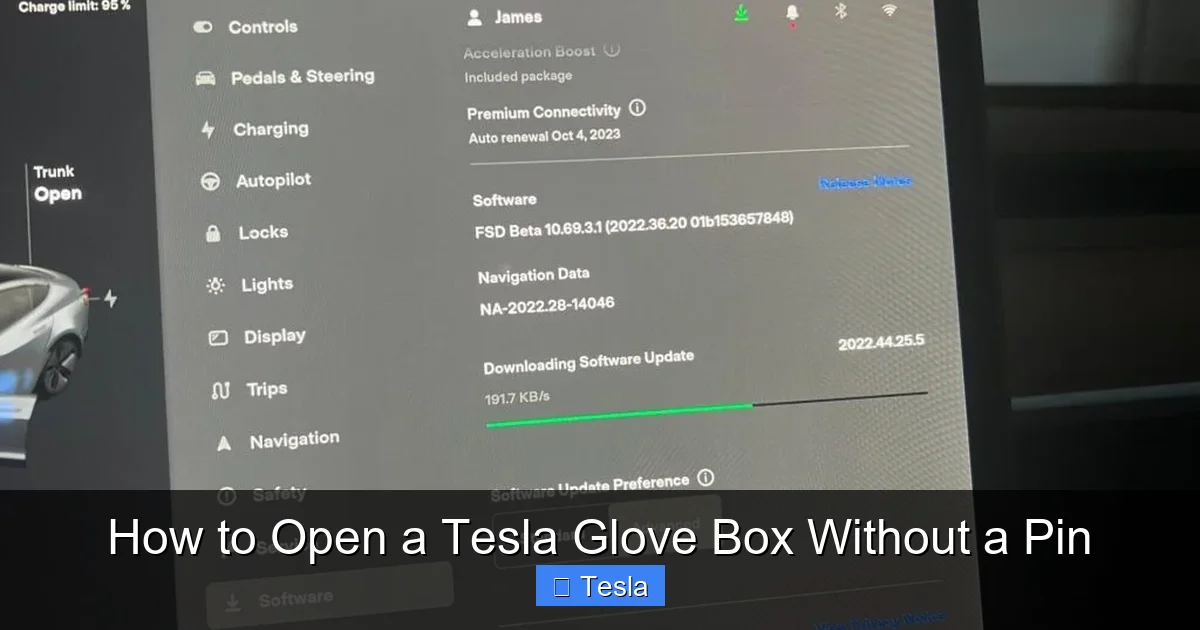
This is the most reliable, immediate, and damage-free method. The mechanical release is a physical cable (often a thin, braided steel wire) that runs from a hidden access point inside the cabin directly to the glove box latch. Pulling it manually disengages the lock mechanism just as the motor would. The location of this cable’s pull point varies by model and model year, which is why identifying your specific Tesla is step one.
Visual guide about How to Open a Tesla Glove Box Without a Pin
Image source: carstale.com
For Tesla Model S and Model X (2016-Present)
In these larger SUVs and sedans, the release is cleverly hidden but relatively easy to find. Look at the bottom edge of the glove box door itself, near the center. You should see a small, trapezoidal-shaped plastic cover (about the size of a large postage stamp) with a tiny slit or seam. This is the access panel. Using a flat, non-metallic tool like a plastic trim removal tool or even a sturdy fingernail, gently pry this cover off. Underneath, you’ll see the end of a braided steel cable with a plastic handle or loop. Firmly pull this cable straight out towards you. You should hear a distinct click or pop as the glove box latch releases. The glove box will then drop down freely. On some early 2016-2018 models, the cable might be located in the top center of the glove box interior, accessible only when the box is slightly ajar—a chicken-and-egg problem. For those, the method in the next paragraph is key.
Critical Note for Older S/X: If your Model S or X has a glove box that won’t open at all and you cannot find the external release panel, the manual cable may be accessed from inside the frunk (front trunk). You’ll need to open the frunk manually (there’s a separate emergency release for that under the front bumper). Once the frunk is open, look at the back of the glove box assembly from the front of the car. You should see the cable running to a latch. You can sometimes pull it with needle-nose pliers, but this is a more advanced procedure.
For Tesla Model 3 and Model Y
The location is different and often less obvious. In the Model 3 and Y, the mechanical release cable is accessed from the passenger side of the center console. Here’s the step-by-step:
- Locate the small, rectangular storage compartment on the passenger side of the center console (the one with the felt liner, often used for charging cables).
- Remove the felt liner and any items inside.
- At the back of this compartment, you’ll see a plastic cover panel. It may be held in place by clips or a single screw. Carefully pry this panel off.
- Behind the panel, you will see the end of the steel cable with a plastic pull tab. Pull this tab firmly and steadily.
- The glove box will unlatch and drop down.
On some Model 3/Y variants, especially early production, the cable may be located under the passenger side dashboard, near the footwell. You might need to remove a small plastic trim piece to access it. A flashlight is your friend here. If you struggle, a quick search for “Tesla Model 3 glove box manual release [your year]” on a video platform will show you exactly where it is for your specific vehicle. The principle is always the same: find the hidden cable and pull it.
Leveraging the Tesla Mobile App for Access
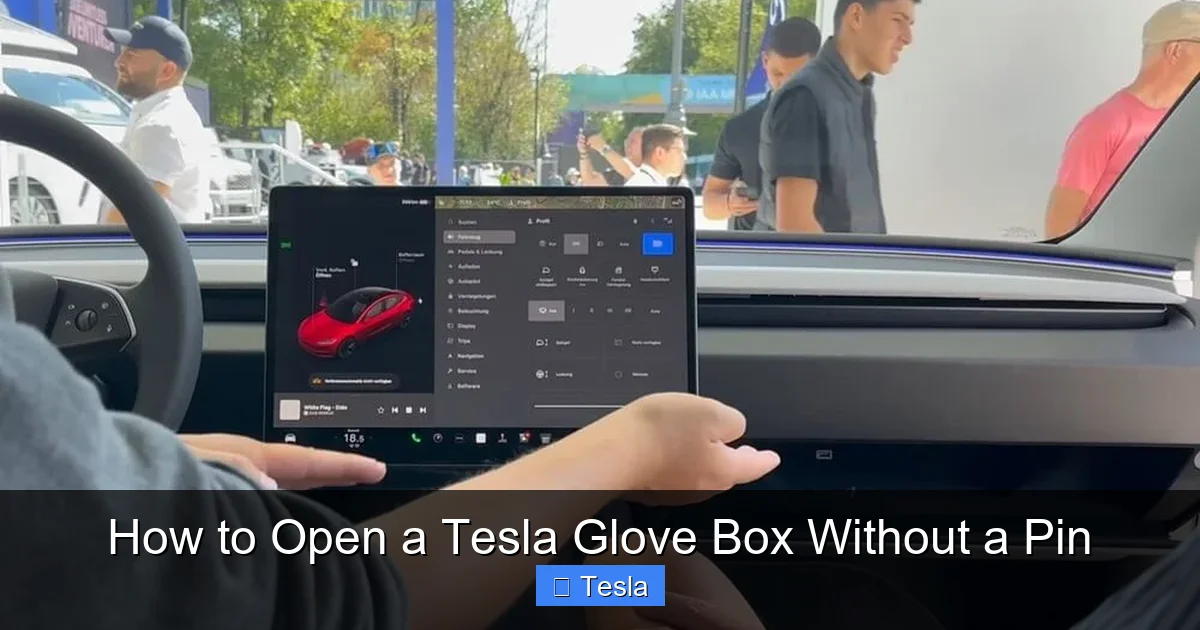
If your phone is properly paired and you have cellular or Wi-Fi connectivity, the Tesla app can be a powerful tool. This method is electronic but does not require the in-car PIN. It works because the app communicates with Tesla’s servers, which then send a command to your vehicle to unlock the glove box.
Visual guide about How to Open a Tesla Glove Box Without a Pin
Image source: carstale.com
Prerequisites for App-Based Unlocking
This method has specific requirements that must be met:
- Phone Key/Pairing: Your smartphone must be set up as a key for the vehicle and be within Bluetooth range or have a data connection to the car.
- Vehicle Connectivity: The Tesla must have an active internet connection (either via its own built-in cellular modem or a connected Wi-Fi network). You can check this on the touchscreen’s top status bar for the signal bars.
- App Permissions & Version: Ensure you have the latest Tesla app installed and that all permissions (like Bluetooth, location) are granted.
- Vehicle Awake: The car must be in a “awake” state—either parked but not in “Sleep” mode, or recently driven. If the car is fully asleep and out of Bluetooth range, the command may not wake it up.
Step-by-Step App Process
- Open the Tesla app on your paired phone.
- Once your vehicle connects (you’ll see its name and status), tap on the vehicle image or name.
- Look for the “Controls” or “Locks” section. The exact layout changes with app updates.
- Scroll through the available controls. You should see an option for “Glove Box” or “Unlock Glove Box.” It might be under a sub-menu like “More” or “Security.”
- Tap the “Unlock Glove Box” button. The app will send the command.
- You should hear the glove box motor activate and see it pop open on the touchscreen display.
If the option is greyed out or missing, your vehicle likely does not meet the connectivity prerequisites. In that case, move to the mechanical release method. This app method is particularly useful if you’re away from the car but need someone else to access something inside, as you can remotely trigger it (provided the car is within cellular range). It’s a fantastic backup to the physical cable. For other vehicles with similar electronic access features, you might find parallels in how to open a Nissan Versa trunk without a key using remote or app-based systems, though the implementation differs.
Service Mode and Professional Assistance
When both the manual release and the app fail, your next stop is Tesla’s own diagnostic and service systems. This is not a method for casual tinkering, but understanding it helps you communicate with Tesla Support.

Visual guide about How to Open a Tesla Glove Box Without a Pin
Image source: carstale.com
What is Tesla Service Mode?
Service Mode is a hidden, technician-only menu within the vehicle’s touchscreen. It provides deep access to vehicle systems, sensors, and controls for diagnostics, calibration, and repair. Within Service Mode, there are options to manually control many actuators, including the glove box latch. A technician can navigate to the appropriate body controller menu and command the latch to open or close. It also allows for resetting the glove box PIN to the default (usually “1234” or “0000”) if the system has become glitchy.
How You Can Access Help Through This
You cannot and should not access Service Mode yourself. It’s password-protected and intended for trained personnel. However, when you call Tesla Roadside Assistance or schedule a service appointment, you can explain your situation: “The glove box is locked with a forgotten PIN, and the manual release cable appears to be broken or inaccessible.” They will either:
- Dispatch a mobile technician who can use their secure login to enter Service Mode and unlock it electronically.
- Advise you to bring the car to a Service Center, where they will perform the same action and, if the manual release is faulty, replace the assembly.
- In some cases, for a simple PIN reset, they might be able to do it remotely via the vehicle’s telematics system if it’s online.
This is a paid service if out of warranty and not related to a defect, but it’s far cheaper than a tow and a forced-entry repair. For context on professional lockout solutions for other brands, procedures for how to unlock a Dodge Charger without keys often involve similar proprietary diagnostic tools that only dealers or locksmiths possess.
What NOT to Do: Avoiding Costly Damage
The desperation of a locked glove box can lead to terrible decisions. Here is a definitive list of actions to avoid at all costs:
- DO NOT pry the glove box door with a screwdriver, coin, or any tool. The glove box is made of plastic and held together by fragile clips. Prying will crack the housing, break the latch mechanism, and likely damage the surrounding dashboard trim. Replacement parts and labor can easily exceed $500.
- DO NOT pull violently on the glove box handle. The handle is not designed to be a lever against the locked latch. You will snap the internal linkage or the plastic gear in the motor assembly.
- DO NOT try to “pick” the electronic lock. There is no keyhole. The system only responds to the correct PIN or a direct electronic command from the vehicle’s computer. Any attempt to drill or manipulate the area around the latch is destructive and pointless.
- DO NOT disconnect the 12V battery or main high-voltage battery. People often think resetting the car’s computer will clear the PIN. It won’t. The glove box PIN is stored in non-volatile memory. Disconnecting power may cause other issues (like needing to recalibrate windows or steering) and will not unlock the box. Furthermore, accessing the 12V battery in a Tesla is a procedure in itself (in the frunk or rear trunk) and doing so without knowledge can be hazardous.
- DO NOT blindly search for the release cable with sharp objects. If you’re unsure of the exact location, use a flashlight and your fingers. Stabbing blindly with a knife or pick can puncture wiring harnesses, cut the cable itself, or damage interior panels.
The mantra is simple: If you cannot find the manual release cable within 60 seconds of targeted searching, stop and call Tesla. The cost of a service call is always less than the cost of a repair caused by force. Remember, the manual release is designed to be pulled, not levered or sawed. It’s a strong cable; use firm, direct traction.
Preventative Measures and Best Practices
Now that you’ve successfully opened it (or are about to), let’s ensure this stressful situation never happens again. A few simple habits will save you immense hassle.
Choose and Record Your PIN Wisely
When setting your PIN, avoid using easily guessable numbers like your birth year, “1234,” or the last four digits of your phone number. Instead, use a memorable but non-obvious sequence. Write it down. Seriously. Keep the written PIN in a secure place at home, not in the car. You could also store it in a secure password manager on your phone. The convenience of the PIN is negated if you forget it, so having a physical backup is a smart trade-off.
Maintain Your Phone Key Connection
The Tesla app method is only viable if your phone is connected. Ensure Bluetooth is always on for your phone key. Keep the Tesla app running in the background (or at least not force-closed). A dead phone battery is the ultimate lockout for this method, so consider keeping a portable power bank in the car for emergencies. Also, ensure your vehicle has a decent cellular signal; if you park in a concrete bunker with no signal, the app won’t work either.
Periodically Test the Manual Release
Once a year, when the glove box is empty and you have time, open it normally, then close it. Now, without looking, try to locate the manual release cable by feel. Find the access panel and pull the cable. This does two things: it confirms the release is functional and it refreshes your muscle memory of its location. You don’t want to be fumbling in the dark during an actual emergency. This is similar to checking your car’s emergency trunk release; it’s a simple safety drill.
Consider Your Use Case
Do you really need the glove box PIN enabled at all times? If you rarely use valet services and the glove box doesn’t contain irreplaceable valuables, you might consider disabling the PIN in your settings (Controls > Safety & Security > Glove Box PIN > Turn Off). This returns the glove box to a simple push-button open (on older models) or a touchscreen toggle without a code. Weigh the minor security convenience against the major access inconvenience. For many, disabling it is the simplest solution.
When to Call Tesla Service: Your Final Resort
You’ve pulled the manual cable and nothing happens. The cable is broken, frayed, or the latch mechanism is seized. The app option is greyed out because your 2018 Model 3 hasn’t had cellular service in months. Now what?
Your first call should be to Tesla Roadside Assistance. Their number is in your Tesla app under “Service” or “Roadside Assistance.” Explain the situation clearly: “The glove box is locked with a forgotten PIN, and the manual emergency release cable appears to be damaged or not functioning.” They can often dispatch a mobile technician who can use their service tools to electronically release the latch from outside the vehicle, saving you a tow. If a mobile tech isn’t available, they’ll arrange a tow to the nearest Service Center.
At the Service Center, the technicians will diagnose the issue. If the manual cable is intact but you just couldn’t find it, they’ll show you. If the cable is broken (a known wear item on some older models), they will replace the entire glove box latch assembly, which includes the cable. This is a standard repair. They can also reset your PIN to a default or help you set a new one. Always get a quote for the repair if it’s not covered under warranty or a service bulletin.
For those who frequently find themselves locked out of storage compartments in any vehicle, understanding the general principle of manufacturer-provided emergency overrides is key. For instance, knowing how to open a Subaru Forester trunk from inside involves a different, often simpler, mechanical lever. Each brand has its own design philosophy, but the goal is always the same: provide access when the primary method fails.
Conclusion: Knowledge is the Key
A locked Tesla glove box is a moment of frustration, but it is never a permanent prison. Tesla’s design includes multiple layers of access precisely for this scenario. Your path forward is a clear hierarchy: first, locate and use the hidden mechanical release cable—it’s your fastest, most reliable solution. Second, try the Tesla app if your connectivity is good. Third, understand that Tesla Service has the ultimate electronic keys via Service Mode. What you must never do is resort to force, as that transforms a $0 fix into a $500+ repair. By learning the location of that small cable in your specific Model S, X, 3, or Y, you empower yourself and avoid stress. Take the preventative steps: record your PIN, maintain your phone key, and periodically test the release. With this knowledge, your Tesla’s glove box remains a convenient storage solution, not a source of anxiety.
Frequently Asked Questions
Will disconnecting my Tesla’s 12V battery reset the glove box PIN?
No. The glove box PIN is stored in non-volatile memory and will not be cleared by a battery disconnect. This action will not unlock the glove box and may cause other systems to require recalibration.
Is the manual release cable location the same for all Model 3 years?
Not exactly. While it’s always on the passenger side of the center console, the exact trim piece to remove and the cable routing can vary slightly between 2017-2023 models. Always consult your owner’s manual or a year-specific video guide for precise location.
Can I use the Tesla app to unlock the glove box if my car has no cellular signal?
No. The app requires an active data connection to Tesla’s servers, which then communicate with your car. If your vehicle is parked in a location with no cellular service (like a deep parking garage), the app command will fail. The manual release is your only option in that scenario.
Is accessing Service Mode myself to unlock the glove box a good idea?
Absolutely not. Service Mode is password-protected for a reason. Incorrect commands in Service Mode can alter critical vehicle settings, disable safety features, or cause system errors that require a dealership visit to fix. It is strictly for trained technicians.
Will repeatedly using the manual release cable wear it out or damage it?
No. The manual release is designed for regular emergency use. It is a robust steel cable and is meant to be pulled many times over the vehicle’s life. Normal use will not cause wear or damage. Only severe physical abuse or corrosion would compromise it.
If I force the glove box open, what exactly will break and how much does it cost to fix?
Forcing it typically breaks the plastic latch mechanism and/or the mounting clips on the glove box housing. The entire glove box assembly (including the latch motor) usually needs replacement. Parts and labor at a Tesla Service Center typically range from $400 to $800+, depending on the model.