
What Is Tesla Wall Connector and Mobile Connector

Choosing between Tesla’s Mobile Connector and Wall Connector is about matching your charging needs to your lifestyle. The Mobile Connector is a portable, versatile cable perfect for travel and occasional home use, plugging into various outlets. The Wall Connector is a permanent, high-power home charging station offering faster daily charging and smart scheduling features. Your decision hinges on where and how often you charge, your electrical setup, and your budget.
So, you’ve got your new Tesla—congratulations! You’re part of the electric vehicle revolution. But now, a very practical question pops up: how do I actually charge this thing? Tesla makes it relatively simple with two primary solutions for Level 1 and Level 2 charging: the Mobile Connector and the Wall Connector. They look somewhat similar—both are sleek, white, Tesla-branded cables with that iconic connector that plugs into your car. But their purposes, capabilities, and costs are quite different. Understanding this difference is the first step to building a charging routine that’s effortless, cost-effective, and perfectly tailored to your life.
Think of it this way: the Mobile Connector is like your smartphone’s charging cable—portable, plug-it-anywhere, and always with you. The Wall Connector is like installing a dedicated, high-speed charging dock on your nightstand. One is for mobility and backup, the other for primary, high-efficiency home charging. In this complete guide, we’ll break down everything you need to know about both, from technical specs and installation requirements to real-world costs and which one is truly right for you. Let’s plug in and get started.
Key Takeaways
- Core Purpose: The Mobile Connector is a portable, flexible charging cable; the Wall Connector is a fixed, high-power home charging station.
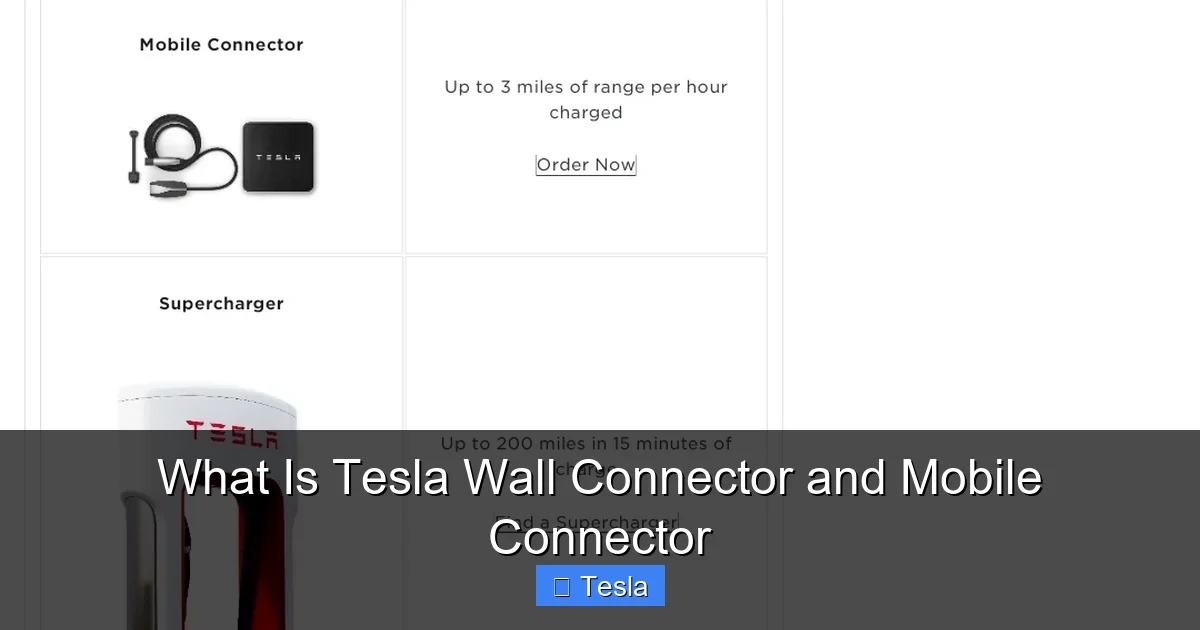
- Speed Difference: Wall Connector charges significantly faster (up to 11.5 kW/44 miles per hour) than the Mobile Connector on standard outlets (up to 3.3 kW/13 miles per hour).
- Installation: Mobile Connector needs no installation; Wall Connector requires professional hardwiring or NEMA outlet installation by a licensed electrician.
- Cost Structure: Mobile Connector has a lower upfront cost but offers less power; Wall Connector has a higher upfront cost including installation but provides long-term convenience and speed.
- Use Case: Mobile Connector excels for travel, apartments, and backup; Wall Connector is ideal for dedicated home charging, maximizing overnight charging.
- Smart Features: Only the Wall Connector offers Wi-Fi connectivity, scheduling, and energy monitoring via the Tesla app.
- Included vs. Optional: The Mobile Connector comes with every new Tesla; the Wall Connector is an optional, separate purchase.
📑 Table of Contents
Understanding the Basics: Level 1 vs. Level 2 Charging
Before diving into the two connectors, it’s crucial to understand the charging “levels.” This isn’t Tesla-specific terminology; it’s an industry standard for AC (alternating current) charging, which is what both these devices provide. The electricity from your home outlet is AC, and your Tesla’s battery stores DC (direct current). The car’s onboard charger converts AC to DC. The speed of this conversion is what defines the level.
Level 1: The Standard Household Outlet
Level 1 charging uses a standard 120-volt outlet, like the one you plug a lamp into. It’s the slowest method, adding about 3-5 miles of range per hour. For a Tesla with a 75 kWh battery, a full charge from empty could take 40+ hours. It’s primarily useful as an emergency backup or for people who drive less than 30 miles daily and can charge overnight. The Mobile Connector, when used with its standard 5-15 (NEMA 5-15) adapter, provides Level 1 charging.
Level 2: The Dedicated Circuit
Level 2 charging uses a 240-volt circuit, similar to what powers an electric dryer or oven. This is the standard for home and public charging stations. It’s dramatically faster, typically adding 20-44 miles of range per hour, depending on the charger’s power output and the car’s onboard charger capacity. A full charge on a 75 kWh battery usually takes 8-12 hours, perfect for overnight replenishment. Both the Mobile Connector (with the appropriate 240V adapter, like the NEMA 14-50) and the Wall Connector deliver Level 2 charging.
Deep Dive: The Tesla Mobile Connector
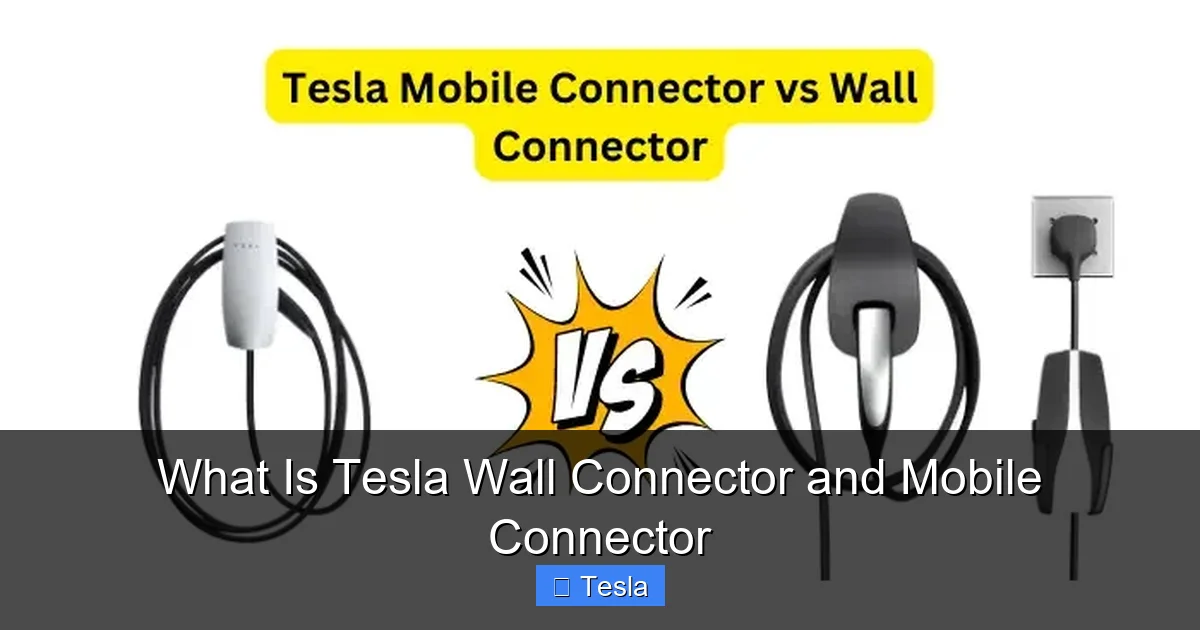
The Mobile Connector is the versatile workhorse that comes standard in the trunk of every new Tesla. It’s not just a cable; it’s a kit that includes the main unit, a 20-foot cable, and a set of interchangeable plugs (adapters) for different outlet types. Its genius is in its flexibility and portability.
Visual guide about What Is Tesla Wall Connector and Mobile Connector
Image source: teslord.com
Design, Components, and Included Adapters
The core unit is a compact, rectangular box with a Tesla connector on one end and a female outlet on the other. You plug the correct adapter (male plug) into this female outlet based on the outlet you have access to. The kit typically includes:
- NEMA 5-15 (120V): The standard household plug for Level 1 charging.
- NEMA 14-50 (240V/50A): A common 240V outlet for RVs and older ranges. This is the most popular adapter for faster home charging without a Wall Connector.
- NEMA 10-30 (240V/30A): Common for older dryers.
- NEMA 6-50 (240V/50A): Common for welders and some ranges.
- NEMA 14-10 (240V/30A): Less common, but included for flexibility.
You can purchase additional adapters (e.g., for a NEMA 10-30 or a 120V 20A outlet) separately from Tesla or third-party vendors. This modular system means you can use the same cable at home, at a friend’s house, or at a campground, as long as they have a compatible outlet.
Performance and Charging Speeds
The Mobile Connector’s maximum power output depends entirely on the circuit and adapter you’re using. On a standard 120V/15A circuit (NEMA 5-15), it delivers about 1.2 kW, adding 3-5 miles of range per hour. On a 240V/50A circuit with the NEMA 14-50 adapter, it delivers up to 7.2 kW (for Model 3/Y) or 9.6 kW (for Model S/X), adding about 25-30 miles of range per hour. It’s important to note that the actual charging speed is limited by your car’s onboard charger. For example, a standard range Model 3 has a 7.2 kW onboard charger, so a 14-50 adapter will max out at 7.2 kW. A long-range Model 3 has an 11.5 kW charger, but the Mobile Connector on a 14-50 circuit is still limited to 9.6 kW due to the adapter’s design.
Who Is the Mobile Connector For?
- The Traveler: If you frequently visit family, stay in hotels with EV charging, or go camping, packing the Mobile Connector and the adapters you need is essential. Many public Level 2 stations use a J1772 connector, but with a simple, inexpensive J1772-to-Tesla adapter (sold separately), your Mobile Connector can plug into thousands of public stations.
- The Apartment Dweller or Renter: If you can’t install a permanent charger, the Mobile Connector allows you to use whatever 120V or 240V outlet is available in your parking spot (with landlord permission). The NEMA 14-50 is a common request for landlords to install.
- The Backup/Secondary Charger: Even if you have a Wall Connector, keeping the Mobile Connector in your trunk is a smart move for emergencies, road trips, or charging at a second location like an office.
- The Budget-Conscious Buyer: Since it’s included with the car, the upfront cost is zero. You only pay if you want additional adapters.
Deep Dive: The Tesla Wall Connector
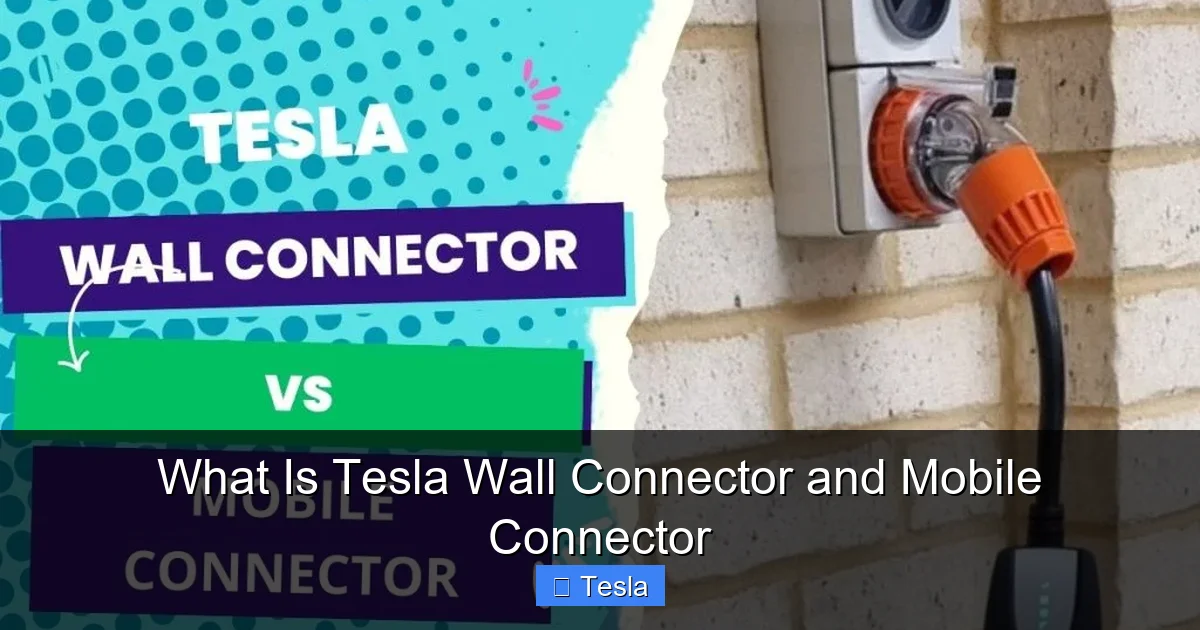
The Wall Connector is Tesla’s premier home charging solution. It’s a permanent fixture designed to be hardwired or installed on a dedicated 240V circuit. It’s faster, smarter, and more convenient for daily charging, but it requires professional installation and a separate purchase.
Visual guide about What Is Tesla Wall Connector and Mobile Connector
Image source: evmotorr.com
Design and Build Quality
The Wall Connector is a sleek, minimalist wall-mounted unit with a long, fixed cable (18 feet) and a Tesla connector. It has a small, clear LED indicator ring that shows charging status (green for ready, yellow for scheduled, blue for charging, red for fault). It’s designed for indoor or outdoor installation (rated NEMA 4 for water resistance) and looks clean and modern on a garage wall.
Performance and Maximum Power
This is where the Wall Connector shines. It’s capable of delivering up to 11.5 kW (48A @ 240V) to newer Tesla models (Model 3/Y Long Range/Performance, Model S/X). This translates to about 44 miles of range per hour. For a 75 kWh battery, that’s a full charge in roughly 6-7 hours. To achieve this maximum speed, you must have a compatible vehicle and a 60-amp circuit installed. However, the Wall Connector is configurable. During installation, an electrician can set its maximum amperage draw to match your home’s electrical capacity and your car’s onboard charger, ensuring safety and efficiency. You can also adjust this limit later via the Tesla mobile app.
Smart Features and Wi-Fi Connectivity
The Wall Connector’s killer feature is its connectivity. It connects to your home Wi-Fi network, enabling a suite of smart features through the Tesla app:
- Charging Scheduling: Set specific times to start and stop charging. This is invaluable for taking advantage of time-of-use (TOU) electricity rates, where power is cheaper at night. You can schedule your car to charge automatically during off-peak hours, saving significant money.
- Energy Monitoring: Track your charging history, energy consumption in kWh, and estimated costs. This helps you understand your EV’s impact on your electric bill.
- Remote Control & Diagnostics: Start/stop charging remotely, receive notifications if charging is interrupted, and get firmware updates over the air.
- Power Sharing (Multi-Unit Installations): If you install multiple Wall Connectors (e.g., for two Teslas), you can set them to share a single electrical circuit’s power intelligently, preventing overloads.
Who Is the Wall Connector For?
- The Dedicated Home Charger: If you have a dedicated parking spot (garage or driveway) and plan to charge your Tesla at home 80-100% of the time, the Wall Connector is the ultimate convenience. Just plug in when you get home; it handles the rest.
- The Tech Enthusiast: If you love smart home integration, scheduling, and data, the Wall Connector’s app features are a major draw.
- The High-Mileage Driver: If you drive a lot daily and need to replenish a large amount of range quickly overnight, the faster charging speed is a tangible time-saver.
- The Future-Proof Investor: Installing a Wall Connector adds value to your home and is a clear signal of your commitment to EV ownership. It’s a permanent, high-quality installation.
Head-to-Head: Wall Connector vs. Mobile Connector Comparison
Let’s lay it all out on the table. This comparison will make the choice crystal clear based on your specific situation.
Visual guide about What Is Tesla Wall Connector and Mobile Connector
Image source: lh3.googleusercontent.com
| Feature | Mobile Connector | Wall Connector |
|---|---|---|
| Included with Car? | Yes | No (Separate purchase) |
| Upfront Cost (Unit Only) | $0 (Included) / $275 for additional | $550 |
| Installation | None (Plug-and-play) | Required (Licensed Electrician) |
| Max Power (with compatible car) | 9.6 kW (on 50A circuit) | 11.5 kW (on 60A circuit) |
| Max Range/Hour | ~30 miles | ~44 miles |
| Cable Length | 20 ft (with adapter) | 18 ft (fixed) |
| Portability | Excellent (Packs in trunk) | None (Fixed installation) |
| Smart Features (App) | No | Yes (Scheduling, Monitoring, Control) |
| Ideal For | Travel, apartments, backup, flexibility | Dedicated home charging, speed, convenience |
| Typical Total Cost | $0 – $200 (for extra adapters) | $550 + $400-$1,500+ (electrician) |
Installation, Costs, and Practical Considerations
This is where the rubber meets the road—or rather, the wire meets the panel. The cost and effort difference between the two options is the most significant factor for most owners.
The Mobile Connector: Zero-Hassle, Limited Power
There is no installation cost because you don’t install it. Your only potential costs are for additional adapters if your home’s outlet doesn’t match the included ones. The most common and cost-effective home setup is to have a NEMA 14-50 outlet installed by an electrician. This is a 240V/50A circuit, similar to an RV outlet. The cost for this installation varies widely by region and electrical panel complexity but typically ranges from $300 to $800. Once installed, you simply plug your Mobile Connector with the 14-50 adapter into it. This gives you very good home charging speed (~25-30 miles/hour) without the permanent commitment of a Wall Connector.
The Wall Connector: Professional Investment for Speed
The Wall Connector must be installed by a licensed electrician. It can be hardwired directly to a circuit breaker or connected to a NEMA 14-50 outlet (though the former is preferred for a permanent install). The electrician will assess your home’s electrical panel capacity, run the necessary wire (usually 6-gauge copper for a 60A circuit), and mount the unit. The cost for this professional installation is the major variable. A straightforward installation with a panel that has space and capacity might cost $400-$800. A complex installation requiring a panel upgrade, significant wire runs, or trenching can push costs to $1,500 or more. Always get multiple quotes. Importantly, the Wall Connector’s amperage setting can be configured during install to match your panel’s available capacity, making it adaptable.
Total Cost of Ownership Over 5 Years
Let’s do a hypothetical 5-year math. Assume you drive 12,000 miles/year and get 4 miles/kWh.
- Scenario A (Mobile Connector + 14-50 outlet): Initial cost: $800 (outlet install). No charger cost. Electricity cost (at $0.13/kWh): ~3,000 kWh/year * $0.13 = $390/year. 5-year total: $800 + ($390*5) = $2,750.
- Scenario B (Wall Connector + 60A circuit): Initial cost: $550 (unit) + $1,200 (install) = $1,750. Same electricity cost. 5-year total: $1,750 + ($390*5) = $3,700.
The Wall Connector scenario costs about $950 more upfront. However, you gain massive convenience, faster charging (saving time), and smart features that can optimize electricity cost further. For many, the time savings and peace of mind are worth the premium.
A Note on Maintenance
Both connectors are extremely reliable and require virtually no maintenance. Keep the connectors clean and dry. Periodically check the cable for any nicks or damage. The Wall Connector’s firmware can be updated automatically over Wi-Fi. In terms of longevity, both are built to last for years. For general vehicle care, following a regular tire rotation and balance schedule is far more critical to your Tesla’s performance and efficiency than any concern about the charger.
Making Your Decision: Which One Should You Buy?
So, which one is right for you? Answer these questions:
Ask Yourself:
- Do I have a dedicated, permanent parking spot at home? If no, Mobile Connector is your only realistic option.
- Do I frequently take road trips or stay elsewhere? If yes, you need the Mobile Connector’s portability regardless of your home charger.
- Is my electrical panel easily accessible and capable of a new 60A circuit? If no, installation costs for a Wall Connector could skyrocket, making the Mobile Connector with a 14-50 outlet more sensible.
- Do I have time-of-use (TOU) electricity rates? If yes, the Wall Connector’s scheduling feature can save you significant money automatically, making it a strong contender.
- What is my budget for charging setup? If you want the lowest upfront cost, use the included Mobile Connector with a standard outlet or install a 14-50. If you can invest for long-term convenience, go for the Wall Connector.
- Do I want “set it and forget it” convenience? The Wall Connector’s permanent mount and smart features offer the ultimate plug-and-forget experience.
The “Best of Both Worlds” Strategy
Many Tesla owners, especially those with a garage, opt for a hybrid approach: Install a Wall Connector for daily, fast, smart home charging AND keep the Mobile Connector in the trunk for travel and emergencies. This gives you the best of both worlds. The Mobile Connector, being included, effectively becomes your free, portable backup. This is the most common and recommended setup for full-time Tesla owners with a home.
Conclusion
The Tesla Mobile Connector and Wall Connector are not competitors; they are complementary tools designed for different scenarios. The Mobile Connector is your Swiss Army knife—it’s always with you, incredibly versatile, and comes free. It’s the perfect solution for anyone without a permanent home charger or for anyone who needs to charge on the go. The Wall Connector is your specialized, high-performance home tool. It’s a dedicated station that delivers faster charging, cutting-edge smart features, and unparalleled daily convenience, but it demands a professional installation and a separate investment.
Your choice ultimately comes down to your living situation, driving habits, and how much you value convenience versus cost. For renters, apartment dwellers, or those with unpredictable parking, the Mobile Connector is the clear and only practical choice. For homeowners with a dedicated spot, the Wall Connector is a transformative upgrade that makes owning an electric car feel utterly seamless. And for the optimal Tesla experience, consider embracing both: anchor the Wall Connector at home for effortless daily power, and keep the Mobile Connector in your trunk for the adventures that lie beyond your driveway. Happy charging!
Frequently Asked Questions
Can I use the Mobile Connector for daily home charging?
Yes, absolutely. If you have a 240V outlet like a NEMA 14-50 installed, the Mobile Connector will provide very good daily charging speeds (25-30 miles of range per hour). It’s a cost-effective alternative to the Wall Connector for many homeowners.
Is the Wall Connector worth the extra cost?
For many homeowners, yes. The faster charging speed (up to 44 miles/hour), ability to schedule charging for off-peak electricity rates, and permanent convenience often justify the higher upfront cost and installation over the long term, especially for high-mileage drivers.
Can I install the Wall Connector myself?
No. Tesla requires that the Wall Connector be installed by a licensed electrician to ensure safety, comply with local electrical codes, and maintain the product warranty. Attempting a DIY installation is dangerous and will void the warranty.
Will the Wall Connector work if my power goes out?
No. Like all home charging equipment, the Wall Connector requires a functioning electrical grid. It is not a battery backup system. For backup power, you would need a home battery like the Tesla Powerwall.
Can I use a Tesla charger for non-Tesla electric vehicles?
Not directly. Tesla’s connectors (Mobile and Wall) are proprietary. However, non-Tesla EVs use the standard J1772 connector. You can purchase a simple, inexpensive J1772-to-Tesla adapter that allows your Mobile Connector to plug into public J1772 stations. The Wall Connector, being fixed, cannot be adapted.
What happens if my Wall Connector loses Wi-Fi?
Charging will continue normally using its last configured schedule or settings. You simply lose remote control, scheduling adjustments, and energy monitoring via the app until the Wi-Fi connection is restored. It will still charge your car reliably on a basic level.
