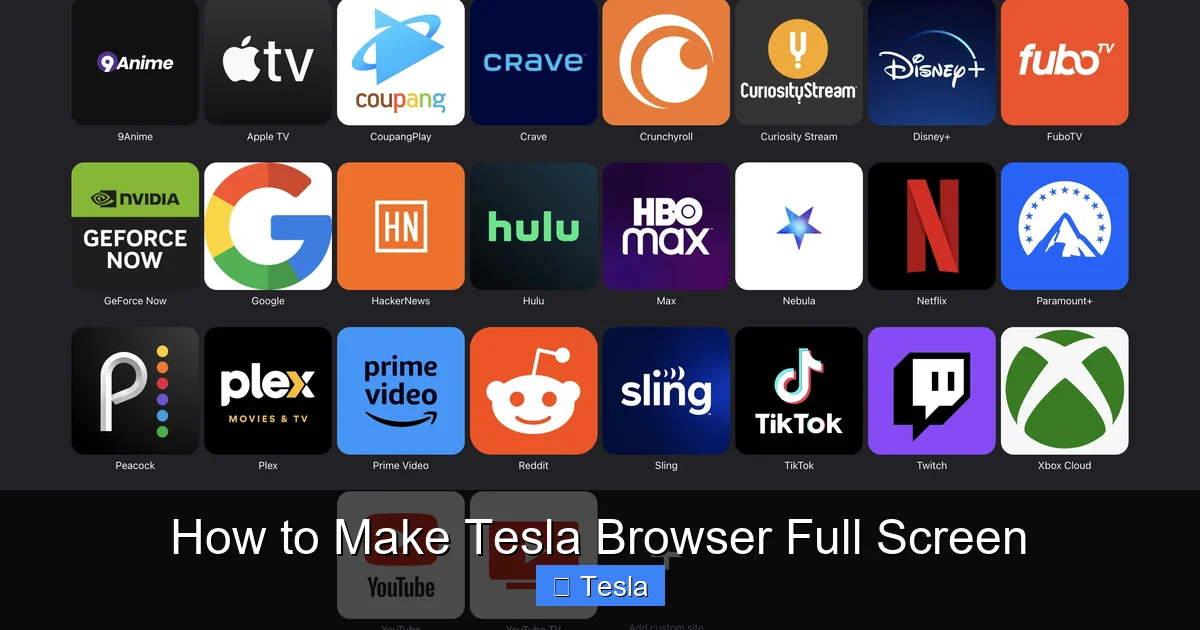
How to Make Tesla Browser Full Screen

Contents
- 1 Key Takeaways
- 2 📑 Table of Contents
- 3 Unlock a Bigger Canvas: Why Go Full Screen in Your Tesla?
- 4 Finding the Full-Screen Toggle: Your Treasure Map
- 5 A Step-by-Step Visual Guide for All Models
- 6 The Tangible Benefits: Why You’ll Want to Do This
- 7 Important Limitations and Crucial Safety Notes
- 8 Advanced Tips and Troubleshooting
- 9 Conclusion: Your Window to a Wider World
- 10 Frequently Asked Questions

Car Roof Rack Cross Bars

Car Storage Net
Dash Cam

Waterless Car Wash Spray
Unlock your Tesla’s full potential by maximizing the browser’s screen space. Making the Tesla browser full screen is a simple process that varies slightly by model year and software version, typically involving a dedicated full-screen toggle within the browser’s settings menu. This feature transforms your central touchscreen into a dedicated viewing canvas for web content, videos, or maps. Always remember to use this feature responsibly as a passenger, as it can be highly distracting for the driver.
Key Takeaways
- The toggle is in-browser: The full-screen option is found within the Tesla browser’s own settings menu (three-dot icon), not in the main vehicle settings.
- Model/version matters: The exact location and appearance of the full-screen button can differ between older (MCU1) and newer (MCU2/3) systems and across software updates.
- It’s a passenger feature: Tesla’s full-screen browser is intended for rear-seat passengers or parked vehicles. Using it while driving is unsafe and often restricted.
- No system-wide setting: You must enable full-screen mode each time you open the browser; there is no permanent “always full screen” configuration.
- Exit is easy: You can always exit full-screen mode by tapping the screen edge or using the vehicle’s back button, preventing you from getting “stuck.”
- Content must be mobile-friendly: Websites not optimized for mobile may still display awkwardly, even in full-screen mode, due to the browser’s mobile user-agent.
📑 Table of Contents
- Unlock a Bigger Canvas: Why Go Full Screen in Your Tesla?
- Finding the Full-Screen Toggle: Your Treasure Map
- A Step-by-Step Visual Guide for All Models
- The Tangible Benefits: Why You’ll Want to Do This
- Important Limitations and Crucial Safety Notes
- Advanced Tips and Troubleshooting
- Conclusion: Your Window to a Wider World
Unlock a Bigger Canvas: Why Go Full Screen in Your Tesla?
You’re sitting in your Tesla, the sleek 15-inch (or 17-inch on newer models) touchscreen glowing before you. You’ve fired up the built-in web browser to check a restaurant review, watch a video, or pull up a web-based map. But something feels… constrained. The browser window sits neatly in the center, surrounded by a persistent black frame and the vehicle’s status bar at the top. It’s functional, but it doesn’t feel immersive. This is where knowing how to make the Tesla browser full screen becomes a game-changer. It’s one of those simple discoveries that dramatically upgrades your in-car digital experience, turning a small portal to the internet into a vast, engaging canvas.
Going full screen isn’t just about aesthetics; it’s about utility. It maximizes your precious screen real estate, making text easier to read, videos more cinematic, and web apps more app-like. For passengers, it transforms the rear of the car into a mobile entertainment hub. But before we dive into the “how,” it’s crucial to understand the “why” and the “when.” Tesla designed this feature with specific intentions and limitations in mind, primarily for passenger use or when the vehicle is parked. Using the full-screen browser while driving is not only discouraged but often technically limited by the system for safety reasons. So, let’s embark on this journey to expand your digital horizon, responsibly and effectively.
Finding the Full-Screen Toggle: Your Treasure Map
The command to go full screen isn’t hiding in the deep recesses of your Tesla’s service menu. It’s right there in the browser itself, but its exact location depends on your car’s vintage and software version. Think of it as an Easter egg that Tesla occasionally moves around with updates. The most common starting point is the browser’s own settings menu, represented by three vertical dots (a “kebab” menu) usually located in the top-right corner of the browser window.

Visual guide about How to Make Tesla Browser Full Screen
Image source: evseekers.com
The Classic Path (Most Common)
For the majority of Model S, Model X, Model 3, and Model Y vehicles with the newer MCU2 or MCU3 hardware (roughly 2018 onward), follow these steps:
- Ensure your vehicle is in Park or you are a passenger using the screen while the car is in motion (passenger functionality must be enabled in settings).
- Open the Browser app from the bottom launcher bar or the app list.
- Navigate to any website.
- Look for the three-dot icon (⋯) in the top-right corner of the browser window itself. Tap it.
- A dropdown menu will appear. The option you’re looking for is typically labeled “Full Screen” or represented by a diagonal arrows icon.
- Tap it. Instantly, the browser should expand to fill the entire central display, hiding the vehicle’s status bar at the top and the browser’s address bar until you move your cursor or tap the screen edge.
This is the standard, intended method. If you don’t see a “Full Screen” option, your software version might have placed it elsewhere, or you might be on an older system.
For Older Vehicles (MCU1) & Alternative Methods
Owners of early Model S and Model X (pre-2018, MCU1) might have a slightly different experience. The browser interface was less refined. Sometimes, the full-screen toggle was accessed by a long-press on the address bar itself, which would then offer a full-screen option. Other times, it was simply not available in the same way, and the browser would automatically use more screen space when a video was playing in a site like YouTube.
In some very specific software versions, the option might be hidden under a sub-menu like “Display Options” within that three-dot menu. If you’ve explored the three-dot menu thoroughly and found nothing, your version might not support a manual full-screen toggle for all content, or it may be context-sensitive (only appearing when a video is playing).
Pro Tip: If you’re struggling, try visiting a video-heavy site like YouTube. Play a video. Often, the video player itself will have a full-screen icon that, when tapped, will expand the video to fill the browser area, effectively giving you a full-screen experience for that content.
A Step-by-Step Visual Guide for All Models
Let’s walk through the process with clear, model-agnostic instructions. We’ll focus on the modern MCU2/3 experience, as it’s the most common today.
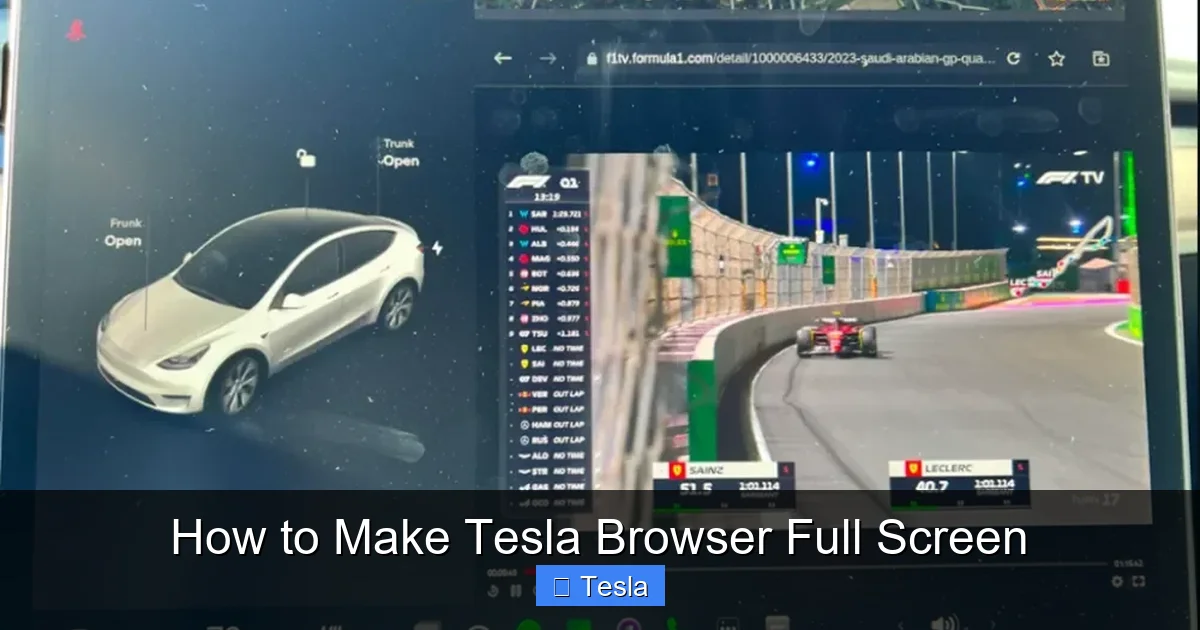
Visual guide about How to Make Tesla Browser Full Screen
Image source: evseekers.com
Step 1: Preparation and Safety First. Ideally, have your car parked. If you’re a passenger, ensure the driver has enabled “Passenger Play” in Settings > Safety & Security > Passenger Play. This allows full screen interaction while moving. Never try to operate the full-screen browser yourself while driving.
Step 2: Launch the Browser. Tap the browser icon from the bottom dock. If it’s not there, tap the “App Launcher” (the grid icon) to find it in the list of all apps.
Step 3: Navigate to a Website. Use the address bar to go to a site. For best results, use mobile-optimized sites. Try m.youtube.com or a news site’s mobile version.
Step 4: Locate the Menu. Your eyes should go to the top-right corner of the browser window. You are looking for three small vertical dots (⋯). This is your gateway.
Step 5: Open the Menu and Find “Full Screen”. A list will drop down. Scan for the words “Full Screen”. In some versions, it’s an icon of two arrows pointing to opposite corners. Tap it.
Step 6: Enjoy the Immersion. The browser will smoothly animate to fill the entire screen. The top status bar (with speed, gear, etc.) and the bottom dock will vanish from view. You now have a clean, 15-inch or 17-inch canvas.
Step 7: Exiting Full Screen. Don’t panic! To exit, simply tap the very top edge of the screen or the bottom edge. The vehicle’s status bar and dock will reappear. You can also use the physical scroll wheel button on the steering wheel (if configured) or the “Back” arrow that may appear. It’s designed to be easily reversible.
The Tangible Benefits: Why You’ll Want to Do This
So you’ve done it. The browser is full screen. Now what? The benefits are immediately apparent and make the feature worthwhile.
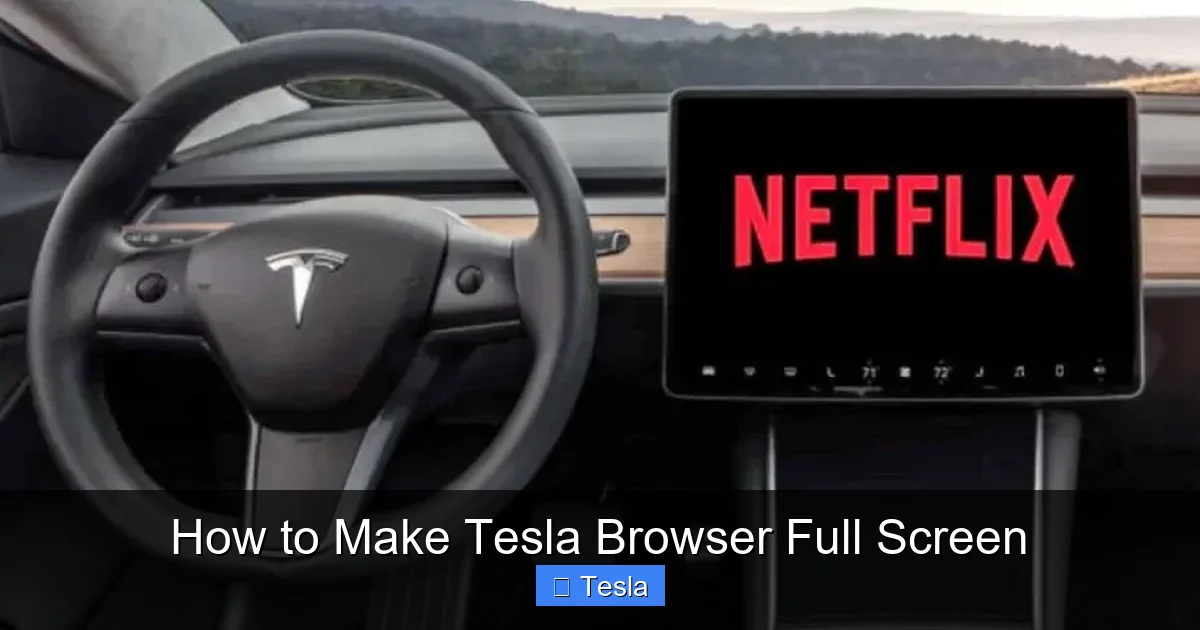
Visual guide about How to Make Tesla Browser Full Screen
Image source: evseekers.com
Enhanced Media Consumption
Watching a YouTube video, a Twitch stream, or a movie on a web service like HBO Max (if accessible) is a night-and-day difference. Without the surrounding chrome of the Tesla UI, the video truly becomes the star. The blacks are deeper, the image is larger, and it feels much more like using a dedicated tablet. For rear-seat passengers on a road trip, this is the prime use case. Pair it with good Bluetooth headphones, and you’ve got a personal cinema.
Improved Readability for Articles and Maps
Reading a long-form article on a news site or a detailed blog post is easier on the eyes when the text column can use more of the screen’s width. Similarly, using a web-based map application (like Google Maps in the browser, though Tesla’s native navigation is superior) allows for a larger, more detailed view of the area, making it easier to spot streets and landmarks.
A More “App-Like” Experience for Web Apps
Many modern web apps (like Spotify’s web player, certain productivity tools, or even web-based games) look and feel more native when they’re not constrained by a browser window. Going full screen minimizes visual clutter and helps these apps feel like first-class citizens on your Tesla’s display, even though they’re running in a sandboxed browser.
Important Limitations and Crucial Safety Notes
The Tesla browser is a powerful tool, but it has clear boundaries. Understanding these is key to a good experience and, more importantly, safe driving.
It’s a Passenger-Centric Feature
This cannot be stressed enough. Tesla explicitly states that the in-car browser is a passenger feature. While you can often access it while driving if “Passenger Play” is on, the system is designed with this use case in mind. The driver’s primary focus must remain on the road. The full-screen mode exacerbates this, as it hides all vehicle information (speed, turn signals, warnings) from the central screen. If you’re the driver, resist the urge. Save the full-screen browsing for when the car is parked or when a responsible passenger is navigating.
Performance is Not Like Your Phone
The Tesla’s browser is based on an older version of Chromium and runs on hardware primarily designed for vehicle control and the main UI. Don’t expect iPhone or Android-level performance. Complex, JavaScript-heavy websites will load slowly, may stutter, or might not render correctly. Simple, text-based, or mobile-optimized sites work best. Don’t try to run Netflix’s full desktop site; it will struggle.
No Permanent Setting
Every time you close the browser app and reopen it, you’ll need to re-engage full-screen mode. There is no hidden setting in Settings > Display to make the browser “always full screen.” This is by design, ensuring the vehicle’s critical UI is always just a tap away.
Content Restrictions Still Apply
Even in full screen, Tesla’s content filters apply. You cannot access explicitly adult or certain streaming sites that are blocked at the network or DNS level by Tesla. The full-screen mode does not bypass these restrictions.
Advanced Tips and Troubleshooting
Once you’ve mastered the basic toggle, here are some pro-level insights.
The “Video Player” Trick
As mentioned, many video sites have their own full-screen control within the video player (the four-arrow icon). Tapping this often provides a more reliable full-screen experience than the browser’s own menu, as it’s specifically tailored for that media element. This is often the best method for YouTube, Vimeo, etc.
What If the Option is Missing?
If you’ve updated your Tesla and can’t find the full-screen toggle, don’t panic. First, check for a software update. Tesla occasionally changes UI elements. Second, try a different website. Some sites might trigger the option in their embedded video players, while others might not. Third, search Tesla’s release notes for your specific software version (found in Settings > Software > Release Notes) for any mention of browser changes. Finally, a simple reboot of the car’s touchscreen (hold down both scroll wheels on the steering wheel until the screen goes black and the Tesla “T” reappears) can sometimes restore missing UI elements.
Connecting to Wi-Fi for Better Performance
Using the browser over a cellular connection (which your Tesla has) is convenient but can be slow. For a significantly better full-screen experience, especially for video, connect your car to a stable Wi-Fi network. Go to Settings > Wi-Fi, connect to your home network or a hotspot, and then enjoy much faster load times and smoother playback. This is the single biggest performance boost you can give the browser. If you’re often using the browser in your garage, setting up a dedicated 220V outlet for your charger might also be a good time to ensure your home Wi-Fi signal reaches the car reliably. You can learn more about home charging setup costs here.
Customizing Your Tesla Beyond the Browser
Maximizing the browser is just one way to personalize your Tesla’s interface. If you’re interested in other software modifications, you might explore how to add third-party apps to your Tesla’s main menu, which can sometimes offer a richer experience than the browser for certain services. Our detailed guide on how to add apps to Tesla covers that process. Furthermore, if you love the clean, expansive look of the full-screen browser, you might also appreciate the aesthetics of a fully wrapped or tinted Tesla. A vinyl wrap can change the entire character of your car’s exterior, much like full-screen mode changes your interface. Explore the costs and options for a Tesla Model 3 wrap or window tinting to extend that personalization to the outside.
Conclusion: Your Window to a Wider World
Mastering the art of making your Tesla browser full screen is a small but significant step in becoming a power user of your vehicle’s technology. It’s a feature that rewards curiosity, offering a more immersive and functional way to consume web content on the go. Remember the core path: open the browser, find the three-dot menu, and tap “Full Screen.” Keep your model year and software version in mind, as the interface can shift slightly. Always prioritize safety—this is a feature for parked moments or rear-seat passengers. By understanding its benefits, limitations, and a few advanced tricks like using Wi-Fi for speed, you can turn your Tesla’s central screen from a simple control panel into a versatile entertainment and information hub. Now, go ahead, tap those dots, and see your favorite websites in a whole new light. Just keep your eyes on the road when it’s time to drive.
Frequently Asked Questions
Is making the Tesla browser full screen the same on all models?
The process is largely similar across Model S, X, 3, and Y with newer hardware (MCU2/3), typically using the three-dot menu. However, very older models (pre-2018 MCU1) may have a different method or lack a consistent full-screen toggle, often relying on the video player’s own controls.
Can I make the browser full screen while the car is driving?
Technically, you can if “Passenger Play” is enabled in your safety settings. However, Tesla strongly advises against this for drivers, as the full-screen mode hides critical vehicle information like speed and warning icons from the central display, creating a major safety hazard. It should only be used by passengers or when parked.
Why does the full-screen browser look weird on some websites?
The Tesla browser identifies itself as a mobile device to websites. Sites not optimized for mobile viewing may not scale correctly, leading to tiny text, awkward layouts, or horizontal scrolling. Sticking to mobile versions of sites (like m.example.com) provides the best full-screen experience.
Why did my full-screen option disappear after a software update?
Tesla occasionally refines the user interface. An update might move the full-screen toggle to a different submenu or change its icon. Check the release notes for your update. A simple screen reboot (holding both steering wheel scroll buttons) can also sometimes restore UI elements.
Does using full-screen mode drain the battery faster?
Yes, but minimally. Running the touchscreen and the browser’s processor uses additional energy. The significant battery drain comes from the browser activity itself (loading pages, playing video), not specifically from the full-screen mode. The effect is negligible compared to driving or climate control.
Can I exit full-screen mode if the screen becomes unresponsive?
Yes. You can always exit by firmly tapping the very top or bottom edge of the screen. If that fails, a reboot of the touchscreen is the ultimate fix: press and hold both scroll wheels on the steering wheel until the screen turns off and the Tesla logo reappears. This will not affect driving.