
Can You Change Tesla Color After Order

Once your Tesla order is locked, changing the factory color is virtually impossible without cancellation. Tesla’s rigid production schedule means no mid-order modifications. However, after delivery, you can explore expensive alternatives like vinyl wraps or a full repaint. The safest path is absolute certainty before confirming your order, as post-delivery solutions are costly and may impact resale value. Always treat your initial color selection as final.
So, you’ve done it. You’ve configured your dream Tesla on the website, clicked that final “Place Order” button, and felt that incredible mix of excitement and anticipation. But then, a doubt creeps in. “Did I pick the right color?” You scroll through the gallery again, seeing a stunning Deep Blue Metallic or a bold Red Multi-Coat that now seems infinitely cooler than your chosen White. The big, terrifying question hits: Can you change Tesla color after order?
Let’s be brutally honest upfront. The short answer is almost always a heartbreaking no. Tesla’s entire business and manufacturing model is built on efficiency, scale, and minimizing variation. The moment your vehicle identification number (VIN) is assigned and your car enters the production stream at Gigafactory Shanghai, Berlin, or Fremont, its fate—including its exact paint code—is sealed. There is no “color change” department, no mid-line adjustment. What you ordered is what you will get.
But all hope isn’t lost for the indecisive or the regretful. While you cannot officially change the factory paint, there is a whole world of aftermarket solutions that can give your Tesla a new look. These come with significant costs, caveats, and important considerations for your wallet and your car’s future value. This guide will walk you through everything you need to know, from Tesla’s ironclad policies to the pros and cons of wraps and repaints, helping you make the smartest decision if you’re facing color regret.
Key Takeaways
- Tesla’s policy is extremely rigid: Once a vehicle enters production, color changes are not permitted under any circumstances.
- Cancellation is the only official “change” option: You can cancel a pending order (if within the window) and reorder, but you face delays, potential price changes, and lost deposit.
- Vinyl wraps are the most popular alternative: A high-quality wrap can completely change your car’s color temporarily, but costs $3,000-$7,000+ and must be removed carefully.
- A full repaint is permanent and expensive: Professional paint jobs start around $10,000 and can void parts of Tesla’s warranty if not done perfectly.
- Resale value is impacted: Wrapped or repainted Teslas typically sell for less than factory-original paint, as buyers prefer unaltered vehicles.
- Decision paralysis is real: Use Tesla’s online studio, physical showrooms, and real-world photos/videos to be 100% confident before ordering.
- Future flexibility is unlikely: Tesla’s vertically integrated, high-volume manufacturing model leaves no room for post-order customization, unlike traditional dealer networks.
📑 Table of Contents
- Tesla’s Ordering & Production Pipeline: Why Flexibility is Zero
- The Only Official “Change”: Order Cancellation and Reordering
- After Delivery: The Two Main Paths to a New Color
- Cost Considerations: The True Price of Regret
- Real Owner Experiences: Lessons from the Community
- How to Avoid Color Regret: A Proactive Strategy
Tesla’s Ordering & Production Pipeline: Why Flexibility is Zero
To understand why changing your Tesla’s color after ordering is impossible, you need a peek under the hood of Tesla’s unique process. Traditional car buying involves a dealer who orders a specific vehicle from the manufacturer with a list of options. That vehicle sits on a lot, and you can often swap for a different one on the same lot with a different color. Tesla disrupts this entirely.
The Direct-to-Consumer, Build-to-Order Model
When you order a Tesla, you are not buying a car from a dealer inventory; you are placing a custom factory order. You select your model, trim, wheel, interior, and color from a finite, pre-determined palette. This order goes directly into Tesla’s global production scheduling system. Cars are built in massive batches to optimize the paint shop, body assembly, and final line efficiency. A sudden request to change a single car’s color from White to Black would disrupt the carefully choreographed ballet of a factory producing thousands of vehicles a week. It’s logistically unfeasible.
This model is why articles about traditional manufacturers, like how you might custom order a Subaru through a dealer network, involve a completely different level of potential flexibility. That dealer network has physical stock and can sometimes source a vehicle with different options from another dealer. Tesla has none of that. Your order is a unique ticket into the production queue.
The Point of No Return: VIN Assignment & Production Start
The critical moment is when your order status changes from “Order Placed” to “Production” or “Scheduled for Production.” At this point, Tesla has allocated materials, scheduled your specific vehicle’s body and paint in the line, and assigned a VIN. The paint color is baked into the production schedule for that specific VIN. Once the car’s body hits the electro-coat and paint booths, there is no turning back. The only theoretical “change” possible before physical production begins is a full order cancellation, which we will discuss.
The Only Official “Change”: Order Cancellation and Reordering
If you have immediate buyer’s remorse before your car has physically started being built, there is one, and only one, official Tesla-sanctioned way to get a different color: cancel your current order and place a new one.
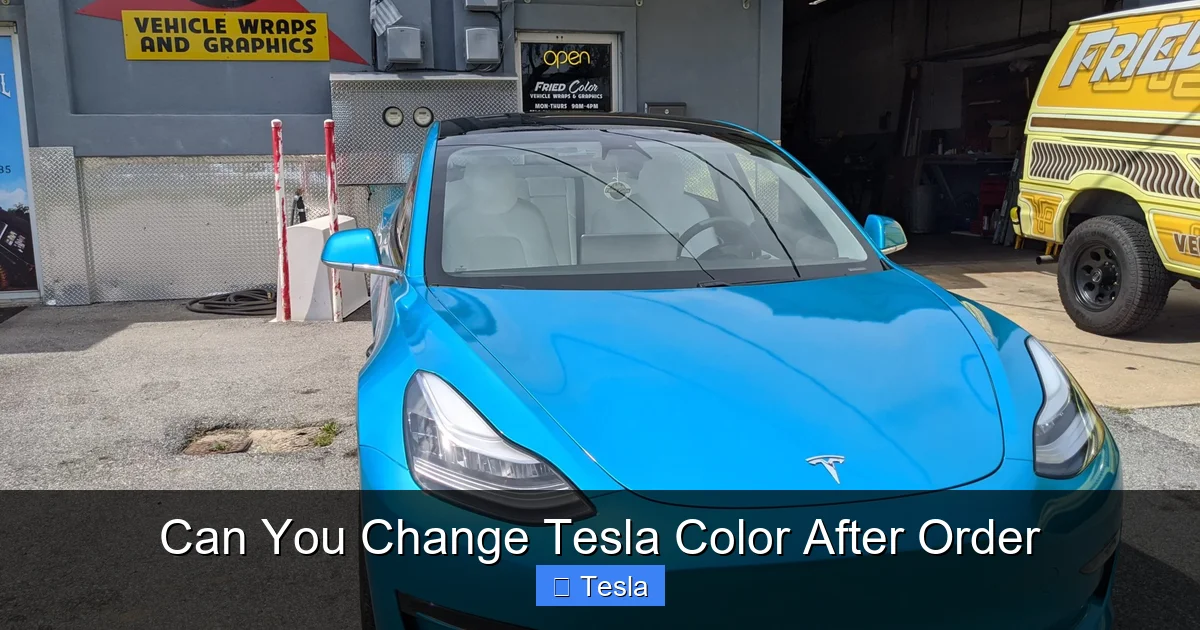
Visual guide about Can You Change Tesla Color After Order
Image source: friedcolor.com
Cancellation Windows and Process
Tesla’s cancellation policy is not as straightforward as a 30-day money-back guarantee. It varies by region and can change. Generally, you can cancel an order through your Tesla account online while the status is still “Order Placed” or sometimes “Production Scheduled.” Once production has physically started, cancellation may require a phone call to Tesla Support and is not guaranteed. The key things to know:
- Your deposit is typically refunded (the $100-$250 order fee).
- You lose your place in line. Your original delivery estimate is gone. You re-enter the queue at the current backlog, which could mean waiting weeks or months longer.
- Prices may have changed. Tesla adjusts prices frequently. The color you now want might cost more (or less) than when you first ordered.
- Incentives may be lost. If you had a qualifying referral, tax credit, or regional incentive tied to your original order date, canceling could make you ineligible.
This process is a nuclear option. It’s not a simple color change; it’s a complete reset of your purchase journey. For anyone even remotely close to production, this is a risky and often undesirable path, making it clear that the time for color certainty is before you order.
After Delivery: The Two Main Paths to a New Color
So, your Tesla is in your driveway, and you can’t stop staring at that Pearl White Multi-Coat, realizing you should have gone for the Stealth Grey. Since you can’t send it back to the factory for a repaint, the aftermarket world is your only option. There are two primary paths: a vinyl wrap or a full custom paint job.
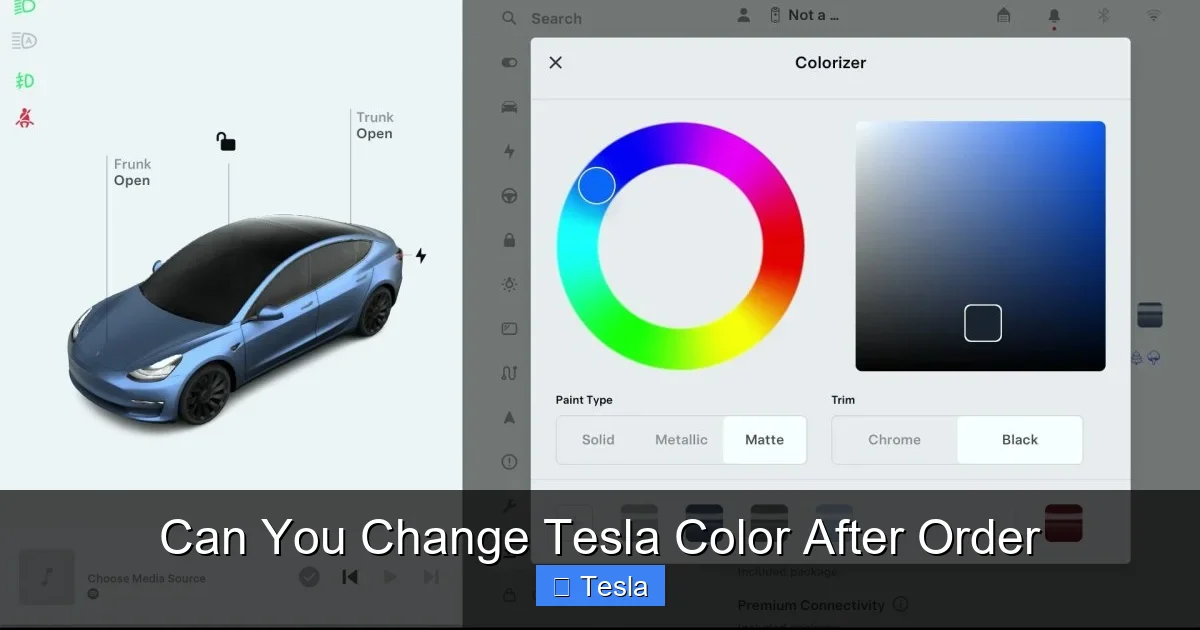
Visual guide about Can You Change Tesla Color After Order
Image source: notateslaapp.com
Path 1: The Vinyl Wrap – A Reversible, High-Quality Skin
A vinyl wrap involves applying large, adhesive-backed sheets of durable plastic film over the entire original paint. It’s like giving your car a new, removable skin. High-quality wraps from brands like 3M, Avery Dennison, or ORAFOL are engineered to last 5-7 years with proper care and come in virtually every color, finish (matte, satin, gloss, metallic), and texture imaginable.
Pros:
- Reversible: It can be removed by a professional without damaging the original factory paint, assuming it was installed correctly and removed properly after several years.
- Protective: It acts as a sacrificial layer against stone chips, minor scratches, and sun damage, preserving your original paint.
- Extreme Customization: Want a color not offered by Tesla? A satin finish? A two-tone design? Wraps make it possible.
- Cost: Generally less expensive than a full repaint, typically ranging from $3,000 for a basic sedan wrap to $7,000+ for complex colors or an SUV like the Model X.
Cons & Critical Considerations:
- It’s not cheap. While cheaper than paint, $3,000-$7,000 is a significant sum.
- Quality is EVERYTHING. A poor-quality wrap or installation will bubble, peel, fade, and damage your paint upon removal. You must use a reputable, experienced shop. Ask for examples of their Tesla work specifically.
- Maintenance: Wrapped cars require special care. No abrasive washes, no high-pressure washers directly on seams, and no waxes/cleaners not approved for vinyl. Some detailers may refuse to work on wrapped cars.
- Resale Impact: While better than a repaint, a wrapped car still requires disclosure. Some buyers are wary of wraps, fearing hidden paint damage underneath. It can slightly reduce value compared to a pristine, unwrapped original.
- Warranty: Tesla’s New Vehicle Limited Warranty does not cover wrap damage or issues arising from it.
A related, smaller-scale option is a color-change wrap for specific parts—like the roof, trim, or calipers. This is a popular and more affordable way to add contrast (e.g., a black roof on a white car) without the full cost and commitment of a full wrap.
Path 2: The Full Custom Paint Job – Permanent and Pricey
This is the nuclear aftermarket option: sanding down your Tesla’s factory paint and applying a new, custom color from scratch. It is a major automotive refinishing project.
Pros:
- Permanent and Factory-Like: A top-tier, professional paint job can look and feel indistinguishable from factory paint. It becomes the car’s new “original” color.
- Unlimited Options: Any color, any finish, from any paint supplier ( PPG, BASF, etc.). You can match a Ferrari red or a unique Lamborghini shade.
- Durability: A excellent paint job, with proper clear coat, can be more durable and UV-resistant than a wrap over the long term (10+ years).
Cons & Major Warnings:
- Extremely Expensive: A proper, full-frame disassembly, bare-metal paint job on a Tesla starts around $10,000-$15,000 and can go much higher. Cheap “paint jobs” ($2,000-$4,000) are just paint over existing paint and will look terrible and crack quickly.
- It Destroys Factory Paint: This is irreversible. You are permanently removing Tesla’s original finish.
- Massive Resale Value Hit: A repainted Tesla, unless done to an absolute concours standard with full documentation, will be valued significantly lower. Buyers are highly suspicious of non-factory paint due to potential rust, poor adhesion, and hidden damage history.
- Warranty Voidance: Tesla’s warranty explicitly states that damage caused by aftermarket modifications, including paint, is not covered. Furthermore, improper paint work can interfere with the vehicle’s sensors (camera, radar) if overspray occurs, leading to costly repairs not covered by warranty.
- Quality Risk: Finding a shop that understands Tesla’s complex curves, sensor locations, and the need for perfect panel matching is a huge challenge. A bad paint job is a permanent eyesore.
Because of these severe drawbacks, a full repaint is considered a last resort, typically only undertaken by those planning to keep the car indefinitely or for specific restoration projects. For the vast majority of owners seeking a color change, a high-quality wrap is the far more sensible, though still costly, path.
Cost Considerations: The True Price of Regret
Let’s talk numbers. The financial impact of changing your Tesla’s color after delivery is the most tangible consequence. It’s not just the cost of the wrap or paint; it’s the lost opportunity cost and impact on your asset’s value.
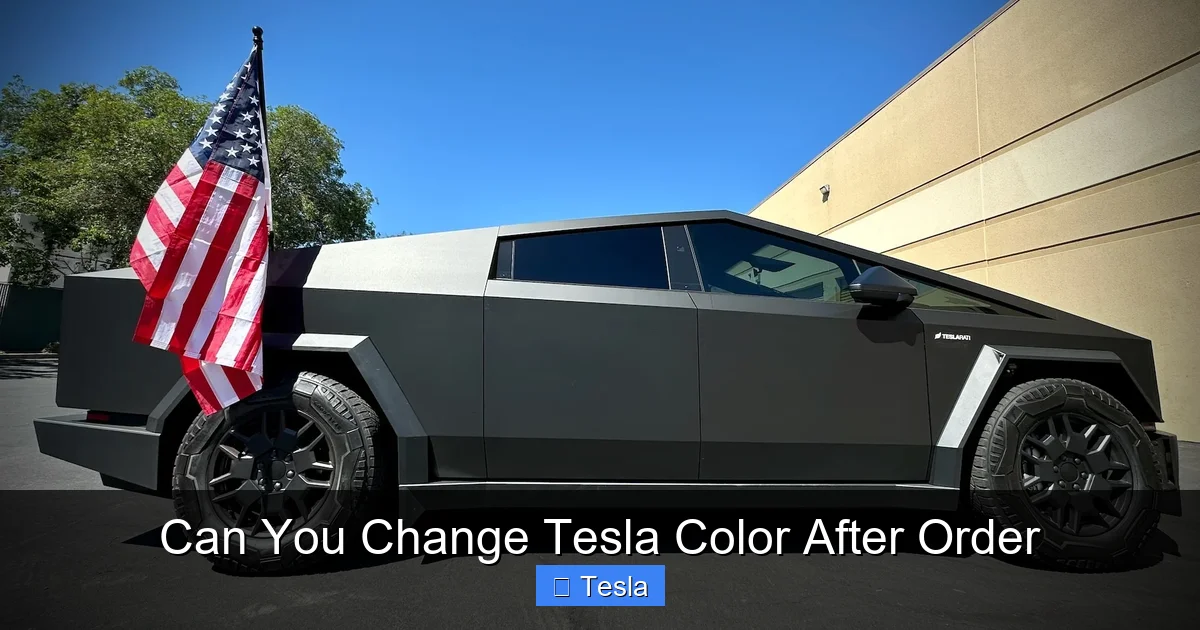
Visual guide about Can You Change Tesla Color After Order
Image source: shop.teslarati.com
Imagine you ordered a Midtown Grey Model 3 for $45,000. After delivery, you decide you want Red Multi-Coat. The aftermarket path looks like this:
- Option A (Wrap): Pay a shop $4,500 for a full wrap. Your total outlay is now $49,500. Your car, with a wrap, might be worth $42,000-$44,000 on the private market (vs. a $45,000+ factory-red car). You’ve effectively paid a premium to have a non-original color.
- Option B (Repaint): Pay a top shop $12,000 for a full repaint. Total outlay: $57,000. Your repainted car, due to the permanent alteration, might be valued at $38,000-$40,000. You’ve destroyed thousands in equity.
Compare this to the cancellation/reorder path: You cancel the Grey, get your $200 deposit back, and reorder a Red. You might wait 3 extra months. The Red might now be $45,500 due to a price increase. You’ve paid a $500 premium and lost 3 months of driving, but you have a factory-original, warranty-intact car that will hold maximum value. For many, this “cost” of time and potential price fluctuation is far less than the guaranteed financial hit of an aftermarket color change.
This is where researching total cost of ownership is key. Articles that discuss negotiating on a used car highlight how original documentation and factory specs command premiums. A wrapped or repainted Tesla is, in the used market’s eyes, a “modified” used car, not a “like-new” one.
Real Owner Experiences: Lessons from the Community
Scouring Tesla owner forums, Reddit threads, and Facebook groups reveals a consistent narrative. The most common regret is color selection. The most common advice? “Do not rely on the website photos. Go see the cars in person at a showroom or a delivery center.” The metallic flakes in Deep Blue Metallic, the subtlety of Silver Metallic, the starkness of Solid Black—these are impossible to judge on a screen.
Owners who wrapped their cars often report being thrilled with the result but warn about the process. “Find a shop that has done dozens of Teslas,” is repeated advice. “The curvature of the Model 3’s fenders and A-pillars is no joke.” They also note that while wraps protect the original paint, removing them after 5+ years can still be a sticky, careful process that requires a professional.
Owners who repainted almost universally regret it in terms of resale. “I had my 2016 Model S repainted a custom blue. I loved it, but when I sold it, I lost $8,000 compared to similar models with original paint. The buyer’s inspector found a single imperfection in the clear coat and used it to hammer the price.” This echoes the fundamental principle: factory originality is king in the premium EV market.
There’s also the practical experience of dealing with Tesla Service post-modification. While they will still service the powertrain and battery, some body shop repairs under the warranty for unrelated damage (like a door dent) become complicated if the car is wrapped or repainted, as matching the existing finish perfectly is a challenge. It can turn a simple warranty repair into a headache.
How to Avoid Color Regret: A Proactive Strategy
Given the extreme difficulty and cost of changing your Tesla’s color after order, your energy is best spent on making the right choice the first time. Here is a tactical plan:
1. See the Colors in Person, Not Online
This is non-negotiable. Tesla’s configurator uses professional lighting and rendering that can make colors look vastly different from real life. Find a Tesla delivery center, showroom, or even a public charger where you can see multiple colors side-by-side in natural daylight. Touch the paint. See how the metallic flakes sparkle. The difference between “White” and “Pearl White Multi-Coat” is $1,500 and a world of depth. You must see it.
2. Leverage the Community for Real-World Photos
Go to Tesla owner forums, subreddits (r/teslamotors), and Instagram. Search hashtags like #teslamodel3white, #teslamodel3blue, etc. Look for photos taken in various weather conditions—rain, sun, shade. This gives you a realistic idea of how the color holds up and looks day-to-day. Ask owners their honest opinions. You might learn that Solid Black shows every speck of dirt, or that Red Multi-Coat looks brownish in certain light.
3. Consider Long-Term Practicality
White and Silver are the most popular colors for a reason: they hide dirt and minor scratches best, they reflect heat (keeping the cabin slightly cooler), and they have the highest resale value. Dark colors like Black and Stealth Grey look dramatic but are high-maintenance, showing water spots, swirl marks, and dust instantly. If you don’t plan to detail your car weekly, a lighter color might save you sanity.
4. Understand the “Multi-Coat” Premium
Tesla charges a significant premium ($1,000-$2,500) for its multi-coat metallic/pearl finishes (Midnight Silver Metallic, Deep Blue Metallic, Red Multi-Coat). You are paying for a more complex, multi-layered paint process with metallic/pearl flakes for depth. Is that visual effect worth the extra cost and potential for slightly higher repair costs (a panel-match repaint is harder)? See it in person to decide.
5. Use the 48-Hour (or Similar) Review Period Wisely
After you place your order, Tesla typically gives you a short window (check your regional policy) where you can make *minor* changes to your order before it’s locked for production. This is your last, best chance to switch colors without cancellation. Have your decision made before you even click “Order.” Treat that button as a point of no return.
Frequently Asked Questions
Can I change my Tesla color after I’ve taken delivery?
No, you cannot have Tesla factory change the paint color after delivery. The only options are costly aftermarket solutions: a full vinyl wrap or a complete custom paint job, both of which have significant financial and warranty implications.
How much does it cost to wrap a Tesla in a different color?
A professional, high-quality full wrap for a Tesla Model 3 or Y typically costs between $3,500 and $6,000. For a Model S or X, expect $5,000 to $8,000+. Price varies by wrap material brand, color complexity (e.g., satin finishes cost more), and the shop’s reputation.
Will wrapping my Tesla void the warranty?
Wrapping itself does not void the entire New Vehicle Limited Warranty. However, Tesla will not cover any damage caused by the wrap or its installation/removal. Furthermore, if a warranty-related body repair is needed, matching a wrap perfectly can be difficult and may lead to disputes over the quality of the repair.
Is it better to cancel my Tesla order or wrap it later if I want a different color?
Cancelation (if still possible) is almost always the better financial and preservation choice. You keep a factory-original, warranty-intact vehicle with maximum resale value. Wrapping costs thousands and permanently alters the car’s original state, reducing its value. Cancelation only makes sense if you face long delays or price increases on the new color.
Can Tesla service a wrapped or repainted car?
Yes, Tesla Service will still perform work on the powertrain, battery, and electronics under warranty. However, for any body-related warranty work (e.g., repairing a dent), the presence of a wrap or repaint can complicate panel matching and may lead to disagreements about the quality of the final result, as the shop is trying to match a non-factory finish.
What color Tesla holds its value the best?
3>White (especially Solid White) and Silver Metallic consistently hold the highest resale value in the used Tesla market. They are the most popular, most practical (hiding dirt), and are perceived as the most “standard” and desirable by the broadest range of buyers. Specialty colors like Red Multi-Coat or custom wraps often have a more niche appeal and can take longer to sell.
