Can I Afford a Tesla Model Y?

Contents
- 1 Key Takeaways
- 2 📑 Table of Contents
- 3 So, Can You Actually Afford a Tesla Model Y?
- 4 Understanding the “Sticker Price” vs. The Real Price
- 5 Financing and Monthly Payment Strategies
- 6 Income Requirements and The “How Much Car Can I Afford?” Rule
- 7 The Total Cost of Ownership Deep Dive: It’s Not Just the Payment
- 8 Making the Decision: A Practical Framework
- 9 Conclusion: Affordability is Personal
- 10 Frequently Asked Questions

Windshield Cleaning Tool

Car Battery Tester

Pressure Washer for Car
Power Steering Fluid
Deciding if you can afford a Tesla Model Y means looking beyond the sticker price. You must factor in loan payments, insurance, charging costs, and potential maintenance. Your income, down payment, and credit score directly impact your monthly cost. This guide gives you the real numbers and a clear framework to see if this popular EV fits your budget.
Key Takeaways
- The sticker price is just the start: A Tesla Model Y’s true cost includes loan interest, higher insurance, home charging setup, and annual maintenance.
- Your down payment is critical: A larger down payment (ideally 20%) drastically lowers your monthly payment and total interest paid.
- Income is only part of the equation: Lenders look at your debt-to-income ratio. A $70k salary might work if you have minimal other debts.
- Electricity is cheaper than gas: Charging at home typically costs 1/4 to 1/3 per mile compared to gasoline, offering significant long-term savings.
- Consider the total cost of ownership: Compare the Model Y’s 5-year cost (purchase price + fuel/electricity + insurance + maintenance) against a similar gas SUV.
- Incentives can lower the net cost: Research federal tax credits and state/local rebates that can directly reduce your purchase price or provide a rebate.
- Test the numbers with a budget: Use the 20/4/10 rule (20% down, 4-year loan, 10% of monthly income for total car costs) as a sanity check.
📑 Table of Contents
- So, Can You Actually Afford a Tesla Model Y?
- Understanding the “Sticker Price” vs. The Real Price
- Financing and Monthly Payment Strategies
- Income Requirements and The “How Much Car Can I Afford?” Rule
- The Total Cost of Ownership Deep Dive: It’s Not Just the Payment
- Making the Decision: A Practical Framework
- Conclusion: Affordability is Personal
So, Can You Actually Afford a Tesla Model Y?
Let’s be real. The Tesla Model Y is everywhere. It’s the sleek, fast, tech-packed electric SUV that seems to be on every corner. You see it, you want it, and then the big question hits: Can I actually afford a Tesla Model Y? It’s a valid and smart question. Affordability isn’t just about the window sticker. It’s about the entire financial picture—from your monthly cash flow to the hidden costs of ownership.
This isn’t a simple yes or no. It’s a “it depends on your complete financial situation.” But don’t worry. We’re going to break it down, piece by piece. We’ll look at the real price, how to finance it smartly, the ongoing costs you might not expect, and create a clear framework to see if this EV belongs in your driveway. Think of this as your friendly, no-fluff financial roadmap to Model Y ownership.
Understanding the “Sticker Price” vs. The Real Price
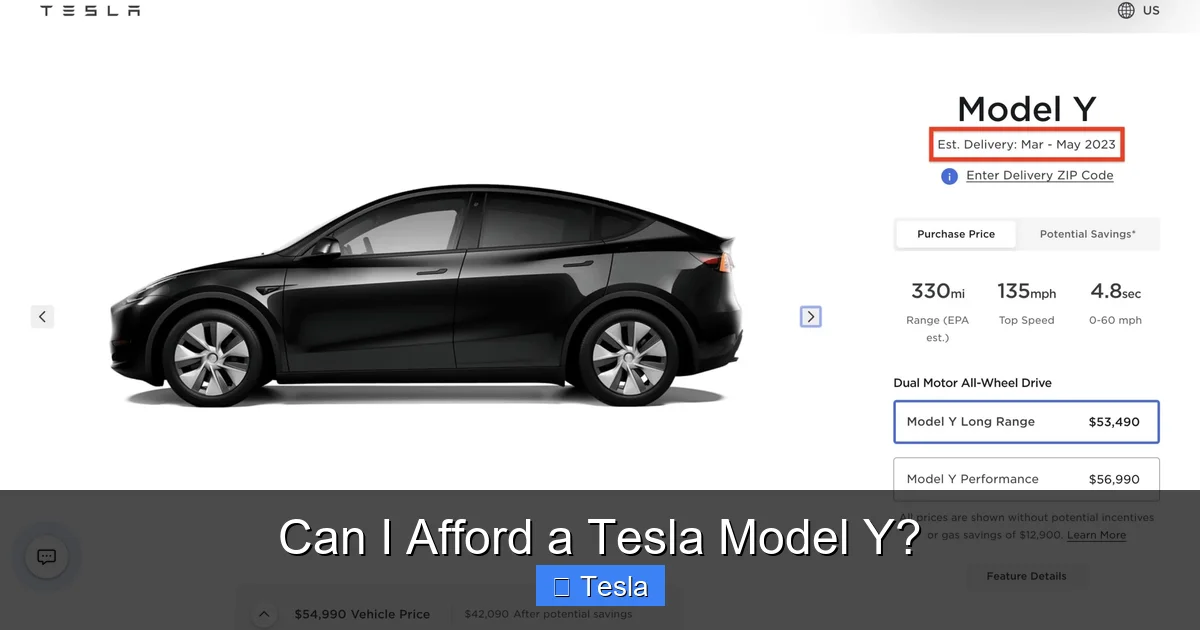
First, let’s get the base numbers. As of 2024, the Tesla Model Y starts at around $44,990 for the Rear-Wheel Drive version. The Long Range starts near $48,990, and the Performance version kicks off at about $52,490. But wait—that’s before options, fees, and taxes. A common “out-the-door” price for a well-equipped Long Range model with a premium paint color and 19” wheels easily lands between $52,000 and $55,000.
Visual guide about Can I Afford a Tesla Model Y?
Image source: teslarati.com
The First Big Decision: New vs. Used
You don’t have to buy new. The used Tesla market is mature, and you can find Model Ys from 2021-2023 with significant mileage for $28,000 to $38,000. This is the single biggest lever to pull for affordability. A used Model Y can cut your upfront cost by 30% or more. You lose the full factory warranty and the latest hardware, but the core experience remains. If your budget is tight, exploring the used market isn’t just smart—it’s essential.
Financing and Monthly Payment Strategies
For most people, buying a car means financing. This is where “affordability” gets real—it’s a monthly number. Let’s run scenarios.

Visual guide about Can I Afford a Tesla Model Y?
Image source: cdn.teslanorth.com
The Down Payment Power Play
Your down payment is your best friend. The standard advice is to put down at least 20%. On a $50,000 car, that’s $10,000. Why so much? A 20% down payment:
- Lowers your loan amount, reducing monthly payments.
- Reduces total interest paid over the loan term.
- Heleps you avoid being “upside down” (owing more than the car is worth) immediately.
- Often gets you better interest rates.
If $10,000 feels impossible, aim for at least 10%. Anything less, and you’re setting yourself up for financial strain.
Loan Term: The 4-Year Sweet Spot
A 72-month (6-year) loan lowers your payment but costs you thousands more in interest. You also risk the car’s warranty expiring before the loan is paid off. A 48- or 60-month loan is the sweet spot for balancing payment and total cost. Let’s do the math on a $50,000 Model Y with a $10,000 down payment (loan amount: $40,000):
- At 5% interest for 48 months: ~$920/month.
- At 5% interest for 60 months: ~$755/month.
- At 5% interest for 72 months: ~$645/month.
That $200/month difference between the 48-month and 72-month loan adds up to $14,400 in extra payments over the life of the loan. That’s a lot of electricity.
Leasing: A Viable Alternative?
Leasing a Model Y can get you into a new car with lower monthly payments (often $500-$700) and a smaller down payment. You’re essentially renting it for 2-3 years with mileage limits. It’s great if you want a new car every few years and don’t put on massive miles. The downside? You never build equity, and you’re subject to wear-and-tear fees. Leasing makes sense if your primary goal is driving the latest tech with predictable costs, not long-term asset building.
Income Requirements and The “How Much Car Can I Afford?” Rule
This is the core of your question. Financial advisors often use the 20/4/10 rule as a guideline:
- 20% down payment.
- 4-year loan term.
- 10% of your gross monthly income for total car costs (payment + insurance + fuel).
Let’s use a $70,000 annual salary ($5,833 gross monthly). 10% is $583. That’s your total monthly car budget. If your estimated insurance is $150/month and electricity/charging is $50/month, that leaves $383 for your actual loan payment.

Visual guide about Can I Afford a Tesla Model Y?
Image source: topelectricsuv.com
Working backward, a $383/month payment at 5% interest for 60 months gets you a loan of about $21,000. Add your 20% down ($5,250), and you’re looking at a total purchase price of roughly $26,250.
Whoa. That’s used Model 3 territory, not a new Model Y. This rule is conservative but safe. To afford a $50,000 new Model Y under this rule, you’d need a gross monthly income of about $9,500 ($114,000/year). That’s the stark reality.
Reality Check: The Debt-to-Income (DTI) Ratio
Lenders care more about your Debt-to-Income ratio. They add up all your monthly debt payments (student loans, credit cards, mortgage/rent, *and* the proposed car payment) and divide by your gross monthly income. Most lenders want this number below 43%, with 36% being ideal. If you have high rent/mortgage or other debts, your capacity for a $900/month car payment shrinks dramatically. You can use a car affordability calculator to plug in your specific income and debt numbers for a personalized figure.
The Total Cost of Ownership Deep Dive: It’s Not Just the Payment
If you only look at the loan payment, you’re missing half the story. The Total Cost of Ownership (TCO) is what truly determines affordability.
Insurance: The EV Premium
Insuring a Tesla is famously expensive. Repair costs for their unique sensors and aluminum bodies are high, so insurers pass that to you. Expect to pay $1,800 to $2,800+ annually ($150-$230/month) for a Model Y, depending on your location, age, and driving record. This is often 25-50% more than insuring a comparable gas SUV. Get quotes before you buy.
Home Charging Setup: The One-Time Cost
You need to charge at home. A standard 120V outlet works but is painfully slow. A 240V outlet (NEMA 14-50) installation by an electrician costs between $500 and $2,000 depending on your home’s electrical panel and distance from the charger. This is a mandatory, upfront cost for a good ownership experience.
Electricity vs. Gas: The Savings (Yes, Savings!)
Here’s the bright spot. Charging at home is incredibly cheap. Driving 12,000 miles a year:
- At 30 MPG and $3.50/gallon gas: ~$1,400/year.
- At 3.5 miles/kWh and $0.15/kWh electricity: ~$514/year.
You’ll save roughly $900 per year on “fuel.” This softens the higher insurance cost.
Maintenance: Shockingly Low
No oil changes, no spark plugs, no transmission fluid. Tesla’s maintenance schedule is light: cabin air filter every 2 years, HVAC service every 2 years, brake fluid check every 4 years. Expect to spend $300-$500 every two years on routine maintenance. Tires wear faster due to weight and torque, so budget for them every 25,000-35,000 miles.
Potential Repair Costs & Warranty
The Model Y comes with a 4-year/50,000-mile basic warranty and an 8-year/100,000-mile battery & drive unit warranty. That’s excellent coverage for the big-ticket items. However, out-of-warranty repairs for things like door handles, touchscreens, or sensors can be pricey. Setting aside $50-$100/month in a “car repair fund” is a wise strategy.
Customization Costs: Wraps & Tint
Many Model Y owners personalize their cars. A full vinyl wrap can cost $3,000 to $6,000. Ceramic window tint is another $400-$1,000. These are optional but common, so factor them in if you plan to customize.
Making the Decision: A Practical Framework
Now, let’s put it all together into a decision-making process.
Step 1: The Brutal Honesty Budget
List your exact monthly take-home pay. List every single monthly debt and expense (rent, utilities, student loans, credit cards, subscriptions). Subtract all expenses from your income. What’s left over? This is your “disposable income.” A responsible car payment should be no more than 15% of your take-home pay, leaving room for savings and unexpected costs. If you have $2,000 left after bills, a $300 car payment is reasonable; a $900 payment is a huge risk.
Step 2: The 5-Year Total Cost Scenario
Build a 5-year projection for both a Model Y and a comparable gas SUV (like a Honda CR-V or Ford Mustang Mach-E). Include:
- Purchase price (after down payment)
- Loan interest paid over 5 years
- Insurance (5 years)
- Fuel/electricity (5 years)
- Estimated maintenance/repairs
- Depreciation (car’s lost value)
This total number is the real cost of choosing that car. Often, the Model Y’s higher purchase price is offset by lower fuel and maintenance costs over time.
Step 3: The Stress Test
Ask yourself: If I lost my job tomorrow, could I afford this car for 3 months? If I had a $1,000 emergency repair, could I pay it without using a credit card? If the answer is no, the car is too expensive for you, regardless of what the lender says you “qualify” for.
Conclusion: Affordability is Personal
So, can you afford a Tesla Model Y? The answer lives in your budget spreadsheet, not on Tesla’s website. For a high earner with low debt and a solid down payment, the answer is likely yes. The lower running costs make it a smart long-term choice. For someone with average income and existing debts, a new Model Y is probably a stretch. The used Model Y market or a less expensive EV (or efficient hybrid) is a far wiser path.
The most important step is to separate emotion from mathematics. The Model Y is an incredible product, but a car is a tool for transportation, not a financial trophy. Build your budget, understand the total cost, run the 5-year comparison, and be brutally honest with yourself. If the numbers work without causing stress, fantastic. If they don’t, there’s no shame in choosing a different vehicle that aligns with your financial reality. Your future self will thank you for the clarity.
Frequently Asked Questions
What is a realistic monthly payment for a Tesla Model Y?
For a new Long Range Model Y ($50k) with a 20% down payment and a 60-month loan at 5% APR, your principal and interest payment would be about $755/month. However, you must add $150-$250/month for insurance, making the total monthly cost of ownership $905-$1,005.
Is it better to buy a new or used Tesla Model Y for affordability?
For pure affordability, a used Model Y is almost always the better choice. You avoid the steepest part of depreciation, significantly lowering the total cost. A 2-3 year old Model Y with 30,000 miles can be 25-30% cheaper than a new one while still having most of its battery warranty remaining.
How much does it actually cost to charge a Tesla Model Y at home?
It depends on your electricity rate. At the U.S. average of ~$0.16/kWh, a full charge (0-100%, ~75-80 kWh usable) costs $12-$13. For a typical 250-mile range, that’s about $0.05 per mile. This is 70-80% cheaper than gasoline for a comparable SUV.
Are Tesla maintenance costs really that low?
Yes, for scheduled maintenance. There are no oil changes, and the drivetrain is sealed. Tesla’s recommended service is minimal: cabin filter every 2 years, brake fluid check every 4 years. Budget $300-$500 every two years. However, potential out-of-warranty repairs for non-drivetrain items (like the MCU touchscreen) can be expensive.
Why is Tesla insurance so expensive?
Insurance premiums are high because Teslas are expensive to repair. Their unique aluminum body panels, advanced sensor suites (cameras, radar), and specialized parts increase collision repair costs. Insurers pass this risk onto customers, so always get a quote before purchasing.
How much should I make to comfortably afford a new Tesla Model Y?
Using the 20/4/10 rule as a guideline, you should have a gross annual income of $110,000 to $130,000+ to comfortably afford a new, well-equipped Model Y without stretching your budget. This assumes a 20% down payment and accounts for high insurance and a $900-$1,000 total monthly cost.