
Ac Compressor for Nissan Altima: Cost and Replacement Info

Replacing the AC compressor in your Nissan Altima can cost between $800 and $1,500, depending on labor rates and part quality. This guide breaks down symptoms, replacement steps, and how to save money while ensuring your AC runs cool and efficient.
If your Nissan Altima’s air conditioning suddenly starts blowing warm air or making strange noises, the culprit might be the AC compressor. This small but mighty component is the heart of your vehicle’s cooling system, and when it fails, it can turn a comfortable summer drive into a sweltering ordeal. Whether you’re cruising down the highway or stuck in traffic, a working AC isn’t just a luxury—it’s a necessity, especially in hot climates.
The AC compressor’s job is simple in theory but complex in practice: it pressurizes the refrigerant and circulates it through the system, enabling the cooling process. Without it, your AC system can’t function. Unfortunately, like any mechanical part, the compressor wears out over time. Mileage, lack of use, poor maintenance, or manufacturing defects can all contribute to its failure. If you’re noticing reduced cooling, odd clunking sounds from under the hood, or a refrigerant leak near the front of the engine, it’s time to investigate.
In this comprehensive guide, we’ll walk you through everything you need to know about the AC compressor for your Nissan Altima—from recognizing the warning signs to understanding replacement costs and making smart decisions about parts and labor. Whether you’re a DIY enthusiast or prefer to leave it to the pros, this article will help you stay cool, save money, and keep your Altima running smoothly.
Key Takeaways
- Understanding AC Compressor for Nissan Altima: Cost and Replacement Info: Provides essential knowledge
📑 Table of Contents
What Is an AC Compressor and Why Does It Matter?
The AC compressor is often called the “pump” of the air conditioning system. It’s responsible for compressing the low-pressure refrigerant gas into a high-pressure, high-temperature gas, which then flows to the condenser where it cools down and turns into a liquid. This process is essential for removing heat from the cabin and delivering cool air through the vents.
In a Nissan Altima, the compressor is typically belt-driven and located at the front of the engine, connected to the serpentine belt. It’s powered by the engine’s rotation and controlled by an electromagnetic clutch that engages and disengages based on the AC system’s needs. When you turn on the AC, the clutch activates, and the compressor starts working. When the desired temperature is reached, the clutch disengages to save energy.
Without a functioning compressor, the refrigerant can’t circulate properly, and the entire AC system fails. Even if other components like the condenser or evaporator are working perfectly, a broken compressor means no cool air. That’s why it’s one of the most critical—and expensive—parts to replace.
How the AC System Works in a Nissan Altima
To understand why the compressor is so important, it helps to know how the AC system operates as a whole. The process begins when you turn on the AC. The compressor kicks in, drawing in low-pressure refrigerant gas from the evaporator. It then compresses this gas, increasing its temperature and pressure.
This hot, high-pressure gas flows to the condenser (usually located in front of the radiator), where it releases heat to the outside air and condenses into a high-pressure liquid. The liquid then moves to the expansion valve or orifice tube, which regulates the flow into the evaporator. As the refrigerant enters the evaporator, it expands and cools dramatically, absorbing heat from the cabin air that passes over the evaporator coils.
The now-cooled air is blown into the cabin by the blower fan, while the low-pressure refrigerant gas returns to the compressor to start the cycle again. This continuous loop keeps your car cool and comfortable.
In the Nissan Altima, this system is designed for efficiency and reliability, but like any mechanical system, it’s subject to wear and tear. The compressor, being the most active component, is often the first to show signs of trouble.
Signs Your Nissan Altima’s AC Compressor Is Failing

Visual guide about Ac Compressor for Nissan Altima: Cost and Replacement Info
Image source: buyautoparts.com
Recognizing the early warning signs of a failing AC compressor can save you time, money, and discomfort. While some symptoms are obvious, others are more subtle. Here are the most common indicators that your compressor may be on its last legs.
Weak or Warm Airflow
One of the first signs is reduced cooling performance. You might notice that the air coming from the vents isn’t as cold as it used to be, or it takes much longer to cool the cabin. In some cases, the air may start cold but gradually warm up as you drive. This could mean the compressor is struggling to maintain pressure or the clutch is slipping.
Strange Noises from Under the Hood
Listen for unusual sounds when you turn on the AC. A failing compressor often makes grinding, squealing, or clunking noises. These sounds may come and go or persist once the compressor engages. A loud knocking noise could indicate internal damage, such as broken pistons or bearings.
AC Clutch Not Engaging
The AC clutch is a small pulley that spins freely when the AC is off. When you turn on the AC, it should “click” and lock onto the compressor shaft, causing the compressor to turn. If the clutch doesn’t engage, the compressor won’t run. You can check this by looking under the hood while someone turns on the AC. If the clutch doesn’t move, it could be due to a faulty clutch, electrical issue, or low refrigerant.
Refrigerant Leaks
Refrigerant leaks are another red flag. If you notice oily residue around the compressor, hoses, or connections, it could indicate a leak. Refrigerant doesn’t just disappear—it escapes through damaged seals or cracks. Low refrigerant levels can cause the compressor to overwork and fail prematurely.
Dashboard Warning Lights
Some newer Nissan Altimas (especially 2013 and later) have AC system monitoring. If there’s a problem with pressure or electrical components, a warning light may appear on the dashboard. While not all models have this feature, it’s worth checking your owner’s manual.
Compressor Lock-Up
In severe cases, the compressor can seize completely. This means the pulley won’t turn at all, even when the engine is running. You might hear a loud squeal from the serpentine belt or notice that the belt is slipping. A locked compressor often requires immediate replacement.
AC Compressor Replacement Cost for Nissan Altima

Visual guide about Ac Compressor for Nissan Altima: Cost and Replacement Info
Image source: m.media-amazon.com
Replacing the AC compressor in a Nissan Altima is not a cheap repair, but understanding the cost breakdown can help you budget and avoid surprises. The total price depends on several factors, including the model year, part type, labor rates, and whether you go to a dealership or an independent shop.
Average Cost Range
On average, replacing the AC compressor in a Nissan Altima costs between $800 and $1,500. This includes both parts and labor. Here’s a typical breakdown:
– **Compressor unit (OEM or aftermarket):** $300–$700
– **Labor (2–4 hours):** $200–$600
– **Refrigerant recharge:** $100–$200
– **Additional parts (clutch, seals, receiver-drier):** $50–$150
Labor costs vary widely by location and shop. Dealerships tend to charge more—often $120–$180 per hour—while independent mechanics may charge $80–$120. Some shops also include a diagnostic fee, which can add $50–$100.
OEM vs. Aftermarket Compressors
You’ll have a choice between OEM (Original Equipment Manufacturer) and aftermarket parts. OEM compressors are made by Nissan or its suppliers and are designed to meet exact factory specifications. They’re reliable and often come with a warranty, but they’re also the most expensive option—typically $500–$700.
Aftermarket compressors are made by third-party manufacturers and can cost significantly less—sometimes as low as $200–$400. While many are high quality, others may be poorly made and fail prematurely. Look for reputable brands like Denso, Four Seasons, or UAC, and check customer reviews before buying.
Some aftermarket compressors are remanufactured, meaning they’ve been rebuilt using new components. These can be a good middle ground between cost and quality, often priced around $300–$500.
Model Year and Trim Level Impact
The cost can also vary depending on your Altima’s model year and trim. Older models (2007–2013) are more prone to compressor issues due to design flaws and higher mileage. Newer models (2019–2024) may have more complex systems, which can increase labor time and cost.
For example, a 2010 Altima with a 2.5L engine might have a simpler compressor setup than a 2022 Altima with dual-zone climate control and advanced sensors. The latter may require more diagnostics and recalibration after replacement.
DIY vs. Professional Installation
While it’s technically possible to replace the AC compressor yourself, it’s not recommended for most DIYers. The process involves handling refrigerant, which is regulated by the EPA and requires special equipment and certification. Improper handling can be dangerous and illegal.
Additionally, the job requires evacuating and recharging the system with the correct amount of refrigerant and oil. Too little or too much can damage the new compressor. Most professionals use a vacuum pump and manifold gauge set to ensure the system is properly sealed and charged.
If you do attempt a DIY replacement, expect to spend $300–$500 on tools and refrigerant. You’ll also need to dispose of the old refrigerant properly, which may require a visit to a certified recycling center.
Step-by-Step: How the AC Compressor Is Replaced
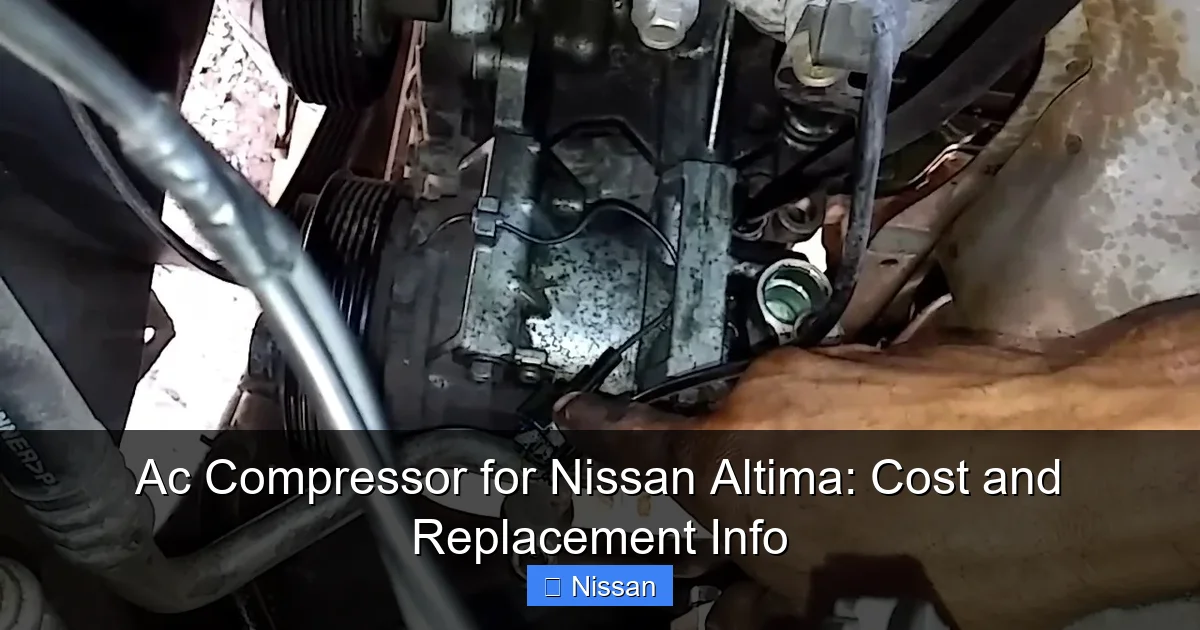
Visual guide about Ac Compressor for Nissan Altima: Cost and Replacement Info
Image source: i.ytimg.com
Replacing the AC compressor is a multi-step process that requires precision and the right tools. Here’s what a professional mechanic typically does when replacing the compressor in a Nissan Altima.
Step 1: Diagnose the Problem
Before replacing the compressor, the technician will confirm that it’s actually the source of the problem. They’ll check for refrigerant leaks, test the electrical system, and inspect the clutch and belt. This ensures they’re not replacing a good part unnecessarily.
Step 2: Recover the Refrigerant
The first physical step is to safely remove the refrigerant from the system using a recovery machine. This is required by law to prevent harmful chemicals from escaping into the atmosphere. The old refrigerant is stored and later recycled.
Step 3: Remove the Serpentine Belt
The serpentine belt must be removed to access the compressor. The technician will use a belt tensioner tool to release tension and slide the belt off the pulley.
Step 4: Disconnect Electrical and Refrigerant Lines
The compressor has electrical connectors and high/low-pressure refrigerant lines attached. These are carefully disconnected, and the openings are capped to prevent contamination.
Step 5: Remove the Compressor
The compressor is mounted with bolts to the engine block. Once the lines and electrical connections are removed, the bolts are loosened, and the compressor is lifted out.
Step 6: Install the New Compressor
The new compressor is installed in reverse order. It’s important to add the correct amount of compressor oil before installation—usually specified in the repair manual. The technician will also replace the receiver-drier or accumulator, as it absorbs moisture and should not be reused.
Step 7: Reconnect Lines and Reinstall Belt
The refrigerant lines and electrical connectors are reattached, and the serpentine belt is reinstalled and properly tensioned.
Step 8: Evacuate and Recharge the System
A vacuum pump is used to remove air and moisture from the system. This step is critical—any air left in the system can reduce cooling efficiency and damage the compressor. Once the system holds a vacuum, it’s recharged with the correct type and amount of refrigerant (usually R-134a).
Step 9: Test the System
Finally, the technician will start the engine, turn on the AC, and monitor performance. They’ll check for proper cooling, clutch engagement, and any leaks. The system is tested under various conditions to ensure it’s working correctly.
Tips to Extend the Life of Your AC Compressor
While AC compressors will eventually wear out, you can take steps to prolong their life and avoid premature failure. Regular maintenance and smart usage habits can make a big difference.
Run the AC Regularly
Even in winter, run your AC for 10–15 minutes every week. This keeps the compressor seals lubricated and prevents them from drying out. It also helps maintain pressure in the system.
Use the Recirculation Mode
When it’s hot outside, use the recirculation mode instead of fresh air. This reduces the workload on the compressor by cooling already-cooled air rather than pulling in hot outside air.
Park in the Shade
Whenever possible, park in a garage or shaded area. This reduces the initial heat load on the AC system when you start the car, giving the compressor less work to do.
Check Refrigerant Levels Annually
Have a technician check your refrigerant levels once a year. Low levels can cause the compressor to overheat and fail. Topping off refrigerant without fixing leaks is not a long-term solution—always find and repair the source of the leak.
Inspect Belts and Hoses
Worn or loose serpentine belts can cause the compressor to slip or not engage properly. Check the belt for cracks, fraying, or glazing, and replace it if needed. Also, inspect AC hoses for leaks or bulges.
Replace the Cabin Air Filter
A clogged cabin air filter restricts airflow, forcing the blower motor and compressor to work harder. Replace the filter every 12,000–15,000 miles or as recommended in your owner’s manual.
Common Myths About AC Compressor Replacement
There are several misconceptions about AC compressors that can lead to confusion or poor decisions. Let’s clear up some of the most common myths.
Myth 1: “You Can Just Top Off Refrigerant to Fix a Bad Compressor”
Adding refrigerant won’t fix a failed compressor. If the compressor is damaged, it needs to be replaced. Topping off refrigerant without addressing the root cause can lead to further damage and higher repair costs.
Myth 2: “Aftermarket Compressors Are Always Inferior”
Not true. Many aftermarket compressors are built to high standards and perform just as well as OEM parts. The key is choosing a reputable brand and ensuring it’s compatible with your Altima.
Myth 3: “You Can Replace Just the Clutch”
While it’s possible to replace the clutch separately, it’s often not cost-effective. If the compressor is old or showing signs of wear, replacing the entire unit is usually the better long-term solution.
Myth 4: “AC Compressor Failure Is Always Due to Age”
While age and mileage are factors, other issues like poor maintenance, refrigerant leaks, or electrical problems can cause early failure. Regular inspections can help catch these issues early.
Myth 5: “DIY Replacement Is Easy and Saves Money”
Unless you have the right tools, certification, and experience, DIY replacement is risky. Improper installation can lead to system damage, refrigerant leaks, or even personal injury.
Conclusion
Replacing the AC compressor in your Nissan Altima is a significant repair, but it’s often necessary to restore cool, comfortable driving. With costs ranging from $800 to $1,500, it’s important to choose the right parts, find a qualified technician, and understand the process.
By recognizing the warning signs early, maintaining your AC system, and making informed decisions about OEM vs. aftermarket parts, you can extend the life of your compressor and avoid costly surprises. Whether you’re driving a 2007 model or a 2023 Altima, keeping your AC in top shape ensures you stay cool no matter how hot it gets outside.
Don’t wait until your AC completely fails—address issues promptly and keep your Altima running smoothly for miles to come.
Frequently Asked Questions
How long does an AC compressor last in a Nissan Altima?
Most AC compressors in a Nissan Altima last between 80,000 and 120,000 miles, depending on usage and maintenance. Some may fail earlier due to leaks or electrical issues.
Can I drive my Altima with a bad AC compressor?
Yes, you can drive the car, but the AC won’t work. In some cases, a seized compressor can damage the serpentine belt, so it’s best to have it repaired promptly.
Is it worth replacing the AC compressor myself?
Only if you have EPA certification, proper tools, and experience. Most people are better off hiring a professional to avoid safety risks and system damage.
Does insurance cover AC compressor replacement?
No, standard auto insurance does not cover mechanical failures like a bad AC compressor. However, some extended warranties or service contracts may include it.
What happens if I don’t replace a failed AC compressor?
Your AC will stop working, and debris from the failed compressor can contaminate the system, damaging other components like the condenser or expansion valve.
Can a bad AC compressor affect engine performance?
Indirectly, yes. A seized compressor can strain the serpentine belt and reduce engine efficiency, but it won’t typically cause major engine problems unless the belt breaks.
