
How Big Is a Jeep Wrangler Gas Tank?

The Jeep Wrangler’s gas tank size isn’t one-size-fits-all; it varies significantly by generation, model, and even optional packages. From the compact TJ’s 15-gallon tank to the extended-range JL’s 22.5-gallon option, knowing your specific tank capacity is crucial for planning off-road adventures and long highway trips. This guide breaks down every variation to give you a clear, definitive answer.
So, you’re eyeing a Jeep Wrangler, or you already own one and are planning your first big road trip or off-road expedition. A critical question bubbles up: “Just how far can I go before I need to find a gas station?” The answer, like the Wrangler itself, is wonderfully complex and not as simple as quoting a single number. The size of a Jeep Wrangler’s gas tank is a story of evolution, model differentiation, and purpose-built design. It’s a piece of engineering that directly impacts your adventure range, your fuel stop frequency, and even your payload capacity.
Unlike a sedan where the tank size is often a uniform spec across the lineup, the Wrangler’s fuel capacity tells you about the vehicle’s intended role. A short-wheelbase, rock-crawling TJ has different needs than a long-wheelbase, family-hauling JL Unlimited towing a trailer. Understanding your specific tank size is the first step in becoming a true Wrangler owner who plans for the journey, not just the destination. Let’s pop the hood—or rather, the fuel filler door—and dive into the exact numbers, the reasons behind the changes, and what it all means for you behind the wheel.
Key Takeaways
- Capacity varies by generation: The TJ (1997-2006) had a 15-gallon tank, the JK (2007-2018) had a 19-gallon standard tank, and the current JL (2018+) offers 17.4 or 22.5 gallons depending on the model.
- Model matters within a generation: Within the JL generation, the 2-door has a 17.4-gallon tank, while the 4-door Unlimited offers a larger 22.5-gallon tank for vastly different driving ranges.
- The 4xe plug-in hybrid is different: The Wrangler 4xe uses a smaller 17.4-gallon gas tank, as its 14.9 kWh battery provides significant all-electric range before the engine engages.
- “Sahara” and “Rubicon” trims share tank sizes: Within the same body style (2-door vs. 4-door), these popular trims do not change the physical fuel tank size; it’s determined by the chassis.
- Real-world range is key: Your actual miles per tank depend heavily on driving style, tire size, lift kits, roof racks, and whether you’re on pavement or crawling rocks.
- Fuel filler location is consistent: Regardless of tank size, all modern Wranglers (TJ+) have the fuel filler door on the passenger side, behind a hinged door integrated into the quarter panel.
- Aftermarket options exist: For the JK and JL, auxiliary fuel tanks or larger replacement tanks from companies like AEV or S&B are available for extreme overlanding needs.
📑 Table of Contents
- The Evolution of Fuel Capacity: From TJ to JL
- The Plug-In Hybrid Exception: Wrangler 4xe
- Why the Difference? It’s All About Packaging and Purpose
- What This Means For You: Real-World Range & Planning
- Comparing the Wrangler to the Competition
- Aftermarket Solutions: Going Beyond the Stock Tank
- Conclusion: Your Tank Size is Your Adventure Blueprint
The Evolution of Fuel Capacity: From TJ to JL
To understand “how big” a Wrangler tank is, we must look at its history. Jeep has produced six distinct Wrangler generations since 1987 (YJ, TJ, JK, JKU, JL, JLU). The fuel tank design changed with each major redesign, reflecting improvements in packaging, safety, and consumer demand for longer range.
The TJ Era (1997-2006): The Classic Compact Tank
The iconic round-headlight TJ Wrangler, beloved for its simplicity and pure off-road focus, housed a relatively small fuel tank. All TJ models, whether the standard 2-door or the longer LJ (4-door) variant, came with a 15-gallon (57-liter) steel tank. This capacity was adequate for its era and for a vehicle often used for short, intense off-road trips. However, for modern highway cruising, a 15-gallon tank in a vehicle that might only achieve 15-18 mpg means a theoretical range of just 225-270 miles. Owners quickly learned to plan fuel stops meticulously, especially in remote western states. This modest capacity is a key reason why auxiliary fuel cells became such a popular aftermarket addition for TJs destined for the Rubicon Trail or Moab.
The JK & JKU Revolution (2007-2018): A Major Leap
The 2007 introduction of the JK (2-door) and JKU (4-door Unlimited) was a watershed moment. Jeep significantly enlarged the fuel tank to meet the demands of a broader, more mainstream audience who wanted to use their Wranglers for everything from daily commuting to family camping trips. For the JK and JKU, the standard fuel tank size became 19 gallons (72 liters). This was a 4-gallon (about 26%) increase over the TJ, providing a much-needed boost in range. A JKU with a 19-gallon tank and a conservative 20 mpg average could theoretically stretch to 380 miles, making cross-state travel far less stressful. This 19-gallon tank became the universal standard for all JK/JKU trims—Sport, Sahara, Rubicon—throughout its production run. It was a practical, well-received change that set the new baseline.
The Current JL & JLU (2018-Present): Strategic Differentiation
With the latest generation, the JL (2-door) and JLU (4-door Unlimited), Jeep introduced a strategic split in fuel capacity that directly correlates with the vehicle’s wheelbase and intended use. This is the most important distinction for modern buyers.
- JL 2-Door (All Trims): The shorter wheelbase 2-door Wrangler maintains a 17.4-gallon (66-liter) tank. Yes, it’s actually slightly *smaller* than the JK’s 19-gallon tank. This reflects packaging challenges with the JL’s more refined interior and advanced safety features. The 2-door is still viewed by many as the more agile, off-road-focused king, where a slightly smaller tank is an acceptable trade-off for its nimbleness.
- JLU 4-Door Unlimited (All Trims): Here is where range gets serious. The JLU comes standard with a 22.5-gallon (85-liter) tank. This is a massive 5.5-gallon increase over the 2-door and a 3.5-gallon increase over the previous JKU. This huge tank is a direct response to the JLU’s role as the ultimate adventure-mobile. It’s the vehicle families and overlanders choose for towing, carrying gear, and covering vast distances between fuel stations in the backcountry. The 22.5-gallon tank gives a JLU Rubicon a potential highway range well over 400 miles, even with heavy all-terrain tires.
The Plug-In Hybrid Exception: Wrangler 4xe
Introduced for the 2021 model year, the Wrangler 4xe (available in both 2-door and 4-door) rewrites the rulebook. As a plug-in hybrid electric vehicle (PHEV), it has a fundamentally different powertrain strategy. The 4xe uses a smaller 17.4-gallon (66-liter) gas tank. This might seem like a step back, but it’s by design. The 4xe’s 14.9 kWh battery provides an EPA-estimated 21 miles of pure electric range. The philosophy is: for daily commutes and short trips, you might never touch gasoline. The gas tank is there for when the battery is depleted or for longer highway stretches, but the overall *liquid fuel* capacity is intentionally reduced to make room for the battery pack and maintain similar weight distribution. For a 4xe owner, “range” is a combined electric + gasoline calculation, not just a gas tank number.
Visual guide about How Big Is a Jeep Wrangler Gas Tank?
Image source: cdn11.bigcommerce.com
Why the Difference? It’s All About Packaging and Purpose
You might wonder: why not just put the biggest tank in every Wrangler? The answer lies in the complex art of automotive packaging. The fuel tank is a large, heavy, awkwardly shaped component that must be safely positioned, often between the rear axle and the rear bumper. Its size and shape are dictated by:
Visual guide about How Big Is a Jeep Wrangler Gas Tank?
Image source: adventurejeep.com
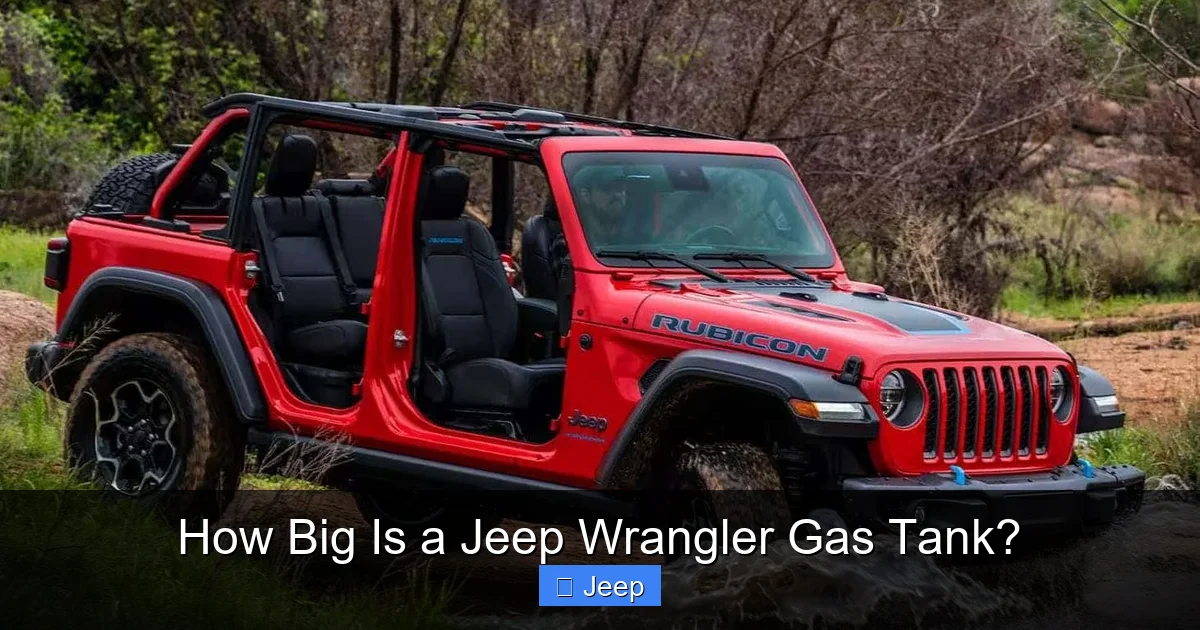
- Wheelbase: A longer vehicle (JLU) simply has more longitudinal space to fit a longer, larger-capacity tank. The 2-door’s shorter rear overhang limits tank volume.
- Suspension Design: The Wrangler’s solid rear axle with its significant travel needs clearance above the tank. A tank that’s too large could interfere with axle articulation or the exhaust.
- Exhaust System: The complex, routed exhaust for the V6 or turbo-4 engines must snake around the tank area, taking up precious space.
- Spare Tire Mount: In the JL, the optional spare tire carrier on the tailgate (common on Rubicon and some Sahara models) uses the space where a larger tank might otherwise extend.
- Safety & Emissions: Modern tanks must withstand rigorous crash tests and have sophisticated evaporative emission systems (charcoal canisters, lines), which add bulk.
Therefore, the 22.5-gallon tank in the JLU is a feat of engineering, maximizing every millimeter of available space in the longer chassis. The 17.4-gallon tank in the 2-door is the optimal solution for its shorter frame.
What This Means For You: Real-World Range & Planning
Knowing your tank’s *capacity* is only half the battle. Your *real-world range* is what truly matters. A 22.5-gallon tank sounds huge, but if you’re running 37-inch mud-terrains, a heavy front bumper, and a roof-top tent, your fuel economy can plummet from an EPA-rated 22 mpg highway to a real-world 14-16 mpg. Suddenly, that 22.5 gallons gets you 315-360 miles instead of nearly 500.
Visual guide about How Big Is a Jeep Wrangler Gas Tank?
Image source: dubai4wd.com
Factors That Devour Your Range:
- Tires: Larger, heavier, more aggressive tires increase rolling resistance dramatically. A lift kit often goes hand-in-hand with bigger tires, compounding the effect.
- Accessories: A steel front bumper, rock rails, a full undercarriage skid plate set, and a roof rack with a tent all add significant weight and wind resistance.
- Driving Style: The Wrangler’s boxy shape makes it a wind tunnel at highway speeds. Aggressive acceleration and high speeds will drain the tank fast. Off-road, low-range crawling in 4WD is exceptionally thirsty.
- Terrain & Load: Mountainous roads, deep sand, and towing a trailer are the biggest range killers. Always assume the worst-case scenario when planning remote trips.
Practical Tip: Use the “One-Third Rule” for off-road travel. Never let your fuel level drop below one-third of your tank’s capacity when you’re in truly remote areas. In a JLU with 22.5 gallons, that means refueling at around 7-8 gallons remaining. This gives you a crucial buffer for getting lost, slow going, or unexpected detours. For a 2-door with 17.4 gallons, start looking for a pump at about 5-6 gallons used.
Comparing the Wrangler to the Competition
Where does the Wrangler’s tank size stack up? It’s helpful to compare it to other popular SUVs, especially those it’s often cross-shopped with. For context, let’s look at a few examples from our comparison guides:
- A Toyota Camry, a midsize sedan, typically has a 15.8-gallon tank. The Wrangler’s smallest modern tank (JL 2-door, 17.4 gal) is actually larger, despite the Camry’s far superior fuel economy.
- A Nissan Altima also has a ~16-gallon tank. Again, the Wrangler’s tanks are physically larger, highlighting its adventure-oriented design over pure efficiency.
- Even a larger SUV like the Nissan Rogue has a 14.5-gallon tank. Its better MPG means similar range to a 2-door Wrangler, but the Wrangler’s larger tank in 4-door form provides a decisive advantage for long, non-highway trips.
The takeaway? The Wrangler, especially the JLU, prioritizes liquid fuel capacity over cabin space or weight savings. It’s built to go far between pumps, even if it pays for that capability at the pump itself. Speaking of costs, if you’re worried about the budget impact of filling that 22.5-gallon tank, our detailed analysis on how much gas costs for a Jeep Wrangler per month breaks down the real-world expenses you can expect based on your driving habits and local fuel prices.
Aftermarket Solutions: Going Beyond the Stock Tank
For the hardcore overlander who finds even 22.5 gallons insufficient for a multi-week expedition across the Australian outback or the Atacama Desert, the aftermarket offers solutions. These are not for the casual owner—they involve significant cost, fabrication, and potential warranty implications—but they exist.
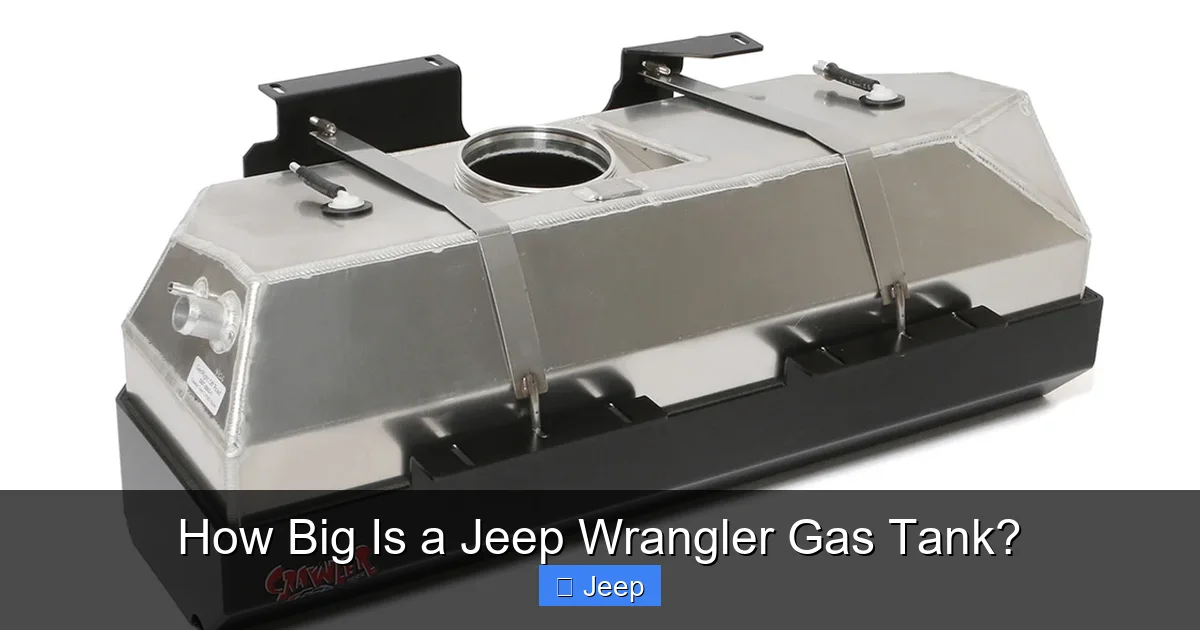
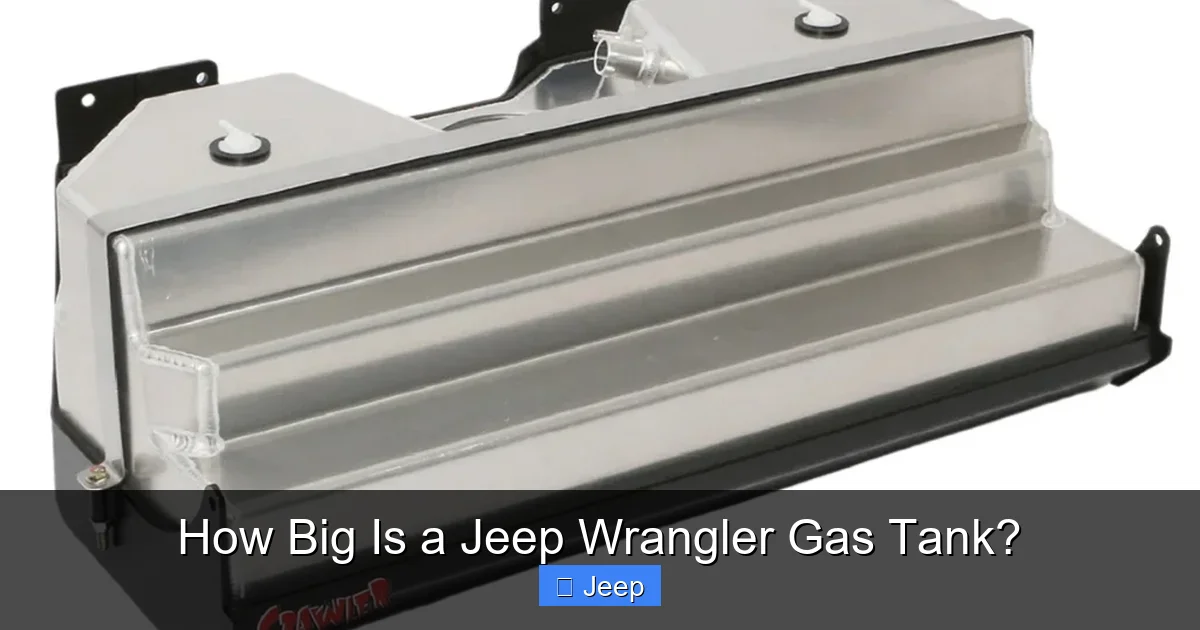
- Auxiliary Tanks: Companies like ARB, Front Runner, or Auto Trailer offer auxiliary fuel cells that mount in the cargo area, often replacing the spare tire or sitting in a custom cage. They connect to the main tank via a switching system. A common setup adds 10-15 gallons.
- Larger Replacement Tanks: For the JK and JL, some manufacturers produce a single, larger tank that replaces the stock unit. S&B Filters is famous for its large-capacity tanks that often integrate a pre-filter. These can boost capacity by 3-5 gallons over stock but require careful fitment checking with your specific axle/suspension setup.
- Jerry Can Mounts: The simplest and most flexible solution. High-quality steel or plastic jerry cans (5 gallons each) mounted on a rear bumper carrier or roof rack provide portable, removable range extension. This is the most common and versatile method.
Critical Warning: Any modification to the fuel system must be done professionally, with extreme attention to safety, venting, and local regulations. Improper installation is a serious fire hazard. Always inform your insurance company of major modifications.
Conclusion: Your Tank Size is Your Adventure Blueprint
So, how big is a Jeep Wrangler gas tank? The definitive answer is: it depends. For the classic TJ, it’s 15 gallons. For the JK/JKU, it’s 19 gallons. For the modern JL 2-door, it’s 17.4 gallons. For the JLU 4-door, it’s a best-in-class 22.5 gallons. And for the 4xe hybrid, it’s 17.4 gallons within a plug-in hybrid system. This isn’t arbitrary; it’s a direct reflection of the Wrangler’s DNA. The 4-door’s massive tank screams “expedition ready,” while the 2-door’s slightly smaller capacity accepts a trade-off for agility. Your specific tank size is a blueprint for your Wrangler’s adventure radius.
Don’t just memorize a number. Use this knowledge to plan. Check your driver’s door jamb sticker for your exact model year and trim. Then, be honest about your Wrangler’s modifications and your typical driving. Calculate a conservative real-world range using 75% of the EPA mileage estimate. That’s your reliable, go-anywhere number. Fill up before you hit that one-third mark in the backcountry. With that discipline, whether you have 15 gallons or 22.5, your Wrangler will take you to incredible places and bring you home safely. That’s what the tank size is really all about: enabling the journey, one gallon at a time.
Frequently Asked Questions
Does a Jeep Wrangler Rubicon have a bigger gas tank than a Sport?
No. Within the same body style (2-door or 4-door), all Wrangler trims—Sport, Sahara, Rubicon, and 4xe—share the exact same fuel tank capacity. The tank size is determined by the chassis length, not the trim level.
Why does my 2022 Jeep Wrangler Unlimited have a 22.5-gallon tank but my friend’s 2022 2-door only has 17.4?
This is by design. The 4-door Unlimited (JLU) has a longer wheelbase and rear overhang, physically allowing Jeep to install a larger, 22.5-gallon tank. The 2-door (JL) has a shorter chassis, limiting it to a 17.4-gallon tank for packaging and safety reasons.
What is the fuel filler door location on a Jeep Wrangler?
On all modern Wranglers (TJ generation and newer), the fuel filler door is located on the passenger (right) side of the vehicle, integrated into the rear quarter panel. You press a button or use the key fob to pop open a small hinged door to access the filler neck.
Can I install a larger gas tank in my 2-door Wrangler?
Aftermarket larger tanks or auxiliary cells are available, but options for the 2-door JL are more limited than for the 4-door due to space constraints. Most solutions involve an auxiliary tank in the cargo area or a spare tire-mounted jerry can system. Any major modification requires professional installation and safety consideration.
How far can a Jeep Wrangler go on a full tank of gas?
This varies wildly. A stock JLU Rubicon with 22.5 gallons and a conservative 20 mpg average has a theoretical range of 450 miles. A lifted 2-door with 37-inch tires might only get 14 mpg, reducing its 17.4-gallon range to about 240 miles. Always calculate using your own observed fuel economy.
Is the gas tank in a Wrangler 4xe smaller because it’s a hybrid?
Yes, but intentionally so. The 4xe uses a 17.4-gallon tank to make room for its high-voltage battery pack. The vehicle is designed for short, all-electric commutes. The gas tank provides extended range for longer trips when the battery is depleted, resulting in a combined system that often yields a greater total range than a gas-only Wrangler.
