
How Big Is a Nissan Altima Gas Tank?

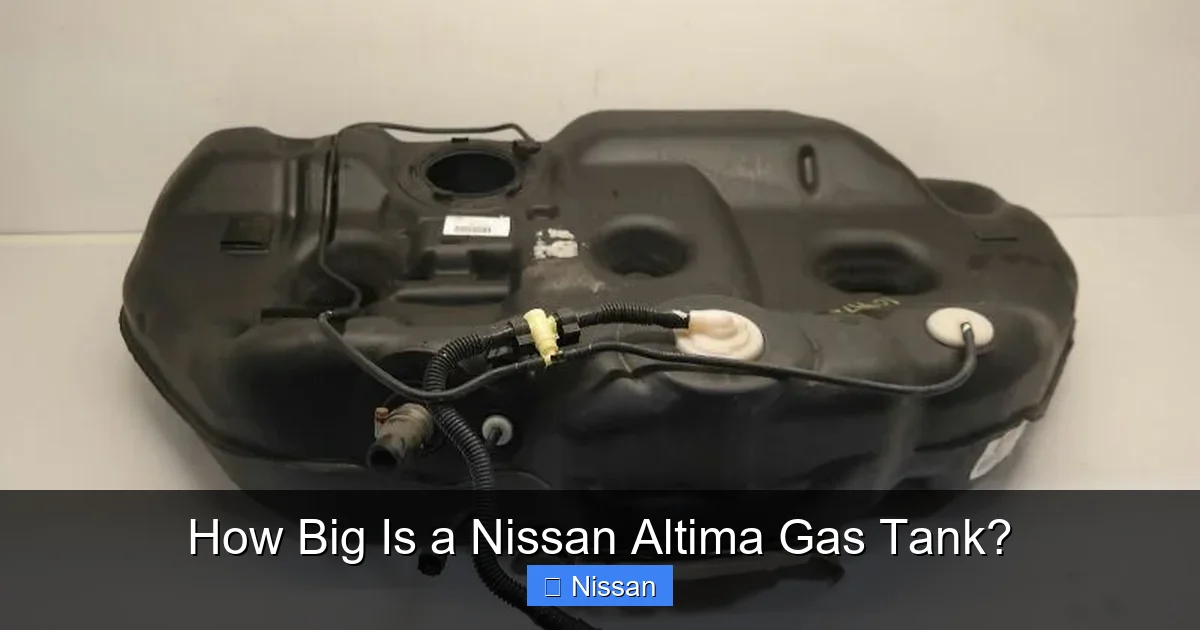
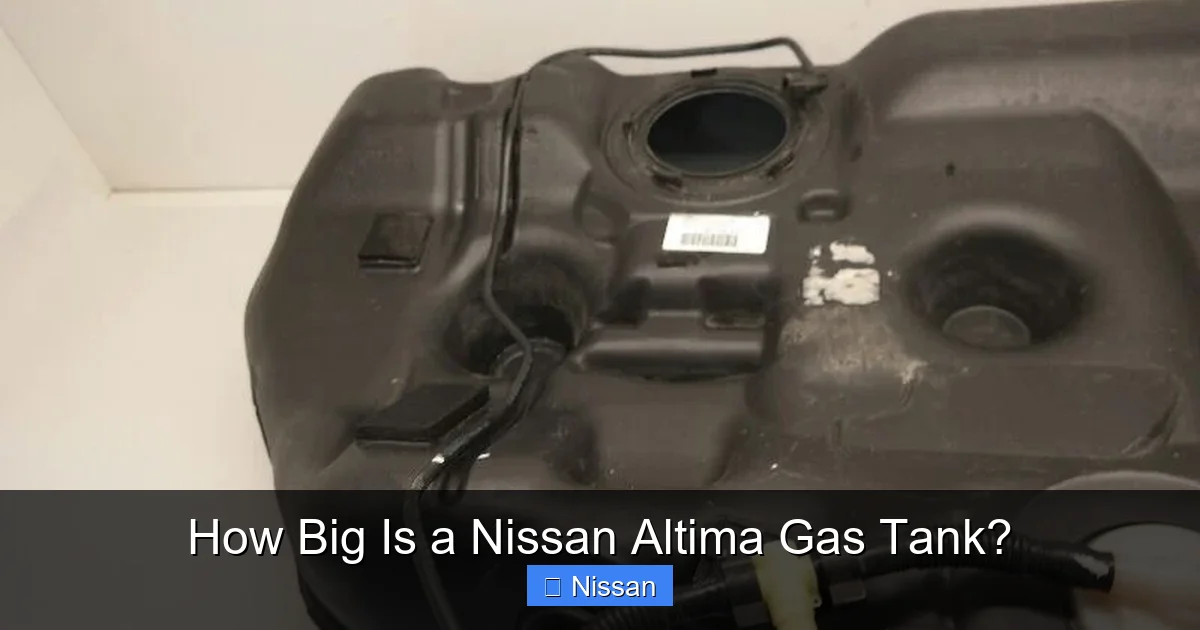
The Nissan Altima gas tank size typically holds between 16 and 18 gallons, depending on the model year and trim. This capacity, combined with strong fuel economy, allows most drivers to travel 400–600 miles on a single fill-up—making it a reliable choice for daily commutes and long-distance travel.
[FEATURED_IMAGE_PLACEHODEL]
Key Takeaways
- Standard Tank Size: Most Nissan Altima models from 2013 to 2024 feature a 16- to 18-gallon fuel tank, with newer trims often at the higher end.
- Fuel Efficiency Matters: The Altima’s combined MPG (up to 32–39 mpg on newer models) directly impacts how far you can go per tank.
- Real-World Range: With a full tank, expect to drive between 450 and 650 miles, depending on driving conditions and engine type.
- Engine Options Affect Usage: The 2.5L four-cylinder and 2.0L turbocharged VC-Turbo engines have different fuel consumption rates, influencing range.
- Fuel Type Recommendations: Always use regular unleaded gasoline (87 octane) unless specified otherwise—premium fuel offers no benefit for most trims.
- Maintenance Tips: Keeping your Altima well-maintained (tires, air filter, oil) maximizes fuel efficiency and extends range per tank.
- Eco Mode Helps: Using Eco Mode and smooth driving habits can stretch your fuel further, especially on highways.
📑 Table of Contents
How Big Is a Nissan Altima Gas Tank?
If you’re considering buying a Nissan Altima—or you already own one—you’ve probably wondered: How big is a Nissan Altima gas tank? It’s a practical question, especially if you commute long distances, take weekend road trips, or simply want to minimize trips to the gas station. The good news? The Nissan Altima is designed with efficiency and convenience in mind, and its fuel tank size reflects that.
Over the years, the Altima has evolved from a compact family sedan into a stylish, tech-savvy midsize car with impressive fuel economy. One of the key factors contributing to its appeal is its fuel tank capacity, which strikes a balance between range and vehicle weight. Most Altima models from the past decade come equipped with a gas tank that holds between 16 and 18 gallons. This size is common among midsize sedans and allows drivers to travel hundreds of miles without needing to refuel.
But tank size is only part of the story. What really determines how far you can go on a full tank is your Altima’s fuel efficiency. Newer models, especially those with the advanced 2.0L VC-Turbo engine, can achieve up to 39 miles per gallon on the highway. Combine that with an 18-gallon tank, and you’re looking at a potential range of over 600 miles—enough to drive from Los Angeles to San Francisco and back without stopping for gas.
In this guide, we’ll break down everything you need to know about the Nissan Altima gas tank: its size across different model years, how fuel economy affects real-world range, tips for maximizing efficiency, and answers to common questions. Whether you’re a current owner or shopping for a used Altima, this information will help you make smarter decisions about fueling and driving.
Nissan Altima Gas Tank Size by Model Year
Visual guide about How Big Is a Nissan Altima Gas Tank?
Image source: d1vnbry5hm94g5.cloudfront.net
One of the first things to understand is that the Nissan Altima’s gas tank size has remained relatively consistent over the years, with only minor variations between trims and generations. Let’s take a closer look at how the tank capacity has evolved.
2013–2018 Nissan Altima Gas Tank Size
During this period, the fifth-generation Altima (introduced in 2013) was known for its sleek design and strong fuel economy. Most models from 2013 to 2018 came with a 16-gallon fuel tank. This was standard across all trims, including the base S, mid-level SV, and top-tier SL.
Even with a slightly smaller tank compared to newer models, the 2013–2018 Altima delivered excellent range thanks to its efficient 2.5L four-cylinder engine, which averaged around 27 mpg in the city and 38 mpg on the highway. That means a full tank could take you approximately 430 miles in the city or over 600 miles on the highway—impressive for a non-hybrid sedan.
2019–2024 Nissan Altima Gas Tank Size
With the introduction of the sixth-generation Altima in 2019, Nissan made several upgrades, including a redesigned exterior, improved interior tech, and a new engine option. One of the notable changes was an increase in fuel tank capacity. Most 2019 and newer Altima models now feature an 18-gallon gas tank, giving drivers even more range between fill-ups.
This upgrade was especially beneficial for highway drivers and those who prefer fewer stops during long trips. The 2019–2024 models also introduced the innovative 2.0L VC-Turbo (Variable Compression Turbo) engine on higher trims like the SR and Platinum. While this engine offers more power, it still maintains strong fuel efficiency—up to 25 mpg city and 34 mpg highway—thanks to advanced engineering.
Even the base 2.5L engine in newer Altimas benefits from the larger tank. With up to 28 mpg city and 39 mpg highway, drivers can expect a range of around 500–650 miles on a full tank, depending on driving conditions.
Trim-Level Differences
It’s worth noting that while tank size is generally consistent across trims, there can be slight variations based on drivetrain and optional equipment. For example, all-wheel drive (AWD) models, introduced in 2020, may have a slightly different fuel system layout, but the tank capacity remains at 18 gallons.
Similarly, hybrid versions of the Altima (though rare and discontinued after 2011) had smaller tanks due to battery placement. However, since the current lineup is fully gasoline-powered, you can expect the standard 16- or 18-gallon tank across the board.
Fuel Efficiency and Real-World Range
Visual guide about How Big Is a Nissan Altima Gas Tank?
Image source: d1vnbry5hm94g5.cloudfront.net
Now that we know the tank size, let’s talk about what really matters: how far can you actually drive on a full tank? The answer depends heavily on your Altima’s fuel efficiency, which varies by engine, driving habits, and road conditions.
Understanding MPG Ratings
The Environmental Protection Agency (EPA) provides fuel economy estimates for every new vehicle, and the Nissan Altima consistently ranks among the most efficient midsize sedans. Here’s a quick breakdown of recent MPG ratings:
– **2.5L Four-Cylinder (FWD):** Up to 28 mpg city / 39 mpg highway / 32 mpg combined
– **2.0L VC-Turbo (FWD):** Up to 25 mpg city / 34 mpg highway / 29 mpg combined
– **2.5L Four-Cylinder (AWD):** Up to 25 mpg city / 32 mpg highway / 28 mpg combined
These numbers are based on ideal conditions, so real-world results may vary. But they give us a solid foundation for calculating range.
Calculating Your Altima’s Range
To estimate how far your Altima can go on a full tank, multiply the tank size by the combined MPG. For example:
– **2019 Altima with 2.5L engine (18-gallon tank, 32 mpg combined):**
18 × 32 = 576 miles
– **2022 Altima with 2.0L VC-Turbo (18-gallon tank, 29 mpg combined):**
18 × 29 = 522 miles
– **2015 Altima with 2.5L engine (16-gallon tank, 31 mpg combined):**
16 × 31 = 496 miles
These calculations show that even older models can deliver impressive range, while newer ones push the limits even further.
Factors That Affect Real-World Range
While EPA estimates are helpful, your actual mileage may differ based on several factors:
– **Driving Style:** Aggressive acceleration and hard braking reduce fuel efficiency. Smooth, steady driving can improve MPG by 10–20%.
– **Road Conditions:** Stop-and-go city traffic lowers MPG, while steady highway cruising maximizes it.
– **Weather:** Cold weather reduces engine efficiency, and using the heater or defroster increases fuel consumption.
– **Cargo and Passengers:** Extra weight in the car means the engine works harder, lowering MPG.
– **Tire Pressure:** Underinflated tires increase rolling resistance, reducing fuel economy by up to 3%.
For example, a 2023 Altima driven in heavy city traffic with frequent stops might only achieve 25 mpg instead of the advertised 28. That drops the range from 576 miles to about 450 miles—still respectable, but a reminder that conditions matter.
Tips to Maximize Fuel Efficiency and Range

Visual guide about How Big Is a Nissan Altima Gas Tank?
Image source: turbochaos.com
Want to get the most out of every gallon? Here are some practical tips to help you stretch your Altima’s fuel tank further.
Use Eco Mode
Most newer Nissan Altimas come with an Eco Mode button, usually located on the center console. When activated, Eco Mode adjusts the throttle response, transmission shift points, and climate control to prioritize fuel efficiency.
While it may feel slightly less responsive, the trade-off is better gas mileage—especially in city driving. Many drivers report a 5–10% improvement in MPG when using Eco Mode consistently.
Maintain Proper Tire Pressure
Check your tire pressure at least once a month and before long trips. The recommended PSI for your Altima is listed on a sticker inside the driver’s door jamb. Keeping tires properly inflated reduces drag and improves handling and safety.
A simple tire pressure check can save you money and extend your range. For every 1 PSI drop in pressure, fuel economy can decrease by 0.2%.
Keep Up with Regular Maintenance
A well-maintained Altima runs more efficiently. Follow the manufacturer’s recommended service schedule, including:
– Oil changes every 5,000–7,500 miles (use synthetic oil if recommended)
– Air filter replacement every 15,000–30,000 miles
– Spark plug inspection/replacement as needed
– Fuel system cleaning every 30,000 miles
A dirty air filter or old spark plugs can reduce engine performance and fuel economy. Regular maintenance ensures your engine burns fuel efficiently.
Avoid Excessive Idling
Idling wastes fuel without moving the car. If you’re waiting for someone or stuck in traffic for more than 30 seconds, consider turning off the engine (if safe to do so). Modern engines use less fuel to restart than they do to idle for extended periods.
Plan Efficient Routes
Use GPS apps like Google Maps or Waze to find the fastest, least congested routes. Avoiding traffic jams and construction zones can significantly improve your MPG.
Also, combine errands into one trip instead of making multiple short drives. A cold engine uses more fuel, so fewer trips mean better overall efficiency.
Reduce Weight and Drag
Remove unnecessary items from your trunk—every 100 pounds can reduce fuel economy by 1–2%. Also, avoid using roof racks or cargo carriers when not needed, as they increase aerodynamic drag.
Fuel Type and Octane Recommendations
Another important factor in maximizing your Altima’s performance and range is using the correct fuel.
Recommended Fuel for Most Altimas
Nissan recommends using regular unleaded gasoline with an octane rating of 87 for all current Altima models, including those with the 2.5L and 2.0L engines. This is the standard fuel available at most gas stations and is the most cost-effective option.
Using premium fuel (91–93 octane) does not improve performance or efficiency in these engines unless specifically required. The Altima’s engine control unit (ECU) is designed to optimize combustion with regular fuel, so paying extra for premium offers no benefit.
When Might Premium Be Needed?
In rare cases—such as extreme heat, high altitude, or heavy towing—your Altima’s engine may benefit from higher-octane fuel to prevent knocking. However, this is uncommon for normal driving conditions.
Always refer to your owner’s manual. If it says “premium fuel recommended,” follow that guidance. But for the vast majority of Altima owners, regular unleaded is perfectly fine.
Ethanol Blends and Fuel Quality
Most gasoline in the U.S. contains up to 10% ethanol (E10), which is safe for your Altima. Avoid E85 (85% ethanol) unless your vehicle is specifically designed for flex-fuel—most Altimas are not.
Stick to reputable gas stations to ensure fuel quality. Contaminated or low-quality fuel can harm your engine and reduce efficiency.
Comparing the Altima to Competitors
How does the Nissan Altima stack up against other midsize sedans in terms of gas tank size and range?
Toyota Camry
The Toyota Camry typically has a 15.8-gallon fuel tank, slightly smaller than the Altima’s 16–18 gallons. However, the Camry often achieves similar or slightly better fuel economy, especially with its hybrid version. The non-hybrid Camry gets up to 28 mpg city / 39 mpg highway, giving it a range of about 550 miles—comparable to the Altima.
Honda Accord
The Honda Accord features a 14.8-gallon tank, smaller than the Altima’s. But with excellent fuel economy (up to 32 mpg combined), it still delivers a solid range of around 475 miles. The Accord Hybrid, however, can exceed 500 miles per tank.
Hyundai Sonata
The Sonata has a 16.4-gallon tank and achieves up to 30 mpg combined, giving it a range of nearly 500 miles. Like the Altima, it offers a turbocharged engine option for more power.
Why the Altima Stands Out
While some competitors have smaller tanks, the Altima’s combination of large capacity and strong fuel economy gives it one of the best ranges in its class. The 18-gallon tank in newer models is a significant advantage for long-distance drivers.
Conclusion: Is the Nissan Altima Gas Tank Big Enough for You?
So, how big is a Nissan Altima gas tank? The answer is: plenty big. With a capacity of 16 to 18 gallons and excellent fuel efficiency, the Altima delivers a range that rivals—and often exceeds—that of its competitors.
Whether you’re commuting 50 miles a day or planning a cross-country road trip, the Altima’s gas tank size ensures you won’t be stopping for fuel too often. And with smart driving habits and regular maintenance, you can stretch that range even further.
The Altima proves that you don’t need a hybrid or electric vehicle to enjoy long-range driving. Its blend of practicality, efficiency, and comfort makes it a top choice for drivers who value both performance and economy.
If you’re in the market for a reliable, fuel-efficient sedan, the Nissan Altima is definitely worth considering. Just remember: the size of the gas tank is important, but how you use it matters even more.
Frequently Asked Questions
What is the gas tank size of a 2023 Nissan Altima?
The 2023 Nissan Altima has an 18-gallon fuel tank, standard across all trims including S, SV, SR, and Platinum. This larger capacity helps support its impressive highway range.
Can I use premium gas in my Nissan Altima?
No, premium gas is not required for most Nissan Altima models. The manufacturer recommends regular unleaded gasoline (87 octane) for optimal performance and fuel economy.
How many miles can a Nissan Altima go on a full tank?
Depending on the model and driving conditions, a Nissan Altima can travel between 450 and 650 miles on a full tank. Newer models with the 2.5L engine and 18-gallon tank often exceed 600 miles on the highway.
Does the Nissan Altima have a reserve fuel tank?
The Nissan Altima does not have a separate reserve tank, but the fuel gauge includes a low-fuel warning light that activates when about 2–3 gallons remain, giving you time to find a gas station.
Is the gas tank size the same for AWD and FWD Altimas?
Yes, both front-wheel drive (FWD) and all-wheel drive (AWD) Nissan Altima models have the same 18-gallon fuel tank. The drivetrain does not affect tank capacity.
How often should I fill up my Nissan Altima?
Most drivers can go 10–14 days between fill-ups, depending on mileage and driving habits. With an average range of 500+ miles, you’ll likely refuel every 1–2 weeks for typical daily use.
