
How Many Gallons Does a Jeep Wrangler Hold

The Jeep Wrangler’s fuel tank capacity varies significantly by generation and model year, ranging from 15.6 gallons in some early TJ models to 22.5 gallons in certain four-door JL Unlimited models. Newer Wranglers often have smaller tanks than their predecessors, a trade-off for improved packaging and emissions equipment. Your actual range depends on driving style, terrain, and any aftermarket modifications like larger tires or lift kits, which can dramatically reduce fuel economy.
Key Takeaways
- Tank size is not uniform: Fuel capacity changes between the YJ, TJ, JK, and JL generations and even varies within the same model year based on engine and trim.
- Two-door vs. four-door difference: The Jeep Wrangler Unlimited (four-door) typically has a larger fuel tank than the standard two-door model to compensate for its greater weight and to enable longer adventures.
- Modern vs. classic trade-offs: Later model Wranglers (JK/JL) prioritize interior space and technology, sometimes resulting in a smaller tank compared to the robust, simpler TJ and early JK models.
- Modifications impact usable range: Lifts, larger all-terrain tires, and added armor increase weight and aerodynamic drag, reducing miles per gallon and effectively diminishing your tank’s practical range.
- Aftermarket solutions exist: For owners needing extreme range, auxiliary fuel tanks or larger replacement tanks are available, though they may affect warranty and vehicle systems.
- Know your specific VIN: The most accurate way to determine your Wrangler’s exact tank capacity is through your vehicle’s VIN, a dealer inquiry, or the official window sticker.
📑 Table of Contents
- Introduction: More Than Just a Number
- The Evolution of Fuel Tank Capacities: By Generation
- Factors That Influence Your Wrangler’s Fuel Capacity
- Real-World Implications: Calculating Your True Range
- Comparison with Other Popular SUVs
- Tips for Maximizing Your Fuel Range and Managing Capacity
- Conclusion: Know Your Jeep, Plan Your Journey
Introduction: More Than Just a Number
If you own a Jeep Wrangler or are thinking about buying one, one of the most practical—and often debated—specifications is its fuel tank capacity. It’s the simple arithmetic that defines your adventure radius: tank size multiplied by miles per gallon equals your range before you need to find a gas station. But for the iconic Wrangler, the answer to “how many gallons does a Jeep Wrangler hold?” is rarely a single, straightforward number. It’s a story of engineering evolution, model differentiation, and the eternal compromise between capability and convenience.
From the boxy YJ of the late 1980s to the refined JL of today, the Wrangler’s tank has been reshaped, resized, and repositioned to meet changing demands. Whether you’re planning a cross-country trip, a remote trail run, or just your daily commute, understanding your specific Wrangler’s fuel capacity is crucial for planning and peace of mind. This guide will dive deep into every generation, configuration, and nuance, giving you a complete picture of exactly how much fuel your Jeep can hold and what that means for you on the road and trail.
The Evolution of Fuel Tank Capacities: By Generation
The Jeep Wrangler’s lineage is divided into four main generations, each with its own architecture and design priorities. The fuel tank, often located under the rear of the vehicle ahead of the rear axle, has been a key component in balancing interior space, ground clearance, and range. Let’s break down the capacities for each era.
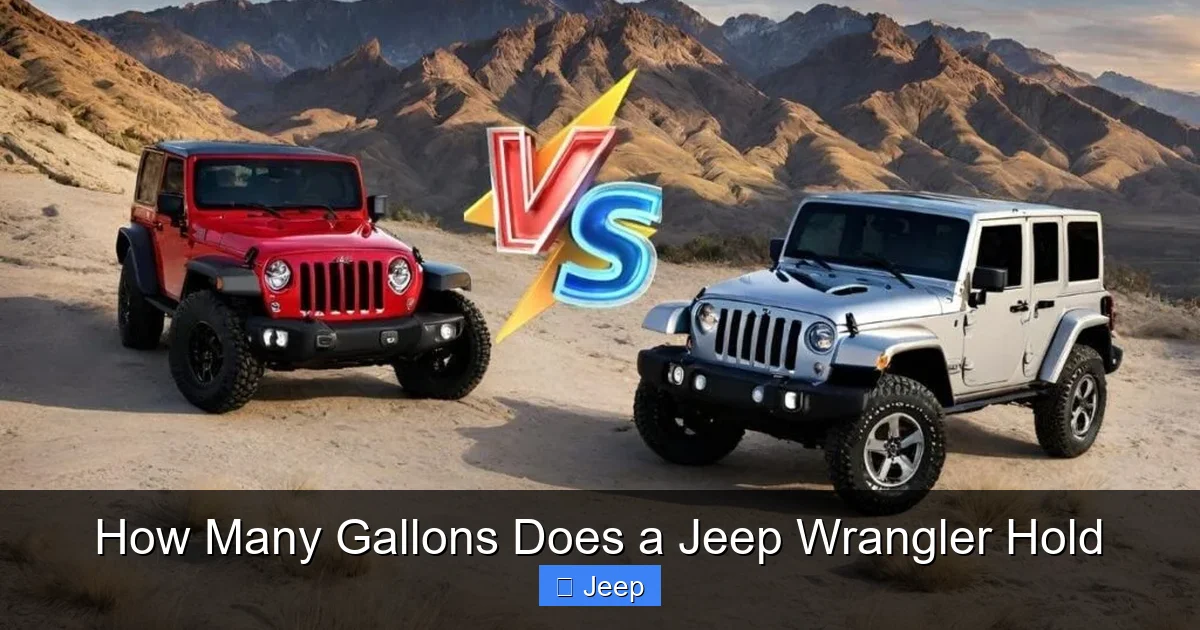
Visual guide about How Many Gallons Does a Jeep Wrangler Hold
Image source: automadesimply.com
YJ Wrangler (1987-1995): The Square-Bodied Foundation
The first Wrangler, the YJ, set the template. Its fuel tank was a relatively simple, rectangular steel unit. Capacity was consistent across most models during this long production run.
- Standard Tank Capacity: 20.0 gallons
- Notable Variation: The high-output 4.0L inline-six engine was the only option for most years, so tank size was uniform. The 1991-1993 “Renegade” package did not alter tank size.
The YJ’s 20-gallon tank was considered adequate for its time, offering a respectable range even with the modest fuel economy of the 4.0L engine paired with an automatic transmission. Its simple design was also easy to replace or modify.
TJ Wrangler (1997-2006): The Round-Faced Revival
The return to the classic round headlights on the TJ brought significant mechanical changes. The most notable fuel tank shift occurred in the middle of its production run.
- 1997-1999 Models: 15.6 gallons (a surprisingly small tank for a rugged SUV, often criticized by owners).
- 2000-2006 Models: 19.0 gallons (a welcome increase after the 1999 model year).
The early TJ’s 15.6-gallon tank was a point of contention. Jeep made the change to accommodate a new rear suspension design and possibly to meet evolving emissions and packaging needs. The switch to a 19-gallon tank in 2000 was a direct response to owner feedback, recognizing that a vehicle capable of serious off-roading needed more range. The TJ also saw the introduction of the long-wheelbase Unlimited (LWB) in 2004, which retained the 19-gallon tank.
JK Wrangler (2007-2018): The Modern Era Begins
The JK generation was a monumental shift: a four-door Unlimited model became a permanent, popular fixture. This immediately created a tank size disparity.
- JK Two-Door (2007-2018): 18.5 gallons
- JK Unlimited Four-Door (2007-2018): 22.5 gallons
The difference is stark and purposeful. The heavier, longer four-door needed more fuel to maintain a similar range to its two-door sibling. The 22.5-gallon tank in the Unlimited became a defining feature for overlanders and long-distance travelers. Within the JK line, engine choice (3.6L Pentastar V6, 3.8L V6 in early years, later the 2.0L turbo and 3.6L with eTorque) did not change the physical tank size, though the diesel (in some markets) and hybrid concepts were different stories entirely.
JL Wrangler (2019-Present): Refinement and Hybrid Options
The current JL generation continued the two-door/four-door philosophy but with some intriguing tweaks and new powertrain options.
- JL Two-Door (2019-Present): 17.6 gallons (with the 3.6L V6, 2.0L Turbo, or 4xe Hybrid).
- JL Unlimited Four-Door (2019-Present): 21.5 gallons (with the 3.6L V6 or 2.0L Turbo).
- JL Wrangler 4xe (Plug-in Hybrid): ~17.7 gallons (gas tank only, plus a large battery). The total combined range is much higher, but the physical gasoline tank is slightly smaller than the standard JL two-door.
The JL saw a slight reduction in tank size compared to the JK, particularly for the two-door. This was likely a packaging decision to make room for new emissions systems (like the gas vapor recovery canister) and to slightly increase interior cargo space. The four-door’s 21.5-gallon tank remains the largest in the current lineup. The 4xe’s smaller tank is a compromise made to fit the battery pack, but its hybrid powertrain means the impact on total range is minimal for most drivers.
Factors That Influence Your Wrangler’s Fuel Capacity
Knowing the base numbers is just the start. Several factors can change the effective fuel capacity and, more importantly, your real-world range.

Visual guide about How Many Gallons Does a Jeep Wrangler Hold
Image source: automadesimply.com
Model Year, Trim, and Engine
As detailed above, the generation and body style (2-door vs. 4-door) are the primary determinants. However, within a specific model year, the base Sport, more luxurious Sahara, and off-road-focused Rubicon trims all share the same fuel tank capacity. The engine choice, for most of the Wrangler’s history, does not change the tank size. A 2023 Wrangler Rubicon 392 (the supercharged V8) uses the same 21.5-gallon tank as the standard V6 four-door. The exception is the 4xe hybrid, which has a uniquely sized tank due to its packaging needs.
The Impact of Aftermarket Modifications
This is where things get interesting for the Jeep community. A bone-stock Wrangler’s tank is just the starting point. Modifications don’t change the tank’s physical volume, but they dramatically affect how far that volume takes you.
- Larger Tires & Lift Kits: This is the #1 range killer. A lift kit (like those discussed in our article on how much a Jeep lift costs) combined with 33-inch or larger tires adds significant rotating mass and changes the vehicle’s aerodynamics and gearing. A 2-5 MPG drop is common, sometimes more. Your 21.5-gallon tank that once gave you 350 miles might now only deliver 280.
- Added Weight: Heavy steel bumpers, rock sliders, winches, and full armor can add 300-500 lbs. More weight means more energy required to move, lowering fuel economy. You can read more about the weight implications of accessories in our piece on how much a Jeep Wrangler weighs.
- Roof Racks & Carriers: A loaded roof rack creates massive aerodynamic drag, especially at highway speeds. This can be another 1-3 MPG hit.
Practical Tip: If you add major mods, recalculate your realistic range. Assume a conservative 15-20% drop in MPG from the stock EPA estimates.
Driving Conditions and Style
The EPA ratings are a baseline. Real-world miles per gallon are highly variable.
- Off-Road vs. Highway: Low-range crawling in 4WD can burn fuel at 2-3 times the highway rate. A tank that lasts a week of city driving might be consumed in a few hours on a technical trail.
- City vs. Highway: Stop-and-go traffic is less efficient than steady cruising.
- Climate: Using the AC in summer or the heater in winter (especially in a cold-weather Jeep with a large cabin) increases engine load.
- Payload: Carrying a full crew and gear adds weight. A Wrangler’s payload capacity is limited, and exceeding it hurts efficiency and safety.
Real-World Implications: Calculating Your True Range
So, you know your tank holds, say, 21.5 gallons. How far can you actually go? It’s a simple multiplication, but you need the right multiplier.
Visual guide about How Many Gallons Does a Jeep Wrangler Hold
Image source: automadesimply.com
Using the EPA Estimate (With a Grain of Salt)
The EPA provides combined, city, and highway MPG ratings. For a current JL Unlimited with the 3.6L V6, the rating is around 22 MPG combined. Simple math: 21.5 gallons * 22 MPG = ~473 miles. Sounds great! But this is a best-case, controlled-test scenario.
A More Realistic “Adventure” Calculation
For a Wrangler owner who occasionally hits the highway but also does moderate off-roading and has a roof rack, a more realistic average might be 17-19 MPG. Let’s use 18 MPG as a practical, real-world average for a moderately equipped four-door.
- Practical Range: 21.5 gallons * 18 MPG = 387 miles.
Now, factor in a safety margin. You should rarely run a vehicle to complete dry tank. Fuel pumps are cooled by gasoline, and sediment sits at the bottom. Plan to refuel when you have 1-2 gallons left, or about a 50-70 mile reserve. Your usable range drops to ~320-340 miles.
The “Trail” Calculation
For a dedicated off-road trip where you’re on dirt, in low range, and at slower speeds, your MPG could plummet to 10-12. That same 21.5-gallon tank might only give you 215-258 miles of *trail time*, which could be consumed in a single long day on the Rubicon or Moab. This is why serious off-roaders often carry extra fuel in certified jerry cans.
Key Insight: Your tank’s capacity is a fixed number, but your effective range is a fluid figure heavily dependent on your Jeep’s setup and your driving habits. Always plan conservatively, especially in remote areas.
Comparison with Other Popular SUVs
How does the Wrangler’s tank size stack up? It’s informative to look at its segment and beyond.
- Toyota RAV4: A popular compact crossover, the RAV4 holds about 14.5 gallons. With its superior fuel economy (up to 40 MPG hybrid), its range is comparable or better than a Wrangler, but it lacks the Wrangler’s off-road prowess and cargo flexibility. You can see the specifics for a Toyota RAV4’s tank size here.
- Ford Bronco Sport: The Bronco Sport’s smaller sibling holds about 13.8 gallons. Its efficient powertrains give it good range, but it’s a different class of vehicle.
- Ford Bronco (full-size): The direct competitor to the Wrangler Unlimited holds 20.1 gallons in its standard configuration—slightly less than the JL’s 21.5. Its newer powertrains are often more efficient, potentially closing the range gap.
- Honda CR-V: Another crossover leader, holding about 14 gallons. Its efficiency-focused design prioritizes MPG over massive tank size.
- Full-Size Trucks/SUVs: Vehicles like the Nissan Armada (26.7 gallons) or Toyota Sequoia have much larger tanks, but they are in a completely different weight and efficiency class. Check out the Nissan Armada’s massive tank for contrast.
The Verdict: The Wrangler Unlimited’s 21.5-22.5 gallon tank is large for its class (mid-size SUV), acknowledging its intended use for adventure and towing. The two-door’s smaller tank is more in line with its smaller size and weight, but still larger than most efficient crossovers, reflecting its less efficient powertrain and potential for heavy off-road use.
Tips for Maximizing Your Fuel Range and Managing Capacity
Whether you have a 15.6-gallon TJ or a 22.5-gallon JK Unlimited, you can optimize your Wrangler’s usable range.
1. Drive Efficiently (Yes, Really)
This sounds obvious, but in a Jeep, it’s easy to drive aggressively. Gentle acceleration, maintaining steady highway speeds (using cruise control), and anticipating stops can improve your MPG by 10-20%. In off-road situations, use the appropriate gear and avoid excessive engine RPM when possible.
2. Maintain Your Jeep Religiously
A well-maintained engine runs efficiently. Stick to oil change intervals, replace air filters (especially if you off-road in dusty conditions), keep tires properly inflated (under-inflation kills MPG), and ensure your alignment is correct. A clogged fuel filter or failing oxygen sensor can also hurt economy.
3. Be Strategic About Modifications
If range is a priority, be ruthless with mods. Choose lighter aluminum bumpers over steel. Consider the trade-off of a 35-inch tire (great look, big MPG hit). If you add a lift, re-gearing (changing axle gears) can help recover some lost acceleration and efficiency. Always research the MPG impact of any major modification before buying.
4. Consider an Auxiliary Fuel Tank for Expeditions
For overlanders heading into the deep backcountry, an aftermarket auxiliary tank is a popular solution. These range from small, bolt-on “saddle” tanks that fit between the frame rails to larger replacements that substitute for the stock tank. Critical: Any fuel system modification must be done professionally, using certified parts, to ensure safe venting, fuel pump compatibility, and to avoid triggering check engine lights. It may also affect your vehicle’s emissions compliance and warranty.
5. Plan Your Refueling Points Meticulously
In remote areas, gas stations can be 100+ miles apart. Use apps like GasBuddy or onX Offroad to plan fuel stops. Never assume a listed station on a map has fuel, especially in small towns. Carry a certified fuel container (like a 5-gallon jerry can) for emergency reserve, stored and secured properly outside the cabin.
6. Understand Your Specific Jeep
Don’t rely on internet averages. Fill your tank from the pump click-off, reset your trip odometer, drive normally until you refuel again, and calculate your actual MPG. Do this a few times to get your personal average. Multiply that by your tank’s *usable* capacity (about 90-95% of the gross volume) for your true, personal range number.
Conclusion: Know Your Jeep, Plan Your Journey
The question “how many gallons does a Jeep Wrangler hold?” opens a window into the soul of the vehicle itself. The answer tells you about its era (a TJ with 15.6 gallons is a different experience than a JL Unlimited with 21.5), its intended purpose (the Unlimited’s larger tank begs for long trips), and the compromises made for modern comforts. Your Wrangler’s fuel tank is more than a container; it’s a fundamental part of your adventure equation.
Whether you’re in a bone-stock 2024 JL Sahara or a lifted, armored 2007 JK Rubicon, the principle remains the same: know your exact capacity, understand your real-world MPG (which will differ from the window sticker), and always plan with a significant safety margin. The freedom of a Jeep is the freedom to go anywhere, but that freedom is bounded by fuel. Respect that boundary, plan accordingly, and your Wrangler will take you to incredible places, one tankful at a time. For more insights into your Jeep’s specifications and costs, explore our other guides on paint jobs or vinyl wraps to customize your ride.
Frequently Asked Questions
Why do some Jeep Wranglers have such small fuel tanks, like the early TJ’s 15.6 gallons?
The early TJ Wrangler (1997-1999) had a smaller tank due to a redesign of the rear suspension and fuel system packaging. It was widely criticized by owners for its poor range, leading Jeep to increase the capacity to 19.0 gallons starting in the 2000 model year. It’s a classic example of an initial design oversight corrected by customer feedback.
Will installing a lift kit and larger tires affect how many miles I can drive on a full tank?
Absolutely. Lift kits and larger, heavier all-terrain tires increase rolling resistance and vehicle weight, which significantly reduces fuel economy. You can expect a 2-5 MPG drop, sometimes more. This doesn’t change the tank’s physical capacity in gallons, but it drastically reduces the number of miles you can travel on those gallons.
Are there aftermarket larger fuel tanks available for the Jeep Wrangler?
Yes, several companies manufacture larger replacement tanks or auxiliary “saddle” tanks for Wranglers, especially the JK and JL generations. These can increase capacity by 2-5 gallons. However, installation can be complex, may require modifications to the fuel system or exhaust, and must be done with certified parts to be safe and legal. Always check local regulations and warranty implications.
Do the four-door Wrangler Unlimited models always have a bigger tank than two-doors?
Yes, this has been a consistent strategy since the JK generation. The four-door is heavier and often used for more family-oriented, long-distance travel. To provide a comparable range to the two-door, it gets a larger tank (e.g., 22.5 gallons on JK vs. 18.5 on JK two-door). The JL continues this with 21.5 gallons for the four-door vs. 17.6 for the two-door.
What’s the safest way to determine my specific Wrangler’s exact fuel tank capacity?
The most reliable method is to check your vehicle’s original window sticker (Monroney label) if you have it. You can also contact a Jeep dealer with your VIN; they can look up the exact specifications for your build. For a DIY check, you can run the vehicle to near empty (with extreme caution), then carefully add a known quantity of fuel (like 5 gallons from a jerry can) and see how many gallons it takes to fill at the pump, but this is risky and not recommended.
How much fuel should I have left in the tank when I plan to refuel?
You should never run your Wrangler to “empty.” The fuel pump is cooled by gasoline, and running it dry can cause premature failure. Sediment also settles at the bottom of the tank and can be sucked into the system. A good rule is to refuel when you have 1-2 gallons remaining, or when your low-fuel light illuminates (which typically comes on with about 2-3 gallons left, depending on the model). This gives you a 50-70 mile buffer and protects your fuel system.
