
How Deep of Water Can a Tesla Drive Through?

Teslas are not designed for driving through deep water. While they have some密封 protection, official wading depths are low (typically 12-24 inches). Attempting to drive through deeper water risks catastrophic battery damage, electrical failure, and voiding your warranty. The safest approach is always to turn around and find an alternate route.
Key Takeaways
- Teslas have limited wading ability: Official specifications range from about 12 inches for most models to 24 inches for the Model S/X. This is far less than many gasoline SUVs or trucks.
- Battery packs are the critical vulnerability: While sealed, a Tesla’s high-voltage battery is not a submarine. Water intrusion can cause immediate short circuits, thermal runaway (fire), and total vehicle loss.
- Your warranty will be voided: Tesla’s warranty explicitly excludes damage from “liquid intrusion” or “flooding.” Driving through deep water is an expensive mistake not covered by insurance or warranty.
- Hydro-lock is a real danger for electric motors: Unlike gasoline engines that can sometimes be dried out, water in a Tesla’s motor or power electronics typically results in instant, irreversible damage.
- All-wheel drive does not mean amphibious: Tesla’s AWD system is for traction on roads and light off-road surfaces, not for creating buoyancy or sealing against water pressure.
- The safest strategy is avoidance: Never guess water depth. Turn around, find a higher route, or wait for waters to recede. Your life and your $80,000+ vehicle are not worth the risk.
- Post-flood inspection is mandatory: If you suspect any water exposure, have a Tesla Service Center inspect the vehicle before driving it again. Do not attempt to start it.
📑 Table of Contents
- Introduction: The Allure and the Reality of EVs in Water
- Tesla’s Design Philosophy: Sealed for Protection, Not for Submersion
- Official Wading Depth Specifications: What Tesla Actually Says
- Real-World Incidents: When Theory Meets Disaster
- The Dangers of Deep Water Driving: Beyond Just “Getting Wet”
- What To Do Instead: The Only Safe Strategy
- Comparing to Traditional Vehicles: Why Trucks and SUVs Seem to Do Better
- The Future: Will EVs Ever Be Better in Water?
- Conclusion: Respect the Water, Enjoy the Drive
Introduction: The Allure and the Reality of EVs in Water
You’re driving your Tesla. The rain is coming down hard. Up ahead, you see a familiar road now transformed into a gushing river of muddy water. Other trucks and SUVs seem to be forging ahead. Your Tesla is all-wheel drive, sleek, and powerful. Could it make it? The question “how deep of water can a Tesla drive through?” is a common one, born from a mix of curiosity and real-world necessity. It taps into the idea that electric vehicles, with their sealed batteries and lack of traditional air intakes, might be better suited for aquatic adventures than their gasoline-guzzling cousins.
But here’s the cold, hard truth: your Tesla is not a boat. It is a marvel of modern engineering, but its engineering priorities are efficiency, performance, and daily drivability—not amphibious capability. The consequences of misjudging water depth in a Tesla are severe, often leading to a total loss of the vehicle. This article will dive deep (pun intended) into the technical realities, official specifications, real-world risks, and the absolute best practices for any Tesla owner facing a flooded road. We’ll separate the myths from the engineering facts.
Tesla’s Design Philosophy: Sealed for Protection, Not for Submersion
To understand why Teslas have specific water limits, we need to look at their design. Electric vehicles have inherent advantages and disadvantages when it comes to water.

Visual guide about How Deep of Water Can a Tesla Drive Through?
Image source: cdn.motor1.com
The Sealed Battery Pack: A Fortress, But Not a Submarine
The heart of a Tesla is its large, flat battery pack located in the floor of the vehicle. This pack is rigorously sealed to meet IP67 standards for its individual cells and modules. IP67 means it is completely dust-tight and can withstand immersion in water up to 1 meter (about 39 inches) for a limited time under controlled laboratory conditions. This is a fantastic protection rating against rain, puddles, and even driving through moderately deep water on roads.
However, there’s a massive gap between “can survive brief, static immersion” and “can drive through moving water.” The IP rating tests a stationary object in calm water. It does not account for water pressure exerted by movement, the force of a vehicle pushing through a current, or the constant dynamic stress on seals. Furthermore, the battery pack is just one component. The entire undercarriage—including the motor(s), power electronics, high-voltage cabling, and the 12V battery—must also remain dry. The seals around axles, wiring conduits, and the vehicle’s belly pan are the weak points in a dynamic water crossing scenario.
No Air Intake, But Many Other Entry Points
A common myth is that Teslas, lacking a traditional engine air intake, are inherently more watertight. While it’s true you don’t have to worry about hydrolocking a combustion engine (where water enters the cylinders and stops the piston), this is only one of many failure modes. The electric motor is a sealed unit, but its cooling system and connections are not designed for high-pressure water jets. The biggest risks come from:
- High-Voltage Cables: These run along the underside. A single nick or seal failure can expose live conductors to water.
- The charge port and its associated electronics are located in the rear quarter panel. Deep water can breach this area.
- The 12V battery (which powers all the car’s computers and accessories) is in the front trunk. This area can flood if water is deep enough to reach the front wheels and splash upward.
- Suspension and Steering Components: These have moving parts and boots that can fail under pressure, allowing water into critical areas.
Official Wading Depth Specifications: What Tesla Actually Says
Unlike manufacturers of off-road vehicles like the Jeep Wrangler or Toyota 4Runner, Tesla does not prominently advertise “wading depth” or “water fording” capabilities in its owner’s manuals or marketing materials. This is a deliberate choice, signaling that it is not a designed feature. However, specifications and tests have emerged.
Visual guide about How Deep of Water Can a Tesla Drive Through?
Image source: i.pinimg.com
Model S and Model X: The Deepest (But Still Shallow)
The larger, older-platform Model S and Model X have the highest quoted wading depths. Various sources, including Tesla’s own service information and tests by owners, suggest these models can potentially handle water up to approximately 24 inches (61 cm). This is still very shallow—less than the average depth of a car’s door sill. It is crucial to remember this is a maximum under perfect, calm conditions with a slow, controlled entry and exit. It is not a recommendation.
Model 3 and Model Y: The Standard for Most Owners
The more popular Model 3 and Model Y have a lower official or estimated wading depth. Most credible sources place their safe limit around 12 inches (30 cm). Some owner reports suggest they may manage slightly more in a pinch, but this is anecdotal and risky. The lower ground clearance of these models compared to the S/X means they will encounter the bottom of the car much sooner in a dip or puddle.
Cybertruck: The Unknown Quantity
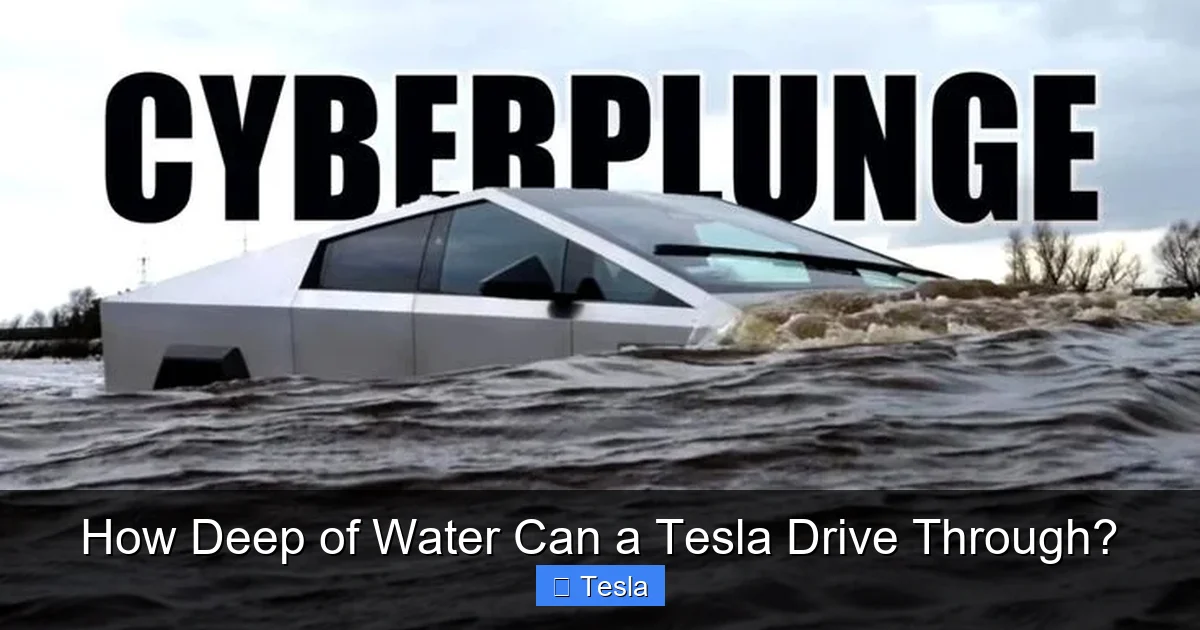
The upcoming Cybertruck is the great unknown. Its stainless steel exoskeleton and high claimed approach/departure angles suggest *potential* for better water handling. Tesla CEO Elon Musk has vaguely stated it could “float for a while.” However, without an official wading depth from Tesla and given the vehicle’s unique construction, it is impossible to give a reliable figure. All current Tesla models should be considered equally unsuitable for intentional deep-water driving.
Real-World Incidents: When Theory Meets Disaster
The internet is filled with videos of Teslas attempting water crossings. The outcomes are almost universally bad and serve as stark warnings.
Visual guide about How Deep of Water Can a Tesla Drive Through?
Image source: cdn.motor1.com
The China Flooding Video: A Case Study in Catastrophe
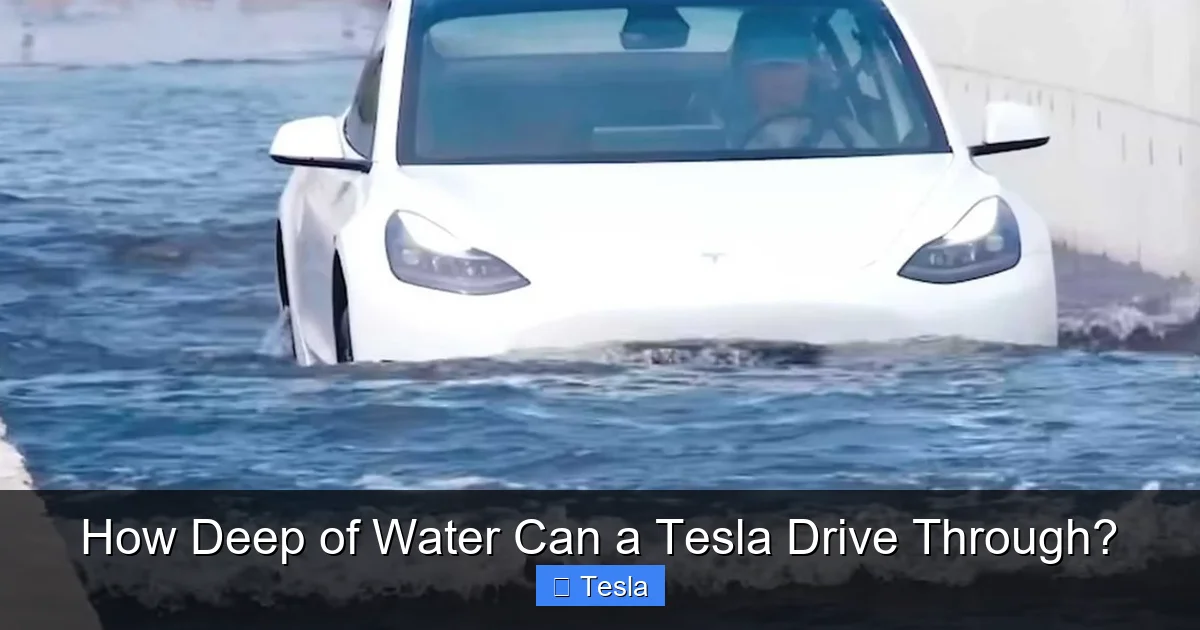
One widely circulated video from China shows a new Tesla Model 3 attempting to drive through what appears to be a flooded underpass. The car enters the water, which is clearly above its door handles. Within seconds, it slows, stops, and begins to float stern-first, like a bathtub toy. The front end sinks, and the vehicle is completely submerged. The damage is, as you’d expect, total. The high-voltage battery was compromised, leading to a very expensive and hazardous recovery operation. This video perfectly illustrates the lack of buoyancy and the rapidity of failure.
Why Teslas Don’t “Float” Like Some ICE Cars
Some older, heavy gasoline cars with large engines can sometimes float briefly due to the heavy iron block in the front. A Tesla’s battery pack is incredibly heavy (over 1,000 lbs), but it is sealed and located centrally. The rest of the car is relatively lightweight aluminum and steel. This can lead to a unstable, tail-heavy floatation that quickly turns into a sinking motion. There is no scenario where a Tesla is a safe vessel.
The Dangers of Deep Water Driving: Beyond Just “Getting Wet”
Let’s break down exactly what happens when you ignore the warnings and drive your Tesla into water that’s too deep.
- High-Voltage System Failure: Water is a conductor. When it bridges the high-voltage components, it creates a short circuit. This can trigger immediate shutdown of the drive system (the car stops), or worse, cause arcing and thermal runaway in the battery pack. A battery fire in water is a nightmare scenario, producing toxic fumes and making recovery extremely dangerous.
- Hydro-Lock of Electric Motors: While not identical to a gasoline engine’s hydro-lock, water entering the motor housing can cause instant, catastrophic mechanical failure. The motor is not designed to have fluid in its bearings and windings.
- Corrosion and “Slow Death”: Even if the car initially survives and is recovered, water will find its way into every connector, control unit, and bearing. Corrosion begins immediately. You may experience intermittent failures for months or years until a critical computer dies, costing tens of thousands to diagnose and repair.
- Total Loss Declaration: Insurance companies are quick to total a submerged Tesla. The cost to replace the battery pack alone often exceeds the vehicle’s value. You will likely receive a settlement for the car’s actual cash value, minus your deductible.
- Voided Warranty: Tesla’s New Vehicle Limited Warranty states that damage caused by “liquid intrusion” or “environmental conditions” (including flooding) is not covered. You are 100% on the hook for all costs.
- Safety Risk to You and Others: A stalled vehicle in a flowing waterway becomes a deadly obstacle. It can trap occupants, be swept away, or cause collisions. Emergency responders face significant risk when rescuing people from a submerged EV due to the high-voltage danger.
What To Do Instead: The Only Safe Strategy
So, what should you do when you encounter a flooded road? The strategy is simple and non-negotiable.
Rule #1: Never Guess. Turn Around.
You cannot judge the depth or current strength of water covering a road. What looks like a shallow puddle could be a washed-out section of road with a hidden drop-off. The “turn around, don’t drown” campaign from the National Weather Service applies equally to Teslas as to any vehicle. It is the single most effective piece of advice. It takes seconds. It costs nothing.
Rule #2: If You’re Unsure, You’re Already Too Late.
If you have to question whether it’s too deep, it is. By the time you’re in the water, the risk of damage has already begun. The goal is to never let the water touch the lower edge of your door handles. If you can’t see the road surface clearly, you should not proceed.
Rule #3: Post-Exposure Protocol (If You Misjudged)
If you accidentally drive through deeper water than intended and your car is still running:
- Do Not Stop. Keep moving at a steady, moderate pace to create a bow wave and minimize water ingress. Do not accelerate hard, as that throws water everywhere.
- Once clear, do not turn off the car. Drive it slowly to a safe, dry location.
- Do not charge the vehicle. Water may have compromised the charging system.
- Contact Tesla Roadside Assistance or a Service Center immediately. Explain what happened. The vehicle needs a full diagnostic inspection of the high-voltage battery, inverters, motors, and all undercarriage connectors before it should be considered safe to drive or charge again.
This is where understanding your vehicle’s specific needs is crucial. While a conventional car might just need its differentials and brakes checked, a Tesla requires a specialist. You might also need to consult an electrician who understands EV systems, especially if your home charging setup was exposed to water. For information on ensuring your home charging equipment is properly installed and rated for its environment, you can refer to guides like this article on installing a 220V outlet for a Tesla.
Comparing to Traditional Vehicles: Why Trucks and SUVs Seem to Do Better
You’ve seen it: a lifted pickup truck plows through a few feet of water while your Tesla hesitates. Why the difference? It’s not about electric vs. gas, it’s about design intent.
- Purpose-Built Design: Vehicles like the Jeep Wrangler, Toyota 4Runner, or Ford F-150 are engineered from the ground up for off-road use. They have high air intakes, sealed differentials with vent tubes, and substantial ground clearance. Their wading depths are often 18-30+ inches, and some modified versions go much deeper. For tips on operating a traditional 4×4 system, resources on engaging 4-wheel drive on a Dodge Ram 2500 or disengaging 4WD in a Toyota 4Runner highlight the mechanical complexity dedicated to terrain, not just pavement.
- Engine Air Intake Location: This is the classic limiting factor. A high-mounted intake allows the engine to “breathe” in deeper water. A Tesla has no such intake, but as we’ve seen, that’s not its primary weakness.
- Simple, Robust Drivelines: A solid axle with a mechanical differential is a simpler, often more robust (and easier to dry/repair) system than a complex integrated drive unit with precision electronics and bearings.
- Buoyancy and Weight Distribution: Many trucks have heavy front engines, which can help keep the nose down. Their simpler construction also means fewer sealed electronic cavities that can trap water.
The key takeaway: comparing a Tesla’s water capability to a body-on-frame SUV is comparing apples to oranges. They are built for entirely different missions.
The Future: Will EVs Ever Be Better in Water?
As electric vehicles become more mainstream, will manufacturers address this? There are some trends.
- Improved Sealing Standards: As EVs are used in more diverse global climates (like monsoon-prone regions), IP ratings for entire vehicle sections may increase. We may see more standardized “wading depth” figures in future owner’s manuals.
- Battery Pack as a Structural, Watertight Tub: The battery pack is already a sealed structural element. Future designs could further isolate it from the rest of the undercarriage.
- Software-Based Protection: Tesla’s systems are already highly integrated. Future software could include flood detection sensors that automatically shut down high-voltage systems the moment water intrusion is detected, potentially preventing a fire.
However, the fundamental physics remain. Water is heavy and corrosive. Creating a vehicle that is both efficient on the road and sealed for deep-water fording would add immense cost, weight, and complexity. It is not a priority for the vast majority of Tesla buyers. The future solution is more likely to be improved driver awareness systems (like cameras that estimate water depth) rather than building Teslas into amphibious cars.
Conclusion: Respect the Water, Enjoy the Drive
The question “how deep of water can a Tesla drive through?” has a clear, safety-critical answer: no deeper than the lowest point of your door sills, and even then, only with extreme caution in calm, slow-moving water. For all practical purposes, treat your Tesla like any other car you love—keep it out of deep water. Its strengths are instant torque, cutting-edge tech, and low running costs. Water fording is not, and will likely never be, one of them.
The convenience of electric motoring comes with new sets of rules. One of those rules is a profound respect for H2O. Your Tesla is a fantastic machine for exploring the world, but the world’s flooded roads are not part of its domain. When in doubt, the only correct decision is to turn around, find another way, and keep your electric companion safe and dry for many more miles of enjoyable driving.
Frequently Asked Questions
What is the official wading depth for a Tesla?
Tesla does not publish an official “wading depth” in its owner’s manual like off-road vehicle manufacturers. Based on service information and owner testing, the Model S and Model X may handle up to approximately 24 inches (61 cm) of calm water, while the Model 3 and Model Y are limited to around 12 inches (30 cm). These are maximums, not recommendations.
Will Tesla warranty cover water damage?
No. Tesla’s New Vehicle Limited Warranty explicitly excludes damage caused by “liquid intrusion,” “flooding,” or “environmental conditions.” Driving through deep water will void your warranty, and your auto insurance may also deny the claim if it’s deemed a reckless act.
Is a Tesla more or less likely to be damaged by water than a gasoline car?
It’s different, not necessarily more or less likely. A gasoline car can hydrolock its engine, which is often a total loss. A Tesla’s high-voltage battery and electronics are also extremely vulnerable to water. The damage in a Tesla is often more immediate and catastrophic (fire, instant shutdown) and is almost always a total loss due to the cost of the battery pack.
What should I do if my Tesla drives through deep water?
Do not turn off the car. Keep driving at a steady, moderate pace to a safe, dry location. Do not attempt to charge it. Contact Tesla Roadside Assistance or a Service Center immediately for a full inspection. The vehicle must be diagnosed before being driven or charged again.
Does Tesla’s all-wheel drive help in water?
AWD helps with traction on slippery surfaces like wet pavement or mud, but it does nothing to prevent water from entering the vehicle’s critical components. It is not a feature designed for or effective in deep-water fording.
Will future Teslas have better water-fording capabilities?
While sealing standards may improve, there is no indication Tesla is designing its vehicles for intentional deep-water driving. The primary focus remains on efficiency and on-road performance. Any improvements will likely be incremental, not revolutionary, making avoidance the only safe strategy for the foreseeable future.
