
How to Engage 4-wheel Drive on a Dodge Ram 2500

Engaging 4-wheel drive on a Dodge Ram 2500 is simple once you know the right steps and safety precautions. Whether you’re tackling snow, mud, or off-road trails, understanding your truck’s transfer case and shift system ensures smooth, reliable performance in tough conditions.
Key Takeaways
- Know Your Transfer Case Type: Dodge Ram 2500 models use either electronic or manual shift systems—identifying yours is the first step to proper engagement.
- Engage 4WD on Loose or Slippery Surfaces: Shift into 4-High or 4-Low only when driving slowly on gravel, snow, or dirt to avoid drivetrain damage.
- Use 4-Low for Extreme Conditions: Reserve 4-Low for steep inclines, deep mud, or heavy towing—never use it on dry pavement.
- Follow the Correct Sequence: Always come to a complete stop or slow to under 5 mph when shifting into or out of 4WD modes.
- Regular Maintenance Matters: Check fluid levels in the transfer case and front differential to keep your 4WD system running smoothly.
- Practice in a Safe Area: If you’re new to 4WD, test the system in an empty parking lot before heading off-road.
- Listen for Warning Signs: Grinding, clunking, or difficulty shifting may indicate a problem—address it promptly to avoid costly repairs.
📑 Table of Contents
Understanding the Dodge Ram 2500 4-Wheel Drive System
If you own a Dodge Ram 2500, you’ve got one of the most capable heavy-duty trucks on the road. Whether you’re hauling a trailer through snow-covered mountain passes or navigating muddy job sites, your truck’s 4-wheel drive (4WD) system is a powerful tool. But like any advanced feature, it works best when you understand how to use it properly.
The Ram 2500 comes equipped with a robust part-time 4WD system designed for off-road and adverse weather conditions. Unlike full-time 4WD, which can be used on any surface, part-time 4WD should only be engaged when traction is low—like on snow, ice, gravel, or dirt. Using it on dry pavement can cause serious damage to your drivetrain, so knowing when and how to engage it is crucial.
Your Ram 2500’s 4WD system is managed through a transfer case, which splits power between the front and rear axles. Depending on your model year and trim, this transfer case may be operated electronically via a dashboard switch or manually with a floor-mounted lever. Both systems are reliable, but they require slightly different procedures to engage safely.
Understanding these basics sets the foundation for safe and effective 4WD use. In the sections that follow, we’ll walk you through the exact steps for both electronic and manual systems, explain when to use each mode, and share tips to keep your truck running strong in any terrain.
Identifying Your Ram 2500’s 4WD System Type
Visual guide about How to Engage 4-wheel Drive on a Dodge Ram 2500
Image source: cdn.dealrimages.com
Before you can engage 4-wheel drive, you need to know what kind of system your Dodge Ram 2500 has. The two main types are electronic shift-on-the-fly and manual shift transfer cases. Identifying yours is essential because the engagement process differs between them.
Electronic Shift-on-the-Fly System
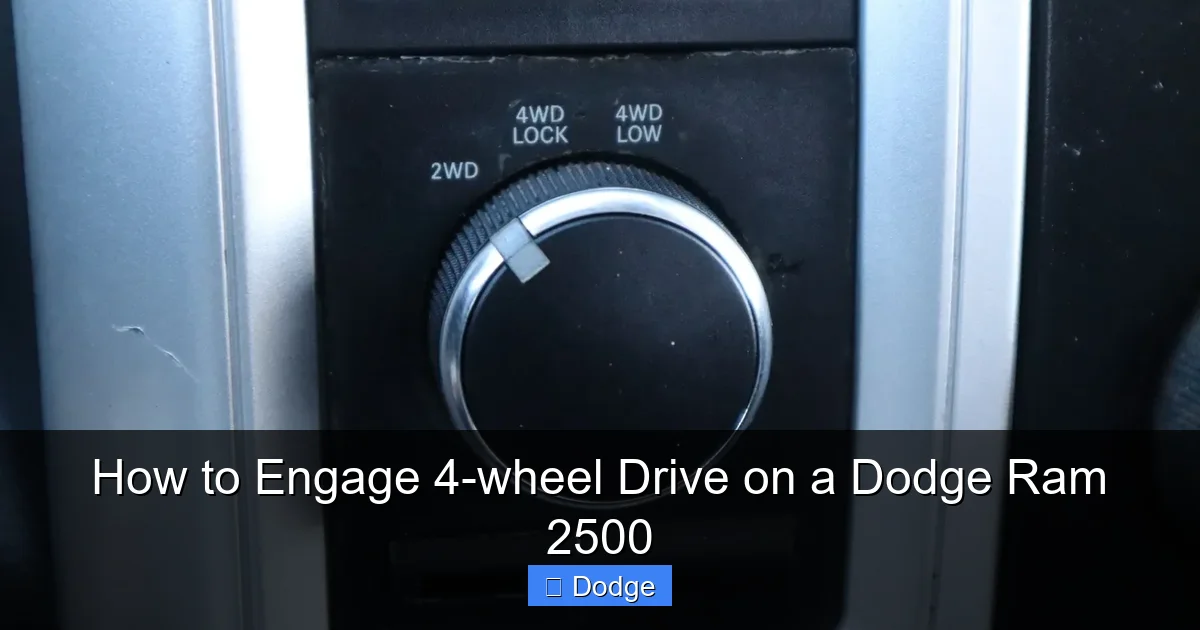
Most modern Ram 2500 models—especially those from 2009 onward—come with an electronic shift-on-the-fly (ESOF) system. This system uses a dashboard-mounted rotary dial or push-button switch, usually located near the center console or instrument cluster. You’ll typically see labels like “2H” (2-wheel drive high), “4H” (4-wheel drive high), “4L” (4-wheel drive low), and “N” (neutral).
The electronic system allows you to shift between modes without leaving the driver’s seat, making it convenient for changing road conditions. For example, you can switch from 2H to 4H while driving at low speeds on a snowy highway. However, you still need to follow speed and surface guidelines to prevent damage.
Manual Shift Transfer Case
Older Ram 2500 models, particularly those from the early 2000s and before, often feature a manual shift transfer case. This system uses a floor-mounted lever, similar to a second gear shifter, usually located between the driver and passenger seats. You’ll need to physically move this lever to engage 4WD.
With a manual system, you must come to a complete stop or be moving very slowly (under 3 mph) before shifting. Some models even require you to press the clutch (if equipped with a manual transmission) or depress a button on the shifter. This system is more mechanical and durable but less convenient for quick changes.
How to Confirm Your System Type
If you’re unsure which system your Ram 2500 has, check your owner’s manual—it’s the most reliable source. You can also look for visual clues: a dashboard switch indicates an electronic system, while a floor lever points to a manual setup. Additionally, newer trucks (2019 and later) almost exclusively use electronic systems, especially in higher trims like the Laramie or Limited.
Knowing your system type ensures you follow the correct engagement procedure and avoid common mistakes that could harm your truck.
Step-by-Step Guide to Engaging 4WD on a Dodge Ram 2500
Visual guide about How to Engage 4-wheel Drive on a Dodge Ram 2500
Image source: cdn.dealrimages.com
Now that you know your system type, let’s walk through the exact steps to engage 4-wheel drive safely and effectively. Whether you have an electronic or manual system, the goal is the same: deliver power to all four wheels when traction is low.
Engaging 4WD with an Electronic Shift System
If your Ram 2500 has an electronic shift-on-the-fly system, follow these steps:
1. Start in 2H (2-wheel drive high): This is your default mode for normal driving on dry pavement. Keep the switch in this position during everyday use.
2. Slow down to under 5 mph: You can shift into 4H (4-wheel drive high) while moving, but only at very low speeds. Avoid shifting at highway speeds or on dry roads.
3. Turn the dial to 4H: Rotate the dashboard switch from 2H to 4H. You may hear a brief clunk or feel a slight vibration—this is normal as the front axle engages.
4. Drive normally: Once engaged, your truck will send power to all four wheels. Use 4H for snow, light mud, gravel, or wet roads. You can drive at normal speeds in this mode.
5. Shifting into 4L (4-wheel drive low): This mode is for extreme conditions. Come to a complete stop, shift the transmission into neutral (or press the clutch if manual), then turn the dial to 4L. Wait for the indicator light to confirm engagement before driving.
6. Returning to 2H: To disengage 4WD, slow to under 5 mph, shift the transmission to neutral (if needed), and turn the dial back to 2H. Wait for the system to disengage before accelerating.
Engaging 4WD with a Manual Shift System
For trucks with a manual transfer case, the process is a bit more involved:
1. Come to a complete stop: Unlike electronic systems, manual systems require a full stop before shifting.
2. Shift the transmission into neutral: This reduces stress on the transfer case. If your truck has a manual transmission, press the clutch.
3. Move the transfer case lever: Push the lever forward or backward to engage 4H or 4L, depending on your model. You’ll feel resistance—this is normal.
4. Shift back into gear and drive: Once engaged, shift the transmission into drive (or first gear) and proceed slowly.
5. Disengaging 4WD: Stop completely, shift to neutral, move the lever back to 2H, then shift into drive and continue.
Tips for Smooth Engagement
– Practice in a safe area: If you’re new to 4WD, try shifting in an empty parking lot to get comfortable with the process.
– Don’t force the lever or switch: If it won’t move, double-check your speed and gear position. Forcing it can damage internal components.
– Listen for engagement: A slight clunk or whine is normal, but grinding or loud noises mean something’s wrong—stop and inspect.
Following these steps ensures your 4WD system engages smoothly and lasts for years.
When to Use 4-High vs. 4-Low on Your Ram 2500
Visual guide about How to Engage 4-wheel Drive on a Dodge Ram 2500
Image source: 2carpros.com
Not all 4WD situations are the same. Your Dodge Ram 2500 offers two 4-wheel drive modes—4H and 4L—and using the right one at the right time is key to performance and safety.
Using 4-High (4H)
4-High is your go-to mode for most slippery or unstable conditions. It delivers power to all four wheels while maintaining normal driving speeds. Use 4H when:
– Driving on snow-covered or icy roads
– Traveling over wet, muddy, or gravelly surfaces
– Towing a trailer in adverse weather
– Navigating light off-road trails
In 4H, your truck’s traction improves significantly, reducing wheel slip and improving control. You can drive at highway speeds in this mode, though it’s still best to avoid dry pavement when possible. Prolonged use on dry roads can cause “binding” in the drivetrain, leading to premature wear.
A good rule of thumb: if you can feel your tires slipping or struggling for grip, 4H is likely the right choice. For example, if you’re driving through a snowstorm and notice the rear wheels starting to spin, shifting to 4H will help maintain momentum.
Using 4-Low (4L)
4-Low is designed for extreme conditions where maximum torque and slow, controlled movement are needed. This mode reduces your truck’s speed while multiplying engine torque, giving you incredible pulling power. Use 4L when:
– Climbing or descending steep, rocky inclines
– Driving through deep mud, sand, or snow
– Towing heavy loads up a hill
– Navigating technical off-road terrain
In 4L, your Ram 2500’s speed is significantly reduced—often to just a few miles per hour. This allows the engine to deliver maximum power to the wheels without spinning. However, 4L should never be used on dry pavement or at high speeds. Doing so can cause severe damage to the transfer case, axles, and differentials.
For example, if you’re stuck in a muddy ditch and need to crawl out slowly, 4L gives you the control and torque to do it safely. But once you’re back on solid ground, shift back to 4H or 2H immediately.
Understanding the Difference
Think of 4H as “extra grip” and 4L as “maximum muscle.” 4H improves traction for everyday slippery conditions, while 4L is for when you need to move slowly but powerfully. Using the wrong mode can lead to poor performance or mechanical failure.
Always consult your owner’s manual for specific recommendations based on your model year and terrain. And remember: when in doubt, start in 4H and only use 4L if conditions demand it.
Safety Tips and Common Mistakes to Avoid
Engaging 4-wheel drive on your Dodge Ram 2500 is straightforward, but a few common mistakes can lead to costly repairs or unsafe driving conditions. Here’s how to stay safe and keep your truck in top shape.
Avoid Engaging 4WD on Dry Pavement
This is the number one mistake drivers make. Part-time 4WD systems like the one in your Ram 2500 are not designed for dry, high-traction surfaces. When you drive in 4H or 4L on pavement, the front and rear axles turn at slightly different speeds during turns. This creates tension in the drivetrain, known as “binding,” which can cause:
– Premature wear on axles and differentials
– Damage to the transfer case
– Increased tire wear
– Loss of steering control
Only use 4WD on loose or slippery surfaces where the wheels can slip slightly to relieve tension. If you must drive on dry roads, return to 2H as soon as possible.
Don’t Shift at High Speeds
Whether you have an electronic or manual system, shifting into 4WD at high speeds is dangerous. For electronic systems, avoid shifting above 5 mph. For manual systems, always come to a complete stop.
Shifting at speed can cause sudden stress on the transfer case and front axle, potentially leading to component failure. If you’re driving on a snowy highway and need 4WD, slow down first, then engage.
Check Fluid Levels Regularly
Your 4WD system relies on proper lubrication to function smoothly. The transfer case and front differential require specific fluids that should be checked and changed according to your maintenance schedule.
Low or contaminated fluid can lead to overheating, grinding noises, and eventual failure. Check your owner’s manual for the recommended fluid type and change interval—typically every 30,000 to 60,000 miles.
Listen for Warning Signs
Your truck will often tell you if something’s wrong. Pay attention to:
– Grinding or clunking noises when shifting
– Difficulty engaging or disengaging 4WD
– Vibrations or shuddering during acceleration
– Warning lights on the dashboard
If you notice any of these, have your truck inspected by a qualified mechanic. Ignoring them can turn a small issue into a major repair.
Practice Before You Need It
Don’t wait until you’re stuck in the mud to learn how your 4WD system works. Practice shifting in a safe, open area like an empty parking lot. This builds confidence and ensures you know exactly what to do when conditions get tough.
Maintaining Your Ram 2500’s 4WD System
Like any mechanical system, your Ram 2500’s 4WD components need regular care to perform at their best. Proper maintenance not only extends the life of your truck but also ensures reliability when you need it most.
Fluid Checks and Changes
The transfer case and front differential are filled with gear oil that lubricates internal components. Over time, this fluid can break down or become contaminated with metal particles or moisture.
Check the fluid level every 15,000 miles or during routine oil changes. Look for signs of discoloration, burnt smell, or metal flakes. If the fluid looks dirty or low, have it changed by a professional.
Most Ram 2500 models use synthetic gear oil (like 75W-90), but always confirm the correct type in your owner’s manual. Using the wrong fluid can damage seals and gears.
Inspecting Driveshafts and U-Joints
The driveshafts that connect your transfer case to the axles are critical for power delivery. Over time, universal joints (U-joints) can wear out, causing vibrations or clunking noises.
During maintenance, have a mechanic inspect the driveshafts for play, rust, or damage. Replace worn U-joints promptly to avoid driveline failure.
Lubricating the Front Axle Actuator
On electronic systems, the front axle uses an actuator to engage and disengage. This component can seize up if not used regularly, especially in cold or wet climates.
To prevent this, engage 4H for a few minutes once a month—even in dry conditions. This keeps the actuator moving and lubricated. Just avoid driving on dry pavement for extended periods.
Checking Tire Wear and Alignment
Uneven tire wear or poor alignment can stress your 4WD system. When all four tires don’t rotate at the same speed, it creates tension in the drivetrain.
Rotate your tires every 5,000 to 7,500 miles and have the alignment checked annually. This ensures even wear and reduces strain on 4WD components.
Seasonal Preparation
Before winter or off-road season, give your 4WD system a thorough check. Test all modes, inspect fluids, and listen for unusual noises. A little prep can prevent breakdowns when you need your truck most.
Conclusion
Engaging 4-wheel drive on a Dodge Ram 2500 is a powerful capability that enhances traction, control, and confidence in challenging conditions. Whether you’re facing snow-covered highways, muddy job sites, or rocky trails, knowing how to use your 4WD system properly makes all the difference.
From identifying your transfer case type to following the correct engagement steps, this guide has covered everything you need to operate your Ram 2500 safely and effectively. Remember to use 4H for slippery roads and 4L for extreme terrain, avoid dry pavement in 4WD, and maintain your system regularly.
With the right knowledge and care, your Ram 2500’s 4-wheel drive system will deliver reliable performance for years to come. So the next time the weather turns bad or the road gets rough, you’ll be ready—shift confidently, drive smart, and enjoy the power of your truck.
Frequently Asked Questions
Can I engage 4WD while driving on the highway?
No, you should not engage 4WD at highway speeds. For electronic systems, shift only when driving under 5 mph. For manual systems, come to a complete stop. High-speed shifting can damage the transfer case and drivetrain.
Is it safe to drive in 4H on dry pavement?
It’s not recommended. Part-time 4WD systems like the one in the Ram 2500 can cause drivetrain binding on dry pavement, leading to wear or damage. Use 2H for normal driving and only switch to 4H on slippery or loose surfaces.
How often should I change the transfer case fluid?
Most manufacturers recommend changing transfer case and front differential fluid every 30,000 to 60,000 miles. Check your owner’s manual for the exact interval and fluid type for your specific model.
Why won’t my 4WD engage?
Common causes include driving too fast, being in the wrong gear, low fluid levels, or a faulty actuator. Ensure you’re under 5 mph (for electronic) or stopped (for manual), and have the system inspected if problems persist.
Can I use 4L for towing?
Yes, but only in specific situations. Use 4L when towing heavy loads up steep hills or through deep mud. Avoid using 4L on flat, dry roads, as it’s designed for low-speed, high-torque scenarios.
Should I engage 4WD in the winter?
Yes, but only when needed. Use 4H when driving on snow, ice, or slush. Return to 2H when roads are clear to prevent unnecessary wear. Regular use also helps keep the system lubricated.
