
How to Add Transmission Fluid to a 2014 Dodge Durango

Adding transmission fluid to your 2014 Dodge Durango is essential for smooth shifting and long-term transmission health. This guide walks you through the process safely, using the right tools and fluid type, so you can maintain your SUV with confidence.
Key Takeaways
- Use the correct fluid: Always use ATF+4 automatic transmission fluid—no substitutes. Using the wrong type can damage your transmission.
Check fluid level when warm: Run the engine until it reaches normal operating temperature for an accurate reading. - Locate the dipstick properly: The transmission dipstick is usually on the driver’s side of the engine bay, labeled and often red or yellow.
- Never overfill: Overfilling can cause foaming, overheating, and transmission damage. Add fluid gradually and recheck.
- Inspect for leaks during the process: While under the vehicle, look for signs of fluid leaks around seals and lines.
- Replace the dipstick securely: Always reinsert the dipstick fully to prevent contamination and ensure accurate future readings.
- Consult your owner’s manual: When in doubt, refer to the factory manual for model-specific guidance and fluid capacity.
📑 Table of Contents
- Why Transmission Fluid Matters in Your 2014 Dodge Durango
- Understanding Your 2014 Dodge Durango’s Transmission System
- Tools and Materials You’ll Need
- Step-by-Step Guide to Adding Transmission Fluid
- Common Mistakes to Avoid
- When to Seek Professional Help
- Maintaining Your Transmission for Longevity
- Conclusion
Why Transmission Fluid Matters in Your 2014 Dodge Durango
Your 2014 Dodge Durango is a powerful, full-size SUV built for towing, hauling, and daily driving. Under the hood, the transmission plays a silent but critical role in delivering that power smoothly to the wheels. Think of transmission fluid as the lifeblood of this system—it cools, lubricates, and enables hydraulic pressure for gear shifts. Without proper fluid levels or quality, your Durango might hesitate, slip, or even suffer costly internal damage.
Many Durango owners overlook transmission maintenance, assuming it’s a “set it and forget it” system. But just like engine oil, transmission fluid degrades over time. Heat, friction, and contamination break it down, reducing its effectiveness. Low or dirty fluid leads to poor shifting, overheating, and accelerated wear on clutches and seals. In extreme cases, it can result in complete transmission failure—repairs that can cost thousands.
The good news? Adding transmission fluid to your 2014 Durango is a straightforward task you can do at home with basic tools. Unlike older vehicles that required messy drain-and-fill procedures, many 2014 Durangos use a dipstick-style system, making top-offs easier and safer. This guide will walk you through every step, from identifying the right fluid to checking the level correctly. Whether you’re a DIY beginner or a seasoned gearhead, you’ll gain the confidence to keep your Durango running smoothly for years to come.
Understanding Your 2014 Dodge Durango’s Transmission System

Visual guide about How to Add Transmission Fluid to a 2014 Dodge Durango
Image source: dodgetransmission.net
Before you pop the hood, it helps to understand how your Durango’s transmission works. The 2014 model typically comes with a 5-speed automatic transmission (known as the 545RFE) on V6 and V8 engines. This robust unit is designed for durability, but it still relies heavily on clean, properly leveled fluid to function optimally.
Unlike some modern vehicles that use sealed transmissions with no dipstick, the 2014 Durango retains a traditional dipstick setup. This means you can check and add fluid manually—no need for specialized scan tools or dealership visits. The dipstick allows you to monitor both fluid level and condition. Healthy fluid should be bright red, clear, and odorless. If it’s dark brown, smells burnt, or has particles, it’s time for a full flush—not just a top-off.
It’s also important to note that the transmission fluid serves multiple roles. It acts as a hydraulic fluid to engage gears, a coolant to prevent overheating, and a lubricant to reduce metal-to-metal friction. Over time, additives in the fluid break down, and contaminants like metal shavings or clutch material can accumulate. That’s why regular checks—every 30,000 to 60,000 miles—are recommended, especially if you tow trailers or drive in stop-and-go traffic.
Another key detail: the 2014 Durango does not have a traditional “fill plug” like some trucks. Instead, you add fluid through the dipstick tube using a funnel. This design simplifies the process but requires precision—adding too much can be just as harmful as too little. We’ll cover how to avoid overfilling later, but for now, remember: slow and steady wins the race.
Tools and Materials You’ll Need

Visual guide about How to Add Transmission Fluid to a 2014 Dodge Durango
Image source: d2n97g4vasjwsk.cloudfront.net
Gathering the right tools before you start saves time and prevents mistakes. You don’t need a full mechanic’s toolbox—just a few essentials to get the job done safely and efficiently.
First and foremost, you’ll need the correct transmission fluid. For the 2014 Dodge Durango, that means **ATF+4 automatic transmission fluid**. This is a synthetic fluid specifically formulated for Chrysler, Dodge, and Jeep transmissions. Never substitute with generic ATF or Dexron/Mercon fluids—they’re not compatible and can cause serious damage. You can find ATF+4 at most auto parts stores, Walmart, or online. A quart typically costs between $8 and $12.
Next, grab a clean funnel. A long-neck funnel with a narrow spout works best for pouring fluid into the dipstick tube without spills. Avoid using funnels that have been used for other fluids—residue from oil or coolant can contaminate the transmission.
You’ll also need a clean rag or paper towels. These are essential for wiping the dipstick, cleaning up spills, and checking fluid condition. Keep a few extra on hand—transmission fluid is slick and can stain driveways or garage floors.
A flashlight is helpful, especially if you’re working in low light. The dipstick and fill area can be tucked away near the firewall, making visibility tricky. A headlamp or work light ensures you don’t miss any steps.
Lastly, consider wearing gloves. Transmission fluid isn’t toxic, but it can irritate sensitive skin and is difficult to wash off. Nitrile gloves are inexpensive and widely available.
Optional but useful: a fluid pump or hand pump. If you’re adding more than a quart, a pump makes the process faster and reduces the risk of spills. Some DIYers also use a transmission fluid checker tool—a small device that attaches to the dipstick to give a digital reading—but this isn’t necessary for most owners.
Step-by-Step Guide to Adding Transmission Fluid
Visual guide about How to Add Transmission Fluid to a 2014 Dodge Durango
Image source: transmissioncar.com
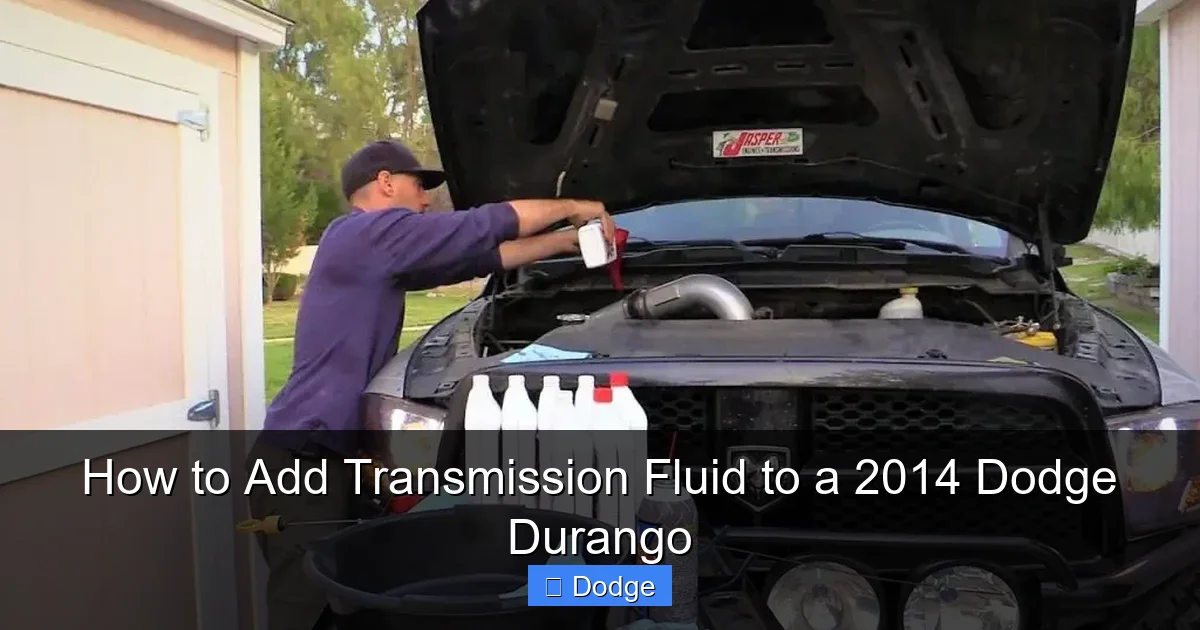
Now that you’re prepared, let’s walk through the process of adding transmission fluid to your 2014 Dodge Durango. Follow these steps carefully to ensure accuracy and safety.
Step 1: Park on a Level Surface and Warm Up the Engine
Start by parking your Durango on a flat, level surface. This is crucial—if the vehicle is tilted, the fluid level reading will be inaccurate. Turn off the engine and set the parking brake.
Next, start the engine and let it run for about 5 to 10 minutes. You want the transmission fluid to reach normal operating temperature—typically around 170°F to 200°F. Warm fluid expands slightly, giving you a more accurate dipstick reading. If the fluid is cold, it may appear lower than it actually is, leading you to overfill.
While the engine is running, shift through all the gears (P → R → N → D, etc.) and hold each for a few seconds. This circulates the fluid and ensures it’s evenly distributed throughout the transmission. Then, leave the engine running and move the shifter back to Park.
Step 2: Locate the Transmission Dipstick
Pop the hood and locate the transmission dipstick. On the 2014 Durango, it’s usually on the driver’s side of the engine bay, near the firewall. Look for a bright-colored handle—often red or yellow—with “TRANS” or “ATF” marked on it. It’s separate from the engine oil dipstick, which is typically black or orange.
If you’re having trouble finding it, consult your owner’s manual. The dipstick tube leads directly into the transmission pan, allowing you to check and add fluid without removing any panels.
Step 3: Check the Current Fluid Level
With the engine still running and in Park, pull out the dipstick. Wipe it clean with a rag, then reinsert it fully. Wait a few seconds, then pull it out again.
Look at the fluid on the dipstick. There should be markings indicating “Full,” “Add,” or “Cold” and “Hot.” Since your engine is warm, focus on the “Hot” range. The fluid should reach the “Full” line. If it’s below the “Add” line, you’ll need to top it off.
Also, inspect the fluid’s condition. It should be bright red and translucent. If it’s dark, cloudy, or has a burnt smell, consider a full transmission service instead of just adding fluid.
Step 4: Add Fluid Gradually
Insert the funnel into the dipstick tube. Slowly pour in a small amount of ATF+4—start with about half a cup (4 ounces). Wait a minute or two to let the fluid settle, then recheck the level using the dipstick method described above.
Repeat this process until the fluid reaches the “Full” line on the “Hot” side. Never pour in a full quart at once—this increases the risk of overfilling. Most top-offs require less than a quart, especially if you’re just maintaining the level.
Step 5: Recheck and Secure
After adding fluid, run the engine for another minute, shift through the gears again, and recheck the level. This ensures the fluid has fully circulated.
Once the level is correct, remove the funnel and securely reinsert the dipstick. Make sure it’s fully seated to prevent leaks or contamination. Close the hood and turn off the engine.
Common Mistakes to Avoid
Even simple tasks can go wrong if you’re not careful. Here are some common pitfalls when adding transmission fluid to a 2014 Durango—and how to avoid them.
Using the Wrong Fluid
This is the #1 mistake. ATF+4 is the only approved fluid for your Durango. Using Dexron, Mercon, or generic “universal” ATF can cause slipping, harsh shifts, or complete transmission failure. Always check the label and confirm it says “ATF+4” or “Chrysler MS-9602.”
Overfilling the Transmission
Adding too much fluid creates excess pressure, which can force fluid past seals and cause leaks. It also leads to foaming, which reduces lubrication and causes overheating. Always add fluid slowly and recheck frequently.
Checking Fluid When Cold
Cold fluid contracts, giving a falsely low reading. Always check the level when the engine is warm and has been driven or idled long enough to reach operating temperature.
Ignoring Fluid Condition
Don’t just focus on the level—look at the color and smell. Dark, burnt, or gritty fluid indicates internal wear and requires professional attention. Adding fresh fluid won’t fix underlying problems.
Skipping the Gear Cycle
Failing to shift through the gears before checking the level can result in an inaccurate reading. The fluid needs to be distributed evenly for a true measurement.
When to Seek Professional Help
While adding transmission fluid is a DIY-friendly task, some situations call for a professional. If you notice any of the following, it’s time to visit a trusted mechanic:
– **Persistent low fluid levels** despite regular top-offs (could indicate a leak)
– **Burnt smell or dark, sludgy fluid** (signs of overheating or internal damage)
– **Slipping gears, delayed shifts, or rough engagement** (may require a full service or rebuild)
– **Visible leaks under the vehicle** (could be from the pan, seals, or cooler lines)
A professional can perform a full transmission flush, replace the filter, and inspect for wear. While more expensive than a top-off, it’s far cheaper than replacing the entire transmission.
Maintaining Your Transmission for Longevity
Adding fluid is just one part of transmission care. To keep your 2014 Durango running smoothly, follow these maintenance tips:
– **Check fluid every 15,000 miles** or during oil changes
– **Replace fluid and filter every 60,000 to 100,000 miles**, depending on driving conditions
– **Avoid towing beyond rated capacity** to prevent overheating
– **Use a transmission cooler** if you frequently tow or drive in hot climates
– **Address leaks immediately** to prevent low fluid levels
Regular care extends the life of your transmission and saves you money in the long run.
Conclusion
Adding transmission fluid to your 2014 Dodge Durango is a simple yet vital maintenance task. With the right fluid, tools, and technique, you can keep your SUV shifting smoothly and avoid costly repairs. Remember to use only ATF+4, check the level when warm, and add fluid gradually. By staying proactive, you’ll enjoy reliable performance from your Durango for years to come.
Frequently Asked Questions
What type of transmission fluid does a 2014 Dodge Durango use?
The 2014 Dodge Durango requires ATF+4 automatic transmission fluid. This is a synthetic fluid specifically designed for Chrysler, Dodge, and Jeep vehicles. Using any other type can damage the transmission.
Can I check the transmission fluid with the engine off?
No, you should always check the fluid with the engine running and warmed up. Cold fluid gives inaccurate readings, and the engine must be on for the pump to circulate fluid properly.
How often should I add transmission fluid to my Durango?
Check the fluid level every 15,000 miles or during routine maintenance. Top off only if it’s low. A full fluid and filter change is recommended every 60,000 to 100,000 miles.
What happens if I overfill the transmission fluid?
Overfilling can cause foaming, overheating, and seal damage. The excess pressure may force fluid past gaskets, leading to leaks and reduced performance.
Can I use a universal ATF instead of ATF+4?
No. Universal ATF is not compatible with the 2014 Durango’s transmission. Only use ATF+4 to ensure proper lubrication and hydraulic function.
Where is the transmission dipstick on a 2014 Durango?
The dipstick is located on the driver’s side of the engine bay, near the firewall. It has a red or yellow handle and is labeled “TRANS” or “ATF.”