
Will a Chevy 350 Bolt Up to a Jeep Transmission?

No, a Chevy 350 engine will not directly bolt up to a stock Jeep transmission without significant modification or an adapter kit. The Chevy small-block Chevy (SBC) and Jeep transmissions (like the AX-15, T-18, or T-5) use completely different bolt patterns, bellhousing shapes, and crankshaft flange designs. Success requires identifying your exact transmission, using a specialized adapter plate and possibly a pilot bushing, or sourcing a transmission that was originally mated to a Chevy engine. Always verify compatibility before purchasing parts.
So you’ve got a classic Jeep project and a reliable Chevy 350 small-block engine burning a hole in your garage. The idea is tempting: drop that proven V8 into your CJ, YJ, or TJ for a massive power boost. But then the doubts creep in. “Will a Chevy 350 bolt up to a Jeep transmission?” It’s the million-dollar question that stands between you and a legendary powertrain swap. The short, frustrating answer is: almost certainly not without some serious homework and hardware.
The world of engine and transmission compatibility is a labyrinth of bolt patterns, pilot shafts, and bellhousing contours. The Chevy 350, a titan of the automotive world, and the humble Jeep transmission, built for rugged simplicity, were never factory-intended to be dance partners. Their connection points are as mismatched as a square peg in a round hole. But where there’s a will (and a wallet), there’s a way—usually through the magical world of adapter plates. Let’s break down exactly why they don’t bolt together directly and what your path forward looks like.
Key Takeaways
- There is no “universal” bolt-up: Compatibility depends entirely on the specific Jeep transmission model (e.g., AX-15, T-18, T-5, NSG360) and the Chevy 350’s year of manufacture.
- Different bolt patterns are the main blocker: Chevy SBC engines use a “corvette” or “pattern A” bellhousing bolt pattern, while Jeep transmissions use their own unique patterns (like the “Dodge/Jeep” pattern). They are not interchangeable.
- Adapter kits are the most common solution: Companies like Novak Conversions, Advance Adapters, and Transmission Adapters manufacture plates and pilot bushings to mate a Chevy SBC to many Jeep manual transmissions.
- Pilot shaft depth and diameter are critical: Even with an adapter plate, the Chevy crankshaft’s pilot shaft (which locates the transmission) may be the wrong length or diameter for your Jeep transmission’s input shaft bore, requiring a bushing or spacer.
- Flywheel and clutch compatibility: You must use a Chevy-compatible flywheel and clutch kit. The Jeep transmission’s input shaft spline count must match the clutch disc you select.
- Some transmissions are easier than others: The Jeep AX-15 (in TJ/LJ/LT) and T-18 (in early CJs and some YJs) are very common candidates for SBC swaps with available adapters. The NSG360 (in TJ/LJ Rubicon) is more complex.
- Automatic transmissions are a different beast: Swapping an automatic (like the AW4) requires a compatible torque converter, flexplate, and often a specific transmission crossmember and shifter linkage, making it a much larger project.
📑 Table of Contents
- The Core Problem: Bolt Pattern Mismatch
- The Adapter Plate Solution: Your Bridge Across the Chasm
- Bellhousing Considerations: The Often-Forgotten Piece
- Automatic Transmission Swaps: A Whole Other Ballgame
- Real-World Examples and Practical Tips
- The Cost and Complexity Reality Check
- Conclusion: Yes, But…
The Core Problem: Bolt Pattern Mismatch
At the heart of every engine-to-transmission connection is the bellhousing. This is the aluminum or cast iron casing that bolts to the back of the engine block and houses the clutch (on manuals) or torque converter (on automatics). Its bolt pattern is its fingerprint.
The Chevy Small-Block “Pattern A”
The classic Chevrolet small-block engine (the 350, 305, 327, etc.) uses what is commonly called the “Corvette” or “Pattern A” bellhousing bolt pattern. This is a two-bolt pattern: two large 7/16″ or 1/2″ bolts on the top, and two on the bottom, arranged in a roughly rectangular shape. This pattern was used on virtually all passenger car and light truck SBC applications from the 1950s through the 1990s. It’s iconic, but it’s a Chevy thing.
The Jeep Transmission Patterns
Jeep, in its various corporate lives (Willys, Kaiser, AMC, Chrysler), used transmissions from multiple suppliers, primarily its own designs and some from Chrysler and later, Aisin. The common manual transmissions found in classic Jeeps have their own patterns:
- T-18 / T-18a: The legendary, ultra-strong “granny gear” four-speed found in CJ-5s, CJ-7s, and early YJs. It uses a distinctive, large, round bellhousing with a specific four-bolt pattern that matches earlier Jeep engines (like the AMC 258 I6) and some Chrysler engines. This is not the Chevy pattern.
- T-5: The lightweight, overdrive five-speed that appeared in late YJs and TJs. The Jeep version of the T-5 (built by TREMEC) uses a unique bellhousing pattern that is different from the Ford or GM T-5 patterns. It’s a “Jeep-specific” pattern.
- AX-15: The robust, cable-shifted five-speed that became the standard in TJ Wranglers and LJ Libertys from the early 1990s onward. This transmission uses a bellhousing with a specific bolt circle that matches the Jeep 4.0L inline-six engine. Again, not a Chevy pattern.
- NSG360: The heavy-duty, Russian-built (ZPAK) six-speed found in TJ/LJ Rubicon models. It has its own complex bellhousing arrangement, often integrated with the transfer case adapter.
The bottom line: You cannot simply take a Chevy 350 and bolt it to the back of a Jeep AX-15, T-18, or T-5. The bolt holes will not line up. The bellhousing flanges themselves are different shapes and sizes.
The Adapter Plate Solution: Your Bridge Across the Chasm
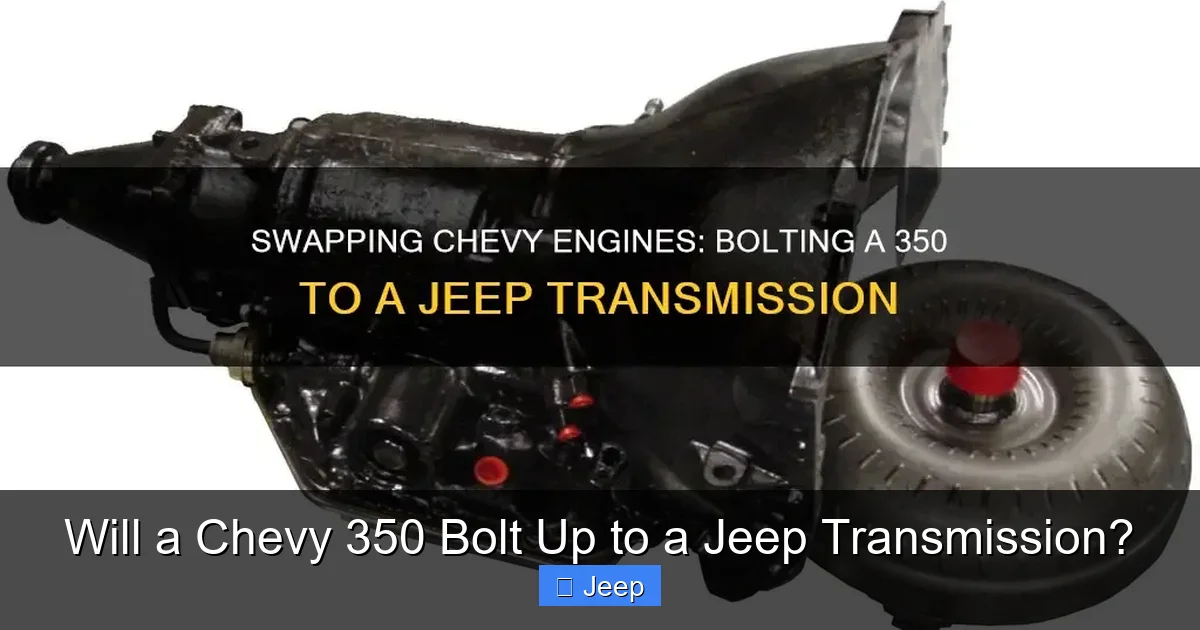
This is where the aftermarket industry comes to the rescue. Specialized manufacturers have spent decades engineering solutions for the exact problem you’re facing: mating a Chevy SBC to a Jeep transmission. The primary tool is an adapter plate.
Visual guide about Will a Chevy 350 Bolt Up to a Jeep Transmission?
Image source: shunauto.com
How an Adapter Plate Works
Think of an adapter plate as a thick, precision-machined steel spacer with two sets of bolt holes. On one side, it has holes that match the Chevy SBC’s “Pattern A” bellhousing. On the other side, it has holes that match the specific bellhousing pattern of your target Jeep transmission (e.g., the AX-15 pattern). You bolt the plate to the back of the Chevy engine, then bolt the Jeep transmission to the front of the adapter plate. It’s a mechanical marriage broker.
Critical Companion: The Pilot Bushing/Bearing
The adapter plate solves the bolt pattern, but it doesn’t solve everything. The transmission’s input shaft must be perfectly aligned with the engine’s crankshaft. This alignment is handled by a pilot bearing or bushing that slides into the engine’s crankshaft rear seal bore. The Chevy crankshaft has a specific pilot shaft diameter and depth. The Jeep transmission’s input shaft has its own requirements. The adapter kit will almost always include a specially sized pilot bushing to bridge this gap. Installing the wrong bushing will cause catastrophic clutch or transmission failure.
Popular Adapter Kits for Common Pairings
For the most popular Jeep transmissions, kits are readily available:
- Chevy 350 to Jeep AX-15: This is one of the most common and well-supported swaps. Novak Conversions and others offer complete kits including the plate, pilot bushing, and often a new clutch disc with the correct spline count (the AX-15 uses a 1.125″ diameter, 10-spline input shaft). You will also need a Chevy-style flywheel.
- Chevy 350 to Jeep T-18: Also very common due to the T-18’s strength. Kits are available. Note that the T-18 is a very long transmission, so you may need to modify the driveshaft length or crossmember location.
- Chevy 350 to Jeep T-5: Kits exist, but the T-5 is less robust than the AX-15 or T-18 and is generally not recommended for a high-torque 350 unless it’s a heavy-duty aftermarket T-5.
Important: You must know the exact transmission model and its year range. An AX-15 from a 1997 TJ is the same as one from a 2004 LJ for adapter purposes, but it is different from an NSG360. Always confirm with the adapter manufacturer.
Bellhousing Considerations: The Often-Forgotten Piece
Here’s a crucial detail that trips up many first-time swappers. When you use an adapter plate, you are not using the Jeep transmission’s original bellhousing. The Jeep transmission’s bellhousing is permanently attached to its case. The adapter plate bolts directly to the transmission’s front bolt holes, which are machined to accept a bellhousing. So, you are essentially replacing the Jeep bellhousing with your Chevy engine’s bellhousing (which is part of the engine’s rear casting) and the adapter plate in between.
This means:
- You must use a Chevy SBC-compatible bellhousing or flexplate/flywheel assembly. The Chevy engine’s rear casting has the bolt holes for its own bellhousing. The adapter plate bolts to this.
- The stock Jeep transmission shifter location and linkage will remain the same, as you are bolting the transmission itself (not its bellhousing) to the adapter. However, the transmission may now be positioned slightly differently in the chassis due to the adapter’s thickness, which can affect driveshaft length and shifter boot fitment.
Automatic Transmission Swaps: A Whole Other Ballgame
If you’re dreaming of a Chevy 350 mated to a Jeep automatic transmission, like the AW4 (found in Grand Cherokees and some XJs) or the 46RH (in some ZJs), the challenges multiply exponentially.
Visual guide about Will a Chevy 350 Bolt Up to a Jeep Transmission?
Image source: automotivesimple.com
- Torque Converter & Flexplate: You need a Chevy-compatible torque converter and a flexplate that bolts to the Chevy crankshaft and has the correct bolt hole pattern for the transmission’s starter ring gear. This is a very specific combination.
- Crossmember & Mounts: The transmission’s mounting points and the required crossmember will be completely different from the manual transmission setup. You’ll likely need to fabricate or source a custom crossmember.
- Shifter & Linkage: The steering column linkage or floor shifter will need complete adaptation or replacement.
- Electronic Controls: Modern automatics (like the 46RE/46RH) have complex电子控制单元 (ECU) requirements for lockup torque converters and shift scheduling. You’ll need a standalone transmission controller or a way to integrate it with the Jeep’s (or a new) engine management system.
Because of this complexity, automatic swaps are far less common than manual swaps for the Chevy 350 into a classic Jeep. Most builders opt for a robust manual like the AX-15 or T-18 for simplicity and control.
Real-World Examples and Practical Tips
Let’s make this concrete. Here are two common scenarios:
Visual guide about Will a Chevy 350 Bolt Up to a Jeep Transmission?
Image source: smclassiccars.com
Example 1: The TJ Wrangler with an AX-15
You have a 1999 Jeep TJ with the 4.0L inline-six and an AX-15 manual. You want to swap in a 1996 Chevy 350 from a C/K pickup. The process:
- Remove the 4.0L and AX-15 as a unit.
- Source a Novak (or similar) adapter kit for “Chevy SB to Jeep AX-15.” This kit will include the adapter plate, pilot bushing, and a new clutch disc (1.125″ x 10 spline).
- You must also source a Chevy SBC flywheel (for a manual application) that matches your 350’s crankshaft bolt pattern and damper balance. A common choice is a flywheel for a 1996-98 C/K with a 168-tooth ring gear.
- Bellhousing: Your Chevy 350’s rear casting already has the SBC pattern. You will bolt the adapter plate directly to this, then the AX-15 to the adapter. No separate bellhousing is used on the transmission side.
- Install the clutch pressure plate to the flywheel, slide the new clutch disc on the input shaft, and bolt the transmission up. You will likely need to adjust or shorten the driveshaft.
- You will need a Chevy-compatible starter motor, as the Jeep starter won’t engage the Chevy flexplate/flywheel correctly.
Example 2: The CJ-7 with a T-18
You have a 1978 CJ-7 with a 304 V8 and a T-18 four-speed. You’re upgrading to a 1972 Chevy 350. The T-18 bellhousing on the CJ might already be the “Dodge/Jeep” pattern. The process is similar, but:
- Verify your T-18 is the correct version (some later T-18s have different input shafts). The adapter kit will specify compatibility.
- The T-18 is much longer than the AX-15. You will almost certainly need to move the transmission crossmember rearward and have a new, shorter driveshaft made.
- The pilot bushing requirement may differ. Follow the adapter kit instructions exactly.
Pro Tip: Before buying anything, physically measure or identify your transmission. The casting number on the side of the transmission case is your best friend. Look it up on sites like Jeep forums or transmission specialty sites. Knowing you have an “AX-15, casting number 53009010” is worth a thousand guesses. This research phase is non-negotiable.
The Cost and Complexity Reality Check
This is not a weekend bolt-in. A Chevy 350 into a Jeep with a manual transmission is a serious fabrication and modification project.
- Adapter Kit: $300 – $600 for a quality kit.
- Flywheel & Clutch: $200 – $400.
- Starter Motor: $100 – $250 (you need a Chevy starter that clears the oil pan and mates to the flexplate).
- Driveshaft: $200 – $500 for a new, shortened shaft or a new CV joint at the transmission end.
- Crossmember Modification/Fabrication: $100 – $500+ depending on your skill and need.
- Engine Mounts: You will need new, custom motor mounts. The Chevy’s mounting ears are in different locations than the Jeep’s. This is a critical safety and alignment item.
- Time & Fabrication: The most expensive cost. You’ll need welding, drilling, measuring, and likely some trial-and-error fitting.
Total, you’re looking at a minimum of $1,000 in parts, not counting the engine and transmission themselves, and a significant investment in time and shop tools. If you’re not comfortable with precision measurements and fabrication, this job is best left to a professional drivetrain shop.
Conclusion: Yes, But…
So, will a Chevy 350 bolt up to a Jeep transmission? Not directly, but with an adapter plate, the correct pilot bushing, a Chevy flywheel, and a host of supporting modifications, it can be done. The most straightforward path is pairing the SBC with a Jeep AX-15 or T-18 manual transmission using a reputable adapter kit. The automatic route is vastly more complex.
The key to success is ruthless specificity. You must know your transmissions down to the casting number. You must buy a kit designed for your exact pairing. You must address the entire drivetrain—engine mounts, crossmembers, driveshafts, and starters—not just the engine-to-transmission joint. This swap is a classic for a reason: it delivers immense power and reliability, but it demands respect, research, and resources. Do your homework, talk to others who have done it, and plan for every detail. Your legendary Jeep V8 swap is possible, but it’s a marathon, not a sprint.
Frequently Asked Questions
Will a Chevy 350 bolt directly to a Jeep AX-15 transmission?
No. The Chevy SBC uses a “Pattern A” bellhousing bolt pattern, while the Jeep AX-15 uses its own unique pattern. They will not align. You must use a specific adapter plate and pilot bushing kit designed for this exact pairing.
What is the easiest Jeep transmission to swap with a Chevy 350?
The Jeep AX-15 (found in 1991-2006 TJ/LJ Wranglers) and the T-18 (found in CJ-5s, CJ-7s, and early YJs) are the most common and well-supported by aftermarket adapter kits. The AX-15 offers a better gear ratio spread for daily driving, while the T-18 is famously indestructible for rock crawling.
Do I need to change the clutch or flywheel when doing this swap?
Absolutely. You must use a flywheel and clutch assembly designed for a Chevy small-block engine. The stock Jeep 4.0L flywheel and clutch will not work. The clutch disc must also have the correct spline count to match the Jeep transmission’s input shaft (e.g., 10-spline for AX-15). Adapter kits usually specify or include the correct clutch disc.
What about the starter motor? Can I use the Jeep one?
No. The Jeep starter is designed to engage the ring gear on the Jeep flexplate/flywheel. You must use a starter motor designed for a Chevy small-block application that will clear your specific engine’s oil pan and bolt to the Chevy block. This is a critical and often overlooked part.
Will the transmission crossmember and driveshafts need to be changed?
Almost certainly yes. The adapter plate adds thickness, which shifts the transmission’s position in the chassis. Your stock Jeep crossmember will likely be in the wrong place. You will need to modify its location or fabricate a new one. The driveshaft will be the wrong length and may need a different joint (like a CV joint at the transmission end), so a new or modified driveshaft is required.
Is swapping a Chevy 350 into a Jeep with an automatic transmission possible?
It is possible but is a significantly more complex and expensive project than a manual swap. It requires a compatible Chevy flexplate, torque converter, a standalone transmission controller for the automatic, a completely new crossmember and mounts, and extensive adaptation of the shifter linkage and throttle valve/linkage. It is not recommended for a first-time builder.
