Why Are Jeep Renegades So Cheap?

Contents
- 1 Key Takeaways
- 2 📑 Table of Contents
- 3 So, Why Are Jeep Renegades So Cheap, Really?
- 4 Reason 1: The Entry-Level Strategy & Platform Sharing
- 5 Reason 2: The Brutal Reality of Segment Competition
- 6 Reason 3: The Depreciation Avalanche
- 7 Reason 4: The Interior & Material Compromise
- 8 Reason 5: Ownership Costs & Reliability Questions
- 9 Reason 6: Comparing the Renegade to Other Jeeps & The Value Proposition
- 10 Conclusion: Is a “Cheap” Jeep Renegade a Smart Buy?
- 11 Frequently Asked Questions

Emergency First Aid Kit

Windshield Washer Fluid

Parking Sensor Kit

Portable Air Pump
The Jeep Renegade’s low price tag stems from a perfect storm of factors: its position as Jeep’s entry-level model, intense competition in the compact SUV segment, higher depreciation rates, and perceptions about interior quality and long-term reliability. While it offers authentic Jeep styling and off-road capability in a small package, potential buyers must weigh the significant cost savings against higher ownership costs and faster value loss compared to segment leaders like the Subaru Forester or Honda CR-V.
Key Takeaways
- Entry-Level Positioning: The Renegade is Jeep’s most affordable model, built on a Fiat-based platform to keep costs low and attract new, budget-conscious buyers to the brand.
- Fierce Segment Competition: The hot compact SUV class is packed with refined, reliable, and value-packed rivals from Japanese and Korean brands that pressure the Renegade’s pricing and perceived value.
- Steep Depreciation: Renegades lose value much faster than competitors, making used models exceptionally cheap but new ones a tougher financial proposition due to rapid asset loss.
- Interior & Material Trade-offs: To hit a low base price, the Renegade uses more hard plastics and lesser-quality materials than rivals, which hurts its premium feel and long-term perceived quality.
- Ownership Cost Concerns: While the purchase price is low, potential reliability issues, higher insurance (a common theme for Jeeps), and fuel economy can erode the initial savings over time.
- Capability vs. Refinement Divide: You pay for authentic Jeep off-road pedigree (Trailhawk trim) but sacrifice the on-road comfort, quietness, and smoothness of more road-focused competitors.
- The “Cheap” Used Car Opportunity: For savvy buyers, the Renegade’s rapid depreciation creates a compelling used-car value, offering a low-cost entry into Jeep ownership with a capable, distinctive vehicle.
📑 Table of Contents
- So, Why Are Jeep Renegades So Cheap, Really?
- Reason 1: The Entry-Level Strategy & Platform Sharing
- Reason 2: The Brutal Reality of Segment Competition
- Reason 3: The Depreciation Avalanche
- Reason 4: The Interior & Material Compromise
- Reason 5: Ownership Costs & Reliability Questions
- Reason 6: Comparing the Renegade to Other Jeeps & The Value Proposition
- Conclusion: Is a “Cheap” Jeep Renegade a Smart Buy?
So, Why Are Jeep Renegades So Cheap, Really?
You’re scrolling through listings, and there it is: a brand-new Jeep Renegade with a sticker price that seems almost too good to be true for a vehicle wearing the iconic Jeep badge. Or you see a three-year-old model with incredibly low mileage listed for what feels like a steal. The question practically screams itself: why are Jeep Renegades so cheap? It’s a great question, and the answer isn’t a simple one. It’s not because Jeep is suddenly altruistic. It’s a complex equation of market strategy, platform sharing, brand perception, and brutal financial mathematics—specifically, the math of depreciation.
Let’s be clear: “cheap” here is relative. Compared to a lifted, Wrangler Unlimited, any Renegade is a bargain. But in the cutthroat world of compact SUVs—the most popular vehicle segment on the planet—the Renegade often finds itself priced below stalwarts like the Subaru Forester, Honda CR-V, and Toyota RAV4. For a Jeep? That feels odd. This article will pull back the curtain on the Renegade, examining every reason its price point sits where it does. We’ll talk about what you’re actually paying for, what you’re potentially giving up, and whether that low number is a siren song or a smart buy. By the end, you’ll understand the Renegade’s place in the automotive ecosystem and if its “cheapness” aligns with your needs.
Reason 1: The Entry-Level Strategy & Platform Sharing
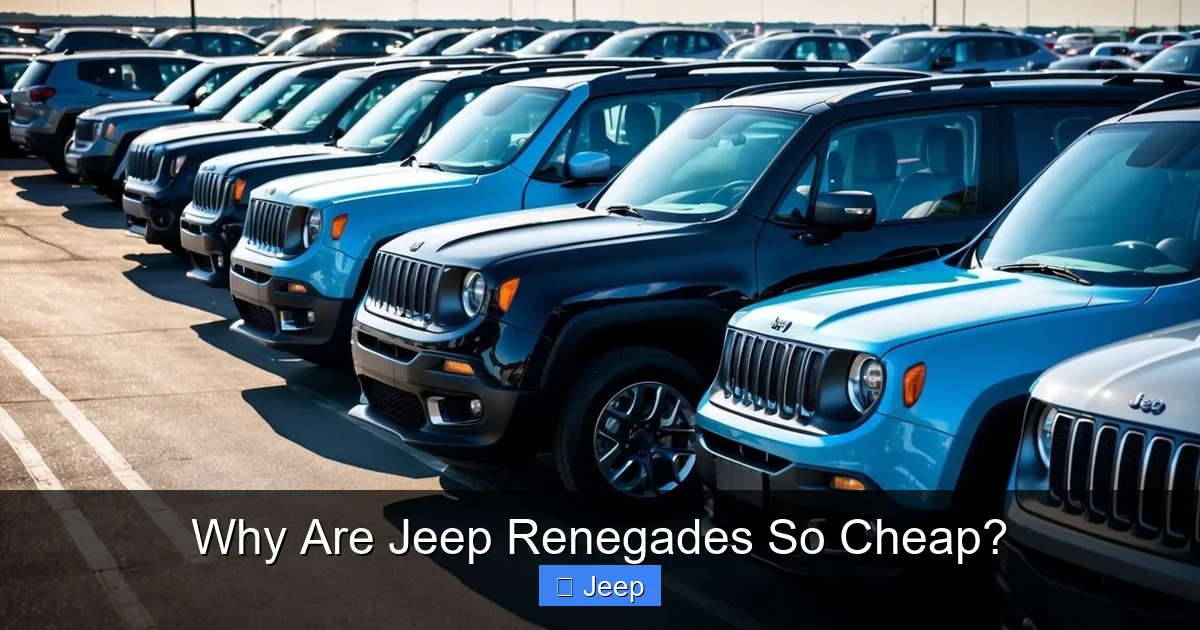
To understand the Renegade’s price, you must first understand its mission. The Renegade is not a Wrangler. It is not a Grand Cherokee. It is, unequivocally, Jeep’s entry point. It’s the model designed to hook first-time Jeep buyers, young families, and urbanites who want the *image* of Jeep without the Wrangler’s size, fuel bill, or price tag. To make this model profitable at a low price, Jeep (really, its parent company Stellantis) had to make some foundational compromises.

Visual guide about Why Are Jeep Renegades So Cheap?
Image source: mir-s3-cdn-cf.behance.net
Built on a Fiat Foundation
The single biggest factor is the Renegade’s architecture. It rides on the “Small Wide” platform, a global architecture co-developed with and primarily used by Fiat. This is the same bones under the Fiat 500X and, in other forms, the Chrysler Pacifica minivan. Sharing this platform with a high-volume, cost-conscious brand like Fiat allows for massive economies of scale. Development costs are spread across millions of vehicles, not just the Renegade. The engineering, while capable, is not bespoke Jeep engineering from the ground up. This shared foundation drastically reduces the per-unit cost, enabling the low starting MSRP.
This isn’t inherently bad—many great cars share platforms. But it does mean the Renegade doesn’t have the same heavy-duty, body-on-frame heritage as a Wrangler. It’s a unibody crossover SUV through and through, just one wearing Jeep’s distinctive skin and equipped with Jeep’s celebrated 4×4 systems (in the appropriate trims). The cost savings from this platform sharing are direct and significant.
Reason 2: The Brutal Reality of Segment Competition
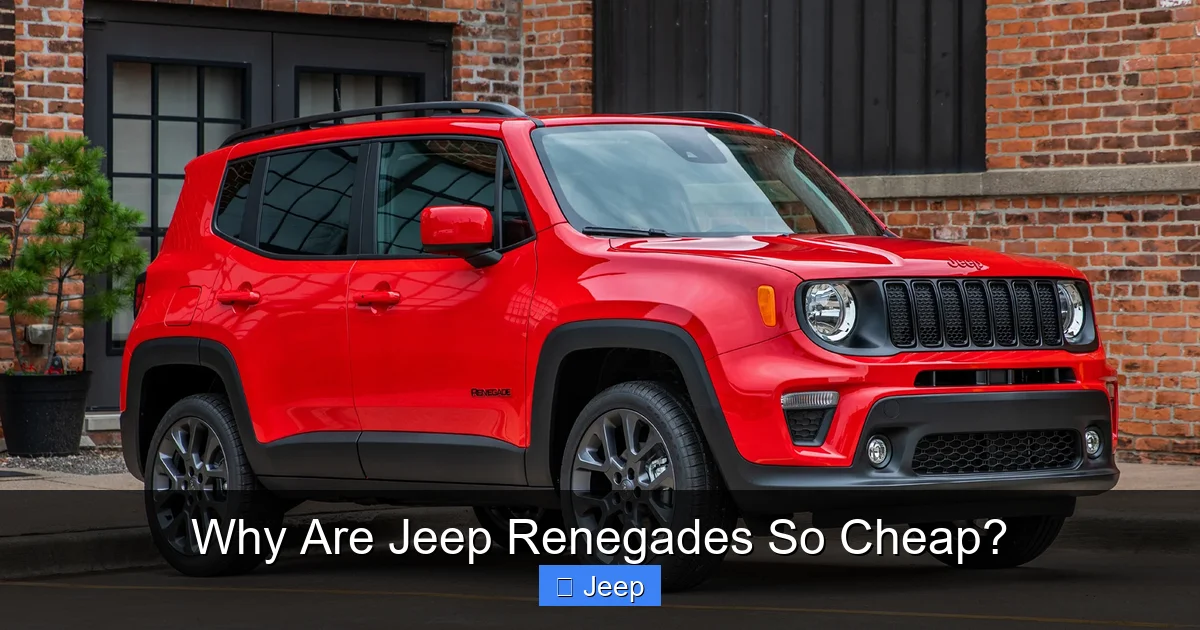
The compact SUV segment is a gladiatorial arena. It’s not just competitive; it’s hyper-competitive. Every manufacturer throws its best and most popular models into this ring. When a buyer cross-shops a Renegade, they are almost certainly looking at the Subaru Forester, Honda CR-V, Toyota RAV4, Mazda CX-5, and Kia Sportage. These are not just good cars; they are class benchmarks defined by exceptional reliability, high interior quality, strong fuel economy, and outstanding resale value.
Visual guide about Why Are Jeep Renegades So Cheap?
Image source: motortrend.com
The Value Equation is Stacked Against It
For a similar price as a base Renegade, you can often get a better-equipped, more refined, and more fuel-efficient Forester or CR-V. The Japanese/Korean rivals consistently score higher in initial quality surveys (like J.D. Power’s) and long-term reliability studies (from Consumer Reports and others). Their cabins feel more substantial, with softer-touch materials. Their powertrains are often more efficient and smoother. Their safety feature suites are more comprehensive out of the gate.
To compete, Jeep has two levers: price and capability. It pulls the price lever hard. The starting MSRP of a Renegade is typically thousands less than a similarly equipped Forester or RAV4. It’s an admission: “We know our interior may not feel as plush, and our long-term reliability reputation isn’t as rock-solid, so here’s a lower number to start the conversation.” That lower number is the primary weapon in a battle it can’t win on refinement alone. For value-focused buyers who prioritize cost-of-entry over long-term ownership serenity, that number is powerful.
Reason 3: The Depreciation Avalanche
This is the financial heart of the “why are they so cheap” question, especially for used models. The Jeep Renegade suffers from some of the steepest depreciation in the entire automotive industry. A new car is a depreciating asset, but some assets depreciate faster than others. The Renegade is a speedster in this ugly race.
Visual guide about Why Are Jeep Renegades So Cheap?
Image source: mir-s3-cdn-cf.behance.net
Why Does It Fall So Fast?
Several factors collide. First, the market perception we just discussed. Buyers in the segment simply value Hondas, Toyotas, and Subarus more highly. Their resale values are buoyed by legendary reliability reputations. A five-year-old CR-V is seen as a safe, nearly worry-free bet. A five-year-old Renegade carries the question marks about long-term durability and higher maintenance costs. Second, the new car market is flooded with inexpensive, off-lease Renegades. High supply of used models directly suppresses used prices. Third, the initial low purchase price means the absolute dollar amount of depreciation is a higher percentage of its original value. A $5,000 drop on a $25,000 car (20%) feels worse than a $4,000 drop on a $30,000 car (13%).
The result is a brutal cycle. Low new prices lead to low used prices, which makes buying new seem like a poor financial decision (you lose more value upfront), which pushes more people to the used market, which increases used supply and further depresses prices. If you buy a Renegade new, you will likely be “underwater” on the loan faster than with almost any other compact SUV. But if you buy used, you can capture a vehicle that is functionally almost new for a fraction of its original cost. This is the core paradox and opportunity of the Renegade.
Reason 4: The Interior & Material Compromise
Walk into a base-model Jeep Renegade. Then walk into a base-model Honda CR-V or Toyota RAV4. The difference in tactile feel is often immediately apparent. To hit that aggressive entry-level price point, Jeep had to cut costs somewhere. That somewhere is frequently the interior materials.
Hard Plastics and Cost-Cutting
The Renegade’s cabin is functional and stylish in a rugged way, but it’s laden with hard, scratch-prone plastics on the dashboard, door tops, and center console. In rivals, you’ll find more soft-touch surfaces, padded armrests, and higher-quality switchgear. The Renegade’s lower-quality sound deadening also means more road and wind noise at highway speeds. These aren’t just minor niggles; they are daily sensory reminders of the vehicle’s budget positioning. They hurt its perceived quality and long-term durability in the eyes of consumers, which again feeds into the lower resale values. You are quite literally getting less material substance for your money compared to the segment leaders.
This is a conscious trade-off. Jeep’s engineers and designers likely argued that the target buyer—someone wanting the Jeep look and a low price—would prioritize the iconic exterior styling and badge over a supple dashboard. To a point, they’re right. But for many cross-shoppers, the interior is where the “cheap” feeling becomes undeniable and a deal-breaker.
Reason 5: Ownership Costs & Reliability Questions
The purchase price is just the first check you write. The total cost of ownership (TCO) includes fuel, insurance, maintenance, repairs, and depreciation. The Renegade’s “cheapness” can quickly evaporate here.
Fuel Economy, Insurance, and the Reliability Cloud
Its Fiat-derived 2.4L four-cylinder engine is adequate but not fuel-efficient by modern compact SUV standards. You’ll often see competitors like the CR-V Hybrid or RAV4 Hybrid achieving 35-40 MPG, while the Renegade struggles to hit 25 MPG combined. That gap translates to hundreds of dollars more in fuel costs annually. Insurance rates for Jeeps are also notoriously higher than for many mainstream brands, a factor we see in articles like why car insurance is so expensive in Michigan and other states, due to higher claim rates and repair costs.
Then there’s the reliability question. While not universally disastrous, the Renegade’s reliability ratings from sources like Consumer Reports and J.D. Power have historically been below average for its segment. Issues with the dual-clutch automatic transmission (in some model years), infotainment glitches, and general fit-and-finish concerns have been noted. These aren’t catastrophic engine failures, but they lead to more frequent, annoying, and potentially costly out-of-warranty repairs. This reputation for slightly higher maintenance needs and lower predicted reliability directly impacts its resale value and total cost of ownership. A car that costs more to maintain and insure over five years has a lower “true” value, even if the sticker price is low.
Reason 6: Comparing the Renegade to Other Jeeps & The Value Proposition
It’s useful to zoom out and compare the Renegade not just to its direct competitors, but to its own Jeep siblings. This contrast highlights its specific value proposition.
Not a Wrangler, But a Different Kind of Jeep
The Jeep Wrangler is an icon with near-unmatched resale value. Its price is high because buyers are paying for unparalleled off-road capability, a unique open-air experience, and a strong community. The Grand Cherokee is a larger, more luxurious, and more powerful family hauler with towing capacity. The Renegade occupies a completely different niche: it’s the urban-friendly, fuel-station-friendly, parking-garage-friendly Jeep. It offers authentic off-road capability (especially the Trailhawk trim with its 4×4 system, skid plates, and lift) in a package that fits in a compact spot.
Is it a “real” Jeep? Purists might argue no, lacking solid axles and body-on-frame construction. But for someone who wants Jeep styling and occasional trail capability for a weekend adventure, without daily-driving a Wrangler, the Renegade’s combination of features at its price point is unique. You are paying for the badge, the looks, and a proven (if not rugged) 4×4 system. You are *not* paying for Wrangler-level toughness or Grand Cherokee-level refinement. Understanding this internal Jeep hierarchy is key to evaluating if the Renegade’s price is fair for what you’re actually getting. For those who prioritize off-pavement adventures in a small SUV, it remains one of the few—and most affordable—options.
Conclusion: Is a “Cheap” Jeep Renegade a Smart Buy?
So, we’ve unraveled the mystery. The Jeep Renegade is cheap because it’s a strategically positioned entry model built on a shared, cost-efficient platform. It’s cheap because it competes in a segment with superior, more refined, and more reliable rivals, forcing a price discount to be considered. It’s cheap because it depreciates at an alarming rate, a victim of its own segment competition and perceived quality concerns. And it’s cheap because material compromises inside keep the base MSRP low.
Does this mean you should avoid it? Not necessarily. The “cheap” label is a double-edged sword. For the used-car buyer, it’s a siren song. A low-mileage, recent-model Renegade can represent incredible value, offering a distinctive, capable, and badge-laden vehicle for the price of a well-equipped economy car. You absorb the depreciation hit that the first owner took. If you do your homework, get a pre-purchase inspection, and buy a well-maintained example, you can enjoy the Jeep experience on a budget.
For a new-car buyer, the calculus is tougher. You must honestly ask: do I prioritize the lowest possible upfront cost and Jeep styling over the long-term peace of mind, higher resale, and likely better fuel economy of a CR-V or Forester? If you need maximum off-road capability in a small SUV and the Trailhawk trim calls to you, the Renegade is one of the only game in town at its price. But if your life is 95% pavement, the competition offers a more sensible, cost-effective, and likely more enjoyable ownership experience. The Jeep Renegade’s cheapness isn’t a mystery; it’s a reflection of its place in the market. Whether that place is a smart one for you depends entirely on your priorities.
Frequently Asked Questions
Are Jeep Renegades reliable enough to buy used?
Used Renegades can be reliable purchases if they have a clean service history and have had any known issues (like potential transmission software updates on earlier models) addressed. Always get a pre-purchase inspection from a trusted mechanic, focusing on the transmission and infotainment system. Models from the 2020+ year range tend to have fewer reported problems.
Is the Jeep Renegade a good value for the money?
As a new car, its value is debatable against class leaders. As a used car, its value proposition becomes significantly stronger due to steep depreciation. You get a lot of Jeep character and capability for a low price, but you must accept potentially higher long-term running costs and lower resale when you eventually sell.
What are the biggest problems with Jeep Renegades?
Commonly reported issues include rough shifting or hesitation from the dual-clutch automatic transmission (in certain years), glitchy Uconnect infotainment systems, premature brake wear, and occasional electrical gremlins. These are typically annoyances rather than catastrophic failures, but they impact the ownership experience and cost.
How does the Jeep Renegade compare to a Subaru Forester?
The Forester typically offers better fuel economy, more standard safety features (like EyeSight), a more comfortable and quiet ride, and superior long-term reliability and resale value. The Renegade offers more distinctive styling, a more rugged available 4×4 system (Trailhawk), and a lower initial purchase price. The choice is between refined practicality and adventurous character.
Why is insurance on a Jeep Renegade so high?
Jeep as a brand often has higher insurance rates due to historical data showing higher claim frequencies and repair costs, partly because of its off-road orientation and the potential for more damage in accidents. The Renegade inherits this brand-based risk assessment from insurers, which you can learn more about in general articles on why car insurance is so high.
Should I buy a new or used Jeep Renegade?
Financially, buying used is almost always the smarter move for a Renegade due to its steep first-year depreciation. You let the first owner take the biggest value hit. A certified pre-owned (CPO) model from a Jeep dealer can offer a good balance of low price and remaining warranty. Buying new makes sense only if you plan to keep it for a very long time and want the full warranty, but you will pay a significant premium for that new-car status.