
Where to Buy Tesla Tiny House

Contrary to popular belief, Tesla does not sell a branded “Tiny House.” However, you can create a Tesla-powered sustainable tiny home by combining their energy products with a third-party-built tiny house. This guide debunks the myth and provides a clear roadmap for sourcing the components, from certified tiny house builders to Tesla’s own Solar, Powerwall, and charging solutions.
Key Takeaways
- Myth Debunked: Tesla does not manufacture or sell a complete, branded “Tesla Tiny House” product to consumers.
- Ecosystem Approach: The Tesla tiny home lifestyle is achieved by integrating Tesla’s energy products (Solar, Powerwall) with a separately purchased tiny house shell.
- Two-Part Purchase: You must 1) buy a tiny house from a specialized builder and 2) purchase/install Tesla energy systems separately, often requiring certified installers.
- Third-Party Builders: Numerous tiny house companies across the US and Canada build custom, road-legal homes that are perfectly compatible with Tesla tech.
- Charging is Key: For a mobile tiny house on wheels, installing a Tesla Wall Connector or using public Superchargers is a critical logistical step.
- Direct from Tesla: You buy Solar Roof, Solar Panels, and Powerwall directly through Tesla’s website or stores, not through tiny house builders.
- Research is Crucial: Success depends on researching both tiny house builders for quality/laws and understanding Tesla’s product specifications and installation requirements.
📑 Table of Contents
- The Great Tesla Tiny House Myth: What’s the Real Story?
- Part 1: Sourcing the “House” – Certified Tiny House Builders
- Part 2: Sourcing the “Tesla” – Energy & Charging Systems
- Bringing It All Together: The Integration Process
- Legal, Logistical & Cost Considerations
- Looking Ahead: The Future of Tesla & Tiny Living
- Conclusion: Your Actionable Path Forward
The Great Tesla Tiny House Myth: What’s the Real Story?
Let’s clear the air right away. If you’re searching for “where to buy a Tesla Tiny House,” you’ve likely seen exciting headlines or viral videos hinting at a futuristic, minimalist home straight from Elon Musk’s imagination. The idea is captivating: a sleek, sustainable, tech-packed tiny domicile with a Tesla badge. But here’s the crucial truth—Tesla does not sell a complete, branded “Tiny House” product on the consumer market.
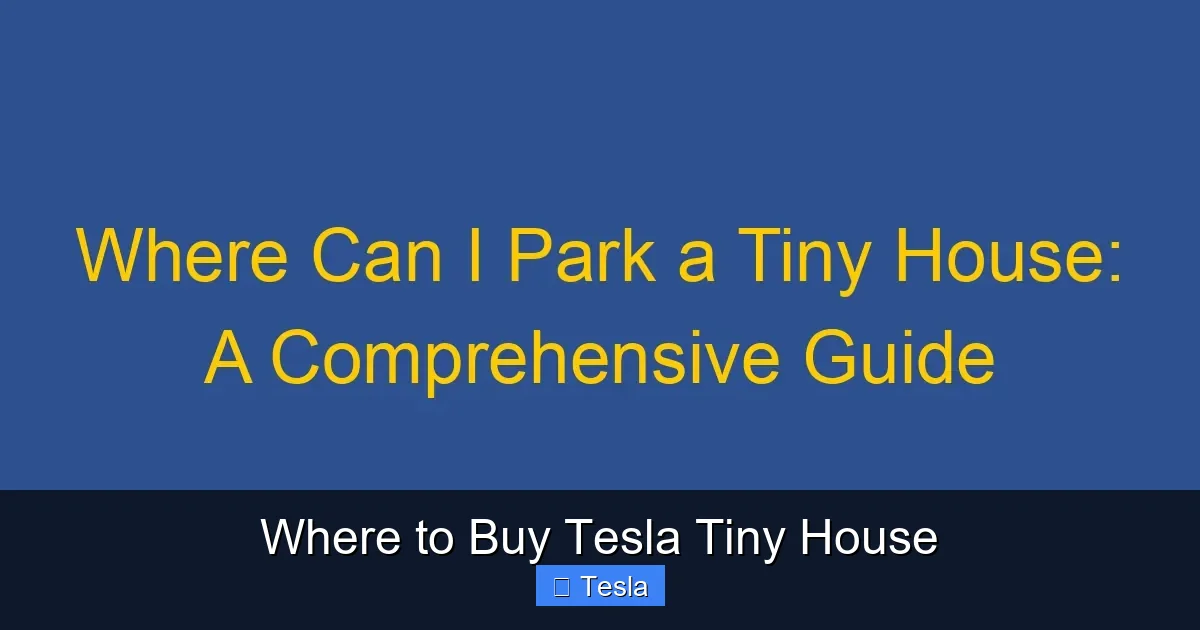
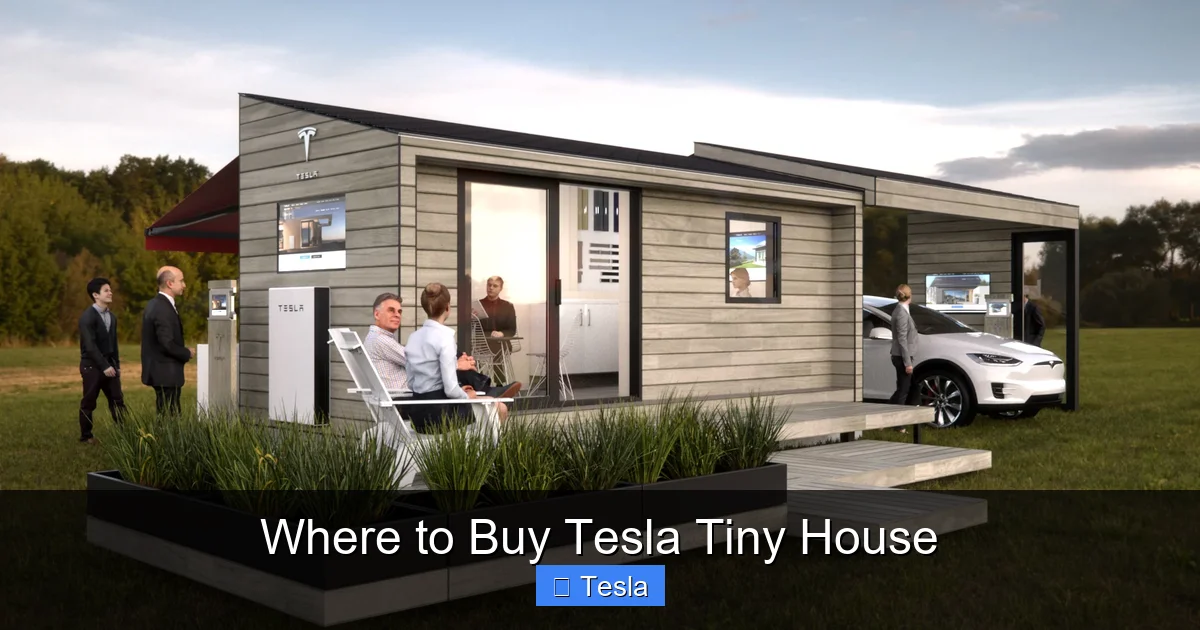
So, where did this idea come from? It stems from a few key sources. Years ago, Tesla showcased a stunning, modern tiny house structure at events, but it was a one-off display meant to demonstrate the capabilities of its Solar Roof and energy ecosystem in a compact, off-grid setting. It was a marketing prop, not a product for sale. Additionally, the natural synergy between Tesla’s mission of sustainable energy and the tiny house movement’s ethos of minimalism and environmental consciousness created a powerful narrative that stuck. People logically connected the dots: “Tesla makes cars and power; tiny houses need power; therefore, Tesla makes tiny houses.” It’s an understandable assumption, but it’s not the reality of how you can achieve a Tesla-powered tiny living setup.
This article is your definitive guide to navigating that reality. We will explain precisely what you can buy from Tesla to power your tiny home, where to find the actual house structure, and how to bring the two together into the sustainable, mobile (or stationary) lifestyle you’re dreaming of. Think of it not as buying one product, but as sourcing two complementary systems and integrating them.
Part 1: Sourcing the “House” – Certified Tiny House Builders
Since Tesla isn’t in the business of manufacturing habitable structures, your first and most significant step is to find a builder for the physical tiny house itself. This is a thriving industry with hundreds of companies across North America specializing in custom-built, road-legal tiny homes on wheels (THOWs) or foundation-based small footprint houses.
Visual guide about Where to Buy Tesla Tiny House
Image source: downsizegeek.com
What to Look for in a Tiny House Builder
Choosing a builder is a deeply personal and logistical decision. You’re not just buying a product; you’re commissioning a custom home. Here are the non-negotiable factors to investigate:
- Legality & Codes: The builder must be an expert in the building codes and zoning laws for your intended location. Are you placing it in a certified RV park, a rural area with relaxed rules, or as an accessory dwelling unit (ADU) on family property? A reputable builder will guide you through International Residential Code (IRC) exceptions for RVs or local ADU regulations. Never buy a house shell without confirming it meets the legal standards for where you plan to live.
- Quality & Craftsmanship: Look closely at their portfolio. Are the joints tight? Is the insulation adequate for your climate? What materials do they use (e.g., structural composite panels, traditional framing)? Ask about their build process, warranty, and request references from past clients. Visiting a completed home or a build in progress is invaluable.
- Customization & Compatibility: You need to communicate your Tesla integration plan early. Can they design the electrical system to handle a Powerwall? Is the roof structure and pitch suitable for mounting Tesla Solar Panels or a Solar Roof? Will they create a dedicated, weatherproof conduit chase for wiring from the roof to the battery/electrical room? A builder who understands energy systems is a huge asset.
- Reputation & Reviews: Deep dive into independent reviews on platforms like Google, Yelp, and tiny house forums (e.g., Tiny House Talk, Reddit’s r/TinyHouses). Look for patterns in feedback about communication, delays, and post-build support.
Some well-known, established builders in the US include Tiny Home Builders (Florida), Rocky Mountain Tiny Houses (Colorado), Gander Tiny Homes (Virginia), and Blackbird Tiny Houses (Washington). However, there are excellent small-shop builders in nearly every state. The search is part of the journey.
The “Where to Buy” for the Physical Structure
You will purchase your tiny house directly from the builder’s website or by contacting their sales team. This is a custom, made-to-order process, not an Amazon click. You’ll typically:
- Browse their floor plans and completed projects online.
- Contact them for a consultation to discuss your needs, budget, and location.
- Receive a detailed quote based on your selected customizations (size, appliances, finishes, etc.).
- Sign a contract, pay a deposit (often 30-50%), and wait for the build (timelines vary from 3 to 12+ months).
- Finalize financing, insurance, and land/parking arrangements during the build period.
- Complete the build, conduct a final inspection (often with an RV inspector), and arrange for delivery/pickup.
Important Note: If your goal is ultimate sustainability and you want the Tesla Solar *Roof* (tiles, not panels), you must select a builder with a roof structure that meets Tesla’s strict requirements for tile installation. This is a critical compatibility question to ask upfront.
Part 2: Sourcing the “Tesla” – Energy & Charging Systems
This is the part you buy directly from Tesla. Their product lineup for home energy is perfectly suited for a tiny house’s modest but critical power needs. You have three primary components to consider, which can work together as a complete system.

Visual guide about Where to Buy Tesla Tiny House
Image source: downsizegeek.com
1. Tesla Solar: Capturing the Sun’s Energy
Tesla offers two main solar products for homes:
- Tesla Solar Panels: These are traditional photovoltaic (PV) panels. They are a more affordable, simpler retrofit option if your tiny house roof is already built and structurally sound. Tesla sells them in pre-sized systems based on your annual energy needs (e.g., a 4.8 kW system for a small home). You purchase them through Tesla’s website.
- Tesla Solar Roof: This is the integrated system where the roof tiles themselves are solar cells. It’s more expensive but aesthetically seamless and durable. Installation is a major project requiring a Tesla-certified installer to remove your existing roof and install the new one. For a tiny house, this is a significant undertaking but offers a clean, all-in-one look.
How to Buy: You start by requesting a quote on Tesla’s official website. They will use satellite imagery to assess your roof and design a system. A Tesla energy advisor will then schedule a virtual or in-person consultation. Installation is performed exclusively by Tesla’s certified installation partners. You do not hire your own contractor for these systems.
2. Tesla Powerwall: Storing Energy for Night & Cloudy Days
The Powerwall is a sleek, wall-mounted lithium-ion battery. For a tiny house, one Powerwall (13.5 kWh capacity) is often sufficient, storing excess solar energy for use when the sun isn’t shining and providing backup power during outages. It’s the heart of a self-sufficient off-grid or grid-tied system.
How to Buy: Powerwalls are also purchased through Tesla’s website, typically bundled with a Solar system for the best value, but they can be bought standalone. Like solar, installation is done by Tesla’s certified partners. The Powerwall mounts to a wall (interior or exterior) and requires a dedicated electrical connection.
3. Tesla Charging: Powering Your Mobile Life
If your tiny house is on wheels (a THOW) and you plan to move it regularly, you’ll need a way to charge the Powerwall and any other large batteries (like a lithium-based house battery from another brand) while parked at a new location. This is where Tesla’s charging ecosystem comes in.
- Mobile Connector: This is the portable charger that comes with every Tesla car. It can plug into a standard 120V outlet (very slow) or a 240V outlet (faster, ~30 miles of range per hour for a car). For a tiny house Powerwall, it can provide a trickle charge, but it’s not ideal for full recharges after heavy use.
- Wall Connector: This is Tesla’s hardwired, high-power home charger. It can be configured to provide up to 48 amps on a 240V circuit (11.5 kW). This is the gold standard for quickly charging a Tesla vehicle and can also be used to charge a Powerwall much faster than the Mobile Connector. Installing a Wall Connector at your tiny house’s permanent or semi-permanent parking spot is a major convenience.
- Supercharger Network: This is Tesla’s public, high-speed DC fast-charging network. While designed for cars, it’s theoretically possible to use a Tesla-to-J1772 adapter (sold separately) to charge some third-party EV batteries or even a Powerwall from a Supercharger, but this is not a standard or officially recommended use case. It’s slow, potentially costly, and may violate terms of service. For mobile tiny living, planning your stops around RV parks with 50-amp service (where you can install your own outlet) is a more reliable strategy than relying on Superchargers for house power.
How to Buy Charging Equipment: The Mobile Connector comes with a Tesla vehicle. The Wall Connector is purchased separately from the Tesla shop or website. Installation of a Wall Connector must be done by a licensed electrician (Tesla can recommend partners).
Bringing It All Together: The Integration Process
Now you have your two separate purchases: a tiny house from Builder X and a Tesla energy system from Tesla. How do they become one? This integration phase is where careful planning pays off.
Visual guide about Where to Buy Tesla Tiny House
Image source: czarviz.com
Step 1: Design & Planning (Months Before Build)
This is the most critical phase. Before you sign a contract with a tiny house builder, you must have a detailed energy plan.
- Calculate your estimated daily energy load. List every appliance: mini-split HVAC, induction cooktop, refrigerator, water heater (on-demand or small tank), lights, laptop, phone chargers, etc. Use their wattage ratings and estimated hours of use. A typical tiny house might use 10-30 kWh per day.
- Based on that load, determine your required solar array size and Powerwall capacity. Tesla’s online tools can help here. Your goal is usually to cover 100% of your annual usage (net-zero) or to have enough storage for 1-2 days of autonomy.
- Communicate these specs—the location of the Powerwall, the conduit path from the roof to the battery, the main electrical panel specs—to your builder. They must design the house’s “bones” (roof structure, wall thickness for conduit, utility room space) around this equipment. A builder who says “we’ll figure that out later” is a red flag.
Step 2: The Build Phase
While your builder constructs the house shell and interior, you should be working with Tesla.
- Finalize your solar and Powerwall design and order through Tesla. The lead time for installation can be several weeks or months.
- Coordinate the installation timeline. Ideally, Tesla’s installation should happen after the tiny house is complete and positioned on its final site. Tesla installers need clear, safe access to the roof and a solid, level mounting surface. They will not install on a house that’s still under construction or in transit.
- Ensure your builder leaves all necessary openings (roof caps, wall passages) and provides structural drawings if needed for Tesla’s engineering review.
Step 3: Installation & Commissioning
This is the “magic” moment.
- Your tiny house is delivered and secured at its permanent or long-term location (this is a separate, huge research topic involving zoning, RV parks, or private land).
- Your licensed electrician (or the builder’s) ensures the house’s internal wiring is 100% complete and up to code, with a main breaker panel ready for the TeslaGateway and Powerwall connection.
- Tesla’s certified team arrives. They install the Solar Panels/Roof tiles, mount the Powerwall(s) on the exterior or interior wall, install the Tesla Gateway (the brains that manages energy flow), and make all final connections. They will also program the system via the Tesla app, setting it to self-power, backup-only, or time-based control modes.
- You receive training on the app, which shows real-time solar generation, battery state of charge, home usage, and grid interaction (if connected).
Pro Tip: For a mobile tiny house, you might opt for a simpler setup: just a Powerwall charged by the Mobile Connector at RV parks or a generator, and skip the solar roof integration for simplicity and mobility. This is a valid, less complex path to a Tesla-powered mobile home.
Legal, Logistical & Cost Considerations
A Tesla tiny home project is a complex puzzle. Here are the major pieces beyond just buying the products.
Zoning, Parking, and “Where to Put It”
This is the #1 hurdle for most people. A tiny house on wheels is legally an RV or trailer in most jurisdictions. This means:
- You cannot simply park it on a vacant lot in a suburban neighborhood. You must be in a legal RV park, a mobile home park, or on private land where local zoning permits an RV or ADU.
- Research is relentless. Contact county planning departments, talk to RV park owners, and understand rules about permanent vs. recreational parking. The phrase “where to buy” extends directly to “where to put.”
- If building a foundation-based tiny house (an ADU), the rules are even stricter, often requiring full compliance with local building codes for a permanent dwelling, which can dramatically increase cost and complexity.
This is where resources like our guide on Where To Buy A Camp Car can offer parallel insights into mobile living logistics, even if the vehicle is different.
The Real Cost Breakdown
Forget the viral $50k total cost claims. A realistic budget for a *high-quality*, *Tesla-integrated* tiny house project in 2024 looks more like this:
- Tiny House Shell & Build: $80,000 – $150,000+. This includes the trailer, chassis, insulation, framing, exterior siding, windows, doors, roofing (pre-Tesla), plumbing rough-in, and interior finishes. Custom finishes and high-end appliances push prices up.
- Tesla Solar System: $20,000 – $40,000+ installed (after federal solar tax credit). A Solar Roof is significantly more, often $40,000-$70,000+ for a tiny house roof.
- Tesla Powerwall(s): $11,500 – $23,000+ installed (each Powerwall is ~$11.5k before incentives). Most tiny homes need 1-2.
- Tesla Wall Connector & Electrical: $1,500 – $4,000+ for the unit and professional installation (dedicated 60-amp circuit).
- Land/Parking & Site Prep: $0 (if staying in a paid RV park) to $50,000+ (for land purchase and utility hookups). This is the wild card.
- Soft Costs: $5,000 – $15,000 for design fees, permits, inspections, insurance, and moving/delivery.
Total Projected Range: A very basic, mobile THOW with Solar Panels and one Powerwall, parked in an affordable RV park, starts around $120,000 – $150,000. A high-end, stationary ADU with a Solar Roof and two Powerwalls on purchased land easily exceeds $250,000.
Financing Your Project
This isn’t a standard mortgage. Your financing options are fragmented:
- Tiny House Loan: Some specialized lenders and credit unions offer loans for tiny homes, treating them like RVs or personal property loans.
- Home Equity Loan/HELOC: If you own a traditional home, this is often the cheapest way to borrow.
- Solar Loan: Tesla and other solar providers offer loans specifically for solar + storage systems. You could finance just the Tesla portion.
- Personal Loan: For smaller budgets or to bridge gaps.
- Cash: The simplest, but least common.
You will likely need 2-3 different financing sources or a large cash reserve to cover the builder and Tesla separately.
Looking Ahead: The Future of Tesla & Tiny Living
While a “Tesla Tiny House” remains a myth, the ecosystem is only getting stronger. Tesla’s energy products are becoming more efficient and affordable. The Cybertruck, with its massive 120V/240V outlets and potential for V2H (vehicle-to-home) power sharing, could revolutionize mobile tiny living, acting as a rolling Powerwall+generator. Our article on How Much Does It Cost To Install A Tesla Charger touches on the infrastructure that will support such a future.
Furthermore, as tiny house legislation slowly evolves in more states to allow them as permanent dwellings, the path to integrating permanent, high-capacity systems like Tesla’s will become smoother. The dream isn’t a single SKU from Tesla; it’s the democratization of a personal, sustainable energy micro-grid, and the tiny house is the perfect vessel for it.
Conclusion: Your Actionable Path Forward
So, where do you actually buy a Tesla Tiny House? The answer is a two-step, research-intensive process:
- First, buy a tiny house. Deeply research builders who understand your vision for Tesla integration. Prioritize legal compliance and structural compatibility. Get quotes, visit factories if possible, and talk to their past clients.
- Second, buy Tesla energy. Use Tesla’s online tools to design your solar and storage system based on your calculated needs. Work with their advisors and certified installers. Treat this as a separate, major purchase with its own timeline and budget.
The magic happens in the integration. Be the project manager. Communicate constantly between your builder and Tesla’s installation team. The result won’t have a Tesla badge on the door, but it will be a home powered by the same innovative, sustainable technology that drives a Model 3, offering a profound degree of energy independence and a dramatically reduced carbon footprint. Start with the builder research, and let that guide your Tesla system design. The future of sustainable, mobile living is yours to build, piece by piece.
Frequently Asked Questions
Does Tesla actually sell a complete tiny house?
No, Tesla does not sell a complete, habitable tiny house. They have showcased concept models, but they are not available for consumer purchase. You must buy the house structure from a third-party tiny house builder and the energy systems (Solar, Powerwall) separately from Tesla.
Can I put Tesla Solar Panels on any tiny house roof?
Technically yes, if the roof is structurally sound, has the correct orientation/tilt, and can support the weight. However, the roof must be built to allow for proper flashing and mounting. You must discuss solar integration with your builder before construction to ensure the roof design is compatible.
How much does a Tesla Powerwall cost for a tiny house?
A single Tesla Powerwall, including installation by a certified partner, costs approximately $11,500 before any applicable solar tax credits or rebates. Most tiny homes require one Powerwall for basic backup, but two may be needed for full off-grid capability depending on your energy usage.
What is the best way to charge a Powerwall in a mobile tiny house?
The most reliable method is to have a 240V outlet (like an RV pedestal or a dedicated circuit) at your parking spot and use a Tesla Wall Connector for fast charging. Using the included Mobile Connector on 120V is very slow. Relying on public Tesla Superchargers for house battery charging is not recommended or practical.
Do I need a special permit or inspection for Tesla’s installation?
Yes. Tesla’s certified installers handle all permitting and electrical inspections required by your local jurisdiction for the solar and battery system. This is part of their service. However, you are separately responsible for obtaining permits and inspections for the tiny house itself (as an RV or ADU) with your local building department.
Can a Tesla Powerwall power an entire tiny house?
Yes, for most tiny houses with efficient appliances (induction cooktop, mini-split heat pump, LED lights, etc.), one or two Powerwalls (13.5 kWh each) can provide ample power for daily use and overnight. The key is accurate energy load calculation during the planning phase to size the system correctly.
