What You Give Tesla Tab Explained

Contents
- 1 Key Takeaways
- 2 📑 Table of Contents
- 3 Introduction: Meet the Brain of Your Tesla
- 4 The Tesla Tab: An Overview of Its Architecture and Layout
- 5 Deep Dive: Mastering the Core Functions of the Tesla Tab
- 6 Customization and Personalization: Making the Tab Truly Yours
- 7 Troubleshooting: When the Tesla Tab Acts Up
- 8 The Tesla Tab in Daily Life: Practical Scenarios and Pro Tips
- 9 The Future of the Tesla Tab: What’s Next?
- 10 Conclusion: Your Partner on the Road
- 11 Frequently Asked Questions



The Tesla Tab is the large, central touchscreen that controls nearly every function in your Tesla, from navigation and media to climate settings and vehicle diagnostics. Think of it as the car’s command center and infotainment hub all in one. Understanding its capabilities, how to customize it, and basic troubleshooting will dramatically improve your ownership experience. This guide breaks down everything you need to know, from everyday use to advanced tricks.
Key Takeaways
- The Tesla Tab is the car’s central nervous system: It’s not just a radio screen; it controls driving settings, climate, security, and all core vehicle functions.
- It’s a software-defined platform: Tesla updates the Tab’s functionality over-the-air (OTA), meaning its features constantly evolve, unlike traditional car screens.
- Customization is key to a great experience: You can personalize the layout, saved favorites, and driver profiles to make the Tab feel uniquely yours.
- Basic troubleshooting can solve most issues: Many glitches are fixed with a simple soft reboot (holding both scroll wheels) or ensuring the car has a strong internet connection.
- Safety is paramount: Tesla designs the Tab to minimize distraction, but responsible use, especially while moving, is the driver’s ultimate responsibility.
- Its value impacts your car’s resale: A fully functional, up-to-date Tab is a major selling point for used Teslas, while a broken or outdated one can significantly hurt value.
[FEATURED_IMAGE_PLACEHOLDER]
📑 Table of Contents
- Introduction: Meet the Brain of Your Tesla
- The Tesla Tab: An Overview of Its Architecture and Layout
- Deep Dive: Mastering the Core Functions of the Tesla Tab
- Customization and Personalization: Making the Tab Truly Yours
- Troubleshooting: When the Tesla Tab Acts Up
- The Tesla Tab in Daily Life: Practical Scenarios and Pro Tips
- The Future of the Tesla Tab: What’s Next?
- Conclusion: Your Partner on the Road
Introduction: Meet the Brain of Your Tesla
Step into a Tesla, and the first thing you’ll notice—after the stunning silence or instant torque—is the screen. That large, sleek, minimalist display dominating the dashboard isn’t just a fancy gadget. It’s the Tesla Tab, the absolute heart and brain of your vehicle. In traditional cars, you’d have a cluster of buttons, dials, and a small screen for the radio. In a Tesla, that entire physical interface is replaced by this single, powerful pane of glass. It’s your navigation system, your media player, your climate control, your vehicle settings menu, your phone book, and your diagnostic tool—all rolled into one. Understanding the Tesla Tab is the single most important step in moving from a casual Tesla driver to a confident, empowered owner. This guide will walk you through every aspect of this revolutionary interface, from the basics of tapping an icon to the nuances of software updates and troubleshooting.
Why does this matter so much? Because in a Tesla, if you can’t do it on the Tab, you generally can’t do it at all. Adjusting the steering feel, setting up a scheduled departure to precondition the battery, checking tire pressures, or even honking the horn—it all flows through that screen. This consolidation offers incredible potential for a clean, customizable cabin, but it also means that any confusion or malfunction with the Tab can feel like you’ve lost control of your car. Our goal here is to eliminate that feeling. We’ll demystify the layout, explore its deepest features, and give you the practical knowledge to keep it running smoothly. Think of this as your owner’s manual for the most important part of your Tesla.
The Tesla Tab: An Overview of Its Architecture and Layout
A Single Pane of Glass, Multiple Planes of Function
The current Tesla Tab (Model S, X, 3, Y) is a landscape-oriented touchscreen, typically 15 or 17 inches depending on the model and year. It’s divided into logical zones, though Tesla’s software updates sometimes shuffle these around. At the top, you’ll find the status bar, showing critical info like the time, connectivity (Wi-Fi, LTE signal), Bluetooth status, and the current driver profile. Below that is the main canvas, where the app icons live. The bottom strip is the “ dock” or “quick controls” area, which always gives you immediate access to essential functions like volume, seat heaters, and lock/unlock, no matter what app you’re in.

Visual guide about What You Give Tesla Tab Explained
Image source: guitartabsexplorer.com
What makes the Tab special is its software-defined nature. In a 2015 Model S, the Tab’s capabilities are vastly different from a 2024 Model Y. Tesla continuously pushes OTA updates that add new apps, redesign the UI, and introduce features like Dog Mode, Camp Mode, or the infamous “Emissions Testing Mode” (the fart app). This means your Tab is a living piece of technology, not a static component that was locked in at the factory. This is a paradigm shift from the automotive industry, where infotainment systems are usually frozen in time until you buy a new car. With Tesla, your car’s brain gets smarter over time.
The Core Apps You’ll Use Every Day
When you first start, the home screen shows a grid of apps. Here are the most critical ones you need to master:
- Navigation: This is the powerhouse. Type in an address, see real-time traffic, Supercharger locations with live stall availability, and estimated energy usage. The navigation system is deeply integrated with the car’s battery management, calculating required charging stops automatically. It’s so good that many owners use it exclusively, even for local trips.
- Media: This app aggregates your music and audio sources. You can stream from Spotify, Tidal, Apple Music (with a subscription), listen to internet radio, or play Bluetooth audio from your phone. The Tesla Tab also has a built-in “TuneIn” radio and a “Browser” for web audio/video (when parked). The interface allows for easy browsing and saving favorites.
- Phone: For Bluetooth pairing, call history, and contacts. Once paired, your phone’s contacts are accessible, and you can answer/end calls via the Tab or steering wheel controls.
- Climate: A dedicated app or quick control icon lets you adjust temperature, fan speed, and seat heaters/ventilation. The “Dog Mode” and “Camp Mode” are special climate presets found here or in the “Controls” menu.
- Controls (The Settings Menu): This is the most important app of all. The gear icon. It’s a hierarchical menu where you adjust everything: driving (Acceleration Modes, Steering Feel, Regenerative Braking), vehicle ( locks, lights, wipers), comfort & access (easy entry, mirrors), service (tire pressure, reset), and software updates. Getting familiar with the Controls menu is essential for personalizing your drive.
Deep Dive: Mastering the Core Functions of the Tesla Tab
Navigation: More Than Just Maps
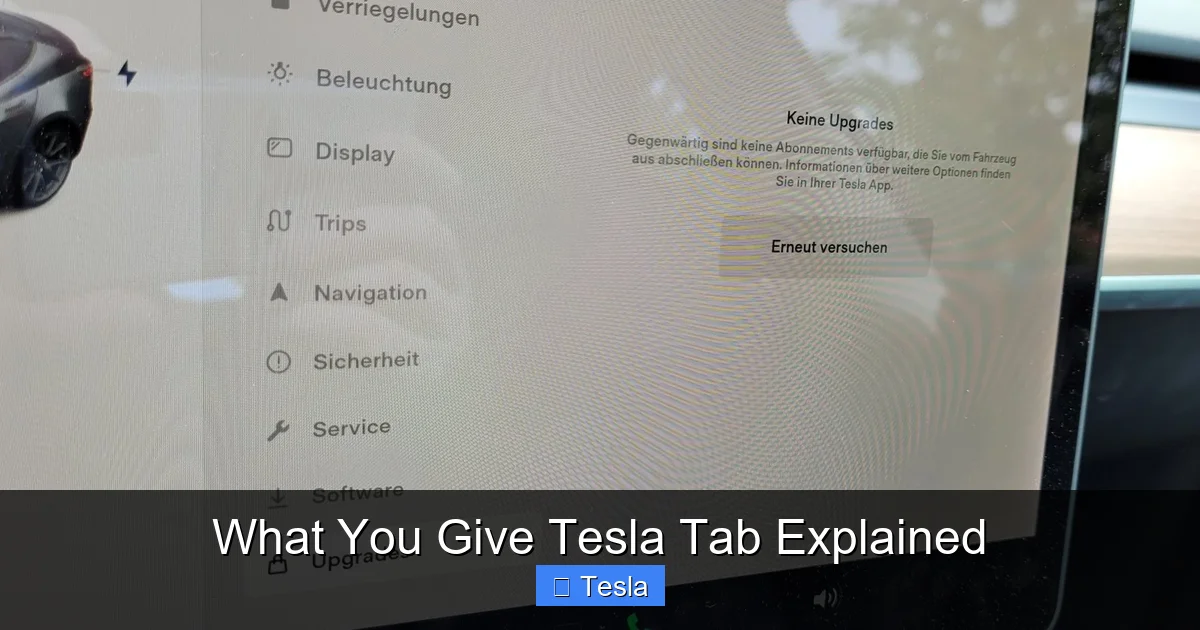
The Tesla navigation system is a marvel of integrated engineering. It doesn’t just show you a route; it plans your entire journey with energy consumption in mind. When you set a destination beyond your current range, the Tab automatically calculates where you need to stop to charge, how long you’ll need to stay at each Supercharger, and your final arrival state of charge (SOC). You can see the exact kW output expected at each stop and even adjust the desired final buffer (e.g., “arrive with 20%”).
Visual guide about What You Give Tesla Tab Explained
Image source: driveteslacanada.ca
Practical Tip: Always use the Tesla navigation for long trips. It provides the most accurate energy estimates because it knows your car’s exact battery health, current temperature, elevation changes, and even your personal driving style from past trips. Using a third-party app like Google Maps for directions while relying on Tesla’s energy prediction is a recipe for range anxiety. The Tab’s navigation is also your best friend for finding Superchargers. You can filter for V3 stalls (fastest), see real-time stall availability, and navigate directly to them. This seamless integration is a killer feature that traditional EVs struggle to match.
Media and Entertainment: Creating Your Soundscape
The Tesla Tab’s media system is robust but has some quirks. The primary way to get music is via streaming services. You’ll need a Tesla premium connectivity subscription (or a trial) for Spotify and Apple Music. Once logged in, your playlists and libraries sync. A great feature is “Share music” via Bluetooth from your phone, which works without a subscription and is perfect for personal music libraries.
For podcasts and audiobooks, you can use the browser (when parked) to access websites like Overcast or Audible, though the experience isn’t as smooth as a native app. The audio quality is excellent, with a clear, balanced sound system. Use the quick controls at the bottom of the Tab for volume and track skip without leaving your current app (like navigation).
Practical Example: Before a long drive, use the Tesla Tab to queue up your driving playlist on Spotify. Then, set your destination in navigation. The Tab will seamlessly lower music volume for turn-by-turn directions and raise it back up, all without you touching a button. You can also use voice commands (press the right scroll wheel) to say “Play [artist]” or “Call [contact].”
Vehicle Controls: The Heart of Personalization
This is where you make the car truly yours. The Controls menu on your Tesla Tab is deep. Here’s where to find the most impactful settings:
- Driving > Acceleration: Choose between “Chill” (slower, more efficient) and “Sport” (instant, neck-snapping torque). Model S Plaid and X have a “Ludicrous” or “Plaid” mode.
- Driving > Steering: Adjust “Comfort,” “Standard,” or “Sport” for steering weight and feedback.
- Driving > Regenerative Braking: Set to “Standard” for max one-pedal driving (lift off the accelerator and the car slows aggressively, recapturing energy). “Low” gives a more traditional coasting feel. This is a huge factor in daily driving comfort and efficiency.
- Vehicle > Lock: Set “Walk-Away Lock” to automatically lock the car when you walk away with the key fob/phone.
- Comfort & Access > Easy Entry: This moves the steering wheel and driver’s seat back when you exit, making it easier to get in/out. It returns to your saved position when you sit back down. A must-use feature.
- Service > Tire Pressure: Here you can view the digital pressure readouts (on supported models) and reset the TPMS after adjusting pressures.
Spend 30 minutes exploring this menu. The Tesla Tab is designed for exploration. Every setting change is immediate, so you can feel the difference in steering or acceleration right away on a safe, empty road.
Customization and Personalization: Making the Tab Truly Yours
Driver Profiles: One Tab, Multiple Drivers
If you share your Tesla, Driver Profiles are a lifesaver. Each profile saves a vast array of settings: seat position, mirror angles, steering wheel adjustment, climate preferences, favorite apps, and even all the settings from the Controls menu (acceleration mode, regenerative braking setting, etc.). You create a profile in Controls > Driver > Driver Profile. Then, when you approach the car, it can automatically detect your phone/key fob and switch to your profile (you must enable “Auto” switching). Alternatively, you can manually select your profile from the top-right corner of the Tesla Tab home screen.

Visual guide about What You Give Tesla Tab Explained
Image source: wordwallscreens.azureedge.net
Pro Tip: Create a profile for “Valet” mode. This restricts the car’s performance (speed, power limit), locks the front trunk and frunk, hides your home/work addresses in navigation, and limits access to the Controls menu. It’s perfect for handing your keys over without worry.
App Layout and Favorites
The app grid on the home screen is fixed in its column/row structure, but you can rearrange the apps within it. Press and hold any app icon until it wiggles, then drag it to a new spot. Use this to put your most-used apps (Navigation, Media, Phone) in the bottom row for easiest thumb reach while driving. You can also add “shortcuts” to specific functions. For example, in the Climate app, you can long-press the “Defrost” icon to add a direct shortcut to the home screen. Explore long-pressing icons in various apps; you’ll find hidden customization options.
Language, Time, and Display Settings
Under Controls > Display, you can change the language, set the time format (12/24h), and adjust the brightness. The brightness slider is separate from your car’s ambient light sensor; you can manually override it. This is useful if the auto-dimming is too aggressive or not aggressive enough. You can also enable “Display Mode” to show additional information like charge rate or speed in the top bar.
Troubleshooting: When the Tesla Tab Acts Up
Even a computer on wheels has glitches. The good news: most Tesla Tab issues are software-related and easily fixed.
The First Line of Defense: The Soft Reboot
This is the #1 fix for 80% of Tab problems: unresponsive screen, apps crashing, weird graphical glitches. A soft reboot restarts the Linux-based operating system without losing any settings or data. Here’s how: Press and hold both scroll wheels on the steering wheel until the screen goes black and the Tesla logo reappears. This takes about 10-20 seconds. Do this while the car is in Park. It’s safe and simple. If the Tab is completely frozen and you can’t get to the steering wheel controls, you can also hold down the two buttons on the steering wheel (if your model has them) or perform a hard reboot by holding the power button in the center console (if equipped) until the screen shuts down.
Connectivity is Key
Many Tab features require an internet connection. Streaming music, live traffic, navigation map updates, and OTA updates all need connectivity. If something isn’t working, check your signal. The LTE/5G icon is in the top status bar. If it’s weak or absent, you may be in a dead zone. Sometimes, toggling Wi-Fi off/on or restarting the car’s cellular connection via the Controls > Safety & Security > Connectivity menu can help. A poor connection is a common culprit for “Service Unavailable” errors in Spotify or map loading issues.
When to Worry: Signs of a Deeper Hardware Problem
While software glitches are common, some issues indicate a failing component. Be alert for:
- Permanent vertical or horizontal lines on the screen: This is often a failing LCD panel or loose internal cable. It won’t fix with a reboot.
- Touchscreen not registering touches in specific areas: A “dead zone” usually means the digitizer (the touch-sensitive layer) is damaged.
- Screen going completely black and not turning back on: Could be a power delivery issue to the display unit. A reboot won’t help.
- Overheating warnings or the screen dimming drastically in normal temperatures: Could indicate a failing backlight or overheating GPU.
For persistent hardware symptoms, you need a service appointment. Use the Service section of the Tesla Tab or the Tesla app to schedule one. Describe the issue clearly and, if possible, take a video. These hardware repairs can be costly, as the entire screen unit is often replaced as a single assembly.
The Tesla Tab in Daily Life: Practical Scenarios and Pro Tips
The Commute and Errand Runner
For your daily drive, the Tesla Tab should be a silent assistant. Set your home and work addresses in navigation. The car will learn your routes and even predict when you’ll likely leave (if you have a consistent schedule) and suggest preconditioning (heating or cooling the cabin while plugged in). Use voice commands for everything: “Drive to the grocery store,” “Call Mom,” “Play my ‘Workout’ playlist.” This keeps your eyes on the road. Get in the habit of checking the Energy app (in the bottom dock) to see your real-time consumption and projected range. It builds an intuitive sense of how your driving affects the battery.
The Long-Distance Road Tripper
Here’s where the Tab shines. Plan your entire trip on the screen the day before. Input your destination. Watch the Tab place your charging stops. Tap on a Supercharger stop to see amenities (food, restrooms) and current stall availability. You can even adjust the desired charge percentage at each stop. On the road, the navigation will proactively tell you which stall to use at a Supercharger station for optimal charging speed. The Media app keeps the whole family entertained. Use Camp Mode (in climate settings) if you need to sleep in the car—it maintains a comfortable temperature and allows you to use the large screen for movies while parked.
The Tech-Savvy Tinkerer
For those who love to explore, the Tesla Tab has hidden depths. The “Service” menu has a “Vehicle Info” section that shows real-time data from every sensor: battery cell voltages, motor speeds, brake pressures. This is a goldmine for enthusiasts. You can also enable “Developer Mode” (a hidden setting) for even more telemetry, though it’s not officially supported for regular users. Another pro tip: use the Tab’s browser (when parked) to access websites that Tesla doesn’t have native apps for, like YouTube, Netflix, or even web-based email. Just remember, for safety, video playback is disabled while the car is in motion.
The Future of the Tesla Tab: What’s Next?
Tesla’s philosophy is that the car you buy today should be better tomorrow. The Tesla Tab is the primary beneficiary of this. We’re already seeing the evolution with the introduction of a secondary screen behind the steering wheel in the new Model 3 and Y, which handles some critical driving info (speed, Autopilot status) to reduce the need to glance at the main Tab for basic data.
Looking ahead, expect deeper integration with Tesla’s Full Self-Driving (FSD) suite. As FSD capabilities grow, the Tab’s interface will need to communicate the car’s intentions more clearly—showing predicted paths, identifying objects, and explaining its decision-making. We may see more “gamified” elements, like the Emissions Testing Mode or the “Santa Mode” update, become permanent playful features. There’s also constant speculation about third-party app support via an official Tesla app store, which would explode the Tab’s utility beyond driving and entertainment.
Hardware-wise, rumors of even larger, higher-resolution screens or even multiple displays persist. The core concept, however, will remain: a single, updatable, central interface that controls the entire vehicle experience. The Tesla Tab is not just a screen; it’s the platform upon which your car’s future is built. By understanding it today, you’re prepared for whatever Tesla pushes out tomorrow.
Conclusion: Your Partner on the Road
The Tesla Tab is more than a piece of hardware; it’s the embodiment of Tesla’s software-first approach to automobiles. It replaces physical buttons with digital flexibility, allowing your car to grow and improve over time. While its learning curve can be steeper than a traditional car’s interface, the payoff is immense: a cabin of serene simplicity, a navigation system that thinks for you, and a personalized driving experience that is truly unique to you.
Take the time to explore its menus, customize your profiles, and master the basic reboots. Treat it with care—avoid extreme temperatures and direct sunlight on the screen when parked, as it can affect performance and longevity. Remember that a well-understood and well-maintained Tab is a source of joy and convenience, while a neglected or misunderstood one can be a point of frustration. It is the command center of your Tesla, and by reading this guide, you’ve taken the first and most important step to mastering it. Now, go tap that screen and enjoy the drive.
P.S. As you get to know your Tesla’s systems, you’ll realize how interconnected everything is. For instance, the Tab’s climate control is part of your car’s larger thermal management system. Understanding how your car’s core systems work—like the importance of proper engine oil in a conventional vehicle—gives you a greater appreciation for the engineering marvel that is your electric Tesla. While Tesla doesn’t need oil changes, the principle of system maintenance remains universal. Always stay on top of your vehicle’s service needs, whether prompted by a notification on your Tab or a scheduled check-up.
Frequently Asked Questions
What exactly is the Tesla Tab?
The Tesla Tab is the large central touchscreen display that serves as the primary interface for controlling almost all vehicle functions, including navigation, media, climate settings, and driving adjustments. It’s the central hub for your Tesla’s infotainment and control systems.
How do I restart or reboot my Tesla Tab if it freezes?
Perform a soft reboot by pressing and holding both scroll wheels on the steering wheel until the screen goes black and the Tesla logo reappears. This restarts the operating system without losing your settings and fixes most temporary glitches.
Can I customize the layout of apps on my Tesla Tab?
Yes. You can rearrange the app icons on the home screen by pressing and holding an icon until it wiggles, then dragging it to a new position. You can also add specific function shortcuts by long-pressing icons within certain apps (like the defrost button in Climate).
Why isn’t my music streaming (Spotify/Apple Music) working on the Tesla Tab?
>The most common reason is lack of an active Tesla Premium Connectivity subscription, which is required for these streaming services. Also, ensure you have a strong cellular (LTE/5G) or Wi-Fi signal, as streaming requires an internet connection.
Is it safe to use the Tesla Tab while driving?
Tesla designs the Tab to minimize distraction with large touch targets and voice control. However, any interaction with the screen takes your eyes off the road. Use voice commands whenever possible, and only perform complex tasks like setting a destination or changing climate settings while the car is stopped or in a safe, controlled situation.
Does a broken Tesla Tab affect my car’s resale value?
Yes, significantly. A fully functional, up-to-date Tab is a major selling point for any Tesla. A cracked, unresponsive, or outdated screen will drastically reduce the car’s value and make it very difficult to sell, as it compromises the core user experience and may indicate deeper software or hardware issues.