What Year of Toyota Highlander Is the Most Reliable?

Contents
- 1 Key Takeaways
- 2 📑 Table of Contents
- 3 Understanding Toyota Highlander Generations
- 4 The Crown Jewel: Why 2016-2019 (3rd Gen V6) Takes the Title
- 5 Critical Components to Inspect on Any Highlander
- 6 Model Years to Target vs. Years to Avoid
- 7 How to Find and Verify a Reliable Highlander
- 8 Conclusion: Your Best Bet
- 9 Frequently Asked Questions
Car Emergency Roadside Kit

Car Hydraulic Jack
Tire Shine Spray

Car Fog Light Bulb
Finding the most reliable Toyota Highlander year depends heavily on which generation you consider. The third generation (2014-2019) is widely regarded as the sweet spot for reliability, value, and proven longevity, especially models from 2016 onward after initial kinks were worked out. The fourth generation (2020+) offers modern tech and efficiency but is too new for long-term reliability data, while the first two generations have age-related concerns. Your best choice balances model year, maintenance history, and intended ownership length.
Shopping for a used Toyota Highlander is a smart move. It’s consistently one of the best-selling three-row SUVs for a reason: it’s practical, comfortable, and carries the Toyota badge, which promises reliability. But “Toyota reliable” isn’t a blanket statement for every single year they ever made it. The Highlander has evolved through four distinct generations, each with its own mechanical personalities, strengths, and occasional weaknesses. So, when you ask, “What year of Toyota Highlander is the most reliable?” you’re really asking which specific production run has earned the best reputation from mechanics, long-term owners, and the data.
We’re going to break it down generation by generation. We’ll look at the engine, transmission, and critical components that define an SUV’s lifespan. We’ll separate myth from fact, highlight which model years to target, and which ones to approach with caution. By the end, you’ll have a clear, actionable answer tailored to your budget and how long you plan to keep the vehicle. Let’s dive in.
Key Takeaways
- The 2016-2019 Toyota Highlander (3rd Gen) is the consensus pick for most reliable. This model years feature a refined 3.5L V6 engine and 8-speed automatic transmission, avoiding the early transmission issues of the 2014-2015 models.
- Avoid the first model year of any generation. The 2014 Highlander had more reported transmission and infotainment problems, while the 2020 model had some early teething issues with its new hybrid system and electronics.
- Regular maintenance is non-negotiable for Highlander longevity. Regardless of year, strict adherence to oil changes, transmission fluid services, and timing belt/water pump replacements (on V6 models) is critical.
- The 3rd generation offers the best balance of proven durability and modern features. You get a spacious, comfortable SUV with a reputation for lasting 300,000+ miles when cared for, without the premium price of the newest models.
- Check the specific vehicle history over the model year alone. A well-maintained 2015 can be more reliable than a neglected 2018. Always get a pre-purchase inspection and review full service records.
- Hybrid models are exceptionally reliable but come with different considerations. The Highlander Hybrid (available in 3rd & 4th gen) has superb reliability due to the Toyota Hybrid System, but battery replacement cost is a future factor for high-mileage examples.
📑 Table of Contents
Understanding Toyota Highlander Generations
Before we crown a champion, you need to understand the family tree. The Highlander has four distinct generations, each representing a major redesign. Reliability isn’t linear across them.
First Generation (2001-2007): The Classic Workhorse
Based on the Toyota Camry platform, this original Highlander was a unibody SUV that prioritized car-like ride and comfort over truck-like ruggedness. It was offered with a 2.4L 4-cylinder or a 3.0L/3.3L V6. The 4-cylinder models (like the 2001-2006) are famously simple, durable, and cheap to repair. The V6 models are also solid, but you must watch for the timing belt service interval (around 90,000-100,000 miles). If the belt or water pump hasn’t been replaced, it’s a red flag. These are old vehicles now, so reliability depends almost entirely on meticulous maintenance history. Rust can be an issue in northern states. They are cheap to buy because they are old, not necessarily because they are unreliable—but age catches up to all machines.
Second Generation (2008-2013): Refined and Capable
This generation grew in size and sophistication. It introduced the 3.5L V6 (2GR-FE) engine, which is an absolute legend in the Toyota world—used in everything from Camrys to Land Cruisers. Paired with a 5-speed or later 6-speed automatic, this powertrain is incredibly robust. The 2008-2013 Highlander is arguably the most mechanically simple and overbuilt of the modern era. There are no widespread catastrophic failures reported for the engine or transmission in this generation. Common issues are minor: occasional power steering leaks, worn suspension bushings on high-mileage examples, and infotainment glitches in later years. For a buyer wanting a large, no-nonsense, and ultra-reliable used SUV, the 2010-2013 models are fantastic, provided they’ve been cared for. They lack the latest safety tech, but their mechanical purity is a huge asset.
Third Generation (2014-2019): The Sweet Spot
This is where the answer to “most reliable” gets interesting. The 2014 redesign brought a more aggressive look, improved interior, and a new 8-speed automatic transmission mated to the proven 3.5L V6 (2GR-FKS, a slightly evolved version). This generation is the heavyweight contender for the title. However, the first two model years (2014-2015) have a notable caveat: there are documented reports of transmission shuddering and harsh shifting, particularly in the 8-speed unit. Toyota addressed this with software updates and, in some cases, physical modifications. By the 2016 model year, these issues were largely resolved. The 2016-2019 Highlander V6 represents the peak of this generation—refined, powerful, and with the transmission gremlins ironed out. The hybrid model (using the 3.5L V6 with hybrid system) is also exceptionally reliable in this gen, with no major systemic issues reported. Build quality is excellent, and the interior held up well over time.
Fourth Generation (2020-Present): The Modern Leader
The current Highlander is a complete redesign, shedding weight and standardizing on a turbocharged 2.4L 4-cylinder (or the hybrid powertrain). The 3.5L V6 was discontinued. The turbo engine is new for this generation and has thus far shown good reliability in early reports, with no widespread failures. The hybrid system is a carryover evolution and remains bulletproof. The challenge for the 2020+ models is time. They haven’t been on the road long enough to accumulate 200,000+ miles and reveal long-term weaknesses. Early owner reports mention minor electronic gremlins (infotainment freezes, sensor errors) and some concerns about the turbo engine’s long-term durability under heavy stress compared to the old naturally aspirated V6. They are also more complex. For a “most reliable” title based on *proven* longevity, they are not yet in the running. But for a buyer wanting a brand-new, efficient, and feature-packed SUV with a strong early reliability outlook, they are excellent.
The Crown Jewel: Why 2016-2019 (3rd Gen V6) Takes the Title
Let’s put a bow on it. For a combination of proven mechanical durability, resolved transmission issues, available features, and strong resale value, the 2016, 2017, 2018, and 2019 Toyota Highlander V6 is the most reliable year range you can buy.

Visual guide about What Year of Toyota Highlander Is the Most Reliable?
Image source: copilotsearch.com
The Perfect Powertrain Harmony
You get the indomitable 2GR-FKS 3.5L V6 engine. This engine family is known for easily surpassing 300,000 miles with basic upkeep. It’s not overly stressed in the Highlander’s application. The 8-speed automatic, while complex, had its early software bugs and potential solenoid issues fixed by 2016. The result is smooth, responsive, and long-lasting shifts. There are no known common failure points for major engine or transmission components in these years.
Matured Design and Quality
By 2016, this generation was in its third year. Toyota had worked out any remaining assembly quirks from the all-new 2014 launch. Interior materials, panel gaps, and electronics integration were refined. You benefit from a vehicle that was designed well and had its initial bugs sorted. It also means you’re not buying the very first model year of a generation, which is always a risk.
Value and Features
A 2019 Highlander is only a few years old, has far more standard safety features (Toyota Safety Sense) than a 2013, and feels much more modern than the previous generation. Yet, it’s significantly cheaper than a 2020+ model. You get a massive amount of “newness” and technology without the premium price or the unproven long-term status of the current gen. For a family wanting a reliable, spacious, and comfortable hauler for the next decade, it’s the optimal financial and practical decision.
Critical Components to Inspect on Any Highlander
Even the “most reliable” year can be a nightmare if neglected. Here’s what you must check on any used Highlander, regardless of year.

Visual guide about What Year of Toyota Highlander Is the Most Reliable?
Image source: familytoyotaofarlington.com
The Transmission (The #1 Concern)
For V6 models, this is paramount. On 2014-2015 models, you must test drive extensively. Look for shuddering between 40-60 mph, delayed shifts, or harsh engagement into Drive/Reverse. On 2016+ and all 4-cylinder models (including the turbo 2.4L), the transmission is generally robust, but a full diagnostic scan is wise to check for any stored solenoid or temperature sensor codes. Always verify transmission fluid has been changed per Toyota’s schedule (every 60,000-100,000 miles depending on generation). Neglected fluid is the fastest way to kill any automatic transmission.
Timing Chain/Belt and Water Pump
This is a critical, expensive service. The 3.5L V6 in 2nd and 3rd gen models uses a timing chain, which is theoretically “lifetime” but the tensioners and water pump (often driven by the timing chain) can fail. On the 4th gen turbo 2.4L, it also uses a chain. However, on the 1st gen 3.0L/3.3L V6, it uses a timing belt that must be replaced at the interval. Never buy a Highlander with a V6 from the early 2000s without documented proof of a recent belt/water pump service.
Hybrid Battery Health
If looking at a Highlander Hybrid (2014-2019 or 2020+), the hybrid battery is a future cost item. While these batteries are very reliable and often last 150,000+ miles, replacement is expensive ($3,000-$5,000+). Ask if the battery has been tested or replaced. A significant drop in fuel economy or electric-only driving range can be a sign of weakening cells. For more on Toyota’s hybrid technology and related components, you can explore resources that detail the unique features like the snow button which is common on many AWD Toyota models, including Highlanders, and how it affects drivetrain behavior.
Rust and Frame Integrity
Check the undercarriage, wheel wells, and rocker panels thoroughly. First and second-gen models, especially in states that use road salt, can suffer from significant frame and body rust. This is a structural and safety issue. The third and fourth generations have much better rust-proofing, but still inspect. A comparison with a competitor like the Nissan Rogue shows that rust can be a class-wide issue in certain climates, not just a Toyota problem.
Model Years to Target vs. Years to Avoid
Let’s get specific.
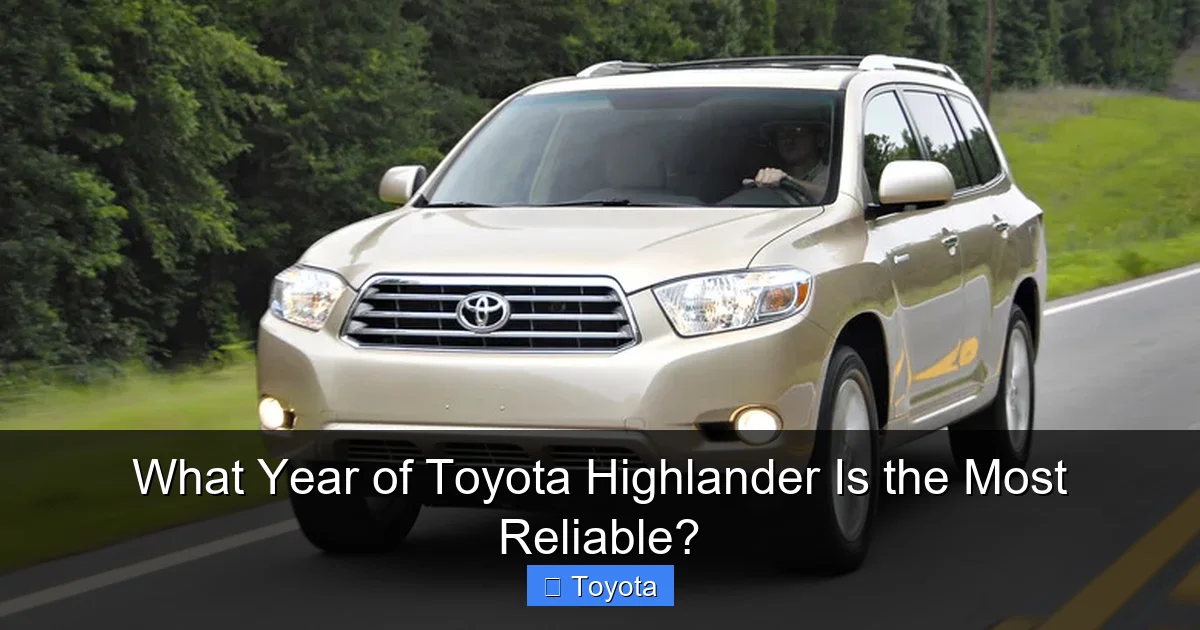
Visual guide about What Year of Toyota Highlander Is the Most Reliable?
Image source: slashgear.com
Top Picks (The Most Reliable)
- 2016-2019 Toyota Highlander V6: The undisputed champion for proven, cost-effective reliability.
- 2010-2013 Toyota Highlander V6: The “old school” pick. Mechanically simple, bulletproof powertrain, but dated tech and higher mileage for the same price as a newer 3rd gen.
- 2021-2023 Toyota Highlander Hybrid: If you want new, this is the safest hybrid bet with the most modern tech and no major red flags yet.
Years to Approach with Caution
- 2014-2015 Toyota Highlander V6: The transmission issue is the primary concern. A 2014-2015 with a fully documented transmission software update and a clean diagnostic scan can be a good value, but the risk is higher. Budget for a potential $3,000+ transmission repair or replacement down the line.
- 2020 Toyota Highlander (all models): First model year of the 4th gen. Early adopter issues are possible. More likely to have minor electronic bugs that require dealer updates. Not unreliable, but not the “most proven” yet.
- 2001-2003 Toyota Highlander 4-Cylinder with High Miles: While the 2.4L engine is tough, these are now 20+ year old vehicles. Expect complete suspension rebuilds, cooling system work, and potential head gasket wear. The cost to bring one to true reliability may exceed the vehicle’s value.
How to Find and Verify a Reliable Highlander
Finding the right year is step one. Finding the right example is step two, and it’s more important.
Prioritize a Full Service History
This is non-negotiable. A Carfax or AutoCheck report is a start, but the real gold is a stack of receipts. You want to see consistent oil changes (every 5,000-7,500 miles), transmission fluid services, and major services like timing belt/chain and water pump replacement on schedule. Gaps in service history are a major red flag. A vehicle with 100,000 miles and perfect records is a far better bet than one with 60,000 miles and none.
The Essential Pre-Purchase Inspection (PPI)
Never buy a used Highlander (or any used car) without a PPI by a trusted, independent mechanic—preferably a Toyota specialist. They will put the vehicle on a lift, check for rust, leaks, suspension wear, and most importantly, run a full computer diagnostic scan. This scan will reveal any stored trouble codes, even if the check engine light is off, which can indicate pending transmission or sensor issues. It costs $150-$250 and can save you $5,000. When comparing to other SUVs in its class, understanding the towing capacity and drivetrain capabilities of competitors like the RAV4 can also help you confirm the Highlander’s strengths in that area.
Check for Technical Service Bulletins (TSBs)
TSBs are manufacturer-recommended fixes for known, non-safety defects. You can ask the dealer for a report or use a paid service like Consumer Reports’ car problem database. For the 2014-2015 Highlander, there are TSBs related to the transmission. A dealer should have performed these updates. If they haven’t, it’s a negotiation point or a reason to walk away.
Conclusion: Your Best Bet
So, what year of Toyota Highlander is the most reliable? The data, owner forums, and mechanic consensus all point to the 2016-2019 model years with the 3.5L V6 engine. They represent the perfect intersection of a fundamentally robust powertrain, resolved transmission software, modern comfort and safety features, and a price that hasn’t yet ballooned into “new car” territory. They are the vehicles that have logged the most miles with the fewest catastrophic reports.
However, “most reliable” is a statistical term. Your personal most reliable Highlander will be the one with the cleanest history, the most complete service records, and a spotless pre-purchase inspection. A 2015 with perfect maintenance can outlast a 2018 with none. Use the model year as your initial filter—targeting 2016-2019 V6 models—and then spend your time and energy vetting individual examples. The Toyota Highlander’s reputation is earned, and by focusing on this proven generation, you’re buying into a legacy of reliability that has already been stress-tested on hundreds of thousands of miles of American roads. If you’re also considering other Toyota models, you might look at the differences between trims, such as understanding the Highlander XLE vs. XSE, to further narrow down your perfect match.
Frequently Asked Questions
What is the most common problem with the 2014-2015 Toyota Highlander?
The most common and significant issue is transmission shuddering and harsh shifting, particularly in the 8-speed automatic V6 models. This was largely addressed by Toyota with software updates for the 2016 model year and beyond.
Should I buy a Highlander Hybrid or a gas V6 for maximum reliability?
Both have excellent reliability. The gas V6 (in 2016-2019 models) is simpler and cheaper to repair long-term. The Hybrid system is famously durable with fewer moving parts to wear out, but the potential future cost of the hybrid battery replacement is a consideration. For pure, no-surprise longevity, the V6 is the classic choice.
Is the 2020+ Highlander’s turbo engine as reliable as the old V6?
It’s too early to say for certain over the long haul (300,000+ miles). Early reports are positive, with no widespread failures. However, turbocharged engines are inherently more complex and operate under higher stress than a naturally aspirated V6. The old 3.5L V6 has a 20-year track record of reliability that the turbo 2.4L cannot yet match.
What is a fair price for a reliable used Toyota Highlander?
Prices vary by region and condition. As of late 2023/early 2024, a well-maintained 2017-2019 Highlander V6 typically ranges from $25,000 to $35,000. A 2014-2015 might be $2,000-$4,000 less but factor in potential transmission costs. Always compare to similar vehicles in your area using pricing guides.
Do I need a 4WD/AWD Highlander for reliability?
No. The 2WD (FWD) models are slightly simpler with fewer drivetrain components (no transfer case, rear differential), which can marginally improve long-term reliability and reduce maintenance costs. AWD is great for snow and light off-road use, but it adds complexity. For pure reliability in a dry climate, FWD is fine.
How many miles is too many for a Highlander?
With proper maintenance, a 3rd generation V6 Highlander (2014-2019) can easily surpass 300,000 miles. “Too many” is less about the number and 100% about the maintenance history. A 250,000-mile vehicle with every service record is a better buy than a 120,000-mile vehicle with none. Always get a thorough inspection for high-mileage examples.