
How Many Miles per Gallon Does a 2025 Toyota Tundra Get?

The 2025 Toyota Tundra offers a significant fuel economy advantage with its standard i-FORCE MAX hybrid powertrain, achieving an EPA-estimated 20-22 MPG combined. The non-hybrid i-FORCE V6 provides slightly lower ratings. Real-world miles per gallon can vary based on driving style, load, and trim configuration. Understanding these factors helps set realistic expectations for this full-size truck’s efficiency.
So, you’re eyeing a 2025 Toyota Tundra. You like the idea of a full-size, go-anywhere, tow-anything truck. But then the practical side of your brain kicks in. “How many miles per gallon does this big truck actually get?” It’s the million-dollar question for anyone shopping in this segment. Fuel costs are a huge part of ownership, and for a vehicle this size, MPG matters. Let’s cut through the marketing and get to the real numbers, the real-world expectations, and what you can do to squeeze every last mile out of your tank.
The short answer is: the 2025 Tundra is far more efficient than its predecessors, thanks to a major engineering shift. But “efficient” is a relative term in the full-size truck world. We’re going to break down exactly what the EPA says, what owners are actually seeing, how different setups change the equation, and how it stacks up against the competition. By the end, you’ll know exactly what fuel economy to expect from your potential new Tundra.
Key Takeaways
- Hybrid is Standard: For 2025, the more efficient i-FORCE MAX twin-turbo V6 hybrid is the standard engine across most trims, not an option.
- EPA Ratings: The hybrid Tundra achieves an EPA-estimated 20 city / 24 highway MPG for most 2WD models, with 4WD models seeing a slight drop.
- Real-World vs. EPA: Actual miles per gallon often falls 1-3 MPG below EPA estimates due to the Tundra’s size, weight, and typical use cases like towing.
- Trim & Configuration Matter: Heavier Limited, Platinum, and 1794 Edition trims with larger tires and more features typically get 1 MPG less than base SR5 models.
- Towing & Payload Impact: Fuel efficiency drops significantly when towing near maximum capacity, often by 25-30%, making trip planning essential.
- Competitive Position: The Tundra’s standard hybrid gives it a notable MPG edge over many non-hybrid full-size competitors like the base Chevrolet Silverado 1500 or Ford F-150.
📑 Table of Contents
- Understanding MPG: EPA Estimates vs. Your Real-World Driving
- The 2025 Tundra’s Powertrain Lineup: It’s All About the Hybrid
- Official EPA Fuel Economy Ratings for 2025
- Real-World Fuel Economy: What Owners Are Actually Getting
- Maximizing Your Tundra’s Fuel Efficiency: Practical Tips
- How the Tundra’s MPG Stacks Up Against the Competition
Understanding MPG: EPA Estimates vs. Your Real-World Driving
Before we dive into Tundra-specific numbers, we need a quick lesson in how miles per gallon is measured and reported. The Environmental Protection Agency (EPA) puts every new vehicle through a rigorous, standardized lab test on a dynamometer. It simulates a mix of city and highway driving under controlled conditions. The resulting number is the official sticker you see on the window. It’s a great baseline for comparing vehicles, but it’s not a guarantee.
Why Your Numbers Will Be Different
Your personal miles per gallon is a unique number shaped by a dozen factors. The EPA test is a gentle, predictable cycle. Your life isn’t. Here are the biggest reasons your Tundra’s MPG will differ from the sticker:
- Driving Style: Are you a gentle accelerator who coasts to stops? Or do you have a lead foot? Aggressive driving can slash fuel economy by 15-30% in any vehicle, especially a heavy truck.
- Terrain & Traffic: Stop-and-go city traffic is the ultimate MPG killer. Constant acceleration and braking waste energy. Hilly or mountainous terrain forces your engine to work harder, too. The EPA’s “highway” number assumes flat, steady-state cruising.
- Climate & Accessories: Using the air conditioning in summer or the heater in winter puts a noticeable drain on your engine (or hybrid battery), reducing efficiency. Cold winter fuel is also slightly less energy-dense.
- Vehicle Load: This is critical for a truck. Every 100 pounds of cargo or passengers can reduce MPG by 1-2%. A fully loaded Tundra with a heavy trailer is a completely different fuel economy beast than an empty truck.
- Tire Pressure: Under-inflated tires create more rolling resistance. A simple, free fix like keeping tires inflated to the recommended PSI (found on your driver’s door jamb sticker) can improve MPG by a few percent.
- Fuel Quality: Using the recommended octane (premium for the Tundra) ensures optimal performance and efficiency. Lower-quality fuel can sometimes cause knocking, forcing the engine’s computer to adjust timing and reduce efficiency.
So, when you see the EPA number, think of it as the truck’s best-case, ideal-scenario score. Your real-world average will almost always be a bit lower, and that’s perfectly normal. If you want a more accurate personal estimate, check owner forums like Tundras.com or Fuelly.com for thousands of real-user reports.
The 2025 Tundra’s Powertrain Lineup: It’s All About the Hybrid
This is the most important chapter for understanding the Tundra’s MPG. For 2025, Toyota has made a decisive move. The standard, default engine is no longer a simple V8. It’s a twin-turbo V6 paired with an electric motor-generator system. This is a huge deal.
Visual guide about How Many Miles per Gallon Does a 2025 Toyota Tundra Get?
Image source: s1.cdn.autoevolution.com
The Standard-Bearer: i-FORCE MAX Hybrid
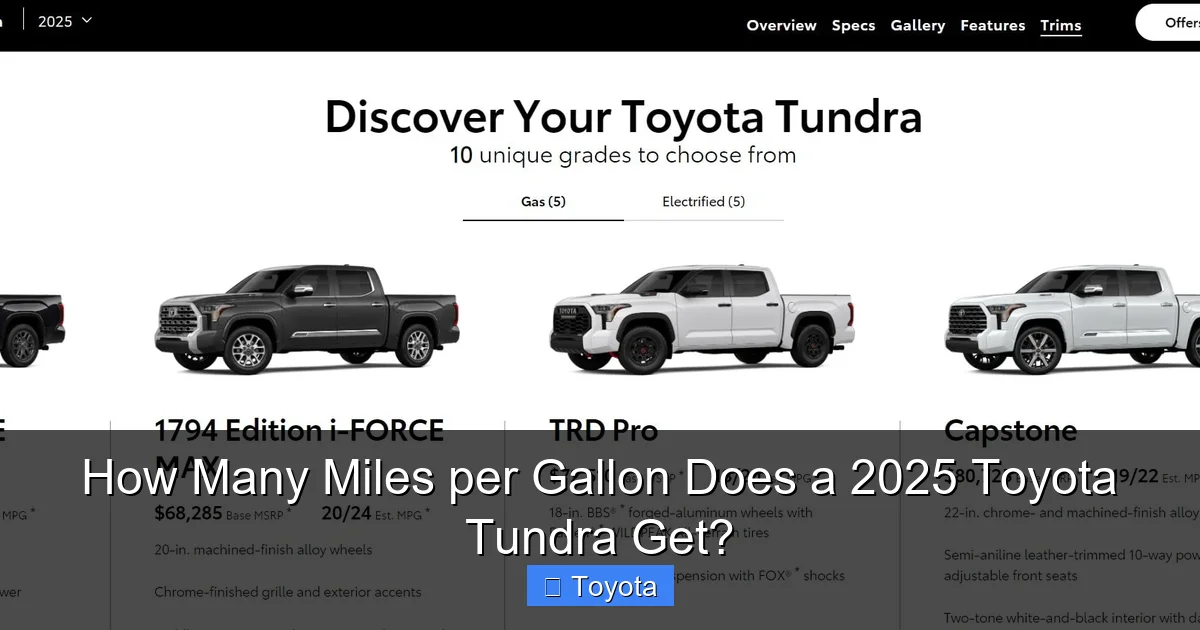
Called the i-FORCE MAX, this powertrain combines a 3.4-liter twin-turbo V6 gasoline engine with an electric motor sandwiched between the engine and the 10-speed automatic transmission. The system makes a combined 437 horsepower and 583 lb.-ft. of torque. That massive torque number is available almost instantly from the electric motor, which is why the Tundra feels so powerful off the line. For fuel economy, the hybrid system allows the engine to shut off more frequently (like at stoplights), and the electric motor can assist during acceleration, reducing the load on the gasoline engine. This is the engine you’ll find in the overwhelming majority of 2025 Tundras on dealer lots.
The Gas-Only Option: i-FORCE Twin-Turbo V6
There is still a non-hybrid option, but it’s now the “upgrade” for specific commercial or fleet use cases. It’s the same 3.4-liter twin-turbo V6, but without the hybrid-electric components. It produces 348 horsepower and 549 lb.-ft. of torque. While still a very potent engine, it lacks the hybrid’s electric assist and start/stop optimization, resulting in lower EPA fuel economy ratings. You’ll most commonly find this engine in the base SR5 model if you specifically seek it out for a lower initial cost or specific fleet requirements.
Key Point: Choosing between these two isn’t just about MPG; it’s about the driving character. The hybrid is smoother, quieter at low speeds, and more responsive. The gas-only feels more like a traditional truck but is less efficient. For most buyers, the hybrid’s advantages in both power and economy make it the clear winner.
Official EPA Fuel Economy Ratings for 2025
Alright, let’s get to the numbers you came for. The EPA has published official estimates for the 2025 Toyota Tundra. Remember, these are for the *combined* city/highway cycle. The “city” number is usually lower due to more stops and starts, and the “highway” number is the peak you might see on a long, flat road trip with no wind.
Visual guide about How Many Miles per Gallon Does a 2025 Toyota Tundra Get?
Image source: tfltruck.com
i-FORCE MAX Hybrid (Most Common)
For the standard hybrid powertrain, the ratings break down primarily by drivetrain (2WD vs. 4WD) and to a lesser extent by cab/bed configuration.
- 2WD (Rear-Wheel Drive) Models: This includes most SR5, Limited, and Platinum trims with the standard bed.
- City: 20 MPG
- Highway: 24 MPG
- Combined: 21 MPG
- 4WD (Four-Wheel Drive) Models: This includes most 4×4 versions of the above, plus the TRD Pro and Capstone.
- City: 19 MPG
- Highway: 22 MPG
- Combined: 20 MPG
The slightly higher rolling resistance and drivetrain losses of 4WD account for the 1 MPG drop across the board.
i-FORCE Gas-Only Twin-Turbo V6
For the non-hybrid model, the ratings are predictably lower. These are typically only on 2WD SR5 configurations.
- City: 18 MPG
- Highway: 21 MPG
- Combined: 19 MPG
The Impact of the Capstone’s Hybrid System
A special note for the top-tier Capstone trim. It uses a revised version of the i-FORCE MAX hybrid system with a higher-capacity hybrid battery and a slightly different calibration to prioritize smooth, silent, and powerful operation. The EPA ratings for the Capstone are identical to the standard hybrid: 20 city / 24 highway MPG for 2WD. The system is tuned for luxury, not for a different MPG target.
Real-World Fuel Economy: What Owners Are Actually Getting
Now for the truth serum. What do people who actually drive these trucks every day report? We’ve combed through owner forums, social media groups, and long-term review data to give you a realistic picture.
Visual guide about How Many Miles per Gallon Does a 2025 Toyota Tundra Get?
Image source: i.ytimg.com
The Consensus Range
For a typical, moderately driven 2024/2025 Tundra hybrid (2WD, not towing, mostly highway), most owners report a real-world combined average between 18 and 20 MPG. That’s a 1-3 MPG gap from the EPA’s 21 MPG combined estimate. For 4WD models, the average tends to land between 17 and 19 MPG. This pattern aligns with the industry-wide trend where real-world combined MPG is often about 10-15% lower than the sticker number for full-size trucks.
The Towing & Hauling Penalty
This is the most critical variable. If you’re using your Tundra as a true truck—towing a boat, trailer, or loaded with heavy gear—your fuel economy will plummet. Here’s a realistic breakdown based on owner reports and engineering principles:
- Light Towing (under 3,000 lbs): Expect a 10-15% drop in MPG. A truck that normally gets 19 MPG might dip to 16-17 MPG.
- Medium Towing (3,000 – 7,000 lbs): This is the most common use case for half-ton trucks. The penalty is severe: a 25-35% reduction. That 19 MPG average could fall to 12-14 MPG on a long highway grade.
- Max Towing (7,000+ lbs, near capacity): We’re talking about a 30-40%+ hit. Double-digit MPG becomes a dream. Aerodynamic drag and the sheer energy required to move the mass are brutal on fuel.
Pro Tip: If you plan to tow regularly, factor in the cost of fuel as a major part of your ownership budget. The Tundra’s hybrid system helps *mitigate* the towing penalty compared to a non-hybrid, but it doesn’t eliminate physics.
The Weight Factor
The 2025 Tundra is a heavy vehicle, with curb weights starting around 5,200 lbs for a base 2WD model and exceeding 6,000 lbs for a loaded 4WD Capstone. More mass means more energy is needed to accelerate and climb hills. This is a fundamental reason why even the efficient hybrid can’t achieve Prius-like numbers. The truck’s weight is a trade-off for its capability and strength. For a deeper dive into just how heavy these trucks are, you can read our detailed breakdown of how much a Toyota Tundra weighs.
Maximizing Your Tundra’s Fuel Efficiency: Practical Tips
You’ve bought the truck. Now, how do you get the best possible miles per gallon from it? You can’t change its size or weight, but you can control how you use it.
Driving Habits That Save Fuel
This is your most powerful tool. Smoothness is key.
- Accelerate Gently: Pretend there’s an egg under your foot. Smooth, gradual acceleration uses far less fuel than slamming the pedal. The hybrid system works best with predictable inputs.
- Anticipate Stops: Look far ahead. If you see a red light or slowing traffic, start coasting early instead of braking hard at the last second. The Tundra’s hybrid system can sometimes recharge the battery during deceleration.
- Use Cruise Control on Flat Highways: Maintaining a steady speed is more efficient than constant minor throttle adjustments. Just be sure to disengage it in hilly terrain where the truck will constantly hunt for the right gear.
- Observe Speed Limits: Aerodynamic drag increases exponentially with speed. Driving 70 mph vs. 65 mph can cost you 1-2 MPG easily. The “sweet spot” for most trucks on the highway is between 60-65 mph.
Maintenance & Setup Matters
- Stick to the Schedule: Regular oil changes, clean air filters, and properly functioning spark plugs are non-negotiable for optimal efficiency. A clogged air filter can reduce MPG by 10%.
- Tire Pressure is Critical: Check it monthly. The recommended pressure is on the driver’s door jamb sticker, *not* on the tire sidewall. Under-inflation by just 5 PSI can reduce fuel economy by 2-3%.
- Use the Right Fuel: The Tundra requires premium (91 octane) fuel for its high-compression turbo engines. Using lower-octane “regular” can cause pre-ignition (knock), forcing the engine computer to run less efficient timing maps to protect the engine.
- Reduce Idling: The hybrid system automatically shuts the engine off at stoplights. Don’t manually idle for long periods. If you’re stopped for more than 30 seconds (not in traffic), turn the engine off.
Smart Loading & Towing Practices
- Travel Light: Remove unnecessary cargo from the bed and cab. Every 100 lbs matters.
- Optimize Trailer Aerodynamics: If you tow, a smooth, streamlined trailer (or a towing “cap” or “shell” that matches your truck’s shape) makes a huge difference at highway speeds. A blunt-fronted utility trailer is an MPG disaster.
- Plan Your Route: Use GPS apps that factor in elevation. A route with fewer hills, even if slightly longer in distance, will often use less fuel.
- Pre-Trip Checklist: Ensure your trailer’s tires are properly inflated, bearings are greased, and brakes are adjusted. A dragging trailer brake can kill your fuel economy.
How the Tundra’s MPG Stacks Up Against the Competition
A full-size truck’s fuel economy doesn’t exist in a vacuum. You’ll compare it to the Ford F-150, Chevrolet Silverado 1500, Ram 1500, and maybe even the Nissan Titan. Let’s see how the 2025 Tundra hybrid holds up.
The Hybrid Advantage
This is the Tundra’s killer app. For the 2025 model year, Toyota makes its hybrid powertrain standard. Compare that to the competition:
- Ford F-150: Offers a hybrid PowerBoost option, but it’s an expensive upgrade ($2,500-$4,000+). The standard non-hybrid V6 and V8 get significantly lower MPG. The F-150 PowerBoost is rated at up to 25 MPG highway (2WD), very close to the Tundra hybrid.
- Ram 1500: Offers a mild-hybrid “eTorque” system on some V6 and V8 models, but it’s not a full hybrid like Toyota’s. It provides a small MPG boost (often 1-2 MPG) and better start/stop smoothness. The most efficient non-hybrid Ram 1500 V6 is rated at up to 23 highway MPG.
- Chevrolet Silverado 1500: No mainstream hybrid option for 2025 (the diesel is a different story). The most efficient gas model, the 2.7L Turbo 4-cylinder, is EPA-rated at up to 23 highway MPG.
The Verdict: The Tundra’s standard i-FORCE MAX hybrid gives it a consistent, built-in efficiency advantage over the base models of its main rivals. You don’t have to pay extra or seek out a special trim to get hybrid efficiency; it’s the default. In head-to-head highway MPG, the Tundra hybrid (24 MPG) is very competitive with the F-150 PowerBoost (25 MPG) and edges out the Ram 1500 eTorque and Silverado 2.7T.
When a Non-Hybrid Might Make Sense
There are a few niches where a non-hybrid full-size truck could be a better fit:
- Extreme Towing in Very Hot Climates: Some heavy-duty tower forums suggest hybrid systems can struggle with thermal management when continuously towing max capacity in high ambient temperatures, potentially reducing power. A robust turbo-diesel or large-displacement V8 might feel more consistent in that extreme scenario (though the Tundra’s non-hybrid V6 is still turbocharged).
- Fleet & Lowest Initial Cost: The gas-only SR5 might have a slightly lower MSRP. For a large fleet where operating cost per mile is meticulously calculated and the price difference matters, this could be a factor.
- Simplicity Preference: Some buyers simply prefer the known quantity of a conventional gas engine without complex hybrid components, though Toyota’s hybrid reliability track record is exceptional.
For the vast majority of private owners, the Tundra hybrid’s combination of massive torque, strong fuel economy, and smooth operation makes it the superior choice. If you’re looking at other efficient Toyota models for comparison, you might also want to see how the Toyota Venza or Toyota RAV4 Hybrid perform, though they are in entirely different vehicle classes.
Frequently Asked Questions
Is the 2025 Toyota Tundra a hybrid?
Yes, for 2025 the standard engine across nearly all trims is the i-FORCE MAX twin-turbo V6 hybrid system. A non-hybrid twin-turbo V6 is available only in select base SR5 configurations for specific markets.
How does towing affect the Tundra’s miles per gallon?
Towing has a dramatic impact. Expect a 25-35% reduction in MPG when towing medium-weight trailers (3,000-7,000 lbs) and even more at maximum capacity. The hybrid system helps somewhat, but physics is the ultimate limit.
What is the real-world MPG for a Tundra hybrid?
Real-world combined MPG for a typical, non-towing 2WD Tundra hybrid usually falls between 18 and 20 MPG, which is 1-3 MPG below the EPA’s 21 MPG combined estimate. 4WD models are typically 1 MPG lower.
Does the Tundra require premium fuel?
Yes, both the hybrid and non-hybrid 3.4L twin-turbo V6 engines require premium (91 octane) fuel for optimal performance and efficiency. Using regular fuel can cause engine knock and force the computer to reduce power and efficiency.
How does the Tundra’s MPG compare to a Ford F-150?
The Tundra’s standard hybrid gives it an edge over the base F-150’s non-hybrid engines. Against the F-150’s optional PowerBoost hybrid, the two are very close, with the F-150 holding a slight 1 MPG highway advantage in some trims. The Tundra’s key benefit is that hybrid efficiency comes standard.
Will the Tundra ever get 25 MPG like some car commercials?
Not in normal driving. The 24 MPG highway EPA rating is the absolute best-case scenario on a perfectly flat, windless road at 65 mph with no cargo. Achieving a sustained 25+ MPG in a Tundra under real conditions is highly unlikely due to its size and aerodynamic profile.
