
How to Disable Steering Wheel Lock on Push-start Toyota

Facing a locked steering wheel on your push-button start Toyota can be frustrating, but it’s usually a simple anti-theft feature, not a mechanical failure. This guide explains exactly why it happens and provides safe, effective methods to unlock it, from basic key fob tricks to the manual override procedure. You’ll learn when a temporary fix is enough and when it’s crucial to seek a professional to diagnose the underlying issue, preventing damage to your vehicle’s complex security system.
Key Takeaways
- It’s an Anti-Theft Feature: The steering wheel lock is a standard security measure in push-start Toyotas, activated when the vehicle is turned off and the wheel is moved.
- Simple Fixes Often Work: Most lock-ups are resolved by reinserting the key fob (if it has a physical key), pressing the brake, and gently wiggling the wheel while starting.
- Manual Override Exists: A hidden procedure using the start/stop button and brake pedal can disengage the lock without the key fob, useful for a dead key battery.
- Diagnose the Root Cause: Frequent lock-ups signal a problem—like a weak key fob battery, faulty ignition switch, or steering column issue—that needs professional attention.
- Never Force It: Forcing the wheel or ignoring persistent locks can break the steering column mechanism or electronic components, leading to expensive repairs.
- Permanent Disable is Not Recommended: Permanently disabling the lock compromises vehicle security and is often illegal; focus on fixing the cause of malfunctions instead.
- Consult Your Manual: Your owner’s manual provides the exact procedure and diagrams for your specific Toyota model and year.
[FEATURED_IMAGE_PLACEHOLDER]
📑 Table of Contents
- Understanding Your Toyota’s Steering Wheel Lock System
- First Things First: The Standard Unlocking Procedure
- What If the Standard Method Fails? The Manual Override
- Diagnosing the Real Problem: Why Is This Happening Repeatedly?
- When to Call a Professional: Don’t Become a DIY Nightmare
- Prevention and Best Practices to Avoid Future Lock-Outs
- The Bottom Line: Safety Over Convenience
Understanding Your Toyota’s Steering Wheel Lock System
So, you’ve parked your Toyota Camry, turned off the engine by pressing the start/stop button, and maybe even shifted into Park. You go to leave, turn the wheel a bit to get out, and… it’s locked solid. The steering wheel won’t budge an inch. Panic sets in for a second. “Is my car broken?” Let’s take a deep breath. This is almost certainly not a mechanical breakdown. It’s your Toyota’s sophisticated anti-theft system working exactly as designed.
In push-button start vehicles, there is no traditional key cylinder to physically lock the wheel. Instead, an electronic actuator inside the steering column engages a mechanical lock pin when the car’s computer (the Engine Control Unit or ECU) receives the signal that the engine is off and the wheel has been turned. This is a brilliant theft deterrent. Without the correct, authenticated key fob present and recognized, the wheel is immobilized. It’s a passive security feature that activates automatically. The most common trigger? You’ve turned off the car, applied the brake to shift into Park, and then—perhaps without thinking—gave the wheel a nudge with your hand or knee as you exited. That slight movement is all it takes for the system to engage the lock.
The Role of the Key Fob and Ignition Switch
Your key fob is more than a remote; it’s a cryptographic token. When you press the start button with your foot on the brake, the car’s antenna rings the fob, and if the encrypted handshake is successful, it powers up the ignition circuit. The steering lock actuator is part of this circuit. For the lock to disengage, the car must see a valid “start” command from a recognized fob while the brake is applied. This is why the solution often involves the fob’s physical presence and the brake pedal.
It’s helpful to understand this isn’t just a simple mechanical lock like in old cars. It’s an electro-mechanical system controlled by software. This means software glitches, low key fob battery voltage, or a faulty brake pedal switch can all trick the car into thinking the conditions for locking are met, or prevent the conditions for unlocking from being recognized. This knowledge is key to troubleshooting.
First Things First: The Standard Unlocking Procedure
Before you panic or call a tow truck, follow this exact sequence. This resolves 95% of “steering wheel locked” incidents on push-start Toyotas. It’s the method you’ll use from now on every time this happens.
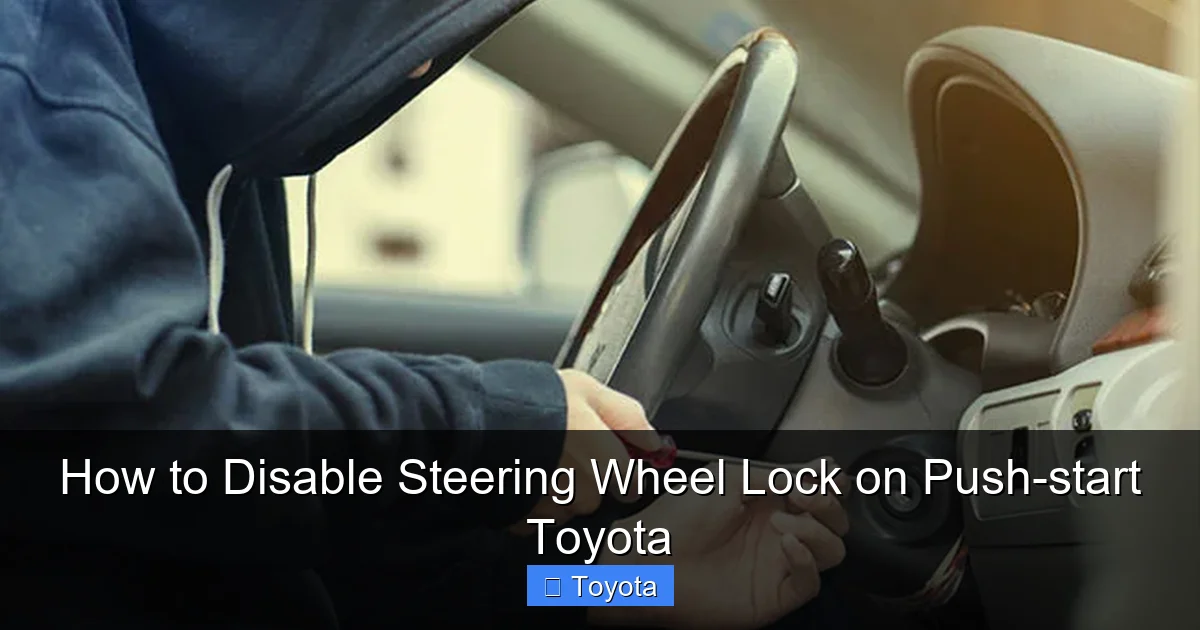
Visual guide about How to Disable Steering Wheel Lock on Push-start Toyota
Image source: d1hv7ee95zft1i.cloudfront.net
Step-by-Step: The Wiggle and Press Method
1. Insert Your Key Fob: If your key fob has a hidden physical key (many do, flip it out), insert it into the slot on the steering column. Some models have a designated slot; others use a cover you pop off. Consult your manual. If your fob is a solid keyless fob with no key, simply place it in the cup holder or on the center console—it must be inside the vehicle for the antenna to detect it.
2. Press the Brake Pedal Firmly: Place your foot firmly on the brake pedal. This is non-negotiable. The car’s safety interlock won’t allow the engine to start or the lock to disengage without the brake being depressed.
3. Gently Wiggle the Steering Wheel: While holding the brake, use your hand to gently turn the wheel to the left and right. You’re not trying to force it fully; you’re just applying slight pressure in both directions. You should feel a tiny bit of play as the lock mechanism shifts.
4. Press the Start/Stop Button: While continuing to wiggle the wheel very slightly and holding the brake, press the engine start/stop button once. You should hear a click from the steering column and feel the wheel release. The instrument cluster will light up normally.
5. Start the Engine: Once the wheel is free, press the start button again to crank the engine.
Pro Tip: The “wiggle” is critical. The lock pin is spring-loaded. Gentle pressure in one direction can bind it against the notch. Wiggling it back and forth helps align the pin with the disengagement channel. Be patient and gentle.
What If the Standard Method Fails? The Manual Override
Okay, you’ve tried the wiggle-and-press method five times. The wheel is still locked, and your key fob battery might be low, or there’s a communication hiccup. Don’t force it. There is a manual override procedure, essentially a “backdoor” for the system, designed for situations like a dead key fob battery. The exact steps vary slightly by model year and Toyota series (Camry, RAV4, Corolla, etc.), but the universal principle is the same: using the start button in a specific sequence to simulate a key turn without needing the fob to be perfectly responsive.

Visual guide about How to Disable Steering Wheel Lock on Push-start Toyota
Image source: m.media-amazon.com
The Universal Manual Override Sequence
1. Ensure the Key Fob is Inside: Place the key fob in the vehicle, ideally in the cup holder or on the wireless charging pad if equipped.
2. Press and Hold the Start/Stop Button: With your foot OFF the brake pedal, press and hold the engine start/stop button for about 5-10 seconds. You will see the instrument cluster lights come on (this is “ACC” or “ON” mode, like turning a key to the run position without starting). Release the button.
3. Apply the Brake and Press Again: Now, firmly press the brake pedal. While holding the brake, press the start/stop button once more. The car should now recognize the fob (even with a weak signal) and disengage the steering lock, then crank the engine.
Why This Works: Holding the button without the brake puts the car into a diagnostic/accessory mode that can sometimes reset low-voltage communication faults. Then, with the brake applied, it attempts a full start sequence. This sequence bypasses some of the more stringent checks that might be failing.
If this still fails, your key fob battery is almost certainly dead. Use the physical emergency key (if your fob has one) to unlock the driver’s door, get in, and then follow the manual override steps with the fob placed in the designated spot (often the front of the center console). If you don’t have a physical key, you may need a locksmith or dealer to cut a key from your VIN.
Diagnosing the Real Problem: Why Is This Happening Repeatedly?
If your steering wheel lock engages once and unlocks easily with the standard method, consider it a one-off. You likely nudged the wheel as you got out. However, if you’re experiencing this frequently—say, every time you start the car—that’s a red flag. The system is malfunctioning, and simply unlocking it each time is treating a symptom, not the disease. Here are the most common culprits.
Visual guide about How to Disable Steering Wheel Lock on Push-start Toyota
Image source: m.media-amazon.com
Weak or Dead Key Fob Battery
The key fob’s radio signal needs sufficient power to communicate with the car. A dying battery produces a weak signal that the car’s antenna might not consistently pick up. This can cause the car to fail the “key present” check when you press start, leaving the lock engaged. Solution: Replace the key fob battery. It’s a cheap and easy DIY fix (usually a CR2032 coin cell).
Faulty Brake Pedal Switch
The brake pedal has a small switch that tells the car, “The driver’s foot is on the brake.” If this switch fails or is out of adjustment, the car never gets the signal that the brake is pressed. Since the steering lock won’t disengage without the brake signal, you’re stuck. Symptoms might also include the car not starting at all or the shift lever not moving out of Park. Solution: Requires a mechanic to test and replace the brake light switch.
Steering Column Lock Actuator Failure
The small electric motor and gear set that physically moves the lock pin can wear out, get jammed, or have electrical connection issues. You might hear a faint clicking or whirring sound when you press the start button, but the wheel doesn’t unlock. Solution: This part needs to be diagnosed and replaced, often requiring steering column disassembly. It’s not a major job but is labor-intensive.
Software Glitch or Low Vehicle Battery
The car’s network of computers can sometimes get confused. A very weak 12-volt car battery (below ~12.2V) can cause all sorts of erratic behavior in sensitive electronic modules, including the steering lock control module. A simple software reset (disconnecting the battery for 10 minutes) can sometimes clear transient faults. Solution: Check the main battery health. If it’s old or weak, recharge or replace it. A dealer can also reflash the steering lock ECU software if a known update exists.
When to Call a Professional: Don’t Become a DIY Nightmare
Your safety is paramount. The steering system is not something to experiment with blindly. Here are clear signs it’s time to pick up the phone for professional help.
Signs You Need a Technician
- Persistent Lock After Multiple Attempts: You’ve tried the standard and manual override procedures several times with no success.
- Warning Lights: The check engine light, steering system warning light (a steering wheel icon), or even the security/immobilizer light is illuminated on your dash.
- Noises from the Column: You hear constant grinding, buzzing, or repetitive clicking from the steering column when trying to start, but nothing happens.
- Other Electrical Gremlins: Along with the steering lock, other features like power windows, door locks, or the infotainment system are acting erratically. This points to a broader network issue.
- After an Accident: If the steering wheel lock engaged following a collision, the entire system must be professionally inspected. Forces from an impact can damage internal components.
A certified Toyota technician has the diagnostic scan tools (like Techstream) to communicate directly with the steering lock ECU, read fault codes, and test the actuator’s operation. They can also perform the necessary calibrations after any part replacement. Attempting to forcibly break the lock or remove components without this knowledge can deploy the airbag (which is in the steering wheel rim) or cause irreversible damage, turning a $300 fix into a $3,000 one.
Prevention and Best Practices to Avoid Future Lock-Outs
An ounce of prevention is worth a pound of cure. Developing simple habits can save you from the hassle of a locked steering wheel.
Develop Good Exit and Entry Habits
The most common cause is accidental activation. When you turn off your Toyota, make a conscious effort to not touch the steering wheel until you are ready to drive again. Get your belongings, close the door, and only then, if you need to adjust your position, do so before pressing the start/stop button. The lock engages when the car is off and the wheel is turned. Breaking that chain of events prevents the lock.
When starting, get in, place your foot on the brake, and then press start. This sequence is natural but ensure you’re not inadvertently putting pressure on the wheel with your knee as you get situated.
Maintain Your Key Fob and Vehicle Battery
Replace your key fob battery every 2-3 years as preventative maintenance, even if it seems fine. A weak signal is the silent culprit. Keep a spare fob battery in your glove box. Similarly, maintain your vehicle’s 12V battery. Have it tested annually, especially if it’s over 3-4 years old. A healthy main battery ensures all electronic modules, including the steering lock control, have stable power.
Know Your Vehicle’s Specifics
Spend 10 minutes with your owner’s manual. Find the section on “Steering Wheel Lock” or “Ignition Switch.” It will have the exact procedure and diagrams for your model year. Procedures can differ between a 2018 RAV4 and a 2022 Tacoma. Knowing this beforehand turns a stressful situation into a routine fix.
The Bottom Line: Safety Over Convenience
The steering wheel lock on your push-start Toyota is a vital security feature. While it can be an annoyance when it accidentally engages, its purpose is to make your car significantly harder to steal. The goal is not to permanently disable this system—doing so would void insurance in some cases, make your vehicle an easy target, and likely require invasive tampering with the steering column wiring. The goal is to understand how to temporarily disengage it when it mistakenly activates and, more importantly, to diagnose and fix the underlying problem if it becomes a recurring nuisance.
Your Toyota’s security system is a complex interplay of mechanical parts and sophisticated software. For the vast majority of lock-ups, the gentle wiggle-and-press method is your best friend. For the persistent few, the manual override is your backup. Beyond that, trust the professionals. A correct repair restores your vehicle’s intended function, safety, and security. Remember, if you ever feel unsure, forcing the issue is the most expensive and dangerous path. Your local Toyota dealership or a reputable independent shop with Toyota-specific experience is always the safest call.
Frequently Asked Questions
Why does my Toyota’s steering wheel lock randomly when I’m not even parking?
This usually happens when you turn off the engine but then apply pressure to the wheel—like leaning on it to get out or adjusting it—before the system fully powers down. The car interprets this movement as a potential theft attempt and engages the lock. It’s a feature, not a bug, designed to activate if the wheel is moved after the engine is off.
Can I permanently disable the steering wheel lock myself?
Technically yes, by physically removing or disabling the lock actuator inside the steering column, but this is highly discouraged. It compromises your vehicle’s security, may trigger permanent fault codes and warning lights, could interfere with airbag systems, and is often illegal for road use in many areas. Always fix the cause of malfunction rather than disabling the safety feature.
My key fob battery is new, but the wheel still won’t unlock. What now?
A new key fob battery rules out one common issue. The next most likely culprit is the brake pedal switch, which tells the car your foot is on the brake—a requirement for unlocking. It could also be a faulty steering column lock actuator or a low main vehicle battery. At this point, professional diagnosis with a scan tool is necessary to pinpoint the exact failed component.
Is a locked steering wheel the same as the steering column lock in older Toyotas with keys?
The function is the same—to immobilize the steering—but the mechanism is different. Older key-based systems used a physical lock cylinder that engaged when you removed the key. Your push-start Toyota uses an electronic actuator controlled by the car’s computer, which is part of the broader immobilizer/anti-theft system. The troubleshooting for an electronic failure is more complex.
How much does it cost to fix a faulty steering wheel lock actuator?
Costs vary by model and labor rates. The part itself can range from $150 to $400+. Labor is significant because the steering column must often be partially disassembled to access it, typically taking 1.5 to 3 hours. Total repair bills usually fall between $400 and $900 at a dealership or independent shop. Always get a specific quote for your vehicle.
My steering wheel is locked, and I don’t have the key fob. What are my options?
If the key fob is truly lost or its battery is dead with no spare, you will need a locksmith or dealer. They can cut a new key from your Vehicle Identification Number (VIN) and program it to your car’s immobilizer system. This is a security measure to prevent theft. For a temporary solution, the manual override procedure with a dead fob placed in the vehicle might work, but without a programmed key, you won’t be able to start the engine afterward.