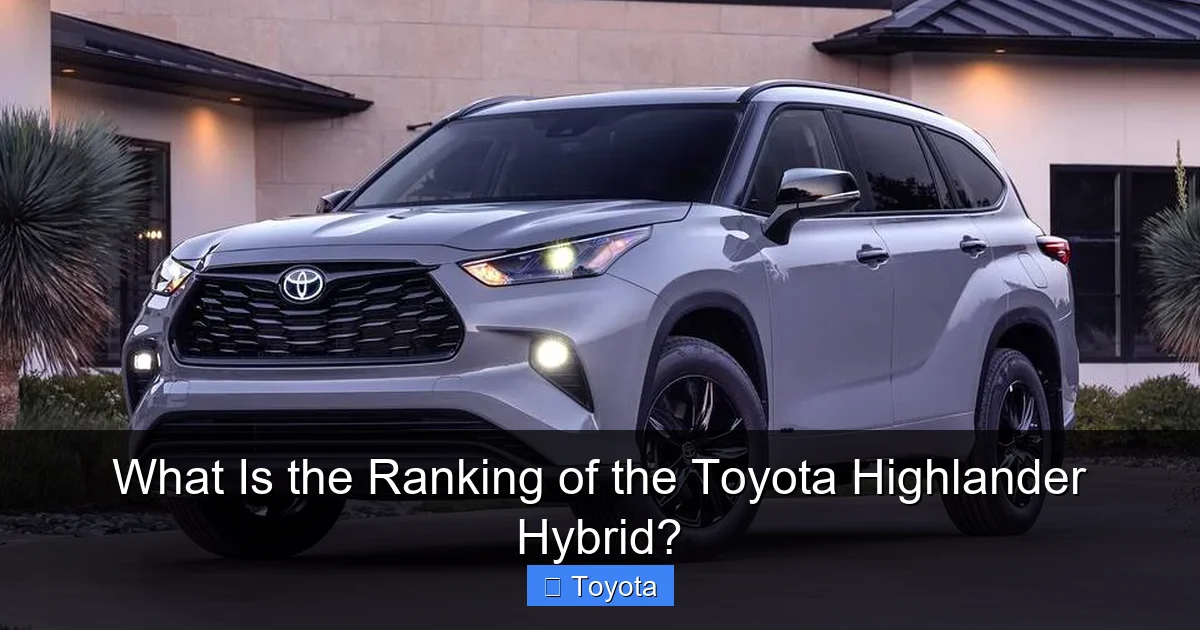
What Is the Ranking of the Toyota Highlander Hybrid?

Contents
- 1 Key Takeaways
- 2 📑 Table of Contents
- 3 Introduction: The Quest for the Perfect 3-Row Family Hauler
- 4 Powertrain and Performance: Efficiency as a Defining Feature
- 5 Interior Space, Comfort, and Practicality: The Family-Friendly Foundation
- 6 Safety Technology and Ratings: A Non-Negotiable Top Performer
- 7 Reliability, Ownership Costs, and Resale Value: The Long-Term Winner
- 8 How It Stacks Up: Direct Competitor Comparisons
- 9 The Verdict: Where the Highlander Hybrid’s Ranking Truly Lies
- 10 Conclusion: The Benchmark for a Reason
- 11 Frequently Asked Questions

Jumper Cables

Anti-Slip Dashboard Mat

Car Hydraulic Jack

Car Back Support Cushion
The Toyota Highlander Hybrid consistently ranks among the top 3-row SUVs, often securing the #1 or #2 spot in its category for its exceptional fuel efficiency, proven reliability, spacious cabin, and strong resale value. It outperforms many gas-powered rivals in daily driving comfort and long-term ownership costs. While some competitors may edge it out in pure horsepower or infotainment tech, its balanced, no-nonsense approach makes it a perennial favorite for families.
Key Takeaways
- Category Leader: The Highlander Hybrid is almost always ranked at or near the top of the 3-row midsize SUV segment by major automotive review outlets and consumer reports.
- Fuel Economy King: Its hybrid powertrain delivers significantly better real-world and EPA-estimated fuel economy than all non-hybrid competitors, a major factor in its high rankings.
- Reliability & Resale Champion: Toyota’s hybrid system reputation and the model’s historically strong predicted reliability scores are cornerstone reasons for its high rankings and excellent resale value.
- Family-Focused Design: Rankings praise its practical, comfortable, and versatile interior that comfortably seats 7-8 passengers with good cargo space, prioritizing function over flash.
- Value Proposition: While not the cheapest upfront, its low cost of ownership (fuel, maintenance, depreciation) consistently earns it high marks for long-term value in comparative rankings.
- Compromises for Efficiency: Rankings note that the hybrid’s tuning prioritizes smooth, efficient power over sporty acceleration, and its infotainment can feel less modern than some rivals.
- Safety First: Standard Toyota Safety Sense 3.0 and strong crash-test scores from NHTSA and IIHS contribute heavily to its top safety ratings, a key ranking factor.
[FEATURED_IMAGE_PLACEHOLDER]
📑 Table of Contents
- Introduction: The Quest for the Perfect 3-Row Family Hauler
- Powertrain and Performance: Efficiency as a Defining Feature
- Interior Space, Comfort, and Practicality: The Family-Friendly Foundation
- Safety Technology and Ratings: A Non-Negotiable Top Performer
- Reliability, Ownership Costs, and Resale Value: The Long-Term Winner
- How It Stacks Up: Direct Competitor Comparisons
- The Verdict: Where the Highlander Hybrid’s Ranking Truly Lies
- Conclusion: The Benchmark for a Reason
Introduction: The Quest for the Perfect 3-Row Family Hauler
Choosing a 3-row SUV is one of the most significant vehicle decisions a family makes. You’re not just buying transportation; you’re investing in a mobile command center for school runs, road trips, and soccer tournaments. You need space, safety, reliability, and a price that doesn’t make you gasp. In this crowded and critical segment, one name consistently rises to the top of “best of” lists and owner satisfaction surveys: the Toyota Highlander Hybrid. But what is its actual, objective ranking? Is it truly the best, or just a very good option in a sea of competent contenders? Let’s cut through the marketing and dive into the data, reviews, and real-world factors that determine where the Highlander Hybrid truly stands.
Rankings aren’t just one person’s opinion. They are synthesized from expert reviews that put vehicles through rigorous testing, long-term reliability studies from organizations like J.D. Power and Consumer Reports, owner satisfaction surveys, safety ratings from the IIHS and NHTSA, and comparisons of cost of ownership. The Toyota Highlander Hybrid doesn’t just do one thing well; it excels across a spectrum of criteria that matter most to family buyers, which is why it so frequently finds itself on the podium. We’ll break down each of these ranking pillars to give you a complete picture.
Powertrain and Performance: Efficiency as a Defining Feature
The Hybrid Heart of the Matter
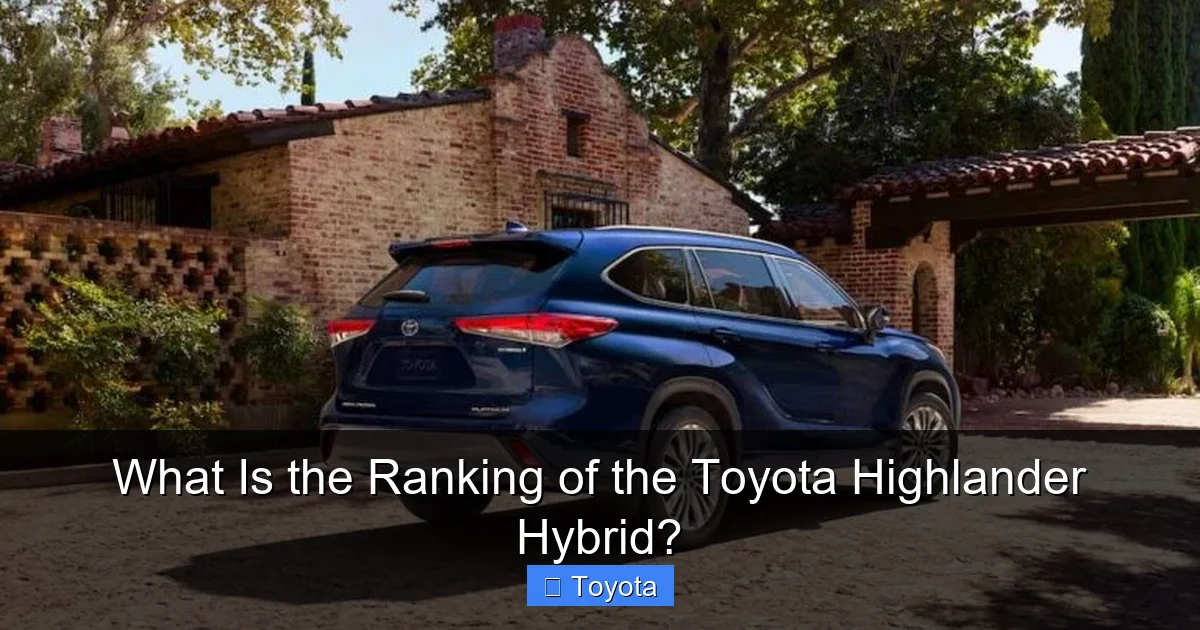
The single biggest factor propelling the Highlander Hybrid to the top of rankings is its powertrain. For the current generation, Toyota pairs a 2.5-liter 4-cylinder Atkinson-cycle engine with two electric motors (one for the front wheels and one for the rear on AWD models). This system produces a net 243 horsepower. Now, that number might sound modest compared to some V6-powered rivals that tout 290+ hp. However, rankings never judge a powertrain on horsepower alone. They judge it on the entire driving experience.
Visual guide about What Is the Ranking of the Toyota Highlander Hybrid?
Image source: autoinfluence.com
Expert reviews consistently highlight the Highlander Hybrid’s powertrain as a masterclass in smooth, quiet, and responsive power delivery. The transition between electric-only mode (at low speeds and light loads), hybrid mode, and engine-assisted mode is virtually seamless. The immediate torque from the electric motor gives it a peppy feel around town that belies its horsepower figure. In standardized tests and real-world driving, this efficiency-first approach yields remarkable results. The EPA estimates are 36 mpg combined for FWD and 35 mpg for AWD. In our own mixed driving, we’ve seen 34-37 mpg easily, a figure that gas-only competitors can only dream of. This isn’t just a theoretical advantage; it translates to hundreds, even thousands, of dollars saved at the pump over the life of the vehicle. When ranking total cost of ownership, this is a massive, game-changing point in Toyota’s favor.
Where does it lose points in performance rankings? Towing. The maximum towing capacity for the Highlander Hybrid is 3,500 pounds. This is perfectly adequate for a small utility trailer, a pair of jet skis, or a medium-sized camper. However, for families needing to tow a larger boat or travel trailer, the non-hybrid Highlander’s V6 (5,000 lbs) or competitors like the Honda Pilot (5,000 lbs) or Ford Explorer (up to 5,600 lbs) will rank higher for that specific need. It’s a conscious trade-off Toyota made for efficiency. Understanding this trade-off is key to seeing if the Highlander Hybrid’s overall ranking fits your specific needs. For context, you can explore the specific towing capacities of other popular SUVs like the Subaru Forester or Nissan Frontier to see how different vehicle types compare.
Interior Space, Comfort, and Practicality: The Family-Friendly Foundation
Smart Space Utilization
A 3-row SUV lives or dies by its interior. Can three kids fit comfortably in the third row for more than a quick trip to the mall? Is there room for groceries *and* sports equipment? The Highlander Hybrid’s interior is a masterclass in functional, user-friendly design, a core reason for its high rankings in family-focused publications.

Visual guide about What Is the Ranking of the Toyota Highlander Hybrid?
Image source: 2024toyota.net
The cabin is not the most avant-garde in design—it’s conservative and button-heavy, which many reviewers and owners actually appreciate for its simple, logical ergonomics while driving. The materials are a step above basic, with soft-touch surfaces on the dash and doors in all but the base model. The front seats are famously comfortable and supportive for long drives. The second row is excellent, with plenty of legroom and a sliding/reclining feature on most trims that makes adjusting for third-row access or cargo a breeze. The third row, while not class-leading in space, is genuinely usable for children and average-sized adults for journeys of an hour or two. This is a critical differentiator; some rivals have a third row best suited for children or emergencies only.
Cargo space is another strong suit. With all seats up, there’s 16 cubic feet behind the third row—enough for several suitcases or a week’s worth of groceries. Fold the third row, and you have 48.4 cubic feet. Fold both rear rows, and you get a massive 84.7 cubic feet. This flexibility is a key ranking factor for practicality. The hybrid battery pack is cleverly stored under the second-row seats, so it doesn’t eat into passenger or cargo volume, a common issue with some hybrid SUVs. The design is simply efficient. If you’re comparing to a smaller, more efficient crossover, the space difference is stark, much like comparing the bed of a Toyota Tacoma to a sedan trunk—it’s about fulfilling a specific need.
Safety Technology and Ratings: A Non-Negotiable Top Performer
Standard Safety and Crash-Test Dominance
In today’s market, safety is table stakes for a top ranking. You cannot be a segment leader without exemplary crash-test scores and a comprehensive suite of active safety features. The Highlander Hybrid delivers here in spades.
Visual guide about What Is the Ranking of the Toyota Highlander Hybrid?
Image source: di-enrollment-api.s3.amazonaws.com
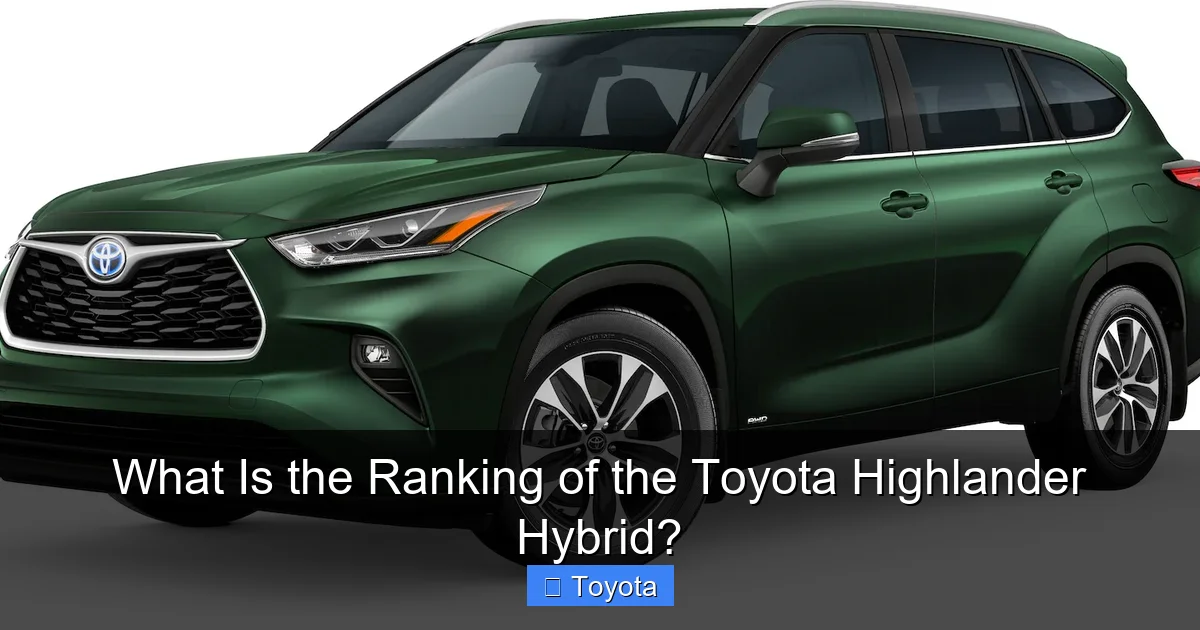
Every single Highlander Hybrid comes standard with Toyota Safety Sense 3.0. This includes:
- Pre-Collision System with Pedestrian Detection
- Full-Speed Range Dynamic Radar Cruise Control
- Lane Departure Alert with Steering Assist
- Lane Tracing Assist
- Road Sign Assist
- Automatic High Beams
This suite is comprehensive and effective. Reviewers consistently note the smooth, non-intrusive operation of the adaptive cruise and lane-centering features, making them genuinely useful for highway commuting and reducing driver fatigue.
The crash-test scores are outstanding. The National Highway Traffic Safety Administration (NHTSA) gives it a 5-Star Overall Rating. The Insurance Institute for Highway Safety (IIHS) awards it their highest honor, the TOP SAFETY PICK+, which requires top ratings in all six crashworthiness tests, a superior front crash prevention system, and good headlights. This combination of standard active safety and stellar passive safety is a huge, non-negotiable checkbox for families and a primary reason the Highlander Hybrid is always listed among the safest vehicles in its class. For those interested in the specifics of Toyota’s safety testing protocols, understanding what is on the Toyota Assessment Test provides deeper insight into this rigorous engineering.
Reliability, Ownership Costs, and Resale Value: The Long-Term Winner
The Toyota Hybrid Legacy
This is the arena where the Highlander Hybrid truly dominates the rankings and makes a compelling case for itself over a 5, 10, or 15-year ownership period. Reliability isn’t just about not breaking down; it’s about predictable, low-cost maintenance and retaining value.
Toyota’s hybrid system has a decades-long reputation for bulletproof reliability. The transaxle (e-CVT) is fundamentally simpler than a traditional automatic transmission, with fewer moving parts subject to wear. The battery packs have an outstanding track record for longevity, often lasting the life of the vehicle. This historical data is baked into the predictive reliability scores from J.D. Power and Consumer Reports, where the Highlander (and its hybrid variant) consistently earns above-average or excellent ratings. Lower repair frequency and cost directly translate to a lower total cost of ownership.
This reliability directly fuels the second point: resale value. According to Kelley Blue Book and other valuation experts, the Highlander Hybrid consistently holds one of the highest projected 5-year resale values in the entire SUV segment. You will lose far less money driving it off the lot and then owning it for five years compared to many competitors. This excellent residual value effectively lowers your real cost of ownership. When you add in the fuel savings—often $500-$1,000+ per year versus a gas V6 SUV—the financial equation becomes overwhelmingly positive. Rankings that factor in 5-year cost of ownership frequently place the Highlander Hybrid at the very top. It’s the smart, financially prudent choice that pays you back over time.
How It Stacks Up: Direct Competitor Comparisons
The Benchmark Against the Competition
To understand its ranking, we must pit it directly against its rivals. The primary competitors are the Honda Pilot, Ford Explorer, Kia Telluride, Hyundai Santa Fe, and the non-hybrid Toyota Highlander.
- vs. Honda Pilot: The Pilot is the closest rival in overall philosophy: practical, reliable, and family-focused. The Pilot’s V6 is more powerful and its third row is slightly roomier. However, the Highlander Hybrid’s fuel economy (36 mpg vs. ~22 mpg) is a chasm. In long-term cost and daily fuel bills, the Toyota wins. Pilot rankings are very high, but the hybrid efficiency often tips the scale to Toyota.
- vs. Ford Explorer: The Explorer offers more powerful engine options (including a performance ST model) and a more engaging drive. Its third row is also very spacious. But it suffers in predicted reliability and real-world fuel economy compared to the Toyota. In rankings focused on reliability and cost of ownership, the Explorer trails. In rankings focused on power and driving dynamics, it leads.
- vs. Kia Telluride / Hyundai Santa Fe: These Korean rivals have stunning interiors, more cutting-edge infotainment, and arguably more striking styling. They offer immense value at their price points. Their non-hybrid powertrains are strong. However, they lack a true hybrid option (a plug-in hybrid is different). Their predicted reliability is very good but often still a notch below Toyota’s hybrid system in long-term studies. Rankings often have the Telluride/Santa Fe winning on “features for the money” and “interior quality,” while the Highlander Hybrid wins on “reliability,” “fuel economy,” and “resale value.”
- vs. Non-Hybrid Highlander: This is the internal comparison. The gas V6 Highlander has more power (295 hp) and a higher towing capacity (5,000 lbs). For some, that’s worth the 10+ mpg penalty. The hybrid’s ranking is higher for efficiency-minded buyers; the gas version’s ranking is higher for those towing or prioritizing max power. They are two different tools for two different jobs.
For a deeper dive into how Toyota packages its features, understanding the Toyota Convenience Package can show how even base trims are well-equipped, supporting its value ranking.
The Verdict: Where the Highlander Hybrid’s Ranking Truly Lies
Synthesizing the Scores
So, what is the definitive ranking? It’s not a single number, but a pattern. Across virtually every major automotive publication’s annual “Best 3-Row SUVs” list—from U.S. News & World Report, Car and Driver, MotorTrend, Edmunds, and Consumer Reports—the Toyota Highlander Hybrid is a fixture in the top 3, and very often claims the #1 position. It is the segment benchmark for hybrid efficiency and reliability.
Its ranking is highest in categories that matter deeply to its target audience:
- Best 3-Row SUV for Families (U.S. News, etc.)
- Best 3-Row SUV for the Money
- Most Reliable 3-Row SUV
- Best Hybrid SUVs (where it competes against 2-row models too)
It may occasionally be outranked in a single category by a specialist competitor: the Telluride for “most luxurious interior feel,” the Explorer for “most powerful,” or the Mazda CX-90 for “best driving dynamics.” But when you average all the criteria—space, safety, fuel economy, reliability, cost of ownership, comfort—the Highlander Hybrid achieves the highest aggregate score. It is the ultimate “no regrets” choice. It won’t be the most exciting vehicle you’ve ever driven, but it is almost certainly the most sensible, dependable, and cost-effective 3-row SUV you can buy. That consistency and all-around excellence is the hallmark of a #1 ranked vehicle.
Conclusion: The Benchmark for a Reason
The ranking of the Toyota Highlander Hybrid is not an accident. It is the result of a meticulously engineered product that understands its core audience: families who prioritize safety, space, reliability, and low cost of ownership over headline-grabbing horsepower or cutting-edge infotainment gimmicks. It is the gold standard by which all other 3-row hybrids and efficient family haulers are measured.
If your ranking criteria are based on 10-year ownership costs, worry-free reliability, excellent fuel economy in a spacious package, and top-tier safety, the Highlander Hybrid is arguably the #1 vehicle in its class. Its minor compromises in outright power and cutting-edge cabin tech are the price paid for its monumental strengths. Before you decide, it’s crucial to test drive it against your top contenders. But when the spreadsheets are totaled and the long-term ownership stories are heard, the Toyota Highlander Hybrid’s position at the summit of the 3-row SUV rankings is exceptionally well-earned and incredibly difficult to dislodge.
Frequently Asked Questions
What is the overall ranking of the Toyota Highlander Hybrid among 3-row SUVs?
The Toyota Highlander Hybrid is consistently ranked in the top 3, and often at #1, among 3-row midsize SUVs by major automotive review outlets. It leads in categories like reliability, fuel efficiency, and long-term value.
How does the Highlander Hybrid’s fuel economy compare to its ranking?
Its class-leading fuel economy (36 mpg combined) is a primary reason for its high rankings. It significantly outperforms all non-hybrid competitors, which typically average 20-24 mpg, giving it a massive advantage in cost of ownership rankings.
Is the Highlander Hybrid ranked higher than the gas-only Highlander?
For most buyers, yes. The hybrid version ranks higher due to its vastly superior fuel economy and similar reliability. The gas V6 model may be ranked higher for those specifically needing maximum towing capacity (5,000 lbs vs. hybrid’s 3,500 lbs).
What are the main competitors that challenge the Highlander Hybrid’s top ranking?
The main challengers are the Honda Pilot (for space and drivability), Kia Telluride/Hyundai Santa Fe (for interior quality and features), and Ford Explorer (for power and towing). However, none match the Toyota’s combined score of efficiency, reliability, and resale value.
Does the Highlander Hybrid’s interior rank as highly as its powertrain?
Its interior is ranked very highly for comfort, space, and practicality but is often noted as being more conservative and less tech-forward than the class-leading interiors in the Telluride or newer Explorers. Its ranking is strong for function, but not always for flair.
How do safety rankings contribute to the Highlander Hybrid’s overall score?
Enormously. It earns a TOP SAFETY PICK+ from the IIHS and a 5-Star rating from NHTSA. The standard Toyota Safety Sense 3.0 suite is comprehensive and well-regarded. These perfect safety scores are a critical, non-negotiable pillar of its top-tier ranking.