
What Is the Towing Capacity of a Subaru Forester?

The Subaru Forester is a versatile compact SUV known for its all-wheel drive and reliability, but its towing capacity is modest compared to larger trucks or SUVs. Depending on the model year and configuration, the Forester can tow between 1,500 and 3,000 pounds—enough for small trailers, bikes, or lightweight campers, but not heavy loads.
If you’re considering a Subaru Forester and wondering whether it can handle towing a trailer, camper, or boat, you’re not alone. The Forester is one of Subaru’s most popular SUVs, praised for its safety features, all-wheel drive capability, and practical interior space. But when it comes to towing, expectations need to be realistic. Unlike full-size trucks or heavy-duty SUVs, the Forester is designed primarily for everyday driving, off-road adventures, and light-duty tasks—not hauling heavy loads.
So, what is the towing capacity of a Subaru Forester? The answer isn’t one-size-fits-all. It depends on the model year, engine type, transmission, and whether you have the proper towing equipment installed. Over the years, Subaru has gradually improved the Forester’s towing capabilities, especially with the introduction of more robust transmissions and optional towing packages. But even at its best, the Forester remains a light-duty towing vehicle. That said, for many drivers, its towing capacity is more than sufficient—especially if you’re looking to tow a small camper for weekend getaways or a trailer loaded with bikes and gear.
In this guide, we’ll break down everything you need to know about the Subaru Forester’s towing capacity. We’ll cover how it varies by model year, what equipment you’ll need to tow safely, practical examples of what you can tow, and tips to maximize performance and safety. Whether you’re a current Forester owner or shopping for one with towing in mind, this article will help you understand exactly what your vehicle can—and can’t—handle.
Key Takeaways
- Towing capacity ranges from 1,500 to 3,000 pounds: Earlier models (pre-2014) typically handle up to 1,500–2,000 lbs, while newer models (2019–2024) can reach up to 3,000 lbs with proper equipment.
- Engine and transmission matter: Models with the 2.5L four-cylinder engine and CVT (continuously variable transmission) generally offer better towing than older manual or lower-trim versions.
- Towing package required for max capacity: To achieve the highest towing rating, you’ll need the optional towing package, which includes a transmission cooler, wiring harness, and sometimes a hitch receiver.
- All trims aren’t equal: Higher trims like the Forester Limited or Touring often include towing prep or packages, while base models may require aftermarket additions.
- Weight distribution is critical: Even within the towing limit, improper load balance can affect handling, braking, and safety—always use a weight-distributing hitch if needed.
- Fuel economy drops when towing: Expect a noticeable decrease in MPG when towing, especially on hills or highways, so plan fuel stops accordingly.
- Not built for heavy trailers: The Forester excels with lightweight loads like jet skis, small pop-up campers, or utility trailers—not large RVs or boats.
📑 Table of Contents
- Understanding Towing Capacity: What It Means and Why It Matters
- Towing Capacity by Model Year: A Year-by-Year Breakdown
- What You Can Actually Tow with a Subaru Forester
- Essential Equipment for Safe Towing
- Comparing the Forester to Competitors
- Final Thoughts: Is the Forester Right for Your Towing Needs?
Understanding Towing Capacity: What It Means and Why It Matters
Before diving into the specifics of the Subaru Forester, it’s important to understand what “towing capacity” actually means. In simple terms, towing capacity is the maximum weight your vehicle can safely pull behind it. This includes the weight of the trailer itself (called the trailer’s dry weight) plus everything inside it—gear, water, fuel, passengers, and cargo. Exceeding this limit can lead to serious mechanical failure, loss of control, or even accidents.
Towing capacity isn’t just about engine power. It’s a combination of several factors: the strength of the chassis, the cooling system, the transmission, the brakes, and the suspension. A vehicle with a high towing capacity is built to handle the extra strain of pulling weight over long distances and varied terrain. The Subaru Forester, while capable, isn’t engineered for extreme towing. It’s a unibody SUV, meaning the body and frame are one piece—unlike body-on-frame trucks, which are generally stronger for heavy-duty tasks.
Subaru designs the Forester with a focus on balance: fuel efficiency, safety, and all-weather capability. That means towing capacity takes a backseat to other priorities. Still, for light to moderate towing needs, the Forester can be a reliable partner—especially if you’re not trying to pull a 5,000-pound travel trailer.
How Subaru Rates Towing Capacity
Subaru determines towing capacity based on rigorous testing and engineering standards. The company provides official towing ratings for each model year and trim, which you can find in the owner’s manual or on Subaru’s website. These ratings assume the vehicle is properly equipped and maintained.
It’s important to note that Subaru’s towing ratings are conservative compared to some competitors. This is partly due to their emphasis on safety and longevity. Subaru doesn’t want owners pushing their vehicles beyond safe limits, so they set realistic thresholds. For example, even if a Forester could technically tow slightly more under ideal conditions, Subaru will rate it lower to account for real-world variables like heat, altitude, and driver error.
Another key point: Subaru often specifies different towing capacities based on whether the vehicle has a manual transmission, automatic transmission, or CVT. In recent years, all Foresters come with a CVT, which has improved towing performance compared to older automatics. The CVT is designed to keep the engine in its optimal power range, which helps when climbing hills or accelerating with a load.
Towing Capacity by Model Year: A Year-by-Year Breakdown
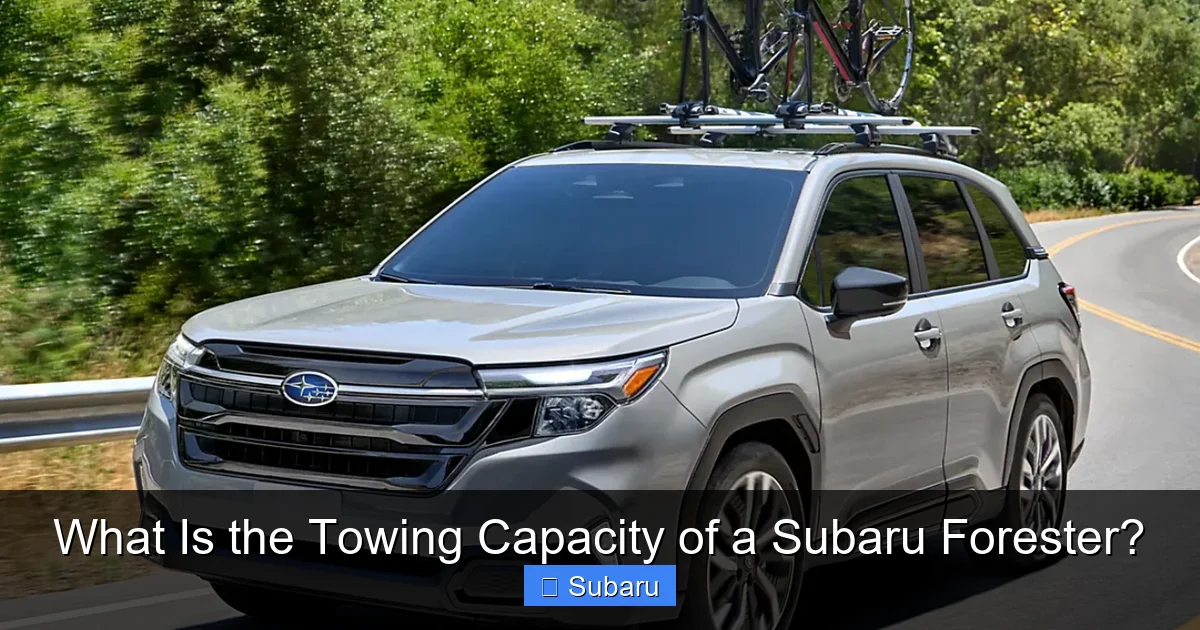
Visual guide about What Is the Towing Capacity of a Subaru Forester?
Image source: dellasubaru.com
The towing capacity of the Subaru Forester has evolved over the years. Earlier models were more limited, but Subaru has made incremental improvements, especially with the introduction of newer engines and transmissions. Below is a detailed look at how towing capacity has changed across major model generations.
2009–2013 Subaru Forester (Second Generation)
The second-generation Forester, produced from 2009 to 2013, had a towing capacity of **1,500 to 2,000 pounds**, depending on the engine and transmission. Models with the 2.5L naturally aspirated four-cylinder engine and manual transmission were typically rated at 1,500 pounds. Those with the automatic transmission could handle up to 2,000 pounds, but only if equipped with the optional towing package.
This generation introduced Subaru’s first real push into light towing for compact SUVs. However, the automatic transmission in these models wasn’t as robust as later versions, and overheating could become an issue during prolonged towing, especially in hot weather or mountainous terrain. Subaru recommended using a transmission cooler if towing frequently or in demanding conditions.
2014–2018 Subaru Forester (Third Generation)
With the third-generation Forester (2014–2018), Subaru made significant improvements. The towing capacity increased to **2,000 to 2,700 pounds**, again depending on configuration. All models came with a CVT, which provided smoother power delivery and better thermal management than the older automatics.
The 2.5L engine remained the standard, but Subaru introduced a more efficient version with direct injection, improving both fuel economy and low-end torque—beneficial for towing. The optional towing package became more widely available and included a transmission cooler, 4-pin wiring harness, and sometimes a trailer hitch receiver.
One notable limitation: the 2014–2018 Forester did not offer a turbocharged engine option in the U.S. market, which meant towing performance was still modest compared to competitors like the Honda CR-V or Toyota RAV4, which offered higher capacities with turbo engines.
2019–2024 Subaru Forester (Fourth Generation)
The current-generation Forester, introduced in 2019, represents the peak of Subaru’s towing capability in this model line. With the updated 2.5L four-cylinder engine and an improved CVT, the towing capacity now reaches **up to 3,000 pounds**—but only when equipped with the optional towing package.
This is a significant jump from earlier models and makes the Forester one of the better compact SUVs for light towing. The towing package includes a transmission cooler, 7-pin wiring harness, and a reinforced hitch receiver. Subaru also improved the cooling system and suspension tuning to better handle the extra load.
It’s worth noting that not all trims come with the towing package standard. Base models like the Forester Base or Premium may require you to add the package at the dealer or install aftermarket components. Higher trims like the Limited, Sport, and Touring often include towing prep or make the package more accessible.
Special Notes on Hybrid and Electric Models
As of 2024, Subaru does not offer a hybrid or fully electric version of the Forester in the U.S. market. While other automakers are introducing electrified SUVs with impressive towing capacities (like the Ford Mustang Mach-E or Hyundai Ioniq 5), Subaru has focused on refining its gasoline-powered lineup. This means the 3,000-pound limit remains the ceiling for now.
However, Subaru has announced plans to expand its electrified offerings in the coming years, so future Forester models could see changes in towing capability—especially if a hybrid or plug-in hybrid version is introduced.
What You Can Actually Tow with a Subaru Forester
Visual guide about What Is the Towing Capacity of a Subaru Forester?
Image source: tractionlife.com
Now that we know the Forester can tow up to 3,000 pounds (with the right setup), let’s look at what that means in real-world terms. Understanding what you can tow helps set realistic expectations and ensures you stay within safe limits.
Lightweight Trailers and Campers
The Forester excels at towing small, lightweight trailers. Here are some common examples:
– **Pop-up campers:** These typically weigh between 1,000 and 2,500 pounds when loaded. Many popular models, like the Jayco Jay Series or Forest River Rockwood, fall within the Forester’s range—especially if you keep gear minimal.
– **Utility trailers:** A standard 4×6 or 5×8 utility trailer weighs around 500–800 pounds empty. Loaded with lawn equipment, furniture, or camping gear, it can easily stay under 2,000 pounds.
– **Motorcycle or ATV trailers:** Single or dual motorcycle trailers usually weigh 300–600 pounds. Even with two full-sized ATVs, the total weight often stays under 2,000 pounds.
– **Small boat trailers:** Jon boats, kayaks, or small fishing boats on lightweight trailers can be towed safely. For example, a 14-foot aluminum boat with trailer might weigh 1,200–1,800 pounds total.
What You Should Avoid Towing
While the Forester is capable, it’s not built for heavy-duty towing. Avoid these types of loads:
– **Travel trailers over 2,500 pounds:** Most conventional travel trailers (like Airstreams or larger RVs) start at 3,000–4,000 pounds and go up from there. Even if your Forester is rated for 3,000 pounds, towing a trailer that heavy leaves no margin for error.
– **Large boats:** Ski boats, pontoon boats, or sailboats often exceed 3,000 pounds when loaded with fuel and gear.
– **Multiple vehicles:** Towing more than one ATV or motorcycle can quickly push you over the limit, especially if the trailer itself is heavy.
Practical Example: Weekend Camping Trip
Imagine you’re planning a weekend camping trip with your Forester. You’ve got a small pop-up camper that weighs 1,800 pounds when loaded with gear, bedding, and a portable grill. Your Forester is a 2022 model with the towing package installed. You’re well within the 3,000-pound limit, and the CVT handles the extra load smoothly.
You pack light, distribute weight evenly in the camper, and use a sway control hitch for added stability. On the highway, you notice a slight drop in fuel economy—from 28 MPG to about 20 MPG—but the Forester handles the load confidently. On a steep mountain pass, you shift into “L” mode on the CVT to maintain engine braking and prevent overheating.
This scenario is realistic and safe. But if you tried to tow a 3,500-pound travel trailer, you’d risk transmission damage, poor braking, and loss of control—especially on downhill grades.
Essential Equipment for Safe Towing
Visual guide about What Is the Towing Capacity of a Subaru Forester?
Image source: tractionlife.com
Towing safely isn’t just about staying under the weight limit. You also need the right equipment to ensure stability, control, and visibility. Here’s what you’ll need to tow with your Subaru Forester.
Factory Towing Package
The most important upgrade is Subaru’s optional towing package. This typically includes:
– **Transmission cooler:** Prevents overheating during prolonged towing.
– **7-pin wiring harness:** Allows you to power trailer lights, brakes, and auxiliary systems.
– **Hitch receiver:** A Class III receiver rated for up to 3,000 pounds.
– **Trailer brake controller (optional):** Not included by default, but recommended for trailers over 1,500 pounds.
Without the towing package, your Forester’s towing capacity may be reduced, and you risk damaging the transmission.
Aftermarket Additions
If your Forester didn’t come with the towing package, you can install aftermarket components:
– **Transmission cooler:** A must-have if you plan to tow regularly. Install it in front of the radiator for maximum cooling.
– **Weight-distributing hitch:** Helps balance the load and improves handling, especially with heavier trailers.
– **Sway control system:** Reduces trailer sway caused by wind or passing trucks.
– **Trailer brake controller:** Required by law in many states for trailers over 1,500 pounds. It allows you to activate the trailer’s brakes from the driver’s seat.
Safety Tips for Towing
– **Check tire pressure:** Both your vehicle and trailer tires should be properly inflated.
– **Secure your load:** Use straps, ropes, or nets to prevent shifting.
– **Practice backing up:** Towing changes how your vehicle handles, especially in reverse.
– **Allow extra stopping distance:** It takes longer to stop with a trailer attached.
– **Inspect lights and connections:** Before every trip, make sure all trailer lights are working.
Comparing the Forester to Competitors
How does the Subaru Forester stack up against other compact SUVs in terms of towing? Let’s look at a few key rivals.
– **Honda CR-V:** The CR-V offers up to 1,500 pounds of towing capacity in most trims, though the hybrid version can reach 2,000 pounds. Less capable than the Forester’s top rating.
– **Toyota RAV4:** The gas-powered RAV4 can tow up to 1,500 pounds, but the RAV4 Hybrid and Prime (plug-in) versions can reach 3,500 pounds—slightly better than the Forester.
– **Mazda CX-5:** Limited to 1,500–2,000 pounds, depending on the model. Less robust than the Forester.
– **Ford Escape:** Up to 2,000–3,500 pounds with the turbo engine and towing package. Comparable to the Forester, but with more variability.
The Forester holds its own, especially among non-hybrid compact SUVs. Its standard all-wheel drive gives it an edge in slippery or off-road conditions, which can be helpful when towing on gravel or snow.
Final Thoughts: Is the Forester Right for Your Towing Needs?
The Subaru Forester is not a towing powerhouse, but it doesn’t need to be. For drivers who occasionally tow a small camper, trailer, or boat, the Forester offers a practical, safe, and reliable solution. With a towing capacity of up to 3,000 pounds in recent models, it’s more than capable of handling light-duty tasks.
However, if you plan to tow frequently or need to pull heavier loads, you might want to consider a larger SUV or truck. Vehicles like the Subaru Ascent (with 5,000-pound capacity), Toyota Highlander, or Ford Explorer offer more power and space.
Ultimately, the Forester shines as a versatile, all-weather SUV that can handle light towing as a bonus—not as its primary purpose. If you respect its limits, maintain it properly, and equip it with the right tools, your Forester can be a dependable partner for years of weekend adventures.
Frequently Asked Questions
What is the maximum towing capacity of a Subaru Forester?
The maximum towing capacity of a Subaru Forester is 3,000 pounds, but only for models from 2019 to 2024 that are equipped with the optional towing package. Earlier models typically max out at 1,500 to 2,700 pounds depending on the year and configuration.
Do I need a special package to tow with my Forester?
Yes, to achieve the highest towing capacity, you’ll need the optional towing package, which includes a transmission cooler, wiring harness, and hitch receiver. Without it, your towing capacity may be reduced, and you risk damaging your vehicle.
Can a Subaru Forester tow a small camper?
Yes, a Forester can tow a small pop-up camper or lightweight travel trailer, as long as the total weight (including gear) stays under 3,000 pounds. Always check the camper’s dry and loaded weight before towing.
Does towing reduce fuel economy in a Forester?
Yes, towing significantly reduces fuel economy. Expect a drop of 20–30%, especially when driving uphill or at highway speeds. Plan for more frequent fuel stops and budget accordingly.
Can I install a towing package on an older Forester?
Yes, you can add aftermarket components like a transmission cooler, hitch receiver, and wiring harness to older Foresters. However, consult a professional to ensure compatibility and safety.
Is the Forester safe for towing on mountain roads?
Yes, but use caution. Use the CVT’s low gear mode for engine braking on descents, and ensure your transmission cooler is functioning. Avoid overloading and drive slower than usual on steep grades.