What Is Brake Hold in a Honda Civic

Contents
- 1 Key Takeaways
- 2 📑 Table of Contents
- 3 What Exactly is Brake Hold? Demystifying the Feature
- 4 How Brake Hold Works: The Technology Behind the Convenience
- 5 When and How to Use Brake Hold: Practical Scenarios
- 6 The Benefits and Considerations: Is It Right for You?
- 7 Comparing Brake Hold to Other Honda Civic Features
- 8 Troubleshooting: When Brake Hold Doesn’t Work
- 9 Conclusion: A Small Button, A Big Difference
- 10 Frequently Asked Questions

Car Wax Polish

Solar Car Battery Maintainer

Rear View Camera

OBD2 Scanner Tool
Brake Hold in a Honda Civic is an intelligent driver-assist feature that automatically maintains brake pressure when you come to a complete stop, like at a traffic light, freeing your foot from the pedal. It’s not a parking brake or hill-hold system, but a convenience tool for stop-and-go traffic. Once activated, it holds the vehicle securely until you press the accelerator, eliminating the need to constantly shift between brake and gas. Understanding its operation, proper use, and limitations ensures you get the most out of this modern Civic technology safely.
Have you ever found yourself at a long red light, foot cramping on the brake pedal, watching the car in front of you creep forward an inch? Or maybe you’ve been in stop-and-go traffic, doing a constant, exhausting dance between the brake and gas pedals. If you drive a modern Honda Civic, you might have noticed a mysterious button with a “BRAKE HOLD” symbol and wondered what secret wizardry it holds. Well, wonder no more. This feature is one of the most genuinely useful pieces of technology in today’s Civics, designed to take the strain out of everyday driving. It’s not about going faster; it’s about driving smarter and more comfortably. Let’s dive deep into everything you need to know about Brake Hold in your Honda Civic.
Key Takeaways
- Brake Hold is a convenience feature, not a safety system: It holds the car at a stop but does not replace the parking brake or prevent rollaway on steep hills.
- Activation requires specific conditions: The driver’s door must be closed, the seatbelt fastened, and the vehicle at a complete stop with the brake pedal depressed.
- It works with both automatic and manual transmissions: On manuals, the clutch must be depressed for activation, and it disengages if the car rolls backward slightly.
- The system has clear indicators and sounds: A “BRAKE HOLD” light on the dash and an audible chime confirm activation and deactivation.
- It deactivates automatically under certain conditions: Pressing the accelerator, turning off the car, or opening the driver’s door while stopped will disengage it.
- Not all Honda Civics have this feature: It’s typically found on higher trims (EX, Touring, etc.) and model years from the 10th generation onward.
- Regular brake maintenance is still critical: Brake Hold relies on your standard braking system; worn pads or low fluid will affect its performance.
📑 Table of Contents
- What Exactly is Brake Hold? Demystifying the Feature
- How Brake Hold Works: The Technology Behind the Convenience
- When and How to Use Brake Hold: Practical Scenarios
- The Benefits and Considerations: Is It Right for You?
- Comparing Brake Hold to Other Honda Civic Features
- Troubleshooting: When Brake Hold Doesn’t Work
- Conclusion: A Small Button, A Big Difference
What Exactly is Brake Hold? Demystifying the Feature
At its core, Brake Hold is an automated braking system that maintains hydraulic pressure in your brake lines after you come to a complete stop. Think of it as your car’s ability to hold its own brake pedal for you. When you press the brake firmly to stop at a light or in traffic, the system engages and keeps the brakes applied, allowing you to take your foot off the pedal. The car will sit perfectly still, just as if you were still pressing the brake. When traffic starts moving again, you simply press the accelerator, and the system smoothly releases the brakes, allowing you to proceed.
The Crucial Distinction: Brake Hold vs. Parking Brake vs. Hill Start Assist
This is the most important point to understand. Brake Hold is often confused with other braking systems, but it has a very specific job.
- Parking Brake (Electronic Parking Brake): This is for securing the vehicle when parked. It mechanically or electronically locks the rear brakes. Brake Hold is temporary and disengages as soon as you touch the gas.
- Hill Start Assist (HSA): This is a safety feature that prevents rollback when you start from a stop on an incline. It holds brake pressure for about 1-2 seconds after you release the brake pedal to give you time to press the gas. It’s automatic and works only on hills. Brake Hold works on flat ground and hills, and you control its duration by keeping your foot off the pedals.
- Auto Vehicle Hold (on some Subarus): Functionally very similar to Honda’s Brake Hold. The concepts are nearly identical across brands.
So, remember: Brake Hold is for convenience during momentary stops. It is not a substitute for your parking brake when leaving the vehicle, nor is it designed to hold the car on a steep grade indefinitely. For that, you must always use the parking brake.
How Brake Hold Works: The Technology Behind the Convenience
The magic of Brake Hold isn’t magic at all—it’s smart engineering and sensor fusion. Your Honda Civic is constantly talking to itself. Here’s a simplified breakdown of what happens when you use Brake Hold:

Visual guide about What Is Brake Hold in a Honda Civic
Image source: simplecarguides.com
The Activation Sequence
1. Prerequisites Met: The system checks that all conditions are safe for engagement. The driver’s door must be closed, the seatbelt must be fastened, and the ignition must be in the ON (II) position. Some models also require the vehicle to be moving initially before it can be activated at a stop.
2. You Come to a Stop: You press the brake pedal normally to bring the vehicle to a complete halt.
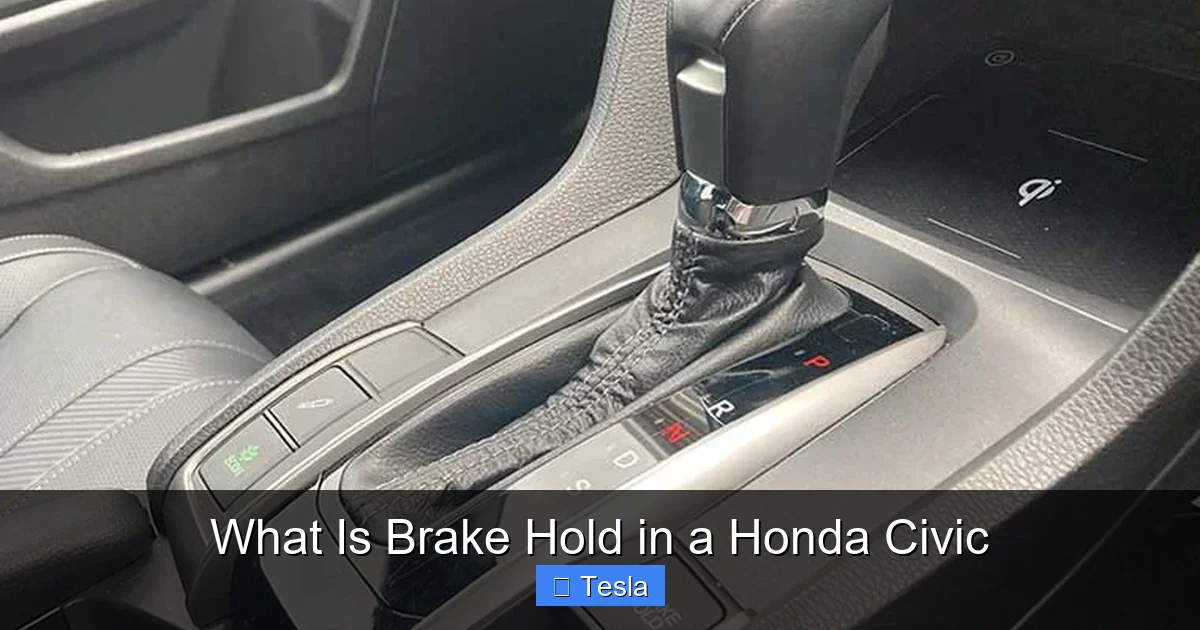
3. System Activation: With your foot still on the brake, you press the Brake Hold button on the center console. You’ll hear a chime and see the “BRAKE HOLD” indicator illuminate in green on the instrument cluster, usually near the speedometer. The system has now taken over.
4. Foot Off the Brake: You can now safely lift your foot from the brake pedal. The Civic’s computer (the Body Control Module) has commanded the brake hydraulic system to maintain the pressure you applied. The car will not move.
The Holding and Release
While holding, the system is active and monitoring. It knows you’re at a stop because the wheel speed sensors read zero. When you’re ready to go, you simply press the accelerator pedal. The system instantly interprets this as a command to move and releases the brake pressure. The transition is designed to be seamless—there’s no lurch or sudden jerk. The car begins to move forward (or backward if in reverse) as if you had smoothly transitioned from brake to gas yourself. The “BRAKE HOLD” light will go out, returning to its off state.
When and How to Use Brake Hold: Practical Scenarios
Knowing *how* it works is one thing; knowing *when* to use it is where the real benefit lies. This feature shines in specific, common driving situations.
Visual guide about What Is Brake Hold in a Honda Civic
Image source: simplecarguides.com
Ideal Use Case: Urban Stop-and-Go Traffic
This is Brake Hold’s bread and butter. Sitting in bumper-to-bumper traffic on a city street or highway is exhausting on your left foot (if driving an automatic) or your right foot (if driving a manual). Constant pressure on the brake pedal leads to fatigue. With Brake Hold engaged, you can relax your foot during the long pauses. You only need to modulate the accelerator for short bursts of movement. It transforms a tiring commute into a more relaxed one. Just ensure you’re keeping a safe following distance and remain alert—the system holds the car, but it doesn’t watch the traffic for you.
Perfect for Long Traffic Lights and Railroad Crossings
Stuck at a seemingly interminable red light? A train blocking your path? Instead of the “one-foot-on-brake, one-foot-ready-on-gas” dance, or the awkward heel-toe pivot, just engage Brake Hold. You can sit back, adjust your mirrors, change the radio station, or have a quick drink of water without the car inching forward. It’s a small comfort that makes a big difference in reducing driving stress.
Using Brake Hold on Inclines (With Caution)
While Brake Hold will function on a hill, its use here requires more caution. On a steep uphill, when you press the gas to go, there might be a slight rollback before the engine torque catches, especially in a less powerful Civic. The system releases the brakes the moment you touch the gas, so it won’t compensate for this rollback like a dedicated hill-start assist might. On a steep downhill, holding the car puts continuous strain on the brakes. For these reasons, on significant grades, many experienced drivers prefer to use the traditional “brake-to-idle, then gas” method or rely on Hill Start Assist (which is automatic and separate). Brake Hold is best reserved for gentle slopes or as a supplement to your normal hill-start technique.
A Special Note for Manual Transmission Civic Drivers
If you drive a stick-shift Civic, Brake Hold still works for you! The activation process is slightly different. After stopping, you must have the clutch pedal fully depressed. Then you can press the Brake Hold button. The system will hold the car even if you take your foot off the clutch and brake. This is incredibly useful at a stoplight on a hill—you can keep the car from rolling backward without having to use the handbrake or ride the clutch. However, the system will disengage if the car does roll backward more than a few inches, so it’s not a substitute for proper hill-start clutch control. It’s a fantastic helper, not a replacement for skill.
The Benefits and Considerations: Is It Right for You?
Like any technology, Brake Hold has clear advantages and some important limitations to keep in mind.

Visual guide about What Is Brake Hold in a Honda Civic
Image source: simplecarguides.com
The Clear Advantages: Comfort and Reduced Fatigue
The primary benefit is driver comfort and reduced physical fatigue. In heavy traffic, eliminating the need for constant pedal pressure is a game-changer for your knee, ankle, and overall concentration. It can also indirectly improve safety by reducing fatigue on long drives. For drivers with certain physical limitations or knee/leg injuries, this feature can be a significant accessibility aid, making driving a Civic possible or much more comfortable.
Important Limitations and Safety Considerations
1. It’s Not a Parking Brake: This cannot be stated enough. If you shift to Park (or Neutral on a manual) and exit the vehicle, you must apply the electronic parking brake. Brake Hold will disengage when you turn off the engine or, in some models, if you open the driver’s door while stopped. Relying on it to secure a parked car is dangerous and will likely result in a rolling vehicle.
2. System Deactivation Triggers: Be aware of what turns Brake Hold off. Besides pressing the accelerator, it will deactivate if you turn off the ignition, open the driver’s door (a safety feature to prevent you from walking away from a running car), or in some models, if you unfasten your seatbelt while stopped. You should always be prepared for it to disengage and have your foot ready to brake if needed.
3. Potential for Distraction: The convenience can become a crutch. Some drivers might become overly reliant on it and less engaged with the basic act of driving. Always keep your eyes on the road and be ready to intervene.
4. Weather and System Reliability: While robust, the system relies on sensors and brake hydraulics. In extremely slippery conditions (ice, deep snow), its holding capability might be reduced, and the feel when it releases could be less smooth. It’s also one more system that could, theoretically, malfunction. If the “BRAKE HOLD” indicator flashes or you get a warning message, have your brake system checked by a professional. This is also a good time to remind yourself about basic maintenance; if you’re wondering about something like how many quarts of oil are in a Honda Civic, you’re likely thinking about overall car care, which includes the braking system.
Comparing Brake Hold to Other Honda Civic Features
The Honda Civic is packed with driver-assist technologies. Understanding how Brake Hold fits into the ecosystem helps you use all features effectively.
Brake Hold vs. The Econ Button
This is a common point of confusion. The Econ Button changes the throttle response, air conditioning behavior, and transmission shift points to maximize fuel efficiency. It makes the car feel more sluggish but saves gas. Brake Hold is a separate convenience feature that has no direct impact on fuel economy (though by reducing unnecessary brake-accelerator cycling, it might have a negligible positive effect). You can use both simultaneously. In fact, using Brake Hold in Econ mode during a traffic jam is the pinnacle of efficient, relaxed commuting. For a deep dive into how the Econ button transforms your Civic’s personality, you can read more about what the Econ button does in a Honda Civic.
Brake Hold as Part of the Honda Sensing Suite
Brake Hold is not part of the Honda Sensing suite (which includes Adaptive Cruise Control, Collision Mitigation Braking, etc.). It’s a standalone convenience feature, often bundled with other comforts like power seats and moonroofs on higher trims. However, it works in harmony with the basic braking components that Honda Sensing also uses (like the wheel speed sensors). It’s a perfect example of how Honda layers different technologies—from core mechanical systems to advanced driver aids—to create a cohesive driving experience. To understand the broader context of what kind of vehicle offers this tech, it helps to know what type of car the Honda Civic is: a compact, efficient, and tech-forward daily driver.
Troubleshooting: When Brake Hold Doesn’t Work
Most of the time, Brake Hold is flawless. But when it fails to activate or disengages unexpectedly, here’s your diagnostic checklist:
- Check the Prerequisites: Is the driver’s door firmly closed? Is your seatbelt clicked in? Is the ignition on? Is the vehicle completely stopped? These are the most common reasons for non-activation.
- Look for Warning Lights: If your regular brake system warning light (the exclamation mark in a circle) is on, or if you see a specific “BRAKE HOLD” malfunction indicator, the system is disabled for safety. You need to have your brake system inspected. Issues like worn brake pads, low brake fluid, or a faulty sensor can take Brake Hold offline.
- Transmission in Neutral/Park: On automatics, Brake Hold typically requires the transmission to be in Drive (D) or Reverse (R). It will not activate in Park (P) or Neutral (N).
- Manual Transmission Clutch: On a manual, ensure the clutch is fully depressed. The system won’t engage if the clutch is partially released or if the car is in neutral.
- Extreme Temperatures: Very hot or cold conditions can sometimes temporarily affect system responsiveness, though this is rare.
If you’ve checked everything and it still doesn’t work, consult your owner’s manual. The final step is a visit to a Honda dealer for a diagnostic scan. Remember, a non-functional Brake Hold is usually a symptom of a broader brake system issue, not an isolated problem.
Conclusion: A Small Button, A Big Difference
Brake Hold in the Honda Civic is a masterclass in thoughtful, user-centric engineering. It solves a tiny, daily annoyance—the strain of holding a brake pedal—that millions of drivers experience. It’s not flashy like a turbocharger, and it won’t win you drag races, but it directly enhances the quality of your driving experience, especially in the real-world conditions of crowded cities and congested highways. By automatically managing brake pressure at stops, it reduces fatigue, allows for momentary multitasking (like adjusting the wiper blades for a 2013 Honda Civic during a downpour at a light), and makes stop-and-go traffic fundamentally less tedious. The key to enjoying it is understanding its purpose—as a convenience tool—and respecting its limits. It’s not a parking brake, and it’s not infallible. Used correctly, it’s a quiet companion that makes every Civic drive a little smoother and a little more relaxing. So next time you’re at that long light, give that Brake Hold button a try. Your left knee might just thank you for it.
Frequently Asked Questions
Can I use Brake Hold on a hill?
Yes, Brake Hold will function on an incline. However, on steeper hills, you may experience a slight rollback when pressing the accelerator, as the system releases the brakes immediately. For severe grades, rely on your own braking control or the automatic Hill Start Assist feature. Always use the parking brake when parking on a hill.
Does Brake Hold work with a manual transmission?
Yes, it does. With a manual transmission, you must first come to a complete stop and fully depress the clutch pedal. Then you can press the Brake Hold button. The system will hold the car, allowing you to remove your feet from the pedals. It will disengage if the car rolls backward more than a few inches.
What happens if I open the driver’s door while Brake Hold is active?
For safety, opening the driver’s door while the vehicle is stopped and Brake Hold is engaged will cause the system to deactivate immediately. You will hear a chime and see the indicator go out. This prevents you from accidentally exiting a running vehicle that might start moving if you touch the gas.
Is Brake Hold the same as an automatic parking brake?
No. Brake Hold only functions while the vehicle is running and you are inside it. It releases as soon as you press the accelerator. An automatic parking brake (like Honda’s Electric Parking Brake) is designed to secure the vehicle when parked and must be manually engaged and disengaged. Never use Brake Hold in place of the parking brake.
Is it safe to use Brake Hold in heavy rain or snow?
Brake Hold will work in wet or snowy conditions, but its holding capability depends on tire traction. If the surface is very slippery, the wheels could still slip. The system is not a traction control system. Always adjust your driving for conditions and be prepared for the system to disengage or for reduced holding force on extremely low-traction surfaces.
Will using Brake Hold wear out my brakes faster?
No. Brake Hold uses the same hydraulic system as your foot on the pedal. It doesn’t create extra friction or wear. In fact, by potentially reducing the number of times you need to press and release the brake in traffic, it might lead to more consistent brake wear. However, any brake system component, including the brake pads and rotors, will wear with normal use, and Brake Hold relies on that system being in good condition.