What Is 503 Server Maintenance on Tesla

Contents
- 1 Key Takeaways
- 2 📑 Table of Contents
- 3 Introduction: Your Tesla’s Digital Lifeline
- 4 Demystifying the “503”: It’s Not Just a Tesla Thing
- 5 Why Would Tesla’s Servers Need Maintenance?
- 6 What Exactly Stops Working? The Feature Impact Breakdown
- 7 Your Action Plan: What To Do When You See 503
- 8 The User Experience: Stories from the Road
- 9 Looking Ahead: The Future of Tesla’s Digital Infrastructure
- 10 Conclusion: A Temporary Hiccup in a Revolution
- 11 Frequently Asked Questions

Brake Cleaner Spray

Fuel Injector Cleaner

OBD2 Scanner Tool

Car Back Support Cushion
A 503 Server Maintenance error on your Tesla indicates that Tesla’s central servers are temporarily offline for updates or repairs, not that your car has a physical problem. This service interruption typically affects connectivity-dependent features like the mobile app, navigation, and streaming services, but core driving functions remain fully operational. The error is usually resolved within a few hours once maintenance is complete, requiring no action from you beyond patience.
Key Takeaways
- Server-Side Issue: The 503 error originates from Tesla’s remote servers, not your vehicle’s hardware or local software.
- Temporary Nature: This is a planned or unplanned maintenance status; functionality returns automatically once servers are back online.
- Feature Impact: Connectivity features (app, streaming, live traffic) are disabled, but driving, charging, and offline functions work normally.
- No Service Center Visit: A 503 error never requires a physical service appointment; it is purely a network communication failure.
- Check Official Sources: Tesla’s own status page and community forums are the best places to confirm ongoing server maintenance.
- Use Offline Alternatives: Prepare by downloading offline maps and using Bluetooth music during connectivity outages.
- Not a Security Risk: The error does not indicate a hack or security breach; it’s a standard HTTP status code for service unavailability.
📑 Table of Contents
- Introduction: Your Tesla’s Digital Lifeline
- Demystifying the “503”: It’s Not Just a Tesla Thing
- Why Would Tesla’s Servers Need Maintenance?
- What Exactly Stops Working? The Feature Impact Breakdown
- Your Action Plan: What To Do When You See 503
- The User Experience: Stories from the Road
- Looking Ahead: The Future of Tesla’s Digital Infrastructure
- Conclusion: A Temporary Hiccup in a Revolution
Introduction: Your Tesla’s Digital Lifeline
Imagine your Tesla as a smartphone on wheels. Its most powerful features—real-time navigation with live traffic, streaming music and video, the ability to check on your car from your phone, and even those magical over-the-air software updates—all depend on a constant, invisible conversation between your vehicle and Tesla’s global network of servers. This digital lifeline is what makes a Tesla feel like a living, evolving product. But what happens when that conversation gets a busy signal? That’s precisely what a “503 Server Maintenance” notification means. It’s not a warning light for a broken part; it’s a message from Tesla saying, “Our computers are getting a tune-up, please wait.” This article will demystify that message, explaining exactly what’s happening behind the scenes, what you can and cannot do when it appears, and why it’s a normal part of owning a connected car.
For new and veteran Tesla owners alike, seeing unfamiliar text on the touchscreen or a failed command in the app can cause alarm. The goal here is to replace that anxiety with understanding. We’ll break down the technical term “503” into simple ideas, explore Tesla’s unique server architecture, and give you practical tips to navigate these temporary blackouts with ease. Think of this as your complete owner’s manual for one of the most common—and least dangerous—messages your Tesla will ever display.
Demystifying the “503”: It’s Not Just a Tesla Thing
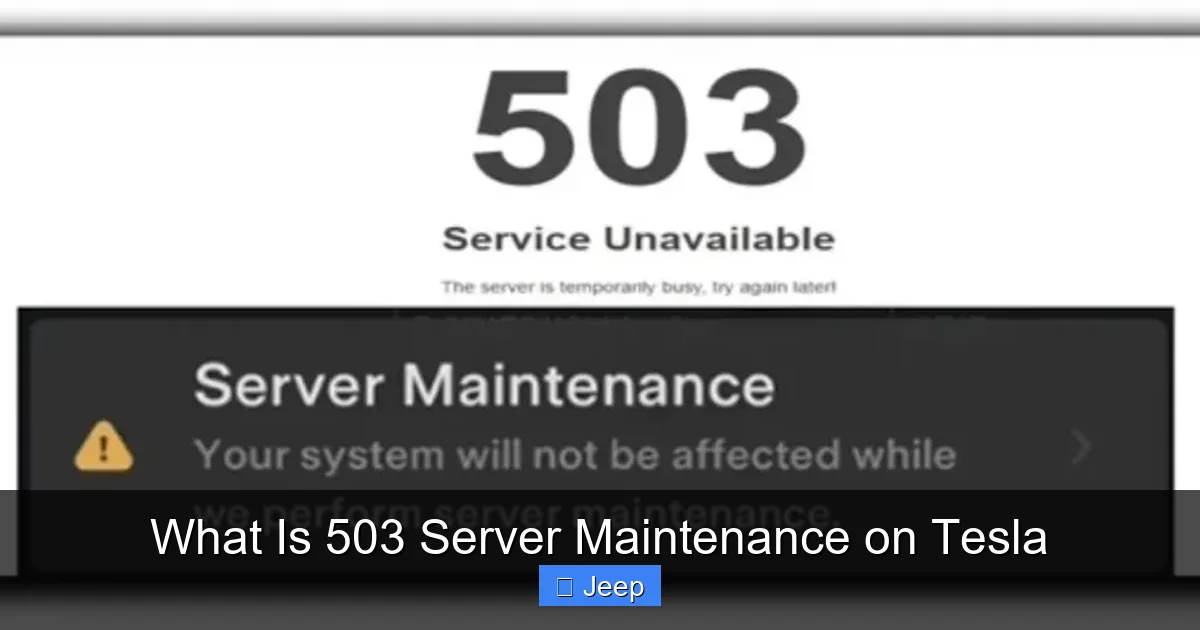
Before we talk Tesla, let’s talk internet. The “503” in “503 Server Maintenance” is a standard HTTP status code, part of the universal language of the web. You’ve likely encountered others, like “404 Not Found” or “500 Internal Server Error.” A 503 status code specifically means “Service Unavailable.” It’s the server’s polite way of saying, “I’m here, but I can’t handle your request right now because I’m overloaded or down for maintenance.”

Visual guide about What Is 503 Server Maintenance on Tesla
Image source: evseekers.com
The Client-Server Handshake in Your Tesla
Every time you ask your Tesla to do something that requires the internet—pull up a Supercharger map, start cabin overheat protection from your phone, or receive a new game—your car (the “client”) sends a request to one of Tesla’s many servers (the “server”). The server processes that request and sends back the data or command. A 503 error occurs when the server receives the request but is intentionally configured to reject it because it’s in a maintenance state. It’s not a crash; it’s a planned pause. This is fundamentally different from a “500” error, which means the server crashed unexpectedly. A 503 is a scheduled or managed downtime.
Why Standard HTTP Codes Matter for Your Car
Using standard web protocols is efficient for Tesla. It means their cars can communicate with their infrastructure using the same rules as any website or app. This standardization is why you might see the same “503” error in your Tesla app that you’d see if you tried to visit a website under construction. It’s a universal signal. Understanding this helps you realize the error is a network issue, not a vehicle malfunction. Your car’s internal systems, which control steering, braking, and battery management, operate on separate, critical networks and are never affected by a 503 message.
Why Would Tesla’s Servers Need Maintenance?
Tesla doesn’t just run a simple website; it operates a colossal, global cloud platform that manages millions of vehicles, processes petabytes of data from their autopilot sensors, delivers software updates, and powers the mobile app ecosystem. This infrastructure requires constant, careful upkeep.
Visual guide about What Is 503 Server Maintenance on Tesla
Image source: evseekers.com
Rolling Out the Future: Over-the-Air (OTA) Update Deployment
The most common reason for a planned 503 is a major software update. When Tesla prepares to push a new version—say, a holiday update with new games and UI tweaks—they often put their primary update servers into a special “maintenance mode.” They upload the massive update files, verify their integrity, and stage them for gradual rollout. During this window, the servers may refuse new update requests, triggering a 503 for any car trying to check for software. This is a good thing! It means the new features are being prepped. You can read more about the intricacies of Tesla’s update process in our detailed guide on what is 503 server maintenance on Tesla.
Scaling for Success: Infrastructure Upgrades
As Tesla’s fleet grows explosively, the demand on their servers skyrockets. A 503 might be triggered if Tesla is adding new server capacity, upgrading database clusters, or implementing more robust cybersecurity measures. It’s like a popular restaurant closing for a few hours to expand its kitchen—a temporary inconvenience for a much better long-term experience. These upgrades are proactive, aimed at preventing larger, more frequent outages in the future.
Unplanned Outages: The “Uh-Oh” Moment
Not all 503s are scheduled. Sometimes, a critical server component fails, or a network provider experiences a widespread issue (like an AWS or Azure region outage, which Tesla uses). In these cases, Tesla engineers might manually take systems offline to diagnose and fix the problem, also resulting in a 503. While unplanned, the response is the same: a temporary loss of connectivity until the issue is resolved. These events are rarer but highlight the complex, interdependent nature of modern cloud computing.
What Exactly Stops Working? The Feature Impact Breakdown
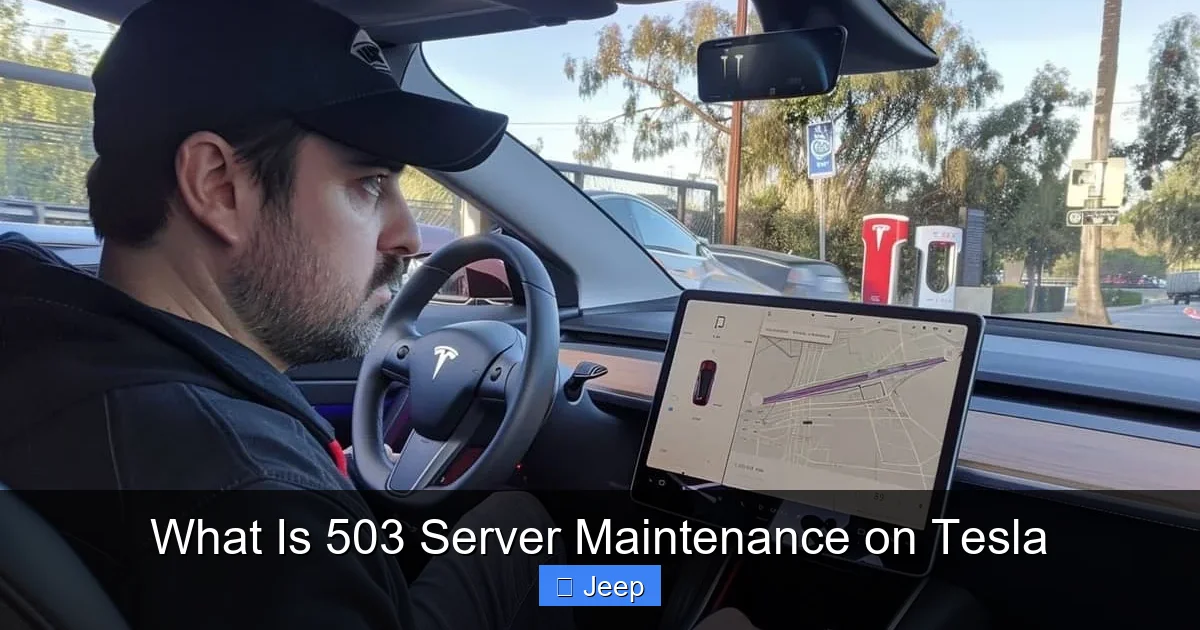
This is the most practical question for an owner. A 503 error does not immobilize your Tesla. You can drive, steer, brake, and charge it perfectly. The impact is solely on features that require a live data connection to Tesla’s mothership. Think of it as your car losing its cell signal.
Visual guide about What Is 503 Server Maintenance on Tesla
Image source: ecarcraze.com
Primary Affected Services
The mobile app is often the first place you’ll notice the problem. You won’t be able to honk the horn, flash lights, see the car’s location, or check the state of charge remotely. Inside the car, the “Live Traffic” layer on the navigation map will disappear, reverting to standard road data. Streaming services like Spotify, Tidal, and Tesla’s own video library (when parked) will fail to load. The “Calendar” sync feature will stop working. Some vehicle-to-grid or energy product integrations (for Powerwall/Tesla Solar owners) may also be disrupted.
What Continues to Work Flawlessly
This is the crucial reassurance. Your car’s core computer systems are offline-capable. Navigation using downloaded maps works perfectly. Bluetooth phone calls and music playback from your phone work. All vehicle controls—climate, seats, steering wheel adjustments, driving modes—are 100% functional. The car will still charge at Superchargers and destination chargers, as charging authentication often has local fallbacks. Autopilot and Full Self-Driving (FSD) capabilities that rely on the car’s own sensors and onboard computers continue to work as designed; they do not need a constant server link for basic operation, though some features like “Navigate on Autopilot” with live traffic routing will be limited. It’s helpful to understand this distinction, similar to how features like selective unlock on Nissan vehicles operate independently of a central server for basic function.
Your Action Plan: What To Do When You See 503
So, the dreaded message appears. Panic is not the answer. Here is your step-by-step guide.
Step 1: Confirm It’s Widespread, Not Just You
Before assuming a global Tesla outage, check your phone’s cellular data and Wi-Fi. Is your internet working? Try opening a website. If your personal internet is fine, the issue is likely on Tesla’s end. The best place to check is Tesla’s official Vehicle and Service Status page (a simple web search will find it). This page lists the operational status of all major Tesla digital services worldwide. If it shows “Degraded Performance” or “Service Disruption” for the APIs your car uses, it’s confirmed. Community forums like the Tesla Motors Club forum are also excellent for real-time user reports.
Step 2: Embrace the Offline Mode
Plan for this. Before a long trip or if you know a major update is rumored, download offline maps for your destination in the Tesla navigation system. Ensure your phone has downloaded podcasts or playlists for Bluetooth streaming. This turns a minor inconvenience into a non-event. Your car is still a fantastic machine to drive; you just lose some of the “smart” extras for a while.
Step 3: Be Patient and Avoid Needless Service Visits
This is the most important step. Do not schedule a service appointment for a 503 error. Service centers cannot fix a global server issue. They will simply tell you to wait. The error will resolve itself when Tesla’s engineers complete the maintenance. This could be 30 minutes, a few hours, or in rare complex cases, a day. Constantly checking the app or rebooting the car’s MCU (Media Control Unit) will not speed up the process. A simple reboot (holding both scroll wheels on the steering wheel) can sometimes help your car re-establish a connection *after* servers are back, but it won’t fix the server itself.
The User Experience: Stories from the Road
Let’s bring this to life with some common scenarios Tesla owners encounter.
The Update Eve Panic
It’s 10 PM, and you see a notification that version 2024.2.1 is downloading. You wake up at 2 AM to get water and see the screen says “503 Service Unavailable.” Your heart sinks. “Did the update break the car?” Relax. This is classic update deployment. Tesla’s servers are likely in maintenance mode to finalize the rollout for millions of cars. Your car will complete its installation from the locally cached file without needing the server. The 503 message might linger until the servers come back online hours later, but your car is fine and will have the new software.
The Road Trip Navigation Glitch
You’re on a cross-country drive, and the live traffic layer on your navigation map vanishes. The estimated times become static. You try to search for a Supercharger via voice command and it fails. A quick glance at the top of the screen shows a small “503” icon. This is inconvenient but not dangerous. You still have your basic map. Your range calculations are still accurate. Simply continue your drive using the offline map. The connectivity will likely return by the next day, or you can check Tesla’s status page from your phone at a rest stop.
The App Connection Blackout
You’re at work and try to precondition your car’s cabin for the commute home. The app spins and then says “Connection Error.” You check your phone’s internet, it’s fine. You try again, same thing. You glance at your car’s dash and see no obvious warning lights. This is a textbook 503. Your car is physically perfect, but it can’t hear the app’s call because Tesla’s phone servers are temporarily down. The solution? Walk outside and use the key card or phone-as-key to get in and turn on the climate manually. It’s a step back in time, but it works. These moments remind us of the incredible convenience we’ve grown accustomed to.
Looking Ahead: The Future of Tesla’s Digital Infrastructure
Tesla is acutely aware that digital service reliability is a cornerstone of its brand experience. As the company moves toward becoming an AI and robotics company, the demands on its server infrastructure will only grow more intense with full self-driving data processing, robotaxi fleet management, and more.
Proactive Monitoring and AI-Driven Maintenance
Industry experts suggest Tesla is investing heavily in predictive maintenance for its server farms. Using AI to forecast load spikes and preemptively scale resources could dramatically reduce both planned and unplanned 503 events. We may see more granular, regional maintenance windows that affect fewer users at a time.
Decentralization and Edge Computing
Another potential solution is pushing more processing to the “edge”—meaning your car itself. While not all services can be localized (like global map updates or app authentication), certain functions could be designed to have a robust offline fallback or process data locally before syncing. This would make the user experience more resilient to central server outages. It’s a complex architectural shift but a logical one for a company building autonomous machines.
Transparency as a Feature
We can also expect better communication. The current status page is a great start, but imagine in-car notifications that are more specific: “Tesla servers are undergoing scheduled maintenance until 3 PM PST. Navigation and streaming may be unavailable.” This level of detail reduces user confusion and anxiety significantly. Clear communication turns a technical problem into a managed expectation.
Conclusion: A Temporary Hiccup in a Revolution
A 503 Server Maintenance message on your Tesla is not a defect; it’s a status update. It’s the digital equivalent of seeing a “We’re Open” sign flipped to “Closed for Cleaning” at your favorite store. The store isn’t gone forever; it’s being improved so it can serve you better. Your Tesla remains a marvel of engineering, safe and drivable regardless of the cloud’s status. This message is simply a reminder of the profound, silent partnership between your car and a vast, global network that makes the Tesla experience possible.
By understanding what a 503 means—server-side, temporary, non-critical—you empower yourself as an owner. You can check official sources, utilize offline features, and wait with confidence. As Tesla’s infrastructure matures, these events will become less frequent and shorter. But when they do happen, you’ll now know exactly what’s going on, why it’s happening, and that everything is going to be okay. The revolution on our roads is powered by silicon and software, and even the best software needs a reboot now and then.
Frequently Asked Questions
What does “503 Server Maintenance” actually mean on my Tesla?
It means Tesla’s servers that power connected features are temporarily offline for updates or repairs. Your car is physically fine, but it cannot communicate with Tesla’s cloud network for services like app control, live traffic, or streaming.
Is a 503 error dangerous? Can I still drive my Tesla?
No, it is not dangerous at all. You can drive, steer, brake, and charge your Tesla normally. All core vehicle functions are completely independent of the server connection. Only internet-dependent conveniences are affected.
How long does a 503 server maintenance usually last?
Most maintenance windows last between 30 minutes and 4 hours. Major software update deployments can sometimes take longer, but they are rarely more than 24 hours. Tesla typically performs these during off-peak hours.
Should I call Tesla Service or schedule a repair appointment for a 503 error?
Absolutely not. A 503 error is a global network issue, not a problem with your specific car. Service centers cannot fix it. The only action is to wait for Tesla to complete the maintenance on their servers.
Can I prevent or avoid seeing the 503 error?
You cannot prevent Tesla’s necessary server maintenance. However, you can prepare by downloading offline maps for areas you travel to and having music/podcasts downloaded on your phone for Bluetooth playback, making the temporary outage seamless.
Where can I check if the 503 error is affecting everyone or just me?
Visit Tesla’s official “Vehicle and Service Status” page online. It shows the real-time health of all Tesla digital services globally. Community forums like the Tesla Motors Club are also great for user-reported outages.