
Is Tesla Enhanced Autopilot Worth It?

Is Tesla Enhanced Autopilot worth it? For frequent highway drivers who value convenience and are attentive, it can be. It adds useful, semi-autonomous features like Auto Lane Change and Navigate on Autopilot that truly reduce driving fatigue. However, it’s not full self-driving, requires constant supervision, and the high price tag is a major hurdle. It’s a premium convenience feature, not a safety necessity.
Let’s be real. The idea of a car that can mostly drive itself is the stuff of science fiction, but Tesla has pulled it into our reality more than any other automaker. When you walk up to a Tesla, the sleek minimalism inside is striking, but your eyes are drawn to the large central screen. That screen is the command center for one of the most advanced consumer driver-assist systems available: Tesla Autopilot. But there’s a fork in the road. After the standard Basic Autopilot (which includes Traffic-Aware Cruise Control and Auto Steer), you face a choice: do you spring for Enhanced Autopilot (EAP), or do you go all-in on the pricier Full Self-Driving (FSD) capability? Today, we’re putting the microscope on that middle option. We’re answering the billion-dollar question on every potential Tesla buyer’s mind: Is Tesla Enhanced Autopilot Worth It?
This isn’t about hype or marketing buzzwords. This is a practical, down-to-earth look at what you actually get for your $6,000 (or $200/month subscription). We’ll talk about the smooth highway merges, the slightly nerve-wracking auto lane changes, and the moments where it throws its digital hands up and says, “You take over.” By the end, you’ll know exactly who should buy it, who should skip it, and whether that price tag translates to real value for your specific driving life. Think of this as the conversation you’d want to have with a friend who already owns a Tesla with EAP, minus the sales pressure.
Key Takeaways
- It’s a Convenience Feature, Not Autonomy: Enhanced Autopilot (EAP) is a sophisticated driver-assist system. It does not make your Tesla a self-driving car. You must remain alert and ready to take control at any moment.
- High Cost for Incremental Gains: At $6,000 (or a monthly subscription), EAP is expensive. You’re paying for features that build on the free Basic Autopilot, primarily for highway and multi-lane road convenience.
- Highway-Centric Brilliance: Its strongest suit is monotonous highway driving. Features like Navigate on Autopilot and Auto Lane Change work remarkably well on major roads, significantly reducing cognitive load during long trips.
- Urban and City Driving Limitations: EAP’s capabilities are severely limited in complex city environments, on surface streets, or in poor weather. It will not handle stop signs, traffic lights, or intricate intersections without Full Self-Driving (FSD).
- User Skill and Attention Are Paramount: The system’s value is directly tied to the driver’s understanding of its limits. Misuse or over-reliance is dangerous and the primary cause of negative experiences.
- Best for Commuters and Road Trippers: If your daily drive involves 30+ minutes on freeways or you take regular long-distance trips, the fatigue-reduction benefits are most tangible and can justify the cost over time.
- Future-Proofing Through Software: Tesla’s approach is software-defined. Buying EAP or FSD means you’re investing in a platform that will receive ongoing updates, potentially adding new features or refining existing ones, unlike traditional one-time hardware options.
📑 Table of Contents
- What Exactly Is Enhanced Autopilot? Demystifying the Features
- The Cost Equation: Is $6,000 (or a Subscription) Justifiable?
- The Real-World Experience: Where It Shines and Where It Stumbles
- Who Is Enhanced Autopilot Actually For? (The Ideal User Profile)
- The Competition: How Does EAP Stack Up Against Other Systems?
- The Verdict: Making Your Decision
What Exactly Is Enhanced Autopilot? Demystifying the Features
Before we judge the value, we must clearly define the product. Enhanced Autopilot is not a standalone package; it’s an upgrade layer on top of the standard Autopilot hardware that every new Tesla ships with. That hardware—eight cameras, radar (on older models), ultrasonic sensors, and a powerful onboard computer—is the same whether you buy a base Model 3 or the top-spec Model S Plaid. What you’re paying for with EAP is access to a specific suite of software features that unlock more of that hardware’s potential.
The Core Feature Set: Beyond “Follow the Car in Front”
Basic Autopilot gives you two main tools: Traffic-Aware Cruise Control (TACC) and Auto Steer. TACC keeps you at your set speed but will slow down for cars ahead. Auto Steer keeps you centered in your lane. It’s fantastic for reducing fatigue on long drives, but it’s a passive system. EAP turns it into a more active co-pilot. Here are the key additions:
- Auto Lane Change: This is the feature most people notice first. When you’re on a highway with Auto Steer active, you simply tap the turn signal stalk. The car will check for traffic, signal for you, and smoothly move into the adjacent lane. It’s surprisingly competent and polite about it.
- Navigate on Autopilot (NoA): This is the headline act. On a mapped highway route, you can set a destination and the car will manage the entire journey. It will automatically take exits, navigate interchanges, and even change lanes to get into the correct lane for an upcoming exit. It’s like having a very cautious, rule-following co-pilot who knows the map.
- Auto Park: The car will detect both parallel and perpendicular parking spots as you drive slowly past them. You tap a button, and it will steer itself into the spot while you control the pedals. It’s a neat party trick, but its real-world utility depends on your parking situations.
- Summon & Smart Summon: This is where things get sci-fi. Summon lets you move the car forward or backward in and out of a tight parking spot using the Tesla app on your phone, from outside the vehicle. Smart Summon is more advanced: you can “call” your car to drive to you (within about 200 feet) in a parking lot, navigating around obstacles. It’s incredibly cool, but its practical use cases are fairly narrow.
- Traffic Light and Stop Sign Control: Important Note: This specific feature is part of the Full Self-Driving (FSD) package, not Enhanced Autopilot. EAP does not handle city traffic lights or stop signs on surface streets. This is a critical distinction many people miss. EAP is primarily for highways and freeways.
So, in essence, Enhanced Autopilot is a suite of features designed to automate the high-stress, high-cognitive-load parts of highway driving: lane changes, exits, and long stretches of monotony. It’s about making the journey less tiring, not about removing the driver.
The Cost Equation: Is $6,000 (or a Subscription) Justifiable?
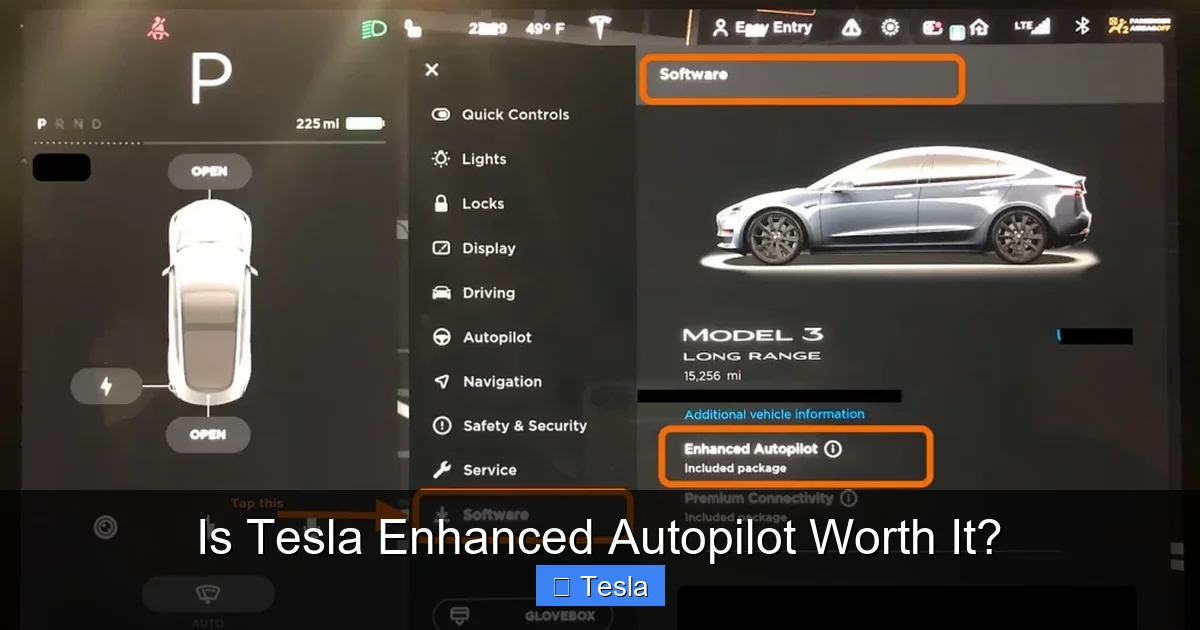
Here’s where the rubber meets the road—or rather, where your wallet meets the screen. The price of Enhanced Autopilot has fluctuated over the years, but it currently sits at a firm $6,000 as a one-time purchase or $200 per month as a subscription. That’s not pocket change. To assess worth, we need to frame this cost against two things: the value it provides and the alternatives.
Visual guide about Is Tesla Enhanced Autopilot Worth It?
Image source: gearfixup.com
Purchasing vs. Subscribing: A Math Lesson
The subscription model is Tesla’s attempt to lower the barrier to entry. Let’s do some quick math. If you subscribe at $200/month, you’ll break even on the purchase price after 30 months, or 2.5 years. If you plan to keep the car for 4+ years, purchasing outright is the cheaper long-term play. The subscription is a smart trial for someone unsure, or for someone who only wants it for a specific period (like a long road trip season). But for a keeper? The one-time fee is better value.
Value Per Mile Driven
Think about your driving habits. If you put 15,000 miles a year on your car, and 10,000 of those are on highways where EAP would be active, that’s a lot of potential fatigue reduction. If you only drive 5,000 total miles a year, mostly in town, the value per mile plummets. The worth is directly proportional to your highway mileage. For a cross-country road tripper or a long-haul commuter, the convenience can feel priceless. For a city dweller who rarely leaves urban grids, it’s an expensive toy that will sit dormant most of the time.
The “Tesla Tax” and Resale Considerations
There’s a common belief that adding EAP or FSD increases a Tesla’s resale value. This is partially true. In the used Tesla market, a car with FSD capability (the hardware) is often priced higher than one without, even if the software wasn’t purchased. However, the software itself—if you’ve purchased EAP or FSD—is typically tied to the car and does transfer, adding value. But the market is volatile. Don’t buy it *solely* as an investment; buy it for the utility you’ll get while you own the car. The resale boost is a potential bonus, not a guarantee.
When comparing to other brands, you might look at subscription services from other manufacturers. For instance, Toyota Connected Services offers remote start, safety alerts, and connected navigation for a much lower annual fee, but it lacks any driving automation. It’s a different value proposition entirely—safety and convenience versus driving convenience. Similarly, premium audio packages from brands like Lexus with Mark Levinson offer immense audio value but don’t change the driving task. EAP is in a category of its own, with a price tag to match.
The Real-World Experience: Where It Shines and Where It Stumbles
Spec sheets are one thing. Using the system day-in, day-out is another. After extensive testing and hearing from countless owners, a clear picture emerges. EAP is a tale of two environments: the open highway and everything else.
Visual guide about Is Tesla Enhanced Autopilot Worth It?
Image source: gearfixup.com
Highway Nirvana: The Sweet Spot
On a well-mapped interstate or freeway, Navigate on Autopilot (NoA) is transformative. You set your destination, engage NoA, and the car takes over. It will:
- Maintain your chosen speed (or the flow of traffic) with smooth, predictable acceleration and braking.
- Stay perfectly centered in the lane, even through gentle curves.
- As you approach your programmed exit, it will automatically move you into the correct exit lane, often well in advance.
- It will execute the exit ramp smoothly.
- If the lane you’re in ends or there’s a “keep right/left to stay on route” sign, it will change lanes without you touching the stalk.
This automation of the entire highway navigation process—from lane changes to exits—is where the $6,000 starts to feel earned. It reduces the constant micro-decisions and scanning required on a long drive. Your brain can relax a bit more, knowing the car is handling the routine, high-speed choreography. The Auto Lane Change is also superb in this context. It’s decisive, checks blind spots reliably, and executes the maneuver with a confidence that builds trust.
The Urban Reality Check: Not Ready for Prime Time
Take EAP off the highway and onto city streets, and its limitations become glaringly obvious. It will not:
- Stop at stop signs or traffic lights.
- Make left turns across traffic.
- Navigate roundabouts.
- Deal with temporary traffic control (flaggers, cones in lanes).
- Understand complex, unmarked intersections.
On a surface street with Auto Steer engaged, it will follow the lane lines like a train on tracks, blissfully ignoring a red light or a stop sign ahead until it’s too late, forcing a frantic takeover. This is why Tesla explicitly states EAP is for “controlled-access highways” and “roads with a physical center divider.” Using it elsewhere is not just useless; it’s dangerous if you misunderstand its scope. The value here is essentially zero. You are 100% responsible for all urban driving decisions.
The “Edge Cases” and Weather: The Ultimate Test
No system is perfect. EAP can be confused by:
- Poor or faded lane markings (common in construction zones or on worn rural roads).
- Heavy rain, snow, or fog that obscures the cameras and sensors. The system will often disengage and warn you to take over.
- Sharp, sudden curves that exceed its comfort zone.
- Merging traffic on very short on-ramps. It can be overly cautious, forcing you to intervene to merge safely.
- Other drivers’ unpredictable behavior (cutting in aggressively, erratic braking).
Your experience will be a mix of “wow, this is magic” and “come on, car, figure it out!” The key is knowing which is which. The best EAP users are not passive; they are engaged supervisors, ready to nudge the wheel or tap the brake at a moment’s notice.
Who Is Enhanced Autopilot Actually For? (The Ideal User Profile)
Given the strengths, weaknesses, and cost, who gets the most value? There’s a very specific user profile that will likely feel EAP is worth every penny.
Visual guide about Is Tesla Enhanced Autopilot Worth It?
Image source: gearfixup.com
- The Long-Distance Commuter: If your daily drive includes 30+ minutes of mind-numbing highway traffic in each direction, EAP is a game-changer. It turns a draining commute into a more manageable, less stressful experience. The ability to let the car handle lane changes and exits lets you mentally decompress.
- The Road Trip Enthusiast: For anyone who regularly drives 8+ hours to visit family or explore, EAP is arguably the best feature in the car. It dramatically reduces driver fatigue on the most tedious segments of the trip, making you feel fresher when you arrive.
- The Tech Enthusiast Who Understands Limits: If you love technology, enjoy learning systems, and have a clear-eyed view of what the car can and cannot do, you’ll appreciate EAP as a marvel of engineering. You’ll use it correctly and be fascinated by its evolution.
- The Safety-Conscious Driver (Used Correctly): While not a safety feature per se, the smooth, predictable driving of EAP can reduce the risk of accidents caused by fatigue or inattention on highways. The constant lane-keeping and adaptive cruise are excellent backup systems.
Who Should NOT Buy It?
- The Primarily Urban/City Driver: If your driving is 90% stop-and-go city traffic, EAP will provide almost no benefit. Save the money.
- The Driver Who Wants to “Check Out”: If you’re hoping to read a book or watch a movie while the car drives, EAP is not for you. It will lead to dangerous situations and a terrible user experience. You must pay attention.
- The Budget-Conscious Buyer: At $6,000, it’s a significant chunk of the car’s price. For many, that money is better spent on a higher trim level, better wheels, or simply saved.
- Someone in an Area with Poor Map Data: NoA relies on highly detailed, accurate map data. If you live in a rural area or a region where Tesla’s mapping is spotty, the Navigate on Autopilot feature will be unreliable or unavailable, stripping away its most valuable component.
The Competition: How Does EAP Stack Up Against Other Systems?
It’s easy to get Tesla myopia, but other automakers offer advanced driver-assist systems, often as standard on higher trims. How does EAP compare?
- GM Super Cruise: This is arguably the closest competitor in terms of highway autonomy feel. Super Cruise uses precise lidar-based mapping and driver attention monitoring (a camera on you) to allow hands-free driving on mapped highways. It’s arguably more capable and less demanding than EAP for hands-free operation but is limited to specific highways (the “mapped” network) and comes on select Cadillac models. It’s a different philosophy: more restrictive but more capable within its box.
- Ford BlueCruise: Similar to Super Cruise, BlueCruise offers hands-free highway driving on pre-mapped “Blue Zones.” It’s rolling out to more Ford and Lincoln models. Its value proposition is similar—premium convenience for highway driving—but again, with a geographic limitation.
- Mercedes-Benz DRIVE PILOT: This is a true Level 3 system (where the car is legally responsible in certain conditions) available on select S-Class and EQS models in Germany and NV, USA. It’s in a different league legally and technologically, but it’s also far more expensive and geographically restricted.
- mainstream brands (Toyota, Honda, etc.): Systems like Toyota Safety Sense or Honda Sensing offer excellent adaptive cruise and lane centering, but they lack the active lane-changing, exit-taking, and summon capabilities of EAP. They are fantastic, reliable safety nets but are not “co-pilots.” They don’t attempt to navigate for you.
The key differentiator for Tesla is its software-first, over-the-air update approach. EAP today is better than it was two years ago, and it will likely get better. A GM system is largely fixed at purchase. This potential for improvement is part of the value you’re betting on.
The Verdict: Making Your Decision
So, after all this, is Tesla Enhanced Autopilot worth it? The answer, frustratingly, is: It depends entirely on you.
If you are the ideal user—a highway commuter or road tripper who is tech-savvy, attentive, and understands this is a driver-assist tool—then yes, the value proposition is strong. The reduction in mental fatigue on long drives is tangible and significant. The smooth, automated lane changes and exits remove a constant source of low-grade stress. For those people, the $6,000 can be justified as a premium convenience feature, much like a premium sound system or a panoramic sunroof. It changes the character of the driving experience for the better in its intended environment.
However, if your driving is predominantly urban, if you are on a tight budget, or if you have any misconceptions about the system’s capabilities, then no, it is not worth it. You will be frustrated by its city limitations, and the high cost will feel like a waste. The worst outcome is buying it with the expectation of a “chauffeur” and being sorely disappointed and potentially unsafe.
Our practical advice? Test drive a Tesla with Enhanced Autopilot on a route that mirrors your typical drive. Don’t just try it for 10 minutes on a perfect highway. Ask to drive it for an hour on your actual commute or a similar stretch of road. Experience the good moments and the moments where it asks for your help. That hands-on experience will give you the clearest answer of all. Remember, you’re not buying a self-driving car. You’re buying a exceptionally good cruise control and lane-keeping assistant with some very clever highway navigation tricks. If those tricks align with your life, the price tag starts to make sense. If not, your money is better spent elsewhere in the car or in your bank account.
Frequently Asked Questions
Is Enhanced Autopilot the same as Full Self-Driving?
No. Enhanced Autopilot (EAP) is a subset of features focused on highway driving (Auto Lane Change, Navigate on Autopilot). Full Self-Driving (FSD) adds all EAP features plus city street capabilities like Traffic Light/Stop Sign Control and Autosteer on city streets. FSD is currently $12,000 and aims for broader autonomy, while EAP is strictly a highway convenience package.
Can I use Enhanced Autopilot on any road?
No. Its advanced features like Navigate on Autopilot are designed for controlled-access highways (freeways, interstates) with clear lane markings and center dividers. It will not work reliably or safely on surface streets, in cities, or in poor weather conditions. You should only use these features where Tesla explicitly states they are intended.
Does buying Enhanced Autopilot increase my Tesla’s resale value?
Generally, yes, but the increase is often less than the purchase price. A Tesla with the FSD hardware (which all new Teslas have) and the software enabled will command a premium over a base car. However, the used market fluctuates, so you shouldn’t buy EAP solely as an investment. Consider it a value for your ownership period first.
What’s the difference between the monthly subscription and buying it?
The features are identical. The subscription ($200/month) offers flexibility—you can cancel if you move to a city or dislike it. The one-time purchase ($6,000) is cheaper if you plan to keep the car for more than 2.5 years. The subscription also means you never “own” the software; if you sell the car, the subscription cancels, and the new owner must subscribe or purchase separately.
Is Enhanced Autopilot safe?
When used correctly by an attentive driver on appropriate roads, data suggests Tesla’s Autopilot suite (including EAP) can reduce accident rates compared to manual driving, primarily by preventing lane departures and rear-end collisions. However, it is not infallible. The primary safety risk comes from driver inattention or misuse outside its operational design domain (like on city streets). Safety is a shared responsibility between the driver and the system.
Will Enhanced Autopilot work if I don’t have the latest Tesla hardware?
All new Teslas shipped since around 2016 have the hardware capable of running EAP and FSD. If you have a used Tesla from before that period, it may lack the necessary cameras or computer. You can check your car’s hardware version in the settings. For the vast majority of recent used and all new Teslas, the hardware is sufficient; you are simply purchasing software access.
