Is a Jeep or Truck Better in Snow?

Contents
- 1 Key Takeaways
- 2 📑 Table of Contents
- 3 The Snow Showdown: Jeep vs Truck – Which Conquers Winter Best?
- 4 Why Jeeps Excel in Snowy Conditions
- 5 Trucks: The Unsung Heroes of Winter Driving
- 6 Head-to-Head: Traction, Handling, and Safety
- 7 Real-World Scenarios: Which Vehicle Fits Your Winter Life?
- 8 The Final Verdict: How to Choose Your Winter Warrior
- 9 Conclusion: It’s About the Right Tool for Your Winter
- 10 Frequently Asked Questions
Car Body Cover

Car Ambient Light Kit

Parking Sensor Kit
Foam Cannon
When it comes to snow, both Jeeps and trucks have distinct advantages. Jeeps, with their legendary part-time 4×4 systems, high ground clearance, and off-road prowess, excel in deep, unplowed snow and backcountry adventures. Trucks, benefiting from increased weight for traction, longer wheelbases for stability, and often sophisticated on-demand AWD, are superb for plowing, towing, and maintaining control on packed snow and ice. The real winner depends entirely on your specific winter driving scenarios, with tire choice being the single most critical factor for both.
Key Takeaways
- Jeeps dominate in deep, fresh snow and off-road situations due to their purpose-built part-time 4×4 systems with low-range gearing, superior approach/departure angles, and immense aftermarket support for extreme winter modifications.
- Trucks offer inherent stability and utility in snow; their heavier weight improves traction on ice and packed snow, while their long beds are perfect for carrying sand or salt, and many modern trucks feature advanced, seamless AWD systems ideal for daily winter commutes.
- Ground clearance is a major Jeep advantage for navigating deep drifts and unplowed roads, whereas a truck’s lower stance (compared to a lifted Jeep) can be a disadvantage in very deep accumulations but a benefit for loading and stability on highways.
- Tires are the ultimate equalizer and the most important upgrade; a front-wheel-drive car with proper winter tires will often outperform a 4×4 vehicle on all-season tires in snowy and icy conditions, making this the non-negotiable first step for any vehicle.
- Your primary use case dictates the best choice choose a Jeep for recreational off-roading in snow, remote access, and rugged versatility. Choose a truck for winter work (plowing, towing), hauling, and predictable, stable highway performance in slush and ice.
- Modern technology narrows the gap significantly features like limited-slip differentials, terrain management systems, and advanced stability control help both vehicle types perform remarkably well, making driver skill and proper equipment more crucial than the badge on the hood.
- Fuel economy and daily comfort often favor trucks in a typical winter commute, as many modern trucks offer more comfortable, car-like cabins and more efficient powertrains compared to the often louder, more utilitarian ride of a Jeep, especially older models.
📑 Table of Contents
- The Snow Showdown: Jeep vs Truck – Which Conquers Winter Best?
- Why Jeeps Excel in Snowy Conditions
- Trucks: The Unsung Heroes of Winter Driving
- Head-to-Head: Traction, Handling, and Safety
- Real-World Scenarios: Which Vehicle Fits Your Winter Life?
- The Final Verdict: How to Choose Your Winter Warrior
- Conclusion: It’s About the Right Tool for Your Winter
The Snow Showdown: Jeep vs Truck – Which Conquers Winter Best?
Winter is coming. The days shorten, the mercury drops, and the first fat, wet flakes begin to fall. For many, this sparks a single, burning question: Is a Jeep or truck better in snow? It’s a classic debate, as old as the four-wheel-drive wars themselves. On one side, you have the iconic, go-anywhere Jeep, symbolizing rugged independence and trail-conquering prowess. On the other, the mighty pickup truck, the workhorse of America, synonymous with strength, stability, and raw utility. But when the roads ice over and the snow piles high, which one truly emerges as the king of winter? The answer, as with most things in the automotive world, is… it depends. It depends on what kind of snow you’re facing, where you’re driving, and what you need to do when you get there. Let’s break down the legends, the mechanics, and the real-world realities to settle this frosty feud.
First, let’s clear the air. This isn’t about brand loyalty. This is about physics, engineering, and practicality. Both platforms have evolved into highly capable winter vehicles, but they start from different philosophical foundations. The Jeep, particularly the Wrangler, is a dedicated off-road tool. Its entire existence is about overcoming obstacles. The truck, particularly full-size models like the Ford F-150 or Ram 1500, is a multi-purpose tool designed for work and play, with a strong emphasis on payload, towing, and on-road stability. Their approaches to snow are reflections of these core missions. To truly understand which is better for your winter, we need to dissect their strengths and weaknesses across several key categories: traction systems, ground clearance, weight and stability, and ultimate utility.
Why Jeeps Excel in Snowy Conditions
When you picture a vehicle blasting through a foot of fresh powder in the mountains, you’re almost certainly picturing a Jeep Wrangler. This reputation is earned, not given. Jeeps are engineered from the ground up to operate in the worst possible conditions, and snow is just another variable in their equation.

Visual guide about Is a Jeep or Truck Better in Snow?
Image source: quadratec.com
The Legendary 4×4 Systems: Part-Time Power for True Control
This is the heart of the matter. Most traditional Jeeps, like the Wrangler and Gladiator, use a part-time 4×4 system. This means you have a choice: two-wheel-drive for dry pavement (for better fuel economy and driveline health) and true four-wheel-drive for low-traction situations. When you engage 4WD, you mechanically lock the front and rear driveshafts together, sending equal power to all four wheels. This is simple, robust, and incredibly effective when traction is minimal, like in deep snow or mud. It’s a no-nonsense system that puts the driver in full control. Furthermore, Jeeps almost universally offer a low-range transfer case. This set of ultra-low gearing multiplies torque, allowing for incredibly slow, controlled crawls over obstacles—a massive advantage when navigating steep, snow-covered hills or deep drifts where momentum is your enemy. You’re not just driving through snow; you’re meticulously placing the vehicle.
Ground Clearance and Approach Angles: The Art of Not Getting Stuck
Snow accumulates. It builds up in drifts, covers hidden rocks and logs, and fills in ditches. This is where Jeep’s off-road geometry pays dividends. A stock Jeep Wrangler Rubicon boasts nearly 10 inches of ground clearance and brutal approach, departure, and breakover angles. This means the front bumper, rear bumper, and the center of the vehicle can crest over large snowbanks and obstacles without scraping or getting high-centered. A typical pickup truck, even a 4×4, sits lower to the ground to facilitate loading and has much gentler angles to protect its longer, more vulnerable bumpers. In deep, unplowed backcountry roads or a particularly nasty blizzard, that extra clearance isn’t just an advantage; it’s often the difference between making it home and needing a tow truck.
Aftermarket Support and Customization: The Ultimate Winter Mod
Jeep owners don’t just buy a vehicle; they buy a platform. The aftermarket for Jeeps is staggering. Need a winch to pull yourself out of a snowbank? It’s a bolt-on affair. Want to add a snow plow to your Gladiator? Companies like SnowWolf and others make kits specifically for it. Want aggressive mud-terrain tires that also bite well in snow? The options are endless. This ecosystem means you can tailor your Jeep specifically for winter warfare—from front-mounted plows and rock sliders to specialized cold-weather battery blankets and cabin heaters. While trucks also have a huge aftermarket, the Jeep’s modular, body-on-frame design and removable doors/roof make it uniquely suited for extreme customization.
Trucks: The Unsung Heroes of Winter Driving
To dismiss the pickup truck in winter is a grave error. While the Jeep is the specialist, the truck is the generalist, and its strengths are perfectly suited for a huge swath of winter drivers. Its advantages are often more subtle but deeply practical for real-world winter conditions.

Visual guide about Is a Jeep or Truck Better in Snow?
Image source: trucksauthority.com
Stability and Traction from Weight and Length
Physics is physics. A heavier vehicle has more downward force on its tires, which generally translates to better traction on ice and packed snow. A full-size truck, especially when its bed is loaded with a few hundred pounds of sand or salt (a common-sense winter practice), becomes a very stable, planted machine. Its long wheelbase also contributes to remarkable straight-line stability on slippery highways. You’ll feel less “twitchy” and more sure-footed at highway speeds in a blizzard compared to a shorter-wheelbase Jeep. This inherent stability is a huge safety and comfort factor for daily winter commutes and long-distance travel. It’s why you see so many trucks and SUVs on the road in northern climates; they inspire confidence.
Modern 4×4 and AWD Systems: sophistication and Seamlessness
Gone are the days of simple, clunky transfer cases. Modern trucks offer incredibly advanced all-wheel-drive and 4×4 systems. Many use on-demand AWD with intelligent clutches or planetary gear centers that can send varying amounts of torque front-to-rear in milliseconds, often without the driver even noticing. Systems like Ford’s 4×4 with electronic shift-on-the-fly, or the sophisticated multi-plate clutch setups in many half-tons, provide excellent traction on slippery roads without the need for the driver to manually engage anything. Some, like the Ram’s eTorque mild hybrid system, can even modulate torque for smoother starts on ice. This seamless, automatic nature is a major advantage for drivers who want capability without the operational steps of a traditional part-time system. For those curious about how these modern systems work, the technology behind features like Subaru’s X-Mode offers a fascinating parallel in intelligent traction management for slippery conditions.
Utility in Snow: The Bed is Your Best Friend
This is the truck’s knockout punch. What do you do when the snowplow can’t keep up? You load your own truck bed with sand, salt, or kitty litter to spread on your driveway. What if you need to help a neighbor? You can carry a snow blower or a heavy-duty shovel. What about a long winter trip? The bed can hold extra fuel, emergency gear, or even a small snowmobile. The utility is unparalleled. A Jeep’s smaller cargo area simply can’t compete with the open-air, massive volume of a truck bed. For anyone who sees winter as a season of work—whether that’s plowing their own driveway, helping the community, or tackling remote jobs—the truck’s bed is an indispensable tool. It transforms the vehicle from mere transportation into a mobile winter service station.
Head-to-Head: Traction, Handling, and Safety
Now, let’s put them in the ring and compare round by round on the key performance metrics that matter in winter.
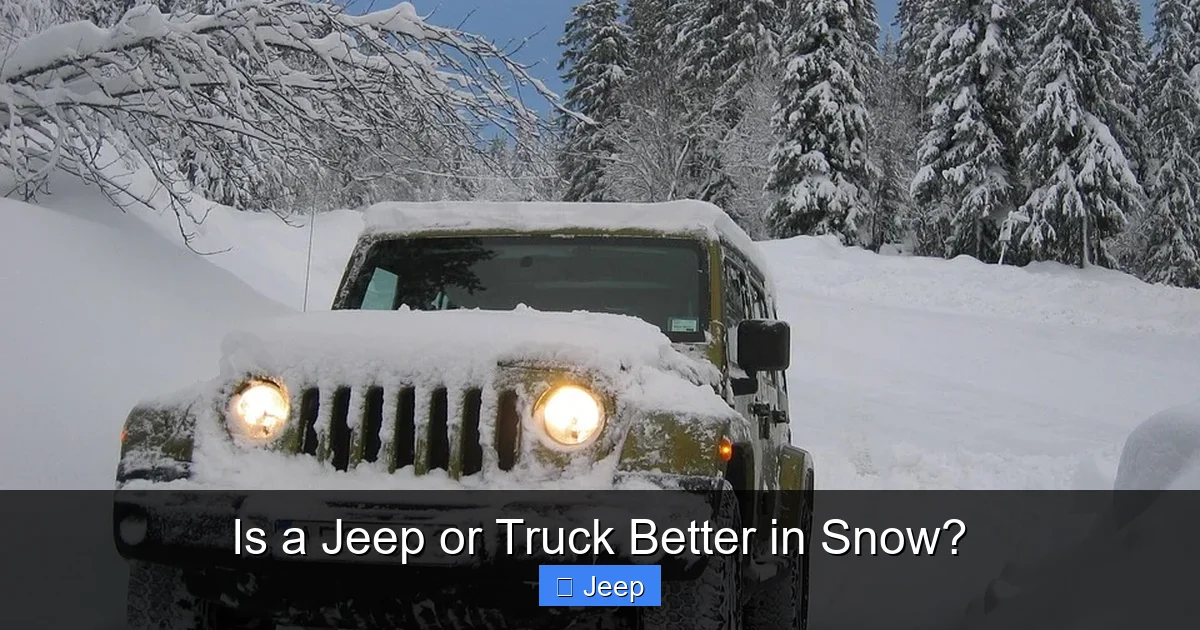
Visual guide about Is a Jeep or Truck Better in Snow?
Image source: cdn.pixabay.com
Traction & Acceleration: Who Gets Moving First?
On a snowy, unplowed road or a hill, the Jeep’s part-time 4×4 with low range gives it a decisive advantage for initial tractive effort. It can creep up steep, deep-snow-covered inclines that would have a truck’s open-differential AWD system spinning its tires. However, on packed snow and ice, a modern truck’s sophisticated AWD system with brake-based traction control (which mimics a limited-slip differential by braking the slipping wheel) can be remarkably effective and often more user-friendly for the average driver. The key differentiator here is tires. A Jeep on all-season tires will lose to a truck on quality winter tires every time. The correct tire is the single greatest traction upgrade you can make to either vehicle.
Braking & Cornering: Stopping and Turning Safely
Here, weight and stability shine. The truck’s heavier mass gives it a slight advantage in braking distance on ice and packed snow, all else being equal. Its longer wheelbase also makes it less prone to “fishtailing” or feeling unstable during emergency maneuvers on slippery surfaces. The Jeep, with its shorter wheelbase and higher center of gravity (especially when lifted), can feel more nimble but also more prone to body roll and a twitchier rear end if you lose traction. Both rely heavily on their ABS (Anti-lock Braking System) and ESC (Electronic Stability Control) systems, which are excellent on modern models. However, the truck’s inherent stability often makes these systems less intrusive, providing a more natural feel for drivers.
Comfort & Daily Drivability in Winter
This is a clear win for the modern pickup. While a new Jeep Wrangler is vastly more comfortable than its ancestors, it still suffers from higher road noise, a choppier ride due to its solid front axle, and wind buffeting with the doors and roof off (which you won’t do in winter anyway). Trucks, especially the half-ton models, have evolved into plush, car-like cabins with superb sound insulation, smooth independent front suspension (on most), and comfortable seats for long, cold drives. If your winter driving involves hours on the highway, the truck is simply a more pleasant and less fatiguing place to be.
Real-World Scenarios: Which Vehicle Fits Your Winter Life?
The “better” vehicle is the one that best matches your life. Let’s play out some common winter situations.
Scenario 1: The Daily Suburban Commute
Your drive is mostly plowed roads, highways, and suburban streets. You need reliability, safety, and comfort. Verdict: Truck (or a crossover SUV). A modern 4×4 truck with good winter tires will be stable, safe, and comfortable. Its AWD system is seamless, and you’ll appreciate the heated seats and quiet cabin. A Jeep will get you there, but you’ll feel every pothole and hear more wind noise. For this scenario, a front-wheel-drive car with winter tires is also a fantastic, more efficient choice.
Scenario 2: The Rural Homeowner with a Long Driveway
You live on a county road that may not get plowed promptly. Your driveway is long and often accumulates deep snow. You also need to move firewood or supplies. Verdict: Strong lean toward Jeep, but truck is viable. The Jeep’s clearance and low-range are perfect for pushing through deep drifts on an unplowed access road. Its ability to be outfitted with a snow plow (especially the Gladiator) is a huge plus. However, a 4×4 truck with a load of sand in the bed and a set of aggressive winter or all-terrain tires can also handle this scenario admirably, and its bed is more useful for hauling wood. The tiebreaker is the depth of the snow: if it’s regularly over a foot deep, the Jeep’s clearance wins.
Scenario 3: The Winter Recreationalist/Off-Roader
You go snowmobiling, cross-country skiing, or explore frozen lakes and backcountry trails. You need to reach remote trailheads often with unmaintained roads. Verdict: Jeep, no contest. This is the Jeep’s native habitat. Its approach angles, low-range gearing, and massive aftermarket support for winches, off-road bumpers, and specialized tires make it the undisputed champion of getting off the grid and back when the snow is deep and the trails are unbroken. A truck, even a 4×4, is simply too long, too low, and too precious to risk on true off-road snow adventures.
Scenario 4: The Workhorse Who Plows and Tows
You need to plow your own business parking lot or tow a trailer (like a snowmobile trailer or work equipment) through winter conditions. Verdict: Truck. The combination of a heavy-duty frame, a massive bed for carrying a plow and sand, and superior towing capacity (with proper winter tires and weight distribution) makes the truck the only logical tool here. While a Jeep Gladiator can tow, its capacity and stability with a heavy plow and load are not in the same league as a properly equipped half-ton or heavier truck.
The Final Verdict: How to Choose Your Winter Warrior
So, is a Jeep or truck better in snow? The technical, non-committal answer is: they are better at different things. The Jeep is the specialist, the scalpel for precise, off-road winter surgery. The truck is the generalist, the reliable, stable, and utilitarian tool for winter work and highway travel. Your choice should flow from your answers to these questions:
- What is the worst snow you’ll encounter? Deep, unplowed, backcountry snow favors the Jeep’s clearance and 4×4. Packed snow and ice on maintained roads favor the truck’s stability and modern AWD.
- What will you DO with it? Recreational off-roading? Jeep. Plowing, towing, hauling? Truck. Daily commuting with occasional snow? Either works with good tires, but the truck is more comfortable.
- What is your budget for tires and modifications? You must budget for a set of quality winter tires for either vehicle. This is the best investment you can make. After that, consider if you need the plow capability or extreme off-road gear that would push you toward a truck or Jeep respectively.
Ultimately, the most capable winter vehicle is the one with the right winter tires, a confident and skilled driver, and a clear understanding of its limits. Don’t buy a Jeep thinking it will magically make you a safe driver on ice. Don’t buy a truck thinking its weight makes you invincible. Both can and will slip if pushed beyond their limits. Test drive both in winter conditions if possible. Feel the truck’s solid, planted stability on a slippery road. Feel the Jeep’s visceral, connected control as you manually engage 4Low and crawl up a snowy hill. That feeling will tell you more than any spec sheet ever could.
And remember, the debate isn’t static. The lines are blurring. Modern trucks offer more off-road packages (like the Ford F-150 Tremor or Ram 1500 Rebel) that rival Jeeps in clearance and suspension travel. Meanwhile, Jeeps like the Grand Cherokee and even the new electric Wagoneer offer luxurious, powerful, and incredibly capable on-road winter performance with sophisticated AWD systems. The “Jeep vs. Truck” snow fight is no longer a battle of two distinct camps; it’s a spectrum of awesome winter options. Your job is to find where on that spectrum your needs lie.
Conclusion: It’s About the Right Tool for Your Winter
After all this analysis, we return to the core question: Is a Jeep or truck better in snow? The honest answer is that there is no single “best.” There is only the “best for you.” The Jeep Wrangler remains the undisputed king of conquering deep, unplowed, off-road winter terrain. Its combination of part-time 4×4, low-range gearing, and unmatched ground clearance is a formula perfected for the backcountry. The pickup truck, however, reigns supreme in the realm of winter utility, stability, and comfortable, capable performance on maintained roads and during work tasks. Its weight, length, and bed provide tangible advantages for towing, plowing, and highway confidence.
But let this be the final, most important takeaway: no vehicle, regardless of badge or drive system, is winter-proof without proper equipment. A set of dedicated winter tires is the single most effective safety and performance upgrade you can make. It will transform the braking, acceleration, and cornering of both a Jeep and a truck more than any other modification. Pair that with an understanding of your vehicle’s capabilities and a dose of common sense (slowing down, increasing following distance), and either of these American icons will serve you faithfully through the coldest months. The real winner in the snow is the prepared driver, sitting behind the wheel of the vehicle that best matches their life. Choose wisely, equip properly, and drive safely.
Frequently Asked Questions
Are Jeeps actually safer than trucks in snow?
Not inherently. Safety in snow depends more on driver skill, tires, and electronic stability systems than the vehicle type. Trucks often feel more stable at highway speeds due to their weight and length, while Jeeps can be more agile in low-traction maneuvers off-road. Both can be very safe with proper winter tires and cautious driving.
Do I really need to add weight to my truck bed for snow?
Yes, for rear-wheel-drive and many 4×4 trucks, adding 100-200 pounds of weight (like sandbags) over the rear axle significantly improves rear tire traction on ice and packed snow. It’s a simple, cheap, and highly effective trick. Just ensure the weight is secured and doesn’t obstruct your view or exceed payload limits.
Which is more fuel-efficient in winter conditions, a Jeep or a truck?
Generally, modern trucks with efficient turbocharged engines and advanced AWD systems will get better fuel economy than a Jeep Wrangler, which prioritizes off-road capability over aerodynamics and efficiency. However, both will see a drop in MPG in cold weather due to engine warm-up, thicker oil, and rolling resistance from winter tires.
Can a two-wheel-drive truck handle snow with good tires?
A two-wheel-drive truck with an excellent set of winter tires on the driven axle (usually the rear) can handle moderate snow and slush surprisingly well, thanks to the weight over the rear axle. However, it will be severely limited in deep snow, on hills, and when compared to a 4×4 or AWD model. For severe winter areas, 4×4 or AWD is strongly recommended.
What about black ice – which vehicle performs better?
On black ice, which offers almost zero traction, the vehicle’s weight and tire quality are the primary factors. A heavier truck with winter tires has a slight advantage in maintaining momentum and stability. However, both vehicles will be equally challenged by black ice, and no amount of weight or 4×4 helps with stopping or turning on pure ice. Winter tires and extreme caution are the only solutions.
Are modern AWD systems making the Jeep vs. truck debate obsolete?
They certainly narrow the gap for on-road winter performance. A modern crossover SUV with a good AWD system and winter tires (like a Honda CR-V or Subaru Outback) can outperform many older or basic 4×4 vehicles on plowed roads. However, for true off-road capability, deep snow, and maximum utility, the dedicated platforms of Jeeps and trucks still hold distinct, meaningful advantages that AWD crossovers cannot match.