
How to Open Jeep Trunk from Inside

Knowing how to open your Jeep trunk from the inside is a vital skill for every owner, whether for everyday cargo access or emergency situations. While most Jeeps feature a standard interior release button, the exact location and method can vary significantly between models like the Wrangler, Grand Cherokee, and Cherokee. This comprehensive guide details every technique, from the primary electronic release to manual overrides and seat-folding access, ensuring you’re never locked out of your cargo space.
Picture this: you’ve just loaded up your Jeep for a weekend adventure, or maybe you’re reaching into the back for a stored emergency kit. You pull the interior trunk release, and… nothing happens. Or worse, you’re inside the vehicle with the trunk lid accidentally locked, and you need to get to your gear or, in a rare emergency, exit through the cargo area. Knowing how to open a Jeep trunk from inside isn’t just a convenience; it’s a piece of practical knowledge that can save you from frustration and, in extreme cases, a dangerous situation. While the process is generally straightforward, Jeep’s long history and diverse model lineup mean there isn’t a single, universal answer. From the rugged, door-mounted buttons of a Wrangler to the sleek console switches in a Grand Cherokee, the method changes. This guide is your definitive, model-by-model roadmap to mastering your Jeep’s interior trunk access, covering standard operations, emergency backups, and the critical safety nuances every owner should understand.
We’ll start with the most common and easiest method, then dive into the specific quirks of different Jeep generations and models. You’ll learn about the all-important manual release cable that is your failsafe when electronics fail. We’ll also explore the alternative access route through the rear passenger compartment, a feature in many Jeep SUVs that turns the entire cabin into a gateway to your cargo. By the end, you’ll be able to confidently reach into your trunk from the driver’s seat, whether your battery is fully charged or completely dead, and you’ll understand the safety systems designed to prevent tragic accidents. Let’s pop the hood on this essential piece of Jeep knowledge.
Key Takeaways
- Primary Interior Button: Almost all modern Jeeps have a dedicated trunk release button, typically located on the driver’s door panel, center console, or floor near the seat.
- Model Variations Are Key: The exact location and type of release (electronic vs. mechanical) differs between Wrangler, Grand Cherokee, Cherokee, and older models; always consult your owner’s manual.
- Emergency Manual Release: Most Jeeps include a hidden manual trunk release cable or mechanism accessible from inside the cabin, designed for use during power failures.
- Folding Rear Seats: In many Jeep SUVs, the rear seats can be folded down to provide direct physical access to the trunk area, bypassing the locked lid entirely.
- Power Failure Protocols: If the vehicle battery is dead, the electronic trunk release will not function, making knowledge of the manual cable or seat-fold method essential.
- Safety First: Be aware of childproofing features and always ensure the trunk is not occupied by a person or pet before closing it, especially when using interior releases.
📑 Table of Contents
- The Standard Interior Trunk Release Button: Your First Go-To
- Model-Specific Nuances: Wrangler, Grand Cherokee, Cherokee & More
- The Critical Emergency Manual Trunk Release
- Access Through the Rear Seats: The Universal Backup Plan
- Safety, Childproofing, and Prevention
- Troubleshooting Table: Common Problems & Solutions
The Standard Interior Trunk Release Button: Your First Go-To
For the vast majority of Jeep owners, opening the trunk from inside is as simple as pressing a button. This electronic solenoid release is the primary method, designed for convenience. However, finding that button is the first step, and its location is not uniform across the Jeep family.
Common Button Locations Across Jeep Models
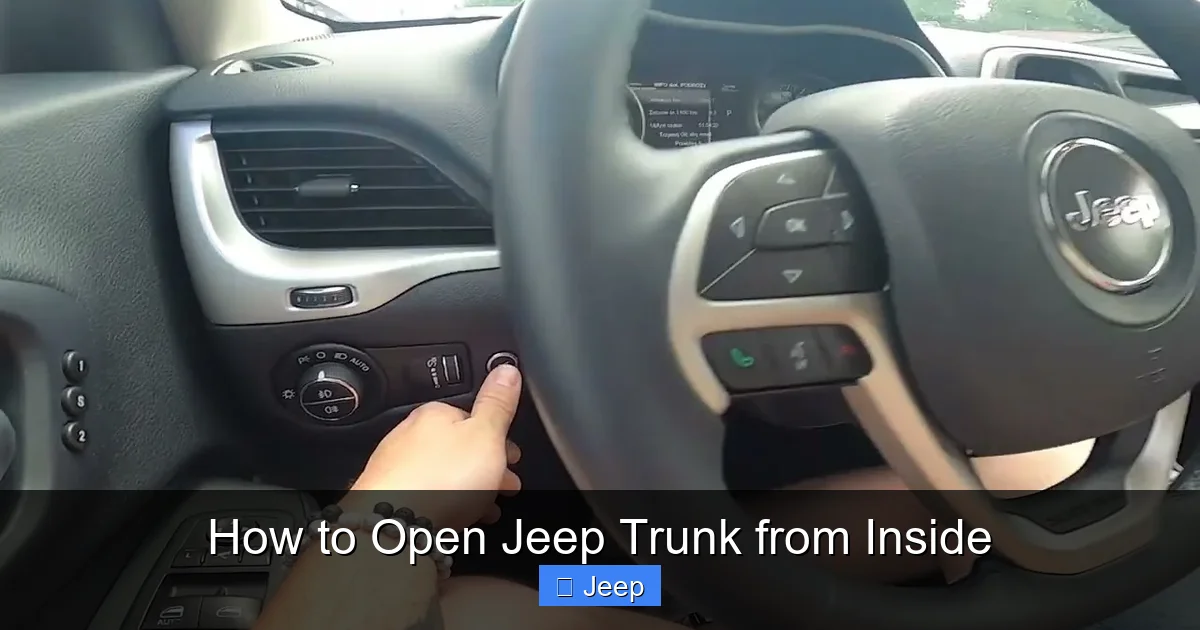
You’ll typically find the trunk release in one of three places. First, and most common in recent models like the Grand Cherokee (WK2, 2014+) and Cherokee (KL, 2014-2023), is on the driver’s door panel. It’s often a distinct icon resembling a car with an open lid, sometimes grouped with other window and lock controls. Second, look on the floor near the driver’s seat or on the lower portion of the center console. In many Wranglers (JL, 2018+) and earlier Grand Cherokees, a simple black or red pull-handle or button is mounted on the carpeted area to the left of the seat. Third, some models place it on the steering column shroud or within the infotainment screen’s menu settings. The key is to do a quick visual scan of these areas. If your Jeep has keyless entry, the same fob button that opens the trunk remotely will also activate the interior release when the vehicle is on and in Park.
Pro Tip: The interior release button is almost always operational only when the vehicle is in the “Park” (P) gear and the engine is running or the ignition is in the “On” (Run) position. This is a critical safety feature to prevent accidental opening while driving. If your Jeep is off and in Park, try turning the key to the “On” position or pressing the start button without pressing the brake to activate the electronics and try the button again.
When the Electronic Button Fails
If you’ve found the button, the vehicle is in Park, and the ignition is on, but the trunk doesn’t open, you have a problem. The issue could be a blown fuse, a faulty solenoid, a disconnected wire, or a dead battery that doesn’t have enough juice to trip the solenoid (a common issue in many vehicles, as discussed in guides for other brands like the Toyota Sienna trunk with a dead battery). Before panicking, check your owner’s manual for the fuse location (often in the interior fuse box under the dash or in the engine bay). Replace any blown fuses with one of the same amperage. If the fuse is fine, the solenoid or its wiring may be at fault, requiring professional diagnosis.
Model-Specific Nuances: Wrangler, Grand Cherokee, Cherokee & More
Jeep’s heritage means a wide range of solutions. Understanding your specific model and year is half the battle.
Visual guide about How to Open Jeep Trunk from Inside
Image source: i.ytimg.com
Jeep Wrangler (JL/JT and Earlier)
The iconic Wrangler, both the two-door (JL) and four-door (JT) unlimited, has a famously simple and robust system. The interior release is almost always a manual pull-cable, not an electronic button. You’ll find a red or black plastic handle attached to a cable, mounted on the driver’s side footwell, just above the parking brake or on the transmission tunnel. Pulling this handle physically releases the trunk latch. It requires no power and is incredibly reliable. For the soft-top Wrangler, remember that the trunk lid (the rear tailgate) is separate from the rear window, which often zippers or clips. This handle releases the entire tailgate assembly. In some very early models (like YJ/TJ), the release might be a lever you push forward.
Jeep Grand Cherokee (All Generations)
The Grand Cherokee has evolved from a simple mechanical handle to a sophisticated electronic system. In late 1990s to early 2000s models (WJ, 1999-2004), you’ll find a mechanical pull-handle on the driver’s side floor. Starting with the WK (2005-2010), an electronic button on the driver’s door became standard. The current WK2 (2014-2020) and WL (2021+) models keep the door panel button but also integrate the function into the key fob and sometimes the infotainment screen. A unique feature in many Grand Cherokees is the ” luggage compartment cover” or cargo shade. If your trunk won’t open, ensure this retractable cover is fully retracted; it can sometimes jam the latch mechanism if not seated properly.
Jeep Cherokee (KL, 2014-2023) and Compass/Patriot
The modern Cherokee (KL) follows the Grand Cherokee trend with an electronic button on the driver’s door. The older Compass and Patriot (MK/MP, 2007-2016) often have a simpler mechanical pull-handle on the floor, similar to the Wrangler. For these more car-like crossovers, the release mechanism is generally less complex but can still suffer from the same electrical faults as larger models.
Classic Jeeps: CJ, SJ, XJ
If you’re dealing with a classic Jeep like a CJ-5, CJ-7, Cherokee (XJ), or Wagoneer (SJ), you are almost certainly dealing with a purely mechanical system. There is no electronic button. Instead, there is an interior trunk release cable that runs from a lever or pull-handle (usually on the driver’s side near the seat) to the latch mechanism on the tailgate. These cables can stretch, fray, or break over time, which is a common failure point. Lubricating the latch and checking cable tension is part of routine maintenance for these vintage models.
The Critical Emergency Manual Trunk Release
This is the most important section of this guide. Every Jeep sold in the United States since the early 2000s is mandated by federal safety regulation (FMVSS 401) to have a glow-in-the-dark manual trunk release inside the cargo area. Its purpose is to allow someone trapped inside the trunk to escape. While its primary location is inside the trunk, many Jeeps have a secondary, hidden manual release cable that can be accessed from the passenger compartment in case of a total power failure. This is your ultimate backup.
Visual guide about How to Open Jeep Trunk from Inside
Image source: jeepfixes.com
Finding the Hidden Cable: A Scavenger Hunt
This is not an officially advertised feature in owner’s manuals, but it exists in most models. You need to look for a small, often red or yellow, plastic handle or knob on a short cable. Common locations include:
- Behind a trim panel: Check the rear side panels of the cargo area, near the tailgate hinges. A small plastic cover may pry off to reveal a cable pull.
- Under the rear cargo floor mat: Lift the carpeted floor panel. In some Grand Cherokees and Wranglers, the cable housing is visible underneath.
- In the rear footwells: Look high up on the rear wheel arches or the rear of the front seats, behind plastic covers.
- Near the third-row seat release (if equipped): In models with optional third-row seating (like the Grand Cherokee), the manual trunk cable is sometimes located near the seat folding mechanisms.
Consulting a model-specific forum (like Jeep Garage or Wrangler Forum) is the best way to find the exact location for your specific year and trim. Search for “[Your Jeep Model Year] manual trunk release cable location.” Users often post pictures and exact locations.
How to Use It
Once found, this cable provides a direct mechanical link to the trunk latch. Pulling it firmly should release the mechanism with a audible “clunk.” It requires significant force, as you are manually overcoming the latch spring. If the cable is broken or disconnected (a common issue in older, high-mileage vehicles), this method will fail, and you may need to resort to the rear seat fold-down method or professional help.
Access Through the Rear Seats: The Universal Backup Plan
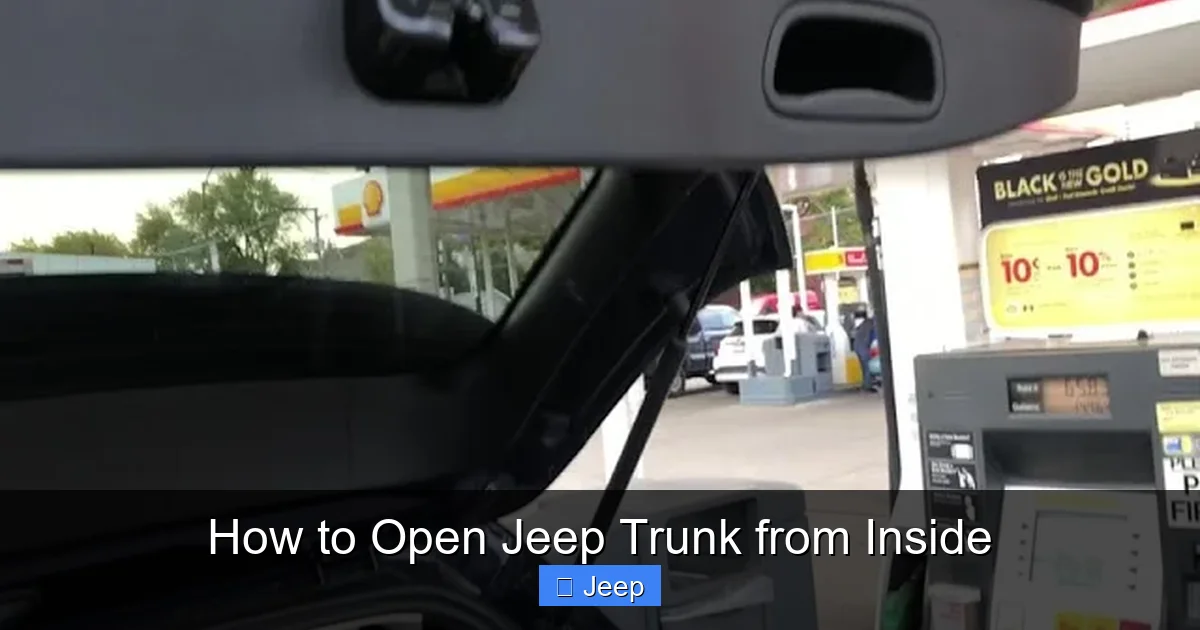
In most Jeep SUVs (Wrangler 4-door, Grand Cherokee, Cherokee, Compass), the rear seats are designed to fold down. This feature isn’t just for cargo space; it’s your guaranteed way into the trunk if all else fails. By folding the rear seatbacks forward, you create a large, open pass-through from the passenger compartment directly into the cargo area. You can then reach through and manually lift the trunk lid from the inside. On some models, you may even be able to crawl through if necessary.
Visual guide about How to Open Jeep Trunk from Inside
Image source: adventurejeep.com
How to Fold the Seats
The process varies. Look for a release lever or button on the top or side of the rear seat cushion. In many Jeeps, you pull a strap or push a button on the upper corner of the seatback, then fold the headrest down and pivot the entire seatback forward. In Wrangler Unlimited (JL/JT) and Grand Cherokees, the rear seats often have a 60/40 split. You can fold one or both sides down. Always clear the seat of any objects before folding. In models with a cargo cover or shade, you will likely need to remove it first to allow the seat to fold fully flat and provide clearance.
Important Note: This method works on *most* Jeep SUVs. However, the two-door Wrangler (JL) has a fixed rear seat that does not fold. For a two-door owner, your only interior options are the primary button or the manual cable. This is a crucial distinction. For models like the Compass and older Patriots, the seat folding mechanism is usually simple and reliable.
Safety, Childproofing, and Prevention
Understanding how to open the trunk is only half the equation. Knowing how to prevent accidental locking and ensuring the safety of children and pets is equally important.
The Trunk is Not for People or Pets
It cannot be stressed enough: never allow a person or animal to ride in the trunk. It is not a ventilated, safe passenger space. The interior release is for cargo access only. Always double-check the trunk is empty before closing it, especially when children are present. The manual emergency release is for escaping a *locked* trunk, not for routine entry.
Child Safety Locks and Trunk Locks
Many Jeeps have a child safety lock for the rear doors, but what about the trunk? Some models feature a trunk lock cylinder that can be disabled with the master key, preventing the trunk from being opened with the key fob or exterior button. This does not affect the interior release. Check your owner’s manual to see if your model has this feature and how to engage/disengage it. There is no standard “childproof” lock for the *interior* trunk release button itself, as its location (usually on the driver’s door) makes it inaccessible to rear passengers. However, in rare cases where a button is on the center console, be mindful of small children.
Preventative Maintenance
To avoid being stranded, periodically test your interior release. Once a month, with the vehicle in Park and On, press the button. Listen for the solenoid “clunk” and try to lift the lid. For manual cables, pull the handle and feel for resistance and release. Lubricate the exterior trunk latch annually with a silicone-based lubricant to keep it moving freely. For the interior mechanical cables (especially in older models), a little lubricant sprayed into the cable housing where it enters the latch can prevent sticking. If you notice the button feels mushy, requires excessive force, or does nothing, investigate the fuse and solenoid immediately.
Troubleshooting Table: Common Problems & Solutions
When your Jeep’s trunk won’t open from inside, methodically work through this checklist before calling for help.
- Symptom: Button does nothing, no sound.
- Solution: Check if vehicle is in Park and ignition is On. Check relevant fuse (see manual). If fuse is good, solenoid or wiring may be faulty.
- Symptom: Button clicks, but trunk doesn’t open.
- Solution: Latch mechanism may be jammed or misaligned. Try manually releasing by pulling the interior cable (if equipped). Lubricate latch. The solenoid may be weak and not have enough power to fully release the latch.
- Symptom: Manual cable pull does nothing or feels loose.
- Solution: The cable is likely broken or disconnected at the latch. This requires accessing the latch mechanism (usually from the outside) to repair or replace the cable. In the meantime, use the seat-fold method.
- Symptom: Everything works, but trunk won’t stay open.
- Solution: The trunk lid support struts (gas shocks) are worn out and need replacement. This is a common wear item and is not related to the release mechanism.
- Symptom: Trunk opens slightly but then re-locks.
- Solution: The latch is likely not fully disengaging. The solenoid may be weak, or the latch itself is dirty/corroded. Thoroughly clean and lubricate the latch mechanism.
For complex electrical issues or broken mechanical parts, consulting a professional mechanic or a Jeep specialist is the safest and most efficient path. They have the diagnostic tools to test solenoid resistance and wiring continuity.
Frequently Asked Questions
What should I do if my Jeep’s interior trunk release button isn’t working?
First, ensure your vehicle is in Park and the ignition is in the “On” position. Check the fuse for the trunk release circuit, located in the interior fuse box (refer to your owner’s manual). If the fuse is intact, the solenoid or its wiring may be faulty, requiring professional diagnosis. As an immediate backup, locate and use the manual trunk release cable or fold down the rear seats to access the trunk manually.
Where is the manual trunk release cable located in a Jeep?
The location varies by model and year but is commonly found behind a small trim panel on the side of the cargo area, under the rear cargo floor mat, or in the rear footwells near the wheel arches. It’s often a red or yellow handle. Since it’s not always obvious, searching online forums for your specific Jeep model and year (e.g., “2020 Jeep Wrangler JL manual trunk cable location”) is the most reliable way to find it.
Can I open the Jeep trunk from inside if the battery is completely dead?
No, the electronic trunk release button will not function with a dead battery. Your only options are to use the manual trunk release cable (if your Jeep has one and it’s in working order) or to fold down the rear seats to physically reach into the trunk and manually lift the lid from the inside. The manual cable is your primary failsafe in a total power loss scenario.
Is it safe for a person to crawl through the folded rear seats into the trunk?
While physically possible in many Jeep SUVs, it is not a safe or recommended practice. The trunk is not designed as a passenger compartment; it lacks proper ventilation, seatbelts, and crash protection. This should only be considered in a true emergency where no other exit is possible. Under no circumstances should children or pets be allowed to play in or travel in the trunk area.
How can I prevent my Jeep’s trunk latch from sticking or jpering?
Perform annual maintenance on the exterior trunk latch. Clean it thoroughly with a degreaser to remove dirt and road grime, then apply a silicone-based lubricant (like a spray lithium grease) to all moving parts and the latch mechanism. Avoid petroleum-based products as they attract dust. Also, ensure the trunk lid is aligned properly; misalignment can cause excessive strain on the latch.
My two-door Jeep Wrangler doesn’t have folding rear seats. What’s my backup if the release fails?
For a two-door Wrangler (JL or earlier), your only interior access methods are the primary manual pull-cable on the driver’s side floor and the federally mandated emergency release *inside* the trunk itself (which requires you to be in the trunk to use). There is no pass-through via the rear seat. Therefore, it is absolutely critical to locate, inspect, and periodically test your interior manual cable to ensure it is functional and not frayed.
