
Is 12.4 Volts Good for a Car Battery

A car battery reading of 12.4 volts indicates it’s about 50–60% charged—better than dead but not fully charged. While it may start your car in ideal conditions, it’s not optimal for long-term health or cold weather performance. Regular charging and maintenance are key to keeping your battery in top shape.
Key Takeaways
- 12.4 volts means partial charge: A reading of 12.4 volts typically means your car battery is about 50–60% charged, which is better than a dead battery but not fully charged.
- It may start your car—but not reliably: In warm weather or with a strong starter motor, 12.4 volts might be enough to crank the engine, but it’s not reliable in cold temperatures or for older vehicles.
- Fully charged is 12.6–12.7 volts: A healthy, fully charged 12-volt car battery should read between 12.6 and 12.7 volts when the engine is off and the car has been sitting for a few hours.
- Low voltage strains the charging system: Running a battery at 12.4 volts forces the alternator to work harder, which can lead to premature wear on both the battery and alternator.
- Recharge promptly to avoid sulfation: Leaving a battery at 12.4 volts for extended periods increases the risk of sulfation, a buildup that reduces battery capacity and lifespan.
- Test regularly and maintain properly: Use a multimeter or battery tester monthly, keep terminals clean, and recharge if voltage drops below 12.4 volts to extend battery life.
- Consider replacement if voltage doesn’t recover: If your battery won’t hold a charge above 12.4 volts after recharging, it may be time for a replacement, especially if it’s over 3–5 years old.
📑 Table of Contents
Is 12.4 Volts Good for a Car Battery? Understanding the Numbers
You’re sitting in your driveway, about to head out for work or a weekend trip, when you notice your car takes a little longer than usual to start. You pop the hood, grab your multimeter, and test the battery. The display reads 12.4 volts. You pause—what does that really mean? Is 12.4 volts good for a car battery? Or should you be worried?
Let’s be honest: most of us don’t think about our car battery until something goes wrong. But understanding basic battery voltage can save you from being stranded, help you avoid costly repairs, and extend the life of one of your vehicle’s most important components. A reading of 12.4 volts is a common point of confusion. It’s not zero—so the battery isn’t completely dead—but it’s also not the 12.6 or 12.7 volts you might expect from a healthy battery. So where does that leave you?
In this guide, we’ll break down what 12.4 volts means, how it affects your car’s performance, and what you should do if your battery consistently reads at this level. Whether you’re a weekend mechanic or just someone who wants to avoid a dead battery on a cold morning, this article will give you the knowledge you need to keep your car running smoothly.
What Does 12.4 Volts Mean for Your Car Battery?
Visual guide about Is 12.4 Volts Good for a Car Battery
Image source: i.redd.it
When you measure your car battery with a multimeter and see 12.4 volts, it’s important to understand what that number represents. Car batteries are designed to operate at around 12 volts, but that’s a simplified way of looking at it. In reality, the voltage tells you how much electrical charge the battery is holding.
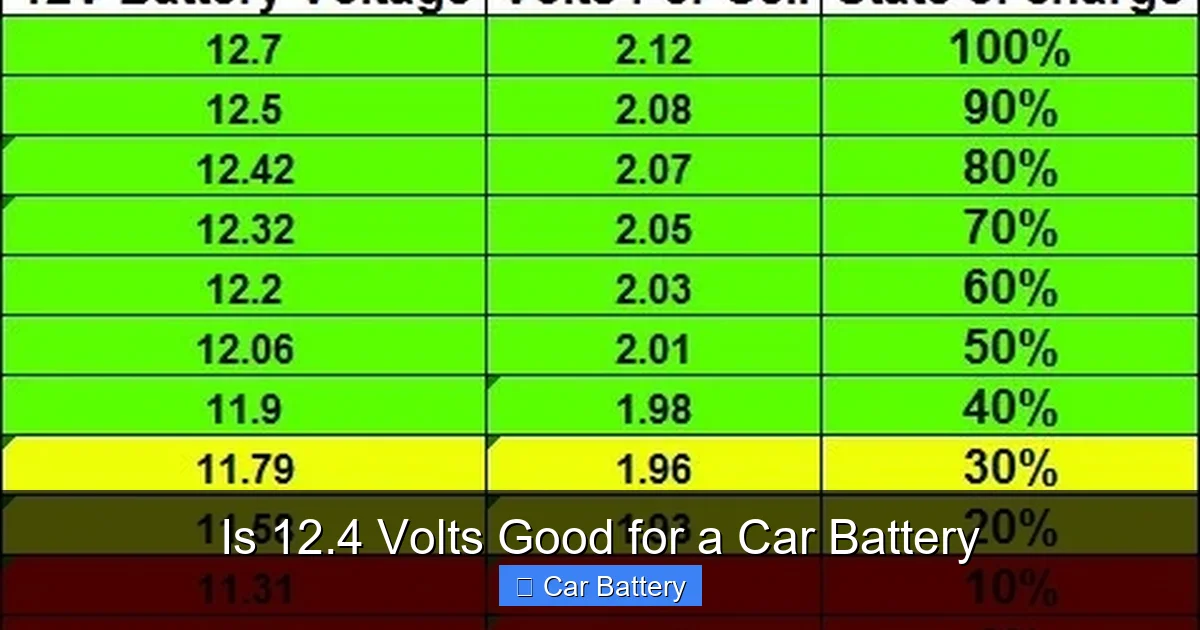
A fully charged, healthy 12-volt car battery should read between 12.6 and 12.7 volts when the engine is off and the car has been sitting for at least a few hours—this is called the “resting voltage.” At 12.4 volts, your battery is only about 50–60% charged. That might sound okay, but it’s actually on the lower side of acceptable.
Think of it like a phone battery. If your phone is at 60%, it might still turn on and let you make a call, but you wouldn’t want to rely on it for a long day out. The same logic applies to your car battery. At 12.4 volts, your battery has enough power to potentially start the engine, especially in warm weather or if your car has a strong starter motor. But it’s not operating at peak efficiency, and it’s more vulnerable to failure under stress—like cold mornings, long drives, or using multiple electrical accessories.
How Voltage Relates to State of Charge
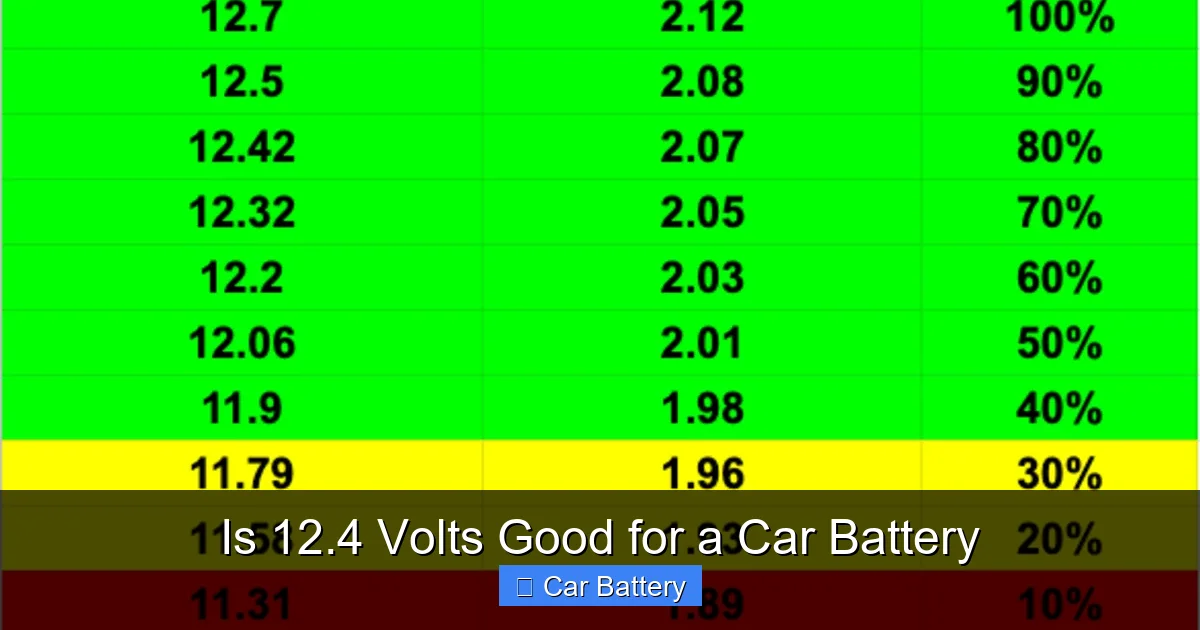
The voltage of a car battery directly correlates to its state of charge (SoC). Here’s a quick reference guide:
– 12.6–12.7 volts = 100% charged (fully charged)
– 12.4 volts = ~50–60% charged
– 12.2 volts = ~25% charged
– 12.0 volts or below = deeply discharged (risky to start)
So, 12.4 volts places your battery in the “partially charged” zone. It’s not critically low, but it’s not ideal either. Over time, keeping a battery at this level can lead to problems like sulfation—where lead sulfate crystals build up on the battery plates and reduce its ability to hold a charge.
Why 12.4 Volts Isn’t “Good” Long-Term
While 12.4 volts might get your car started today, it’s not a healthy long-term condition for your battery. Batteries are designed to be kept near full charge. When they sit at partial charge, especially for days or weeks, chemical reactions inside the battery slow down and become less efficient. This reduces the battery’s overall capacity and lifespan.
Additionally, a battery at 12.4 volts will require more work from your alternator to recharge. The alternator has to supply more current to bring the battery back up to full charge, which can strain both components. In extreme cases, this can lead to alternator failure or a battery that won’t hold a charge at all.
Can a Car Start with 12.4 Volts?
Visual guide about Is 12.4 Volts Good for a Car Battery
Image source: images.saymedia-content.com
This is the million-dollar question: will your car actually start if the battery reads 12.4 volts? The short answer is: maybe.
In ideal conditions—warm weather, a well-maintained engine, and a relatively new battery—12.4 volts might be enough to crank the engine and get your car running. Modern vehicles with efficient starters and fuel injection systems are often more forgiving of lower battery voltages. You might not even notice a difference in starting performance.
But here’s the catch: “maybe” isn’t reliable. Cold weather is the biggest enemy of a partially charged battery. When temperatures drop, the chemical reactions inside the battery slow down, reducing its ability to deliver power. A battery that starts your car at 70°F might struggle or fail completely at 30°F—even if it reads 12.4 volts.
Real-World Example: Morning Cold Start
Imagine it’s a chilly winter morning, and you haven’t driven your car in two days. You turn the key, and the engine cranks slowly—then stalls. You test the battery and see 12.4 volts. What happened?
Even though the voltage seems “okay,” the cold has reduced the battery’s effective power output. The starter motor needs a surge of current to turn the engine over, and a partially charged battery simply can’t deliver that surge reliably in the cold. This is why many people find their cars won’t start on winter mornings, even if the battery tested fine the day before.
Older Cars vs. Newer Cars
Older vehicles with carbureted engines or less efficient electrical systems are even more sensitive to low battery voltage. They often require more cranking power to start, especially when cold. A modern car with electronic fuel injection and a high-torque starter might get by on 12.4 volts, but an older model might not.
If you drive an older car or live in a cold climate, 12.4 volts should be a red flag—not a passing concern.
How to Test Your Car Battery Voltage
Visual guide about Is 12.4 Volts Good for a Car Battery
Image source: cdn.shopify.com
Knowing whether your battery is truly at 12.4 volts—or any voltage—requires accurate testing. Guessing based on how the car starts isn’t reliable. The best way to check is with a digital multimeter, a simple tool that’s affordable and easy to use.
Step-by-Step: Testing Battery Voltage
1. **Turn off the engine and all electrical accessories.** This includes lights, radio, heater, and anything else that draws power. Wait at least 30 minutes to allow the battery to settle into its resting state.
2. **Locate the battery.** It’s usually under the hood, but some vehicles have it in the trunk or under a seat.
3. **Set your multimeter to DC voltage (usually marked as “V~” or “V with a straight line”).** Choose a range that includes 12–15 volts.
4. **Touch the red probe to the positive terminal (+) and the black probe to the negative terminal (-).** Make sure the probes make solid contact.
5. **Read the display.** A healthy, fully charged battery should show 12.6–12.7 volts. 12.4 volts means it’s partially charged.
When to Test
Test your battery:
– First thing in the morning (after the car has sat overnight)
– After a long drive (to check if the alternator is charging properly)
– If the car has been sitting for several days
– Before a long trip, especially in winter
Avoid testing immediately after turning off the engine, as surface charge can give a falsely high reading.
Other Testing Methods
While a multimeter is the most accurate tool for checking voltage, you can also use:
– **Battery load testers:** These apply a load to the battery and measure how it performs under stress. They’re more accurate for diagnosing weak batteries.
– **Battery health scanners:** Many auto parts stores offer free battery testing using advanced diagnostic tools that check voltage, cranking power, and overall health.
– **Built-in vehicle diagnostics:** Some modern cars have battery monitoring systems that display voltage or battery health on the dashboard.
What to Do If Your Battery Reads 12.4 Volts
So you’ve tested your battery and it’s reading 12.4 volts. Now what? The good news is that this isn’t an emergency—yet. But it’s a warning sign that your battery needs attention.
Step 1: Recharge the Battery
The first and most important step is to recharge the battery. You can do this by:
– **Driving the car for at least 30 minutes.** The alternator will recharge the battery while the engine runs. Avoid short trips, which don’t give the alternator enough time to fully recharge a depleted battery.
– **Using a battery charger.** A smart charger is ideal because it automatically adjusts the charge rate and stops when the battery is full. This prevents overcharging and extends battery life.
After recharging, test the voltage again. It should rise to 12.6–12.7 volts within a few hours of charging.
Step 2: Check for Parasitic Drain
If your battery keeps dropping to 12.4 volts even after recharging, there might be a parasitic drain—a small electrical load that’s draining the battery when the car is off. Common culprits include:
– Faulty interior lights or trunk lights that stay on
– Aftermarket electronics (alarms, dash cams, GPS units)
– Malfunctioning relays or control modules
To test for parasitic drain, you’ll need a multimeter set to measure current (amps). Disconnect the negative battery cable and place the multimeter in series between the cable and the terminal. A normal drain is usually less than 50 milliamps (0.05 amps). Anything higher may indicate a problem.
Step 3: Inspect the Battery and Terminals
Physical issues can also cause low voltage. Check for:
– **Corrosion on terminals:** White or green crust around the terminals reduces conductivity. Clean with a wire brush and a mixture of baking soda and water.
– **Loose or damaged cables:** Tighten connections and replace frayed or broken cables.
– **Swollen or leaking battery case:** This indicates internal damage or overcharging. Replace the battery immediately.
Step 4: Test the Alternator
If the battery won’t hold a charge above 12.4 volts even after driving or using a charger, the alternator might not be working properly. To test:
– Start the engine and measure voltage at the battery terminals.
– A healthy alternator should produce 13.8–14.4 volts while the engine is running.
– If the voltage is below 13.5 volts, the alternator may be failing.
Step 5: Consider Battery Age and Replacement
Car batteries typically last 3–5 years. If your battery is older than that and consistently reads 12.4 volts or won’t hold a charge, it’s probably time for a replacement. Even if it starts the car now, it’s living on borrowed time.
Look for signs of aging:
– Slow cranking
– Dim headlights
– Frequent need for jump-starts
– Battery warning light on the dashboard
Preventing Low Battery Voltage
The best way to avoid dealing with 12.4 volts is to prevent it from happening in the first place. A little maintenance goes a long way.
Regular Charging Habits
– **Avoid short trips.** If you only drive a few minutes at a time, the alternator doesn’t have enough time to recharge the battery. Combine errands or take longer drives occasionally.
– **Use a battery maintainer.** If you don’t drive often (e.g., for classic cars or seasonal vehicles), use a trickle charger or smart maintainer to keep the battery at full charge.
– **Turn off accessories when the engine is off.** Leaving lights, the radio, or phone chargers on can drain the battery quickly.
Seasonal Care
– **Winter prep:** Cold weather reduces battery performance. Before winter, test your battery and replace it if it’s weak. Consider a battery warmer in extremely cold climates.
– **Summer care:** Heat accelerates battery degradation. Park in the shade or use a car cover to reduce under-hood temperatures.
Routine Maintenance
– **Clean terminals every 6 months.** Corrosion builds up over time and reduces efficiency.
– **Check battery hold-downs.** A loose battery can vibrate and damage internal components.
– **Inspect the charging system annually.** Have a mechanic test the alternator and voltage regulator during routine service.
When to Replace Your Battery
Even with perfect care, car batteries don’t last forever. If your battery consistently reads 12.4 volts or lower—even after recharging—it’s likely nearing the end of its life.
Signs it’s time to replace:
– Battery is over 4 years old
– Voltage won’t rise above 12.4 volts after charging
– Slow or labored engine cranking
– Frequent jump-starts needed
– Battery warning light is on
Don’t wait for a complete failure. Replacing a battery proactively is cheaper and safer than being stranded on the side of the road.
Conclusion
So, is 12.4 volts good for a car battery? The answer is: it’s not bad in the short term, but it’s not good for long-term health or reliability. A reading of 12.4 volts means your battery is only about half charged, which increases the risk of starting problems, especially in cold weather. It also puts extra strain on your alternator and can lead to sulfation, reducing the battery’s lifespan.
The good news? You can take action. Recharge the battery, check for drains, maintain the terminals, and test the charging system. If the battery won’t hold a charge or is more than a few years old, consider replacing it before it leaves you stranded.
By understanding what 12.4 volts really means and taking proactive steps, you can keep your car starting reliably and extend the life of your battery. After all, a little knowledge and maintenance today can save you a lot of stress—and money—tomorrow.
Frequently Asked Questions
Is 12.4 volts enough to start a car?
A battery reading 12.4 volts may start your car in warm weather or with a strong starter, but it’s not reliable, especially in cold temperatures. It’s better to recharge the battery to ensure consistent performance.
How long does it take to recharge a 12.4-volt battery?
It typically takes 30–60 minutes of driving to recharge a 12.4-volt battery, depending on the alternator output and electrical load. Using a smart charger can fully recharge it in 2–6 hours.
Can a 12.4-volt battery damage my car?
A 12.4-volt battery won’t directly damage your car, but it forces the alternator to work harder, which can lead to premature wear. It also increases the risk of being stranded if the battery fails to start the engine.
Why does my battery keep dropping to 12.4 volts?
Common causes include short trips that don’t allow full recharging, parasitic electrical drains, a failing alternator, or an aging battery that can’t hold a charge.
Should I replace my battery if it reads 12.4 volts?
Not necessarily. First, recharge it and test again. If it won’t hold a charge above 12.4 volts or is over 4 years old, replacement is likely needed.
Can I drive with a 12.4-volt battery?
You can drive short distances, but it’s not recommended for long trips or in cold weather. The battery may fail unexpectedly, and the alternator will be under extra stress.
