
How Many Amps Is a Car Battery

Understanding how many amps a car battery provides is essential for maintaining your vehicle’s electrical system and ensuring reliable starts. Most car batteries deliver between 400 and 1,000 cold cranking amps (CCA), depending on size, type, and climate. Knowing this helps you choose the right battery and troubleshoot starting issues effectively.
Key Takeaways
- Car batteries typically provide 400–1,000 cold cranking amps (CCA): This measures how much current the battery can deliver at 0°F for 30 seconds while maintaining voltage above 7.2V.
- Amps vary by battery type and vehicle size: Larger engines, diesel trucks, and luxury vehicles often require higher amp ratings than compact cars.
- Cranking amps (CA) differ from cold cranking amps (CCA): CA is measured at 32°F and usually 20–30% higher than CCA, but less relevant in cold climates.
- Battery age and health reduce amp output: A weak or old battery may struggle to deliver rated amps, leading to slow cranking or no-start conditions.
- Parasitic drain can deplete amps over time: Electrical components drawing power when the car is off can slowly drain the battery, reducing available amps.
- Testing amps helps diagnose battery problems: Use a multimeter or load tester to check actual amp output and determine if replacement is needed.
- Proper maintenance preserves amp capacity: Keeping terminals clean, securing the battery, and avoiding deep discharges extend battery life and performance.
📑 Table of Contents
- Understanding Car Battery Amps: The Basics
- What Are Cold Cranking Amps (CCA)?
- Cranking Amps (CA) vs. Cold Cranking Amps (CCA): What’s the Difference?
- How Many Amps Does a Typical Car Battery Provide?
- Factors That Affect a Car Battery’s Amp Output
- How to Test Your Car Battery’s Amp Output
- Choosing the Right Battery: Matching Amps to Your Vehicle
- Maintaining Your Battery for Optimal Amp Performance
- Conclusion
Understanding Car Battery Amps: The Basics
When you turn the key in your ignition, your car’s engine roars to life—thanks to a burst of electrical power from the battery. But have you ever wondered exactly how much power that battery is delivering? The answer lies in amperage, or “amps,” a measure of electrical current. Knowing how many amps a car battery can produce isn’t just technical trivia—it’s essential knowledge for keeping your vehicle running smoothly, especially in cold weather or when diagnosing electrical issues.
Car batteries are designed to deliver a high surge of amps for a short period, primarily to crank the engine. Unlike household batteries that provide steady, low-power output, car batteries are built for short bursts of intense energy. This is why they’re rated in terms like “cold cranking amps” (CCA) and “cranking amps” (CA)—metrics that reflect real-world performance under specific conditions. Understanding these ratings helps you choose the right battery, maintain it properly, and avoid being stranded with a dead car.
But amps aren’t just about starting power. They also play a role in powering your car’s electronics—from headlights and infotainment systems to fuel pumps and sensors. While the alternator handles most electrical needs once the engine is running, the battery must supply enough amps to support these systems during startup and when the engine is off. So, whether you’re driving a compact sedan or a heavy-duty pickup, knowing your battery’s amp capacity ensures you’re prepared for reliable performance.
What Are Cold Cranking Amps (CCA)?
Visual guide about How Many Amps Is a Car Battery
Image source: batterychecks.com
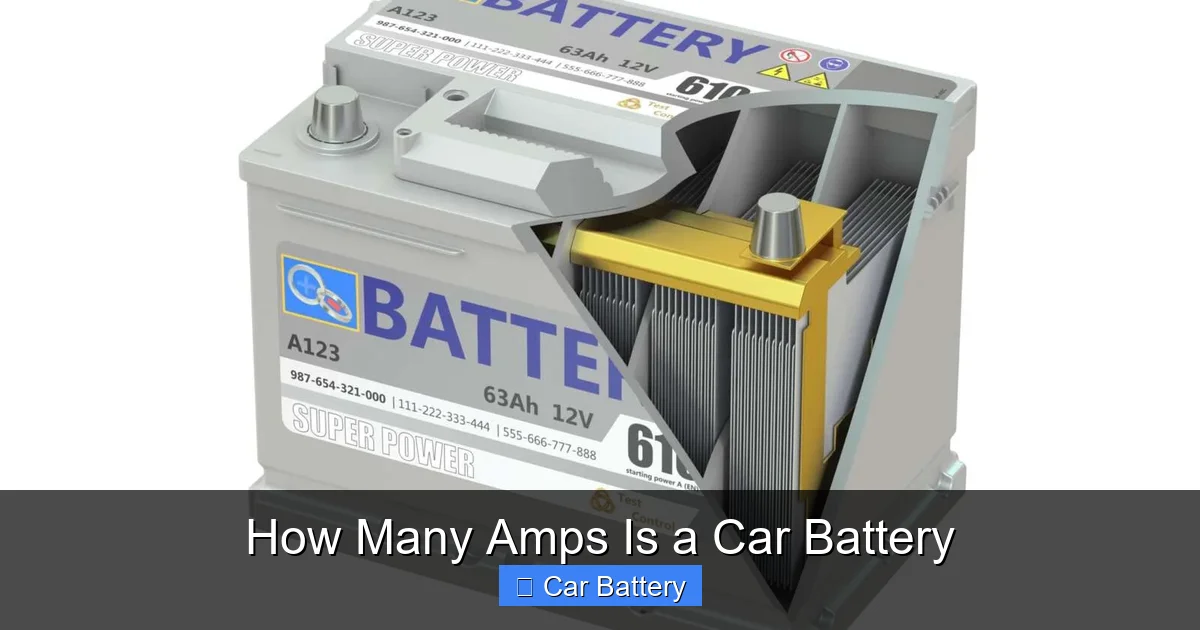
One of the most important specifications when evaluating a car battery is its cold cranking amps, or CCA. This number tells you how much current—measured in amps—the battery can deliver at 0°F (-18°C) for 30 seconds while maintaining a voltage of at least 7.2 volts. In simpler terms, CCA measures how well your battery can start your engine in freezing temperatures.
For example, a typical passenger car might have a battery rated at 600 CCA. That means it can supply 600 amps of current under those cold conditions. In contrast, a large SUV or diesel truck might require 800 to 1,000 CCA due to bigger engines with higher compression ratios. Diesel engines, in particular, need more amps to turn over because of their design, which makes cold starts even more demanding.
Why does CCA matter so much? Because cold weather thickens engine oil and increases resistance in the starter motor, making it harder to crank the engine. If your battery doesn’t have enough CCA for your climate, you might experience slow cranking, clicking sounds, or a complete failure to start. This is especially common in northern regions during winter months.
It’s also worth noting that CCA is not the same as the battery’s total capacity, which is measured in amp-hours (Ah). A 600 CCA battery might have a capacity of 50–70 Ah, meaning it can theoretically deliver 1 amp for 50–70 hours. But in practice, batteries are rarely used this way—they’re designed for short, high-current bursts, not long-term low-power output.
Cranking Amps (CA) vs. Cold Cranking Amps (CCA): What’s the Difference?
While CCA is the gold standard for cold-weather performance, you’ll also see “cranking amps” (CA) listed on many batteries. CA measures how many amps a battery can deliver at 32°F (0°C) for 30 seconds while maintaining at least 7.2 volts. Because it’s tested at a warmer temperature, CA is typically 20–30% higher than CCA.
For instance, a battery rated at 600 CCA might have a CA rating of around 750. This doesn’t mean the battery is more powerful—it just reflects better performance in milder conditions. In warmer climates, CA can be a useful metric, but it’s less relevant if you live where temperatures regularly drop below freezing.
Another related term is marine cranking amps (MCA), which is essentially the same as CA but used for boat batteries. The testing standards are nearly identical, so MCA and CA values are often interchangeable.
So why do manufacturers list both? It gives consumers a fuller picture of performance across different environments. However, for most drivers—especially those in cold regions—CCA remains the most critical number. It’s the one that truly reflects how well your battery will perform when you need it most: on a frigid winter morning.
How Many Amps Does a Typical Car Battery Provide?

Visual guide about How Many Amps Is a Car Battery
Image source: autotoride.com
Now that we’ve covered the key metrics, let’s answer the central question: how many amps is a car battery? The short answer is that most standard car batteries deliver between 400 and 1,000 amps, depending on the vehicle and battery type.
For a typical compact or midsize car with a 4-cylinder engine, a battery with 400–600 CCA is usually sufficient. These vehicles have smaller engines that require less power to start. For example, a Honda Civic might come with a 500 CCA battery, while a Toyota Camry could have a 650 CCA unit.
Larger vehicles need more power. Full-size sedans, SUVs, and trucks often require batteries in the 700–900 CCA range. A Ford F-150, for instance, might use an 800 CCA battery, while a heavy-duty diesel truck like a Ram 2500 could need 1,000 CCA or more. Luxury vehicles with advanced electronics and larger engines also tend to demand higher amp ratings.
It’s important to note that these numbers represent peak output under ideal conditions. In reality, a battery’s actual amp delivery can be lower due to age, temperature, and state of charge. A brand-new battery might deliver its full CCA rating, but after a few years, that number can drop by 20–30%. This is why regular testing and maintenance are crucial.
Factors That Affect a Car Battery’s Amp Output
Several factors influence how many amps a car battery can actually deliver. Understanding these can help you maintain optimal performance and avoid unexpected failures.
Battery Age and Health
As batteries age, their internal components degrade. Sulfation—the buildup of lead sulfate crystals on the plates—reduces the battery’s ability to hold and deliver charge. A 5-year-old battery might only deliver 70% of its original CCA, even if it still shows a full charge on a voltmeter.
Temperature
Cold weather is the biggest enemy of battery performance. At 0°F, a battery can lose up to 60% of its cranking power. That’s why a 600 CCA battery might only deliver 240 amps in extreme cold. Conversely, hot weather can accelerate chemical reactions inside the battery, shortening its lifespan.
State of Charge
A fully charged battery delivers more amps than a partially discharged one. If your battery is only at 50% charge, it may not have enough reserve power to start the engine, especially in cold weather. Regular driving helps keep the battery charged, but short trips or leaving electronics on can drain it over time.
Parasitic Drain
Modern cars have dozens of electronic systems that draw small amounts of power even when the engine is off. This “parasitic drain” can slowly deplete the battery. While normal drain is usually under 50 milliamps, a faulty component like a stuck relay or malfunctioning module can draw hundreds of milliamps, killing the battery overnight.
Battery Type
Different battery chemistries affect amp output. Flooded lead-acid batteries are the most common and offer good CCA for the price. Absorbent Glass Mat (AGM) batteries, often used in start-stop vehicles, deliver higher cranking power and better performance in extreme conditions. Lithium-ion batteries, while less common in traditional cars, offer high power density but require specialized charging systems.
How to Test Your Car Battery’s Amp Output
If you’re experiencing slow cranking or frequent no-starts, testing your battery’s amp output can help determine if it’s time for a replacement. While you can’t measure CCA directly with a basic multimeter, there are several practical ways to assess performance.
Using a Multimeter
A digital multimeter can measure voltage, which gives you a rough idea of battery health. A fully charged battery should read around 12.6 volts with the engine off. If it’s below 12.4 volts, it may be undercharged. However, voltage alone doesn’t tell you about amp delivery—only a load test can do that.
Performing a Load Test
A load test applies a high current draw (usually half the CCA rating) for 15 seconds and measures voltage drop. A healthy battery should maintain at least 9.6 volts during the test. Many auto parts stores offer free load testing, or you can buy a handheld load tester for home use.
Using a Battery Analyzer
Advanced battery analyzers can measure internal resistance, state of charge, and estimated CCA. These devices provide a more comprehensive assessment and are often used by mechanics and fleet managers.
Jump-Starting as a Clue
If your car frequently needs jump-starts, especially in cold weather, it’s a strong sign that your battery isn’t delivering enough amps. While other issues like a bad starter or alternator can cause similar symptoms, a weak battery is often the culprit.
Choosing the Right Battery: Matching Amps to Your Vehicle
When it’s time to replace your car battery, selecting one with the correct amp rating is crucial. Using a battery with too few amps can lead to starting problems, while an oversized battery may not fit or could be unnecessarily expensive.
Start by checking your owner’s manual or the label on your current battery. It will list the recommended CCA and group size (physical dimensions). Most vehicles are designed to work with a specific range—going too far outside that range can cause issues.
For example, if your car calls for a 600 CCA battery, a 550 CCA unit might work in mild climates but struggle in winter. Conversely, a 900 CCA battery might be overkill and could strain the charging system if not compatible.
If you live in a cold climate, consider upgrading to a battery with 10–20% higher CCA than the minimum requirement. This provides a safety margin and ensures reliable starts even as the battery ages.
Also, consider your driving habits. If you frequently make short trips or use a lot of electronics, an AGM battery with higher cranking power and better deep-cycle resistance might be worth the investment.
Maintaining Your Battery for Optimal Amp Performance
Even the best battery will lose amp capacity over time without proper care. Fortunately, a few simple maintenance steps can help preserve performance and extend lifespan.
Keep Terminals Clean
Corrosion on battery terminals creates resistance, reducing the flow of current. Clean terminals with a mixture of baking soda and water, then apply a thin layer of petroleum jelly or terminal protector to prevent future buildup.
Secure the Battery
A loose battery can vibrate excessively, damaging internal plates and reducing amp output. Make sure the hold-down clamp is tight and the battery sits securely in its tray.
Avoid Deep Discharges
Letting your battery drop below 50% charge regularly shortens its life. If you don’t drive often, consider using a battery maintainer or trickle charger to keep it topped up.
Check the Charging System
A faulty alternator won’t recharge the battery properly, leading to chronic low charge and reduced amp delivery. If your battery keeps dying, have the alternator and voltage regulator tested.
Park in a Garage in Winter
Cold temperatures sap battery power. Parking in a garage, even an unheated one, can keep the battery warmer and improve cold-weather performance.
Conclusion
Understanding how many amps a car battery delivers is more than just knowing a number—it’s about ensuring your vehicle starts reliably, powers its electronics, and performs well in all conditions. Most car batteries provide between 400 and 1,000 cold cranking amps, with the exact amount depending on the vehicle, climate, and battery type. By paying attention to CCA, maintaining your battery, and choosing the right replacement, you can avoid unexpected breakdowns and keep your car running smoothly for years to come.
Whether you’re a daily commuter or a weekend adventurer, a healthy battery is your first line of defense against automotive troubles. So next time you turn the key, remember: that roar of the engine starts with a burst of amps—and knowing how many you have makes all the difference.
Frequently Asked Questions
How many amps does a car battery need to start?
A typical car battery needs between 300 and 600 amps to start the engine, depending on engine size and temperature. Larger engines or cold weather may require more.
Can a car battery have too many amps?
Generally, no—having more cold cranking amps than required won’t harm your vehicle. However, an oversized battery may not fit or could be unnecessarily expensive.
How long can a car battery supply amps?
A car battery is designed for short bursts of high current, not long-term power. It can deliver peak amps for 10–30 seconds during startup, but prolonged use drains it quickly.
What happens if my battery doesn’t have enough amps?
If your battery lacks sufficient amps, the engine may crank slowly, make clicking sounds, or fail to start—especially in cold weather.
Can I test my battery’s amps at home?
You can’t measure CCA directly at home, but you can use a multimeter to check voltage and a load tester to assess performance under stress.
Do electric cars use car batteries with high amps?
Electric vehicles use large lithium-ion battery packs that deliver thousands of amps to power the motor, but they’re fundamentally different from traditional 12V car batteries used for starting.