How to Update a Tesla Without Wifi

Contents


Tesla’s over-the-air updates typically require a WiFi connection, but you have several reliable alternatives. Use a mobile hotspot, a USB drive, or visit a Tesla Service Center to update your car without relying on home WiFi. Ensure your battery is charged above 50% and maintain a stable power source during the process. These methods ensure you never miss critical safety fixes or exciting new features, no matter your internet situation.
How to Update a Tesla Without Wifi
You tap the Tesla app, ready to install that shiny new update. But there’s a catch—no WiFi. Your heart sinks. What now? Don’t worry. Tesla’s over-the-air (OTA) magic is designed for convenience, but it doesn’t lock you out if your home internet is down, you’re on the road, or you simply don’t have a dedicated WiFi network for your car. Updating a Tesla without WiFi is not only possible; it’s often straightforward once you know your options. This guide will walk you through every method, step by step, so you can keep your Tesla’s software fresh, secure, and feature-packed, no matter where you are or what connectivity you have.
The idea of updating a car like a smartphone still feels futuristic. But with Tesla, it’s routine. These updates can improve battery range, add new games, refine Autopilot, or patch security vulnerabilities. Missing out means driving an older, potentially less safe or efficient car. The standard path is via your home WiFi network, which Tesla automatically detects. But life happens. Maybe you’re traveling in an RV without a steady signal. Maybe your home internet is spotty. Or perhaps you’re a new owner without a garage WiFi setup yet. Whatever the reason, you have solid workarounds. We’ll explore them all, from the simplest phone hotspot to the more involved USB method and professional service center help. By the end, you’ll be confident that a lack of WiFi is a minor hiccup, not a roadblock.
Key Takeaways
- Mobile hotspots are the most flexible alternative: Your smartphone’s data can deliver updates, but monitor your data plan to avoid overages.
- USB updates are limited and manual: Not all updates are available this way, and you must download the file from Tesla’s website first.
- Service Centers can force updates: If you’re stuck, a Tesla technician can install the latest software directly at a service appointment.
- Battery charge is non-negotiable: Always start an update with at least 50% battery to prevent interruption and potential corruption.
- Stable power prevents update failure: Use a dedicated charger if possible; inconsistent power can brick your system. Consider a professional 220V outlet installation for reliable energy.
- Free up storage space beforehand: Delete unnecessary media files and dashcam clips to ensure the update file has room to install.
- Check your connection before starting: Whether using hotspot or USB, verify the link is stable to avoid partial downloads that require a restart.
📑 Table of Contents
Why Tesla Software Updates Are Essential
Before diving into the “how,” let’s talk about the “why.” Some Tesla owners see update notifications and think, “Meh, I’ll get to it later.” But procrastination can cost you. Tesla updates are not just about adding fun Easter eggs like Emissions Testing Mode or Caraoke. They are critical to your vehicle’s health and performance.
Safety First: Critical Fixes and Enhancements
The most compelling reason to update immediately is safety. Tesla frequently pushes updates that refine the collision avoidance system, improve camera clarity, or adjust emergency braking algorithms. These aren’t trivial tweaks; they are life-saving improvements. For instance, past updates have enhanced the ability to detect pedestrians at night or reduced false forward collision warnings. If you delay an update containing such fixes, you’re driving a car that isn’t as safe as it could be. Tesla’s autonomous driving features, like Autopilot and Full Self-Driving (FSD) capability, evolve rapidly through software. Each update can make your car smarter and more aware. Skipping updates means missing out on these cumulative safety benefits.
Performance, Efficiency, and Battery Longevity
Updates also optimize your Tesla’s core functions. You might see a slight increase in range after an update due to more efficient battery management or motor control algorithms. Regenerative braking can feel smoother. Climate control might become quieter. Even tire pressure monitoring can get more accurate. These small gains add up to a better driving experience and potentially lower energy costs per mile. For the battery, updates can balance cell voltages and calibrate the Battery Management System (BMS), which helps maintain long-term health. An outdated BMS might not charge as optimally or could misreport state of charge.
New Features and Bug Squashing
Let’s not forget the fun stuff. Tesla turns cars into platforms. Updates add Netflix, YouTube, Tesla Arcade games, and Sentry Mode improvements. They also fix bugs—those annoying glitches like a flaky phone key, a frozen touchscreen, or Bluetooth audio dropouts. An update can resolve issues you’ve learned to live with. By staying current, you ensure your Tesla feels modern and reliable, protecting your investment in a premium vehicle. In short, updating isn’t optional maintenance; it’s a core part of Tesla ownership that directly impacts safety, value, and enjoyment.
How Tesla Updates Normally Work Over WiFi
Understanding the standard process helps you appreciate why the alternatives work. When your Tesla is parked, connected to a WiFi network (usually your home network), and the battery is above a certain threshold (typically 50% for larger updates), it silently checks Tesla’s servers. If a new version is available for your model and region, it downloads the file in the background. Once downloaded, the car schedules the installation for a convenient time, often overnight while parked and plugged in. You get a notification on your phone and in-car screen. You can often choose to install immediately or schedule it.
Visual guide about How to Update a Tesla Without Wifi
Image source: d1lss44hh2trtw.cloudfront.net
The Role of Connectivity
WiFi is preferred because it’s typically faster and unmetered. Downloading a major update can use several gigabytes of data. On a metered cellular plan, that could be expensive or hit your data cap. WiFi also provides a stable, low-latency connection crucial for a flawless download. Tesla’s system is designed to be resilient—if the download is interrupted, it can often resume, but a completely corrupted file can cause problems. That’s why a strong, consistent signal matters.
Typical Requirements
For any update, WiFi or not, Tesla requires:
- Sufficient battery charge: At least 50% is standard, though some smaller updates may require less.
- Adequate storage space: The vehicle’s flash storage must have room for the update package.
- Parked and unlocked (usually): The car must be in a state to receive the signal.
- Stable power connection (recommended): While not always mandatory for download, installation is safest when plugged in to prevent power loss mid-install.
When you lack a home WiFi network, you must replace that connectivity with something else. That’s where our alternative methods come in.
Updating Without WiFi: Your Three Main Options
You have three practical paths to get your Tesla updated when WiFi isn’t available. Each has its pros and cons, and your best choice depends on your situation, technical comfort, and urgency.
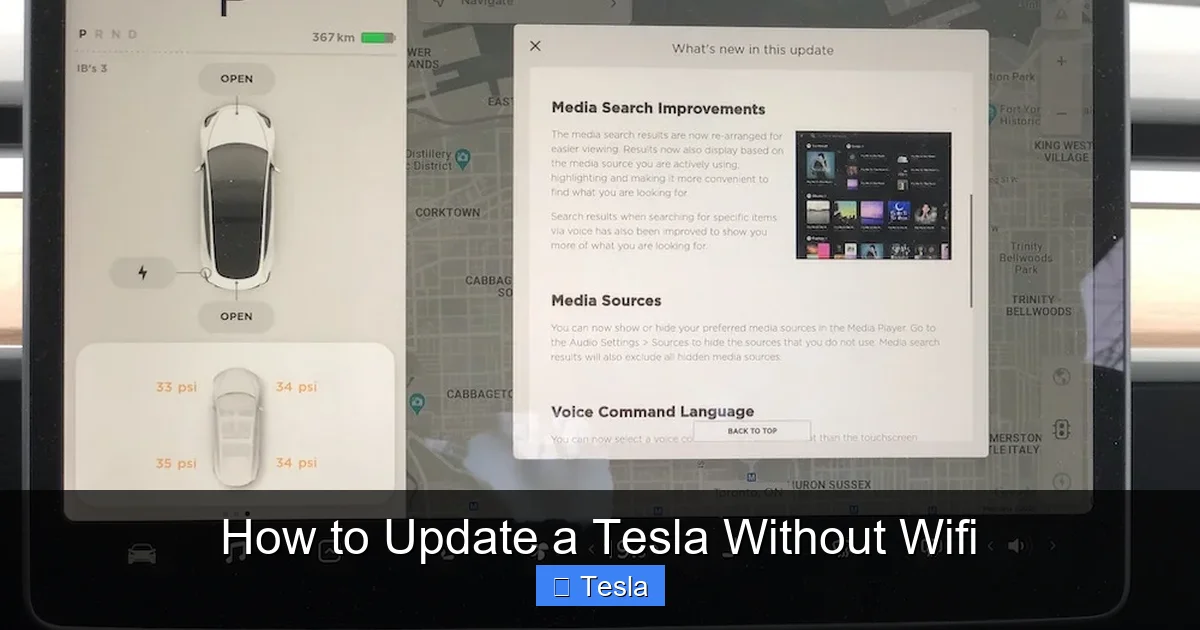
Visual guide about How to Update a Tesla Without Wifi
Image source: tesloid.ca
Method 1: The Mobile Hotspot (Most Common & Convenient)
This is the go-to solution for most owners. Your smartphone—whether iPhone or Android—can create a personal WiFi network using its cellular data. Your Tesla connects to this hotspot just like it would to your home router.
How to do it:
- On your phone, enable the Personal Hotspot feature (usually in Settings > Cellular/Mobile Data). Set a WiFi name (SSID) and password.
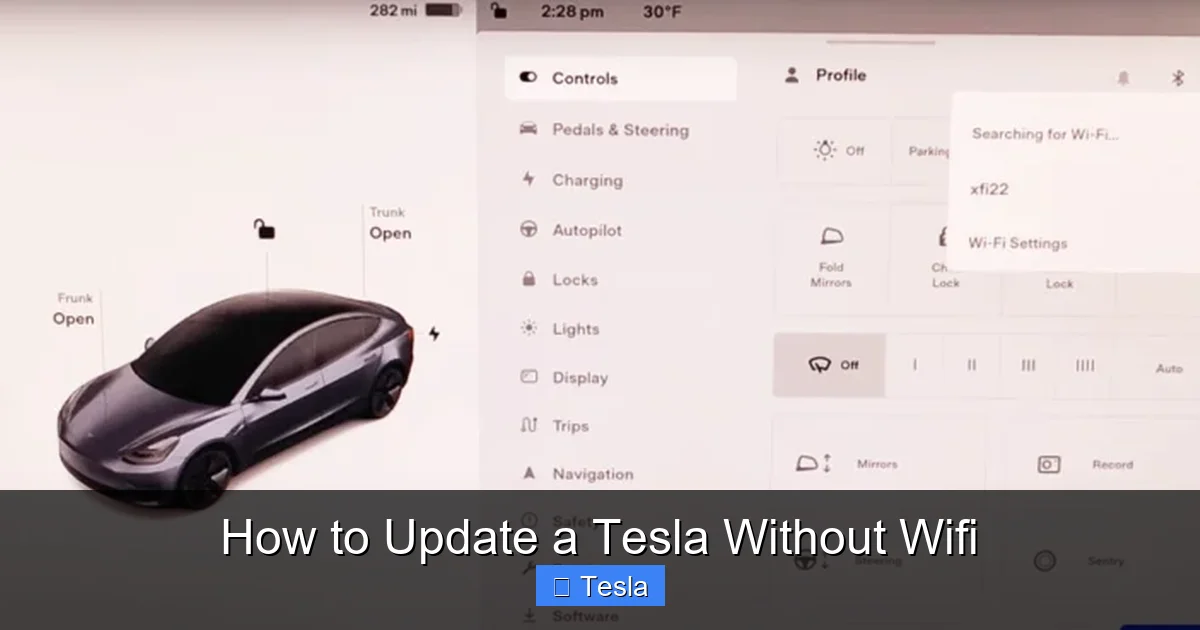
- In your Tesla, go to Controls > WiFi. Turn WiFi on. Your phone’s hotspot should appear in the list of networks.
- Select it and enter the password.
- Once connected, the Tesla will check for updates as usual. If one is available, it will begin downloading.
That’s it. The process is identical to using home WiFi.
Important considerations:
- Data usage: A full update can be 3-5 GB or more. Check your cellular plan’s data allowance. If you have an unlimited plan with deprioritization after a certain threshold, your download speed might slow down, extending the download time. Some carriers throttle hotspot data separately.
- Signal strength: Park your car where your phone has excellent reception. If the signal is weak, the download may fail or stall. Keep the phone near the car, maybe on the roof or dashboard, during the download.
- Battery on your phone: A long download will drain your phone’s battery. Keep it plugged in.
- Cost: If you’re on a limited plan, you might incur overage charges. Consider this before starting a large update.
For most people, the mobile hotspot is the easiest and fastest way to update a Tesla without WiFi. It’s perfect for when you’re traveling, at a friend’s house without WiFi access, or if your home internet is temporarily down.
Method 2: The USB Drive Update (Manual and Selective)
This method is less common but useful in specific scenarios, like if you have no cellular signal at all (e.g., in a remote area) or if you want to download the update file on a fast, unmetered connection elsewhere and bring it to the car.
How it works: Tesla occasionally provides update files for manual installation via USB on their website, usually for “offline” updates or for owners who can’t get the OTA download to complete. However, this is not the standard method for every update. You must first check if Tesla has released the file for your specific vehicle identification number (VIN) and region.
Step-by-step process:
- Check availability: Visit Tesla’s official website or owner forums to see if a USB-installable version of the desired update exists for your car. Not all updates are released this way.
- Download the file: On a computer with good internet, download the update file. It will typically be a .zip or .tar file.
- Prepare the USB drive: Use a USB drive with at least 16 GB of free space. Format it as FAT32 (exFAT may also work, but FAT32 is safest). Create a folder named “Tesla” at the root of the drive. Place the downloaded update file inside that folder. Do not nest it in subfolders.
- Insert into Tesla: With the car parked and on (or accessory mode), insert the USB drive into one of the front USB ports.
- Initiate update: The car should detect the file and prompt you to install. Follow the on-screen instructions. Do not remove the USB drive until the update is complete and the car reboots.
Limitations and risks:
- Availability: This is not a standard channel. Many updates are only available OTA.
- Complexity: You must ensure the file is correct for your vehicle. An incorrect file will be rejected or could cause issues.
- No automatic scheduling: You must physically be with the car to start it.
- Potential for corruption: If the USB drive fails or the file is corrupted during transfer, the update may fail.
This method is a great backup but is more technical and less reliable than the OTA methods. It’s best reserved for when you absolutely cannot get an OTA download to work.
Method 3: Tesla Service Center or Mobile Service (The Guaranteed Fix)
If you’re unable to update via hotspot or USB—perhaps due to a persistent error, a lack of any cellular signal in your area, or a hardware issue preventing connectivity—Tesla’s professional service is your ultimate fallback. They can force the update directly.
How it works: Tesla technicians have diagnostic tools and internal networks that allow them to push updates to vehicles, bypassing the usual owner-initiated process. They can do this during a scheduled service appointment at a Service Center or, in some cases, via Mobile Service where a technician comes to you.
What to do:
- Open the Tesla app.
- Go to Service > Schedule Service.
- Describe the issue: “Unable to download software update over WiFi or mobile hotspot.”
- Choose a Service Center appointment or request Mobile Service if available in your area.
- During the appointment, the technician will connect the car to Tesla’s internal network and install the latest software.
This method is 100% effective if the issue is simply connectivity on your end. However, if your car has a hardware fault (e.g., a faulty modem module), the technician will diagnose and repair that first, which may involve additional costs if out of warranty. But for a pure software update problem, this is the most reliable solution.
Pros and cons:
- Pro: Guaranteed success; no data usage or technical hassle for you.
- Pro: The car gets updated while you’re elsewhere or during another service.
- Con: Requires scheduling and potentially waiting for an appointment.
- Con: If used for a simple update, it might be seen as an unnecessary service visit, though Tesla often accommodates.
Think of this as your “call the experts” option. It’s there when the DIY methods fail or when you simply don’t want to deal with it.
Step-by-Step: Preparing Your Tesla for a Non-WiFi Update
Regardless of which method you choose, proper preparation is key to a smooth update. Rushing in without checking prerequisites can lead to failed downloads, corrupted installations, or a temporarily bricked infotainment system. Follow this checklist before you start.
Visual guide about How to Update a Tesla Without Wifi
Image source: carproblemsolved.com
Ensure Adequate Battery Charge
This is the number one rule. Tesla will not start a major update if the battery is below 50%.
Frequently Asked Questions
What is How to Update a Tesla Without WiFi?
How to Update a Tesla Without WiFi is an important topic with many practical applications.