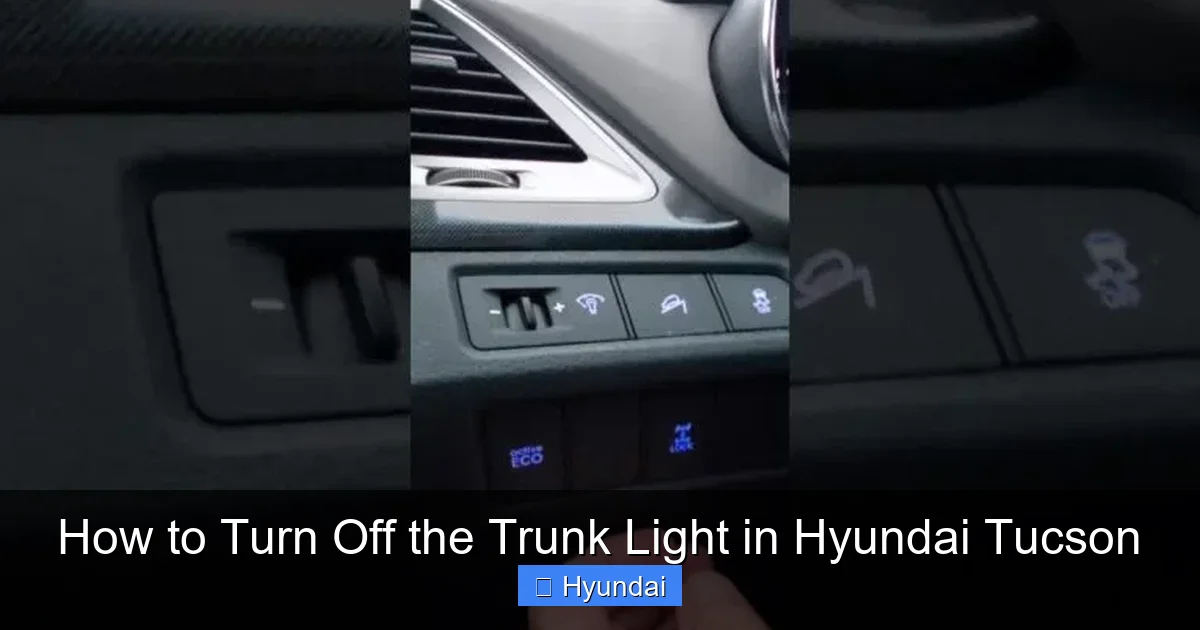
How to Turn Off the Trunk Light in Hyundai Tucson

Contents
- 1 Key Takeaways
- 2 📑 Table of Contents
- 3 Why That Pesky Trunk Light Matters
- 4 Method 1: The Manual Switch—Your First and Easiest Solution
- 5 Method 2: The Fuse Pull—A Guaranteed Power Cut
- 6 Method 3: Diagnosing and Fixing Malfunctions
- 7 Model Year Considerations and Special Cases
- 8 When to Call in the Pros: Beyond Basic Troubleshooting
- 9 Conclusion: Keeping Your Tucson’s Light in Check
- 10 Frequently Asked Questions



If your Hyundai Tucson’s trunk light stays on, it can drain your battery. Locate the manual switch near the trunk latch or remove the fuse to turn it off. Check for stuck switches or wiring issues if the problem persists. Always consult your owner’s manual for model-specific instructions.
Key Takeaways
- The trunk light is controlled by a manual switch or automatically by a latch sensor. Most Tucson models have a small button near the trunk lid that you can press to toggle the light manually.
- Removing the dedicated fuse is a guaranteed way to turn off the light. The fuse is located in the interior fuse box, usually on the driver’s side dashboard, and is labeled for the trunk or cargo area.
- A constantly illuminated trunk light will drain your battery. Even a small bulb can draw enough power over several hours to prevent your engine from starting, especially if the vehicle sits unused.
- Common causes include a faulty switch, misaligned trunk latch, or wiring short. Debris in the latch mechanism or a worn switch plunger are frequent culprits across all Tucson model years.
- Diagnosing the issue often requires a visual inspection and simple tests. Check for obstructions, listen for the switch clicking, and use a multimeter to test for power at the light socket if you’re comfortable.
- Model year matters—procedures can vary between generations. Always verify with your owner’s manual, as the switch location and fuse numbering changed between the 2010-2015 and 2016-2021+ models.
- Seek professional help for complex electrical problems. If the light is on due to a wiring issue or a faulty body control module, a dealership or qualified auto electrician has the tools to diagnose it properly.
📑 Table of Contents
- Why That Pesky Trunk Light Matters
- Method 1: The Manual Switch—Your First and Easiest Solution
- Method 2: The Fuse Pull—A Guaranteed Power Cut
- Method 3: Diagnosing and Fixing Malfunctions
- Model Year Considerations and Special Cases
- When to Call in the Pros: Beyond Basic Troubleshooting
- Conclusion: Keeping Your Tucson’s Light in Check
Why That Pesky Trunk Light Matters
You shut the trunk of your Hyundai Tucson after loading groceries or sports gear. You hear the latch click, you feel it secure. But when you walk away, you notice it—the soft glow from the cargo area, still on. That trunk light, meant to illuminate your belongings when you need it, has become a silent battery vampire. Left unchecked, it can leave you with a vehicle that won’t start, a frustration we’ve all faced. Understanding how to turn off the trunk light in your Hyundai Tucson isn’t just about convenience; it’s about protecting your investment and avoiding a preventable roadside hassle.
The trunk light in your Tucson is a simple yet clever feature. It’s designed to activate automatically when you open the trunk, providing light so you can see your cargo. Most models use a small, spring-loaded plunger switch mounted on the trunk lid or the latch mechanism. When you close the trunk, a tab on the latch presses this switch, breaking the circuit and turning the light off. It’s a system that usually works flawlessly. However, like any mechanical part, this switch can wear out, get dirty, or become misaligned. The result? A light that stays on indefinitely, silently draining your battery’s charge. This guide will walk you through every method to turn off that light, from the simplest manual switch to diagnosing deeper electrical faults, ensuring you have the knowledge to handle it on your Tucson, regardless of its model year.
Method 1: The Manual Switch—Your First and Easiest Solution
Before you pop the hood or start pulling fuses, the absolute first step is to locate and use the manual override switch. Every Hyundai Tucson since its inception has included a way for the driver to manually control the trunk light. This is your primary tool and the solution 70% of the time. The switch is a small, often rubber-covered button. Its exact location varies slightly by generation, but the principle is the same.
Visual guide about How to Turn Off the Trunk Light in Hyundai Tucson
Image source: thecarhow.com
Finding the Switch on Different Tucson Generations
For 2010-2015 Hyundai Tucson (first generation), the manual switch is typically located on the trunk lid itself, near the center or slightly to one side. Look for a small, round button about the size of a pencil eraser, usually with a tiny light bulb icon next to it. It’s often on the interior side of the lid, so you’ll see it when you open the trunk. On some early models, it might be integrated into the trunk’s interior trim panel.
For 2016-2021 Hyundai Tucson (second generation) and the 2022+ (third generation), Hyundai moved the switch. It’s most commonly found on the trunk lid, just above or beside the latch mechanism. You’ll see it when you open the trunk—it’s a small, rectangular button. On some higher trims, the switch might be less obvious, possibly a touch-sensitive area on the trim. A quick visual scan of the entire trunk lid interior usually reveals it. If you can’t find it, your owner’s manual will have a diagram in the “Lights” or “Interior Features” section.
How to Operate the Switch
Once you’ve located the switch, simply press it. You should hear a soft click and see the trunk light extinguish immediately. This action manually breaks the circuit, overriding the automatic latch sensor. Press it again to turn the light back on for loading purposes. If pressing the switch does nothing, the switch itself may be faulty or disconnected. Try pressing it a few times firmly; sometimes debris or a sticky mechanism prevents it from engaging.
Pro Tip: After you’ve manually turned the light off, close the trunk and wait 30 seconds. Then, open it again to see if the automatic system reactivates the light (it should). If the light comes back on automatically when you open the trunk, your manual switch is working, but the automatic shut-off mechanism is the problem. If the light stays off even when you open the trunk, your manual switch may be stuck in the “off” position, or the fuse might have blown during your testing—don’t worry, we’ll cover fuses next.
This method is so straightforward that it’s always the starting point. It’s also a great diagnostic step. If the manual switch works, your problem is isolated to the automatic latch mechanism or its wiring. If the manual switch doesn’t work, the issue is likely with the light bulb itself, a blown fuse, or a complete circuit failure.
Method 2: The Fuse Pull—A Guaranteed Power Cut
If the manual switch is missing, broken, or the problem lies elsewhere in the circuit, your next and most definitive step is to remove the fuse that powers the trunk light. A fuse is a safety device—a small metal strip that melts if too much current flows, breaking the circuit and protecting your car’s wiring. Removing it will 100% turn off the trunk light, as it severs all power to that circuit. This is also the safest method if you suspect a short circuit that could cause a fire.

Visual guide about How to Turn Off the Trunk Light in Hyundai Tucson
Image source: thecarhow.com
Locating the Correct Fuse Box and Fuse
The trunk light fuse is almost always located in the interior fuse box, not the one under the hood. In the Hyundai Tucson, this box is typically on the lower left side of the dashboard, behind a plastic panel. You’ll need to open your driver’s side door and look for a small rectangular cover near the edge of the dashboard, sometimes with a fuse icon on it. Pry it off with a flat-head screwdriver or your fingernail. You might need to consult your owner’s manual for the exact location, as it can differ.
Once the panel is off, you’ll see a grid of small, colored plastic fuses. They are numbered and often have a diagram on the back of the panel or in your manual showing what each fuse controls. You’re looking for a fuse labeled “TRUNK,” “CARGO,” “TAILGATE,” or “INTERIOR LIGHT.” In many Tucsons, it’s fuse number 25 or 32, but this varies wildly by model year and trim level. Never guess. Using the wrong fuse could disable something critical like your power windows or starter. If your manual’s diagram is unclear, you can often find a more detailed legend printed on the fuse box itself inside the panel.
Safely Removing and Checking the Fuse
Hyundai usually provides a small plastic fuse puller tool clipped to the inside of the fuse box panel. If not, you can use needle-nose pliers, but be extremely gentle to avoid bending the fuse. Grasp the top of the fuse firmly and pull straight out. Once removed, hold it up to the light. A good fuse will have an intact, unbroken metal strip visible inside the plastic housing. If the metal strip is broken, melted, or discolored, the fuse is blown and needs replacement.
If the fuse looks good, the problem is not a blown fuse. You can reinsert it. However, if you want the light permanently off for a specific reason (like a broken switch you can’t fix immediately), you can simply leave that fuse out. Be aware: that fuse may also power other interior lights, such as the map lights or footwell lights, depending on your Tucson’s wiring. Removing it might disable those as well. Test by turning on the interior dome light to see if it’s affected.
Important Safety Note: Always replace a blown fuse with one of the exact same amperage (the number printed on the fuse, like 10A, 15A, 20A). Using a higher amperage fuse is dangerous and can cause wiring damage. If a new fuse blows immediately after installation, you have a short circuit that needs professional diagnosis.
This fuse method is universal across almost all vehicles. The process is similar to disabling interior lights in other cars, like the procedure for interior lights in a Dodge Challenger, where the fuse location and labeling follow a comparable pattern.
Method 3: Diagnosing and Fixing Malfunctions
If the manual switch works and the fuse is good, but the light still won’t turn off automatically when you close the trunk, you have a malfunction. The most common culprit is the automatic switch mechanism itself. This requires a bit more investigation but is often a simple fix you can do at home with basic tools.
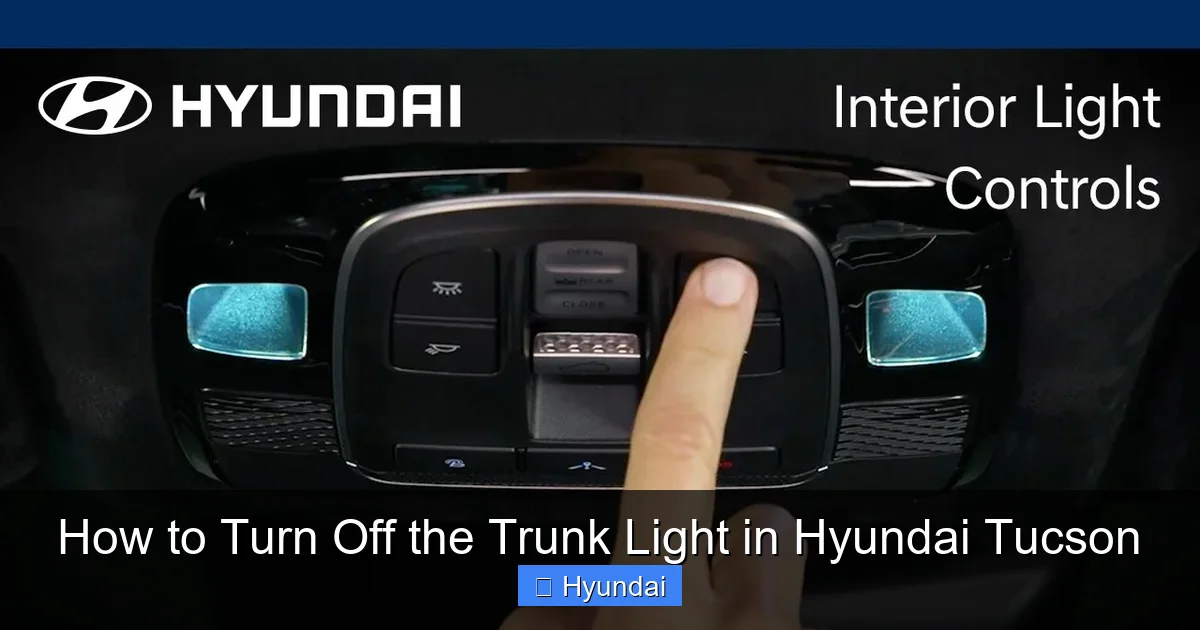
Visual guide about How to Turn Off the Trunk Light in Hyundai Tucson
Image source: thecarhow.com
Inspecting the Trunk Latch and Switch
The automatic switch is usually a small, spring-loaded button mounted on the trunk lid frame. It’s depressed by a pin or tab on the trunk latch when the lid is closed. Start by opening the trunk fully. Locate this switch—it’s often near the latch, on the metal frame of the trunk opening. It may have a rubber boot covering it. Visually inspect it for obvious damage, like a broken plastic tab or a button that is stuck down. Sometimes, dirt, grime, or a small piece of debris (like a leaf or gravel) can lodge under the button, preventing it from popping back up. Use a flashlight and a dry cloth to clean around the switch thoroughly. Gently pry any debris away with a plastic trim tool or a flat screwdriver wrapped in tape to avoid scratching.
Next, manually operate the switch. With the trunk open, press the button in and release it. It should click and spring back firmly. If it feels spongy, sticks, or doesn’t return, the switch is faulty and needs replacement. You can often find replacement switches online or at a Hyundai parts department by searching for your Tucson’s year and “trunk light switch” or “tailgate switch.” Replacement usually involves unplugging an electrical connector and removing a small retaining clip or bolt.
Checking the Trunk Latch Alignment
Sometimes, the latch itself becomes misaligned due to wear, an accident, or even a heavy load hitting the closed trunk. If the latch doesn’t engage the switch tab correctly, the switch may never get depressed, leaving the light on. Close the trunk slowly and watch the latch mechanism. You should see or hear a small metal tab on the latch make contact with and press the switch button. If it misses, or only partially presses it, the latch may need adjustment. This can involve loosening bolts on the latch and shifting its position slightly, which is more involved. Consult a repair manual like Hyundai’s or a trusted online forum for your specific Tucson generation before attempting this.
A faulty switch can be a nagging issue similar to a persistent back seat seatbelt alarm in a Subaru, where a simple switch or sensor failure causes a constant alert. The diagnostic approach is analogous: find the component, inspect it, test it, and replace if necessary.
Model Year Considerations and Special Cases
While the core principles are the same, the exact location of components and the design of the trunk light system can differ between Hyundai Tucson generations. Knowing these nuances can save you time and frustration.
First Generation (2010-2015)
These models have a more traditional setup. The manual switch is almost always on the trunk lid itself, as described. The fuse is typically in the interior fuse box, and the diagram is usually clear. A common quirk on some early Tucsons is that the trunk light may stay on for a minute or two after closing due to a timer circuit—this is normal. If it stays on longer, the switch is the prime suspect.
Second Generation (2016-2021)
Hyundai redesigned the Tucson for 2016. The trunk light switch moved to a less obvious location, often integrated into a plastic bezel on the trunk lid. The fuse box location remains similar (driver’s side dash), but the fuse labeling might use “TAILGATE” instead of “TRUNK.” Some higher trims with a power tailgate have additional wiring and sensors. If your Tucson has a power liftgate, a malfunction in that system can also affect the light. In this case, checking for diagnostic trouble codes with a scan tool might be necessary, which is a step beyond basic DIY.
Third Generation (2022-Present)
The latest Tucson features a more complex electrical architecture. The trunk light is often part of the ambient interior lighting system. The manual switch might be a touch-sensitive pad on the trunk lid trim. The fuse is still in the interior box, but the labeling could be “AMBIENT LIGHT” or similar. These models also have a feature where the light dims gradually. If it stays on bright, it could be a software glitch that might be resolved by a simple battery disconnect (wait 10 minutes) to reset the body control module. Always check for any technical service bulletins (TSBs) for your specific VIN if the problem seems widespread.
Regardless of your model year, the owner’s manual is your best friend. It contains the definitive fuse diagram and switch location for *your* vehicle. If you don’t have the physical manual, Hyundai often has PDFs available on their owner’s website.
When to Call in the Pros: Beyond Basic Troubleshooting
You’ve tried the manual switch. You’ve checked and even replaced the fuse. You’ve cleaned and inspected the latch switch. The trunk light on your Hyundai Tucson still refuses to turn off automatically. At this point, the problem likely lies deeper in the vehicle’s electrical system. This is the moment to consider professional help, not because you’re incapable, but because the diagnosis requires specialized knowledge and tools.
Potential complex issues include: a short circuit in the wiring harness running from the trunk to the fuse box; a faulty body control module (BCM) that isn’t sending the “off” signal; or a problem with the vehicle’s overall lighting control software. Diagnosing these requires a multimeter for continuity testing, a wiring diagram for your specific Tucson, and possibly a professional-grade scan tool to communicate with the BCM. Misdiagnosis can lead to replacing expensive parts unnecessarily.
If your Tucson is still under warranty, this is a clear-cut case for a dealership visit. They will diagnose and repair it at no cost. For out-of-warranty vehicles, a reputable independent mechanic or auto electrician is the way to go. Explain the steps you’ve already taken (switch, fuse, visual inspection)—this saves them time and you money. A proper diagnosis might take an hour of labor, but it’s cheaper than replacing a wiring harness or control module based on a guess.
Remember, while a constantly on trunk light is primarily a battery drain issue, it can sometimes be a symptom of a larger electrical problem that might affect other systems. Getting it fixed professionally ensures your Tucson’s electrical health is sound.
Conclusion: Keeping Your Tucson’s Light in Check
Turning off the trunk light in your Hyundai Tucson is a straightforward task that empowers you as a vehicle owner. We’ve walked through the three main methods: using the manual switch—a quick, no-tools solution; pulling the fuse—a guaranteed power cut that also serves as a diagnostic test; and diagnosing malfunctions in the switch or latch mechanism. Remember, the goal is to restore the automatic function so the light comes on when you need it and turns off when you close the trunk. A permanently disabled light, while solving the battery drain, means you’ll be fumbling in the dark when loading or unloading at night.
Always start with the simplest solution: find and press that manual switch. It’s often the answer. If that fails, move to the fuse. Keep your owner’s manual handy; it’s the ultimate reference for your specific vehicle. And don’t ignore the problem—that little bulb is a silent battery drainer. A healthy electrical system is key to your Tucson’s reliability. By following these steps, you can quickly resolve this common issue, save yourself from a dead battery, and maintain the convenience your SUV was designed to provide. Now, go forth and keep that trunk light under control!
Frequently Asked Questions
Why does my Hyundai Tucson trunk light stay on after closing the trunk?
This is usually caused by a faulty manual switch or a misaligned trunk latch that fails to depress the switch. Debris in the latch mechanism or a worn-out switch plunger are also common culprits. Start by locating and pressing the manual switch to see if it turns off.
Can I permanently disable the trunk light in my Tucson?
Yes, you can permanently disable it by removing its fuse from the interior fuse box. However, this will also turn off any other lights powered by that same fuse, such as map lights. It’s better to fix the underlying issue so the automatic function works correctly.
Will removing the trunk light fuse affect other electrical components?
It might. In many Tucsons, the trunk light fuse is dedicated solely to the trunk light. However, on some models, it may also power cargo area outlets or interior ambient lights. Check your owner’s manual fuse diagram to be sure before removing it.
How do I know if the trunk light switch is faulty?
A faulty switch often feels sticky, doesn’t click, or is physically broken. If pressing the manual switch does nothing, or if the light stays on even when you manually press the switch “off” position, the switch likely needs replacement. You can also test it for continuity with a multimeter if you’re comfortable.
Does a constantly on trunk light really drain the battery?
Absolutely. A typical trunk bulb uses about 5-10 watts. If left on overnight, it can easily drain several amps from your battery, enough to leave you stranded. A battery with a low charge may also have a shortened overall lifespan.
What should I do if none of these methods turn off the trunk light?
If the fuse is good, the manual switch works, but the automatic function still fails, there is likely a wiring issue or a fault with the body control module. At this point, it’s best to consult a professional mechanic or a Hyundai dealership for a proper electrical diagnosis.