
How Often Should I Change Oil on a 2015 Toyota Highlander

For a 2015 Toyota Highlander, the standard oil change interval is every 6 months or 5,000 miles when using conventional oil, but this extends to 10,000 miles with full synthetic. Always consider your driving conditions—severe conditions like frequent short trips or towing require more frequent changes. Following these guidelines protects your engine and maintains your warranty.
Key Takeaways
- Standard Interval: Toyota recommends an oil change every 6 months or 5,000 miles for conventional oil, and up to 10,000 miles or 12 months for full synthetic under normal driving conditions.
- Synthetic vs. Conventional: Full synthetic oil offers superior protection, longer intervals, and better performance in extreme temperatures, making it ideal for most 2015 Highlander owners.
- Severe Driving Shortens Intervals: Conditions like extreme temperatures, dusty roads, frequent short trips, stop-and-go traffic, or towing qualify as “severe” and require changes every 3,000-5,000 miles, even with synthetic oil.
- Trust the Oil Life Monitor: Your Highlander’s intelligent system calculates oil degradation based on engine revolutions, temperature, and driving patterns—never ignore its alert.
- Reset the Light After Service: After any oil change, you must manually reset the maintenance light via the vehicle’s menu system to ensure accurate future alerts.
- Use the Correct Oil: Toyota specifies 0W-20 oil for all 2015 Highlander engines. Using the wrong viscosity can cause damage and void your warranty.
- Holistic Maintenance: An oil change is the perfect time to inspect other critical fluids like transmission fluid and coolant, as they work together to keep your Highlander running smoothly.
📑 Table of Contents
- Manufacturer Recommendations: The Official Word from Toyota
- Decoding Oil Types: Synthetic vs. Conventional for Your Highlander
- Severe vs. Normal Driving: How Your Habits Change the Equation
- The Oil Life Monitor System: Your Highlander’s Smart Assistant
- Step-by-Step: Resetting Your Oil Change Light
- Beyond the Oil Change: A Holistic Approach to Highlander Maintenance
- Conclusion: Your Personalized Oil Change Strategy
Manufacturer Recommendations: The Official Word from Toyota
When you pop the hood of your 2015 Toyota Highlander, you’re looking at one of the most reliable SUVs on the market. But even the most dependable engines need proper care. The absolute best starting point for your 2015 Toyota Highlander oil change schedule is the official manufacturer’s recommendation found in your owner’s manual. For this model year, Toyota provides clear, mileage-based guidelines that form the foundation of your maintenance plan.
For the 2015 Highlander equipped with the standard 2.7L 4-cylinder or the optional 3.5L V6 engine, Toyota’s baseline recommendation is to change the oil and filter every 6 months or 5,000 miles, whichever comes first. This interval assumes the use of conventional motor oil and “normal” driving conditions. However, if your Highlander is filled with full synthetic oil—which is increasingly common and often recommended—the interval can be extended significantly. With full synthetic, Toyota sanctions an interval of 10,000 miles or 12 months, again, whichever occurs first. It’s a straightforward rule, but the critical nuance lies in understanding what “normal” driving really means.
The “Normal” vs. “Severe” Driving Condition Divide
This is where many owners get confused. In automotive engineering, “normal” driving is a specific, narrow set of circumstances. It primarily means consistent highway driving at moderate speeds and ambient temperatures. The moment your driving habits deviate from this ideal—and most of ours do—you likely fall into the “severe” driving category. Toyota explicitly states that severe conditions necessitate more frequent oil changes for a 2015 Toyota Highlander. The manual defines severe conditions as: extended idling, driving in extremely hot (above 90°F) or cold (below 10°F) temperatures, frequent short trips (less than 5 miles in normal temps or 10 miles in freezing temps), driving in dusty or sandy areas, and sustained stop-and-go traffic. If your Highlander is a family hauler that sees lots of school-run traffic, or if you tow a trailer or use it for ride-sharing, you are almost certainly in the severe service category.
Debunking the 10,000-Mile Myth
A common misconception is that all modern cars can safely go 10,000 miles between oil changes. While the 2015 Highlander *can* with synthetic oil, this is only under the strictest “normal” conditions. For the vast majority of owners, especially those in urban environments or with mixed-use driving, sticking to the 5,000-mile interval with conventional oil or a more conservative 7,500-mile interval with synthetic is a wise, engine-protecting practice. The 10,000-mile interval should be viewed as a maximum ceiling, not a standard target. When in doubt, erring on the side of caution with a shorter interval is far less costly than an engine rebuild.
Decoding Oil Types: Synthetic vs. Conventional for Your Highlander
The type of oil you choose is as important as the interval itself. Your 2015 Highlander’s engine was designed with specific tolerances and emissions systems in mind, and the oil must meet exacting standards. Let’s break down the two primary categories.

Visual guide about How Often Should I Change Oil on a 2015 Toyota Highlander
Image source: engineoiil-capacity.com
Conventional Oil: The Budget-Friendly Baseline
Conventional motor oil is derived directly from crude oil and is refined to remove impurities. It performs adequately under standard conditions and is the most cost-effective option at the pump. For a 2015 Highlander owner who primarily drives long, steady highway miles in a temperate climate and changes oil every 5,000 miles, conventional oil will provide sufficient protection. However, it has a higher tendency to break down under thermal stress, forms sludge more easily, and offers less protection during cold starts. Its shorter natural lifespan aligns with the 5,000-mile interval.
Full Synthetic Oil: The Modern Standard
Synthetic oil is engineered in a lab from base compounds, resulting in a highly uniform, pure product. Its molecular structure is designed to resist breakdown, flow better at extreme temperatures (both hot and cold), and clean the engine more effectively. For your Highlander, the benefits are substantial:
- Extended Drain Intervals: Meets the 10,000-mile Toyota specification when used under normal conditions.
- Superior Protection: Reduces wear during critical cold starts and under high-heat, high-stress conditions.
- Cleaner Engine: Contains advanced detergent packages that help keep internal components free of varnish and sludge.
- Potential Fuel Economy Benefit: Lower friction can yield a slight improvement in MPG.
For a 2015 Highlander, using a high-quality full synthetic oil that meets Toyota’s API SN or higher and ILSAC GF-5 certifications is highly recommended, especially if your driving is anything but perfectly “normal.” The small premium per quart is a smart investment in engine longevity. Always verify the correct viscosity—0W-20—in your owner’s manual.
Severe vs. Normal Driving: How Your Habits Change the Equation
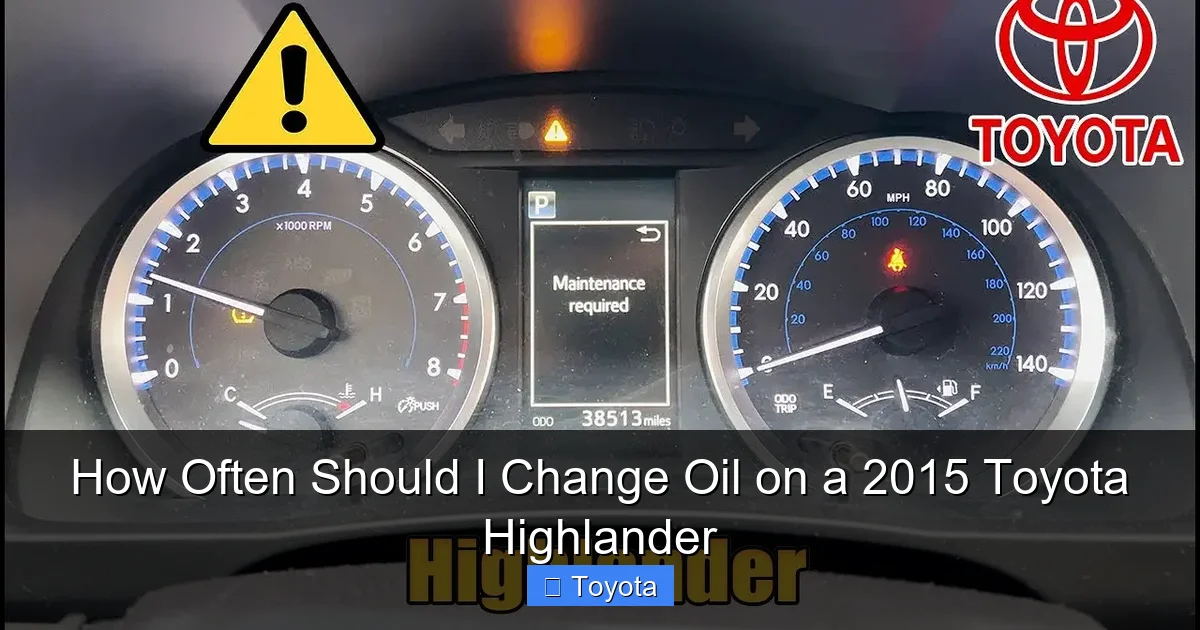
We’ve touched on this, but it’s so crucial it deserves its own deep dive. Understanding whether your driving is “normal” or “severe” is the single most important factor in determining your personal 2015 Toyota Highlander oil change schedule. Let’s translate the manual’s definitions into real-world scenarios.
Visual guide about How Often Should I Change Oil on a 2015 Toyota Highlander
Image source: diycarexpert.com
Defining “Severe Service” for Your Highlander
Toyota’s definition of severe service is comprehensive. Think of it as any driving that prevents the engine from reaching and maintaining its optimal, stable operating temperature for extended periods. This includes:
- Extreme Temperatures: Regular driving in desert heat (Arizona, Nevada summers) or frigid northern winters (Minnesota, Canada). Heat accelerates oil oxidation; cold causes fuel dilution.
- Dusty/Sandy Conditions: Unpaved roads, construction zones, or areas with high particulate pollution. Dust can bypass the air filter and contaminate oil.
- Frequent Short Trips: This is a huge one. If your daily commute is under 5 miles, or under 10 miles in freezing weather, the engine rarely gets fully warmed up. Water vapor from combustion condenses in the oil, creating acidic sludge.
- Stop-and-Go Traffic: Urban commuting with constant acceleration and braking. This causes high engine load and heat buildup without the cooling benefit of highway airflow.
- Towing or Heavy Loads: Using your Highlander to pull a trailer, camper, or carrying maximum cargo. This puts the engine under significant strain, raising operating temperatures.
- Extended Idling: If your Highlander is a work vehicle that idles for hours (e.g., utility trucks, security vehicles), the oil isn’t circulating properly but is still degrading from heat.
Real-World Examples and Adjusted Intervals
If you recognize your lifestyle in any of the above, you should shorten your oil change interval. A safe, conservative rule for severe service is to change oil every 3,000 to 5,000 miles, regardless of whether you use conventional or synthetic oil. While synthetic is more resilient, the extreme conditions still degrade it faster than the extended interval allows. For example, a Highlander used for daily school runs in a cold climate, then driven 15 miles on the highway once a week, is experiencing severe service due to the predominance of short, cold trips. Another example: a Highlander used to tow a 3,500 lb boat on weekends in summer heat is under severe load and temperature stress. For these owners, a 4,000-mile oil change interval with full synthetic is a prudent middle ground that balances cost and protection.
The Oil Life Monitor System: Your Highlander’s Smart Assistant
One of the best features of your 2015 Toyota Highlander is its onboard Maintenance Required (MR) or Oil Maintenance light system. This isn’t just a simple mileage counter; it’s a sophisticated, algorithm-based oil life monitor. Understanding how it works is key to proper maintenance.
Visual guide about How Often Should I Change Oil on a 2015 Toyota Highlander
Image source: i.ytimg.com
How the System Actually Works
Unlike older cars with a fixed 3,000 or 5,000-mile timer, your Highlander’s computer continuously monitors several parameters to calculate the remaining life of your engine oil. It tracks:
- Engine Revolutions: How hard the engine is working. High RPMs and heavy loads degrade oil faster.
- Engine Temperature: How long and how hot the engine runs. Longer warm-up periods and higher sustained temps reduce oil life.
- Driving Patterns: It discerns between steady highway cruising and the constant cycling of city driving.
- Time: Even if you don’t drive much, oil degrades over time from moisture and contaminants. The system accounts for this, typically capping the time interval at 12 months.
Based on this data, the system decrements a percentage value from 100% down to 0%. When it reaches around 15-20%, the “Oil Maintenance Required” light will illuminate on your dashboard. This alert is your vehicle’s direct, personalized recommendation for an oil change based on your actual driving style and conditions.
Why You Must Never Ignore It
Resetting this light without actually changing the oil is a dangerous practice that defeats the system’s purpose. The light is a critical warning that the oil’s lubricating and protective properties have been significantly compromised. Ignoring it means running your engine with degraded oil, leading to increased wear, potential sludge formation, and eventually, costly engine damage. The system is calibrated for both conventional and synthetic oils, but it does not know which type you used. If you use conventional oil, you might reach the light’s trigger point sooner than the manual’s 5,000-mile interval, which is the system correctly identifying severe service. Always change the oil promptly when the light comes on, and then reset the oil maintenance light to restart the monitoring cycle.
Step-by-Step: Resetting Your Oil Change Light
After you or your technician changes the oil and filter, the final and essential step is to reset the Oil Maintenance Required light. Failure to do so means the light will illuminate prematurely, thinking you still have old oil. The process is simple and takes less than 30 seconds. Here is the standard procedure for a 2015 Highlander:
- Ensure the engine is OFF. Do not start the car.
- Press and release the “ODO/TRIP” button on your instrument cluster to display the odometer reading (not the trip meter).
- Turn the ignition key to the “ON” position (the position right before starting, where dashboard lights come on). Do not start the engine.
- Press and hold the “ODO/TRIP” button for at least 5 seconds. You should see the odometer display change to show “OIL MAINTENANCE REQUIRED” or a percentage value, and then it will blink and reset to “000000” or “100%”.
- Release the button. The light should now be off. Turn the ignition off and then back on to verify.
If this procedure doesn’t work or if your Highlander has a different multi-information display, consult your owner’s manual’s index for “Oil Maintenance Reset.” For a detailed visual guide with photos specific to your Highlander’s trim, you can refer to our dedicated article on how to reset the maintenance light on a Toyota Highlander. Remember: reset the light only AFTER the oil change is complete.
Beyond the Oil Change: A Holistic Approach to Highlander Maintenance
An oil change is the single most important routine service, but it shouldn’t be performed in a vacuum. It’s the ideal checkpoint to inspect the entire health of your vehicle’s vital systems. Treating your Highlander’s maintenance as a connected system will maximize its reliability and resale value.
Fluid Interconnectedness: Transmission and Coolant
While you’re under the hood or on the lift, take a moment to check other critical fluids. Your transmission, for instance, relies on clean fluid just as much as your engine does. The 2015 Highlander’s transmission fluid should be checked for level and condition. While Toyota’s official maintenance schedule for the 6-speed automatic often lists it as “check and replace if necessary” at 60,000 miles, many experts recommend a proactive change every 60,000-80,000 miles to ensure long-term shift quality and longevity, especially under severe conditions. Understanding how often to change transmission fluid in a Toyota Highlander is a key part of long-term ownership. Similarly, your engine coolant (antifreeze) degrades over time, losing its corrosion-inhibiting properties. A 50/50 mix of the correct Toyota Super Long Life Coolant (SLLC) is vital for preventing overheating and rust. Toyota’s schedule typically calls for a coolant change at 100,000 miles, but testing its strength and pH level at every major service is a smart practice. You can learn more about the proper schedule for your Toyota’s coolant in our guide on how often to change antifreeze in a Toyota.
Complementary Wear Items: Brakes, Tires, and Filters
The oil change interval is also a perfect time to inspect brakes, tires, and filters. Brake pad life on a Highlander can vary wildly based on driving style—from 30,000 to 70,000 miles. Have a technician measure pad thickness during your oil change visit. Tire rotation should be performed every 5,000-7,000 miles (often coinciding with oil changes) to ensure even wear. Finally, don’t neglect the cabin air filter, which affects your HVAC system’s performance and in-cabin air quality. Replacing it every 15,000-30,000 miles is a cheap and easy job that makes a big difference. By bundling these inspections with your oil change, you create a comprehensive maintenance rhythm that catches small issues before they become big, expensive problems.
Conclusion: Your Personalized Oil Change Strategy
Determining the perfect 2015 Toyota Highlander oil change schedule isn’t about finding a single magic number. It’s about synthesizing Toyota’s official guidelines with your personal reality. Start with the baseline: 5,000 miles/6 months for conventional oil, or 10,000 miles/12 months for full synthetic. Then, honestly assess your driving. If you regularly face severe conditions—and most of us do—dial that interval back by 2,000-3,000 miles. Trust the intelligent oil life monitor as your daily guide, but understand its data is based on your recent driving history. Never ignore its alert. Always use the specified 0W-20 oil that meets Toyota’s certifications. Finally, make the oil change a cornerstone of a broader, proactive maintenance strategy that includes checking transmission fluid, coolant, brakes, and tires. By following this informed, personalized approach, you will protect your Highlander’s engine, ensure its legendary reliability for years to come, and ultimately save money by avoiding catastrophic failures. Your 2015 Highlander is a workhorse; treat it with this level of informed care, and it will faithfully serve your family for hundreds of thousands of miles.
Frequently Asked Questions
What happens if I go over my recommended oil change interval?
Exceeding the recommended interval allows the oil to degrade, lose its lubricating properties, and form sludge and acids. This increases engine wear, reduces fuel efficiency, and can eventually lead to catastrophic engine failure. If you’ve gone significantly over, change the oil immediately and monitor for any unusual noises or performance issues.
Can I switch from conventional to synthetic oil in my 2015 Highlander?
Yes, you can safely switch from conventional to full synthetic oil in your 2015 Highlander. The engine is designed to work with both, as long as the oil meets the specified 0W-20 viscosity and API/ILSAC certifications. Many owners switch to synthetic for its superior protection and longer drain intervals. Just ensure the first change with synthetic is done at a conventional interval (around 5,000 miles) to flush out any residual conventional oil.
How do I know if my driving conditions are truly “severe”?
If your driving involves frequent short trips (under 5-10 miles), extensive idling, towing, driving in very hot or cold climates, or constant stop-and-go traffic, you are operating under severe conditions. A good rule of thumb: if your engine doesn’t fully warm up and reach operating temperature for at least 20-30 minutes during most drives, your conditions are severe.
My oil change light came on, but I just changed the oil. Why?
This almost always means the maintenance light was not reset after the last oil change. The light is based on a calculated algorithm, not just mileage. If the technician or you forgot to reset it, it will illuminate again after the system’s preset interval. Follow the reset procedure in your manual or with our guide to fix this. If the light comes on very shortly after a change, double-check that the correct oil and filter were used.
Is the extended 10,000-mile interval safe for all 2015 Highlanders?
No, it’s only safe under “normal” driving conditions—primarily steady, long-distance highway travel in moderate temperatures. For the majority of owners with mixed or urban driving, a shorter interval of 7,500 miles with synthetic or the standard 5,000 miles with conventional is a much safer and more protective practice.
Does the type of oil I use affect other maintenance like transmission fluid changes?
While engine oil and transmission fluid are separate systems, the principle is similar: using high-quality, manufacturer-specified fluids extends service intervals and protects components. Just as synthetic engine oil lasts longer, some newer synthetic transmission fluids are designed for longer drain intervals. Always follow the specific recommendation in your owner’s manual for each fluid type. You can learn more about your transmission’s needs in our article on how often to change transmission fluid in a Toyota Highlander.
