
How Many Miles per Gallon Does the 2024 Toyota Sienna Hybrid Get?

The 2024 Toyota Sienna Hybrid achieves an outstanding EPA-estimated 36 MPG combined (36 city/35 highway), making it the most fuel-efficient minivan in America. This exceptional mileage is powered by a sophisticated hybrid system that seamlessly blends a gasoline engine with electric motors, eliminating the need for plug-in charging. Families can enjoy significant long-term fuel savings without sacrificing the spacious, versatile interior that defines the Sienna.
Key Takeaways
- Class-Leading Efficiency: The 2024 Sienna Hybrid’s EPA rating of 36 MPG combined is the highest among all minivans, a key advantage for budget-conscious families.
- Full Hybrid, Not Plug-In: It uses Toyota’s proven Hybrid Synergy Drive that self-charges, meaning no plugging in is required, offering unmatched convenience.
- Real-World Results May Vary: While the EPA numbers are excellent, actual MPG depends heavily on driving style, climate, vehicle load, and terrain.
- Powertrain Consistency: Every 2024 Sienna Hybrid uses the same 2.5L 4-cylinder engine and dual-motor system, so MPG ratings are uniform across all trims.
- Significant Fuel Cost Savings: Compared to a traditional gas-only minivan, owners can save hundreds annually on fuel, adding up to thousands over the vehicle’s life.
- Unique Market Position: It’s the only hybrid minivan available, offering a blend of efficiency and practicality no other competitor can match.
📑 Table of Contents
- Introduction: Redefining the Minivan with Hybrid Efficiency
- Official EPA Ratings: The Certified Numbers
- Real-World Factors: Why Your Results Will Differ
- Inside the Hybrid Powertrain: The Magic Behind the Mileage
- How the Sienna Hybrid Stacks Up Against the Competition
- The True Cost of Ownership: Fuel Savings Breakdown
- Practical Tips to Maximimize Your Sienna Hybrid’s MPG
- Conclusion: The Unbeatable Efficiency Equation
Introduction: Redefining the Minivan with Hybrid Efficiency
For years, the minivan segment has been synonymous with practicality and space, but often at the cost of fuel economy. If you needed a vehicle for the whole family, you accepted the trade-off of frequent gas station stops. The 2024 Toyota Sienna turned that assumption on its head. As the first and only hybrid minivan on the market, it delivers the room and versatility families demand while achieving remarkable fuel efficiency that rivals many compact sedans. The core question for any potential buyer is simple: just how many miles per gallon does this revolutionary people-mover actually get? The answer, backed by EPA testing and real-world owner feedback, solidifies the Sienna Hybrid as the efficiency leader in its class.
Understanding the Sienna’s MPG isn’t just about a number on a window sticker. It’s about the technology behind it, how that number translates to your daily life, and how it compares to both traditional minivans and other hybrid SUVs you might be considering. This deep dive will break down the official ratings, explore the hybrid system that makes it possible, discuss factors that influence your real-world mileage, and crunch the numbers on what this efficiency means for your wallet. Whether you’re a current minivan owner looking to upgrade or a family crossover shopper needing more space, the 2024 Sienna Hybrid’s fuel economy is its most compelling feature.
Official EPA Ratings: The Certified Numbers
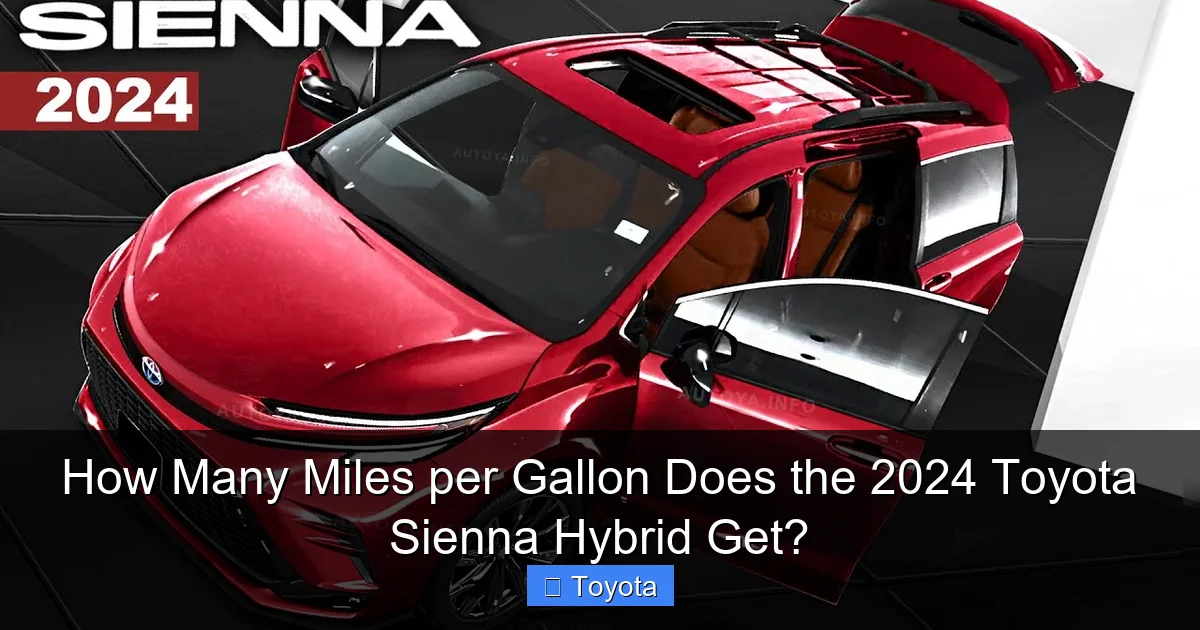
The Environmental Protection Agency (EPA) puts every new vehicle through standardized tests to determine its official fuel economy estimates. For the 2024 Toyota Sienna Hybrid, the results are exceptionally strong across the board. It’s crucial to note that these ratings apply universally to every Sienna Hybrid trim, from the base LE to the top-tier Platinum. The powertrain is identical, so efficiency doesn’t change based on features or wheel size (all use 18-inch wheels).
Visual guide about How Many Miles per Gallon Does the 2024 Toyota Sienna Hybrid Get?
Image source: i.ytimg.com
Breaking Down the EPA Estimates
The EPA provides separate estimates for city, highway, and combined driving. The combined figure is a weighted average representing a typical mix of driving conditions.
- City Driving: 36 MPG – This rating reflects stop-and-go traffic, where hybrid systems excel. The electric motor provides smooth, efficient launches from a dead stop, and the engine can frequently shut off while idling at lights.
- Highway Driving: 35 MPG – Steady-state cruising at higher speeds is less advantageous for hybrids, as the gasoline engine does most of the work. However, the Sienna’s efficient 2.5L engine and optimized aerodynamics keep this number very close to its city rating.
- Combined Driving: 36 MPG – This is the headline number and the one most relevant to average drivers. It indicates that for a typical mix of commuting and errands, you can expect to see around 36 miles per gallon.
These figures are not just incremental improvements over the old V6-powered Sienna; they represent a monumental leap of nearly 60% better fuel economy. For context, the previous gas-only model was rated at 19-20 MPG combined. This transformation is solely due to the adoption of the hybrid powertrain.
Real-World Factors: Why Your Results Will Differ
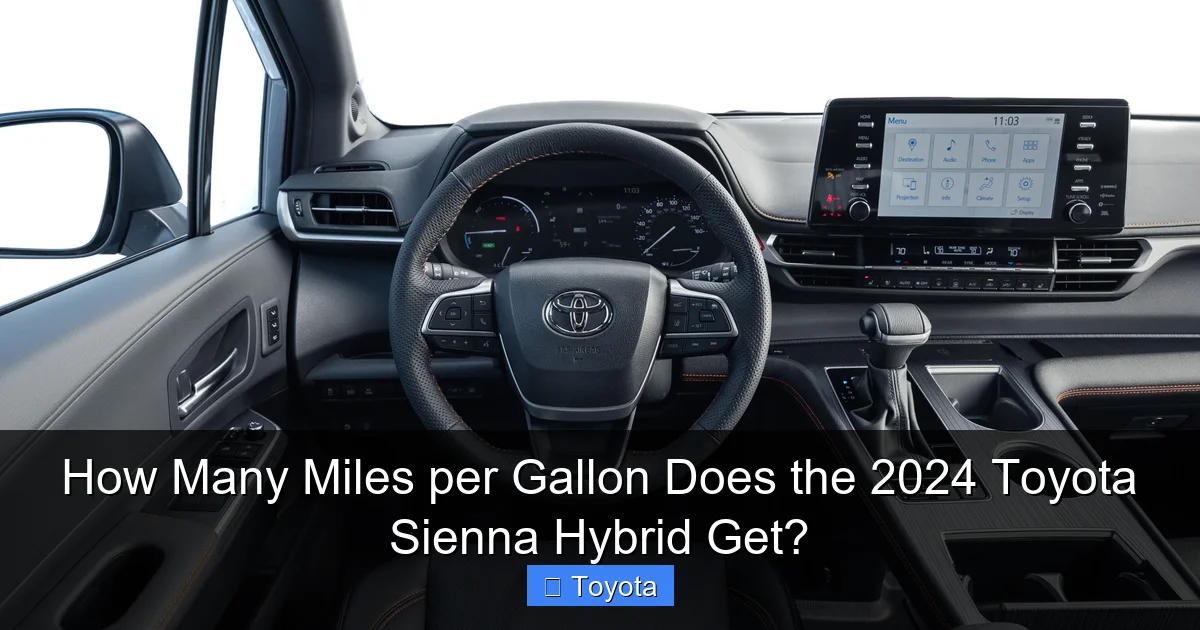
While the EPA 36 MPG combined is an excellent benchmark, it’s a laboratory result. Your personal fuel economy will be a unique number influenced by your specific circumstances. Understanding these factors helps set realistic expectations and, more importantly, identifies opportunities to maximize your mileage.
Visual guide about How Many Miles per Gallon Does the 2024 Toyota Sienna Hybrid Get?
Image source: motortrend.com
The Impact of Driving Style and Environment
Your right foot has the single largest impact on fuel economy. Aggressive acceleration and hard braking can drastically reduce MPG, potentially by 15-30% in city driving. The Sienna Hybrid rewards smooth, anticipatory driving. Using the vehicle’s built-in Eco driving mode (more on this later) helps by softening throttle response and adjusting climate control settings.
Climate is another major variable. Extreme cold or heat requires more energy for cabin heating or cooling. In winter, the engine must warm up faster to provide heat, running less efficiently initially. In summer, the air conditioning compressor places a continuous load on the engine. Using the automatic climate control wisely and pre-conditioning the cabin while plugged in (if equipped) can mitigate some of this loss. You’ll often see a 2-4 MPG drop in very harsh conditions.
Load, Terrain, and Vehicle Configuration
A fully loaded Sienna with eight passengers and a roof full of cargo is working much harder than an empty van. Added weight increases rolling resistance and energy required for acceleration. Similarly, driving in mountainous or hilly terrain consistently will lower MPG, as the hybrid system and engine work harder on inclines and must use regenerative braking on descents.
The Sienna’s all-wheel drive (AWD) system, which uses a rear electric motor, has a negligible impact on fuel economy compared to front-wheel drive (FWD). The difference is typically less than 1 MPG, a small price to pay for enhanced traction and safety in slippery conditions. Finally, while the Sienna isn’t a heavy vehicle, its size means aerodynamic drag is a factor at highway speeds. Using standard roof crossbars instead of a large cargo box can help maintain those 35 MPG highway numbers.
Inside the Hybrid Powertrain: The Magic Behind the Mileage
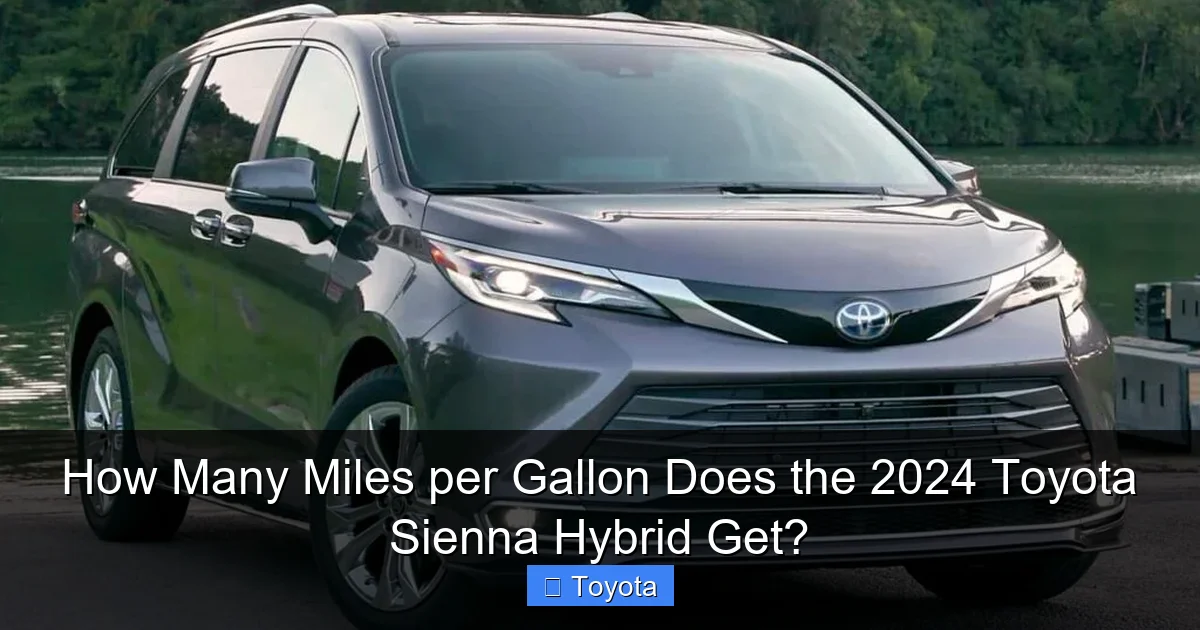
To truly appreciate the Sienna’s MPG, you need to understand how its hybrid system works. It’s not a mild hybrid with a small辅助 motor; it’s a sophisticated full hybrid system, similar to the one found in the iconic Toyota Prius, but scaled and tuned for a minivan.
Visual guide about How Many Miles per Gallon Does the 2024 Toyota Sienna Hybrid Get?
Image source: topelectricsuv.com
The Toyota Hybrid Synergy Drive Explained
The system centers on a 2.5-liter 4-cylinder gasoline engine (2AR-FXE) paired with two electric motor-generators (MG1 and MG2) integrated into a planetary gearset called the Power Split Device. This clever setup allows the engine, MG1, and MG2 to work together in various combinations:
- Electric-Only (EV) Mode: At low speeds and light loads (e.g., parking lots, quiet streets), the Sienna can run on battery power alone from MG2. The engine stays off, delivering zero emissions and zero fuel use. This is most common in city driving.
- Hybrid Drive: The most common mode. The engine and electric motors work together to provide power efficiently. MG1 can generate electricity to supplement the battery or spin at variable speeds to keep the engine in its optimal efficiency range.
- Engine-Only: At steady, higher highway speeds, the system can mechanically connect the engine directly to the wheels for maximum efficiency, though the electric motors may still provide a slight assist or generate electricity.
- Regenerative Braking: This is key to the system’s efficiency. When you coast or brake, the electric motors act as generators, converting kinetic energy back into electricity to recharge the high-voltage (HV) battery. This recaptures energy that would otherwise be lost as heat in traditional brakes.
No Plug-In Required: The Self-Charging Advantage
Unlike plug-in hybrids (PHEVs) or electric vehicles, the Sienna Hybrid’s battery pack is recharged solely by the gasoline engine and regenerative braking. There is no external charging port. This “self-charging” nature eliminates range anxiety and the need for home charging infrastructure. The vehicle manages battery state of charge automatically, ensuring it’s always ready to provide electric boost or EV mode when possible. The HV battery is located under the second-row seats, a design that lowers the center of gravity for better handling and does not compromise interior or cargo space—a major engineering win.
How the Sienna Hybrid Stacks Up Against the Competition
The minivan segment is small but fiercely competitive. The Sienna Hybrid’s 36 MPG combined isn’t just good; it’s in a league of its own. Comparing it directly to its primary rivals highlights just how dominant its efficiency is.
Gas-Only Minivan Rivals
The main competitors are the Chrysler Pacifica (non-hybrid), Honda Odyssey, and Kia Carnival (Sedona in some markets). All three use powerful V6 engines and traditional transmissions. Their EPA combined ratings typically fall in the 19-22 MPG range. This means the Sienna Hybrid offers an extra 14-17 miles per gallon. Over a year of driving 15,000 miles, that difference translates to roughly 400-600 fewer gallons of gasoline consumed. With gas prices fluctuating, that’s a potential $1,200 to $1,800 in annual savings compared to these gas-guzzling rivals. The hybrid system also provides smoother, quieter acceleration than the V6s.
Hybrid and Electric SUV Alternatives
Some families may consider a large hybrid or electric SUV instead of a minivan. Here, the Sienna’s efficiency holds its own remarkably well. For a direct Toyota comparison, the Toyota Venza Hybrid, a midsize crossover, is rated at 40 MPG combined. It’s slightly more efficient due to its smaller size and lower weight, but it lacks the Sienna’s vast passenger and cargo space. The Toyota RAV4 Hybrid, a compact SUV, gets 40 MPG combined but is significantly smaller inside. The Sienna offers a unique value proposition: minivan space with hybrid efficiency that rivals these smaller crossovers.
Looking beyond Toyota, the Nissan Rogue Hybrid (if available in your market) or other hybrid SUVs like the Ford Escape Hybrid also rate in the high 30s to low 40s MPG. Again, none can match the Sienna’s three rows of flexible seating and cavernous cargo area. For pure efficiency in a three-row vehicle, the Sienna Hybrid is currently unmatched. The only plug-in hybrid minivan alternative is the Chrysler Pacifica Hybrid, which offers about 30 miles of electric-only range before its gasoline engine kicks in, achieving a combined rating of 82 MPG-e when plugged in regularly. However, if you don’t plug it in, its gas-only MPG drops to around 30, still below the always-hybrid Sienna.
The True Cost of Ownership: Fuel Savings Breakdown
The higher initial purchase price of a hybrid can be a concern. However, the Sienna Hybrid’s significant fuel savings and Toyota’s reputation for reliability often make it the financially smarter choice over the ownership period.
Crunching the Numbers: A Sample Calculation
Let’s do a simple 5-year ownership comparison. Assume:
- Annual mileage: 15,000 miles
- Average national gas price: $3.50 per gallon (for calculation ease)
- Comparison vehicle: A gas minivan at 20 MPG combined.
Sienna Hybrid (36 MPG):
15,000 miles / 36 MPG = 416.7 gallons per year
416.7 gallons * $3.50 = $1,458.45 in fuel costs annually.
Gas Minivan (20 MPG):
15,000 miles / 20 MPG = 750 gallons per year
750 gallons * $3.50 = $2,625.00 in fuel costs annually.
Annual Savings with Sienna Hybrid: $1,166.55
Over 5 years, that’s a staggering $5,832.75 saved on fuel alone. This simple math often closes or even eliminates the initial price premium of the hybrid model. Furthermore, Toyota’s hybrid components are covered by an excellent warranty (8 years/100,000 miles for the HV battery), providing long-term peace of mind. The resale value of hybrids, particularly reliable ones like the Sienna, also tends to be strong, further improving the total cost of ownership.
Practical Tips to Maximimize Your Sienna Hybrid’s MPG
While you can’t change the EPA rating, you can actively influence your real-world MPG to get as close to that 36 as possible. The Sienna Hybrid provides the tools; it’s up to the driver to use them effectively.
Drive Mode Mastery: Eco, Normal, and Sport
The Sienna offers three selectable drive modes that alter throttle response, steering weight, and climate control behavior.
- Eco Mode (The MPG Champion): This is your primary tool for maximizing efficiency. It softens throttle response, making acceleration more gradual. It also adjusts the air conditioning to be slightly less aggressive and may alter shift points (in the simulated gear display). Use Eco mode for daily commuting and errands.
- Normal Mode: A balanced setting for everyday driving with a more responsive throttle than Eco.
- Sport Mode: Sharpens throttle response and steering for a more engaging feel. Use it sparingly if you want to enjoy driving, but know it will reduce MPG.
Leverage the Hybrid Information Display
Your Sienna’s multi-information display is a powerful coach. Pay attention to the hybrid system indicator, which shows power flow (engine, motor, regeneration). Use it to learn how to drive more efficiently: aim to keep the needle in the “Eco” zone and maximize the time the display shows battery regeneration (often a blue or green area) during deceleration. Smooth, early braking is key to capturing more regenerative energy.
Other High-Impact Habits
- Maintain Proper Tire Pressure: Under-inflated tires increase rolling resistance. Check pressures monthly and keep them at the recommended PSI (found on the driver’s door jamb sticker), not the max on the tire sidewall.
- Reduce Excess Weight: Remove unnecessary items from the vehicle. Every 100 pounds of extra cargo can reduce MPG by about 1%.
- Use Accessory Power Wisely: The air conditioning is the biggest accessory drain. In moderate weather, use the ventilation system or open windows at low speeds. At highway speeds, use AC with recirculation, which is more efficient.
- Plan Trips and Combine Errands: A warm engine is more efficient. Combining multiple short trips into one longer trip allows the engine and hybrid system to operate at optimal temperatures more consistently.
- Observe Speed Limits: Aerodynamic drag increases exponentially with speed. Driving 65 MPH instead of 75 MPH can significantly improve highway fuel economy.
Conclusion: The Unbeatable Efficiency Equation
The 2024 Toyota Sienna Hybrid answers the “how many miles per gallon” question with a resounding and class-leading 36 MPG combined. This isn’t a niche number achieved under perfect conditions; it’s a real, achievable figure that transforms the minivan ownership experience. By combining Toyota’s proven, reliable hybrid technology with unparalleled interior space and flexibility, the Sienna creates a new benchmark for the segment. It proves that a family’s need for practicality does not have to come at the expense of fuel economy or the environment.
When you consider the thousands of dollars in potential fuel savings over five years, the strong predicted resale value, and the peace of mind from Toyota’s hybrid engineering, the Sienna Hybrid emerges as not just the most efficient minivan, but arguably the most intelligent choice for most families. It’s a vehicle that pays you back every time you fill up the tank. So, while the sticker says 36 MPG, your personal results will be your own story—a story written by your driving habits, your climate, and your load. But with the Sienna Hybrid, you start that story from the best possible position in the minivan world.
Frequently Asked Questions
Is the 2024 Toyota Sienna Hybrid a plug-in hybrid (PHEV)?
No. The Sienna Hybrid is a full hybrid, sometimes called a “self-charging” hybrid. It uses a gasoline engine and regenerative braking to recharge its battery pack. There is no external charging port, so you never need to plug it in. This provides the efficiency benefits of a hybrid without any charging infrastructure requirements.
How does the Sienna Hybrid’s MPG compare to the old V6 Sienna?
The improvement is dramatic. The previous gas-only V6 Sienna was EPA-rated at 19-20 MPG combined. The 2024 Hybrid’s 36 MPG combined represents an increase of about 16-17 MPG, or an 80-85% improvement in fuel efficiency. This translates to roughly double the driving range on a single tank of gas.
Does all-wheel drive (AWD) lower the Sienna Hybrid’s MPG?
Yes, but the impact is minimal. AWD models have a very slightly lower EPA rating (35 MPG combined vs. 36 for FWD) due to the added weight and mechanical drag of the rear electric motor and drive unit. In real-world driving, the difference is often negligible, and many drivers find the enhanced traction and safety of AWD well worth the tiny potential MPG loss.
What is the real-world MPG I can expect in winter?
In very cold climates (below 20°F), you can expect a drop of 2-5 MPG from the EPA estimates. This is because the engine runs longer to warm up and provide cabin heat, and cold air is denser (increasing aerodynamic drag). Using the seat heaters and steering wheel heater (if equipped) instead of the cabin heater can help mitigate this loss, as they use less energy.
Can the Sienna Hybrid run on electricity alone for long distances?
No. While it has an EV mode for very short, low-speed trips (like in a parking lot), it is not designed for sustained electric-only driving. Its battery is small and optimized for assisting the gasoline engine, not for storing large amounts of energy for long distances. It is fundamentally different from a plug-in hybrid or electric vehicle in this regard.
How does the Sienna Hybrid’s fuel economy compare to a 3-row SUV like the Toyota Highlander Hybrid?
3>The Toyota Highlander Hybrid is rated at 36 MPG combined for FWD models (35 MPG for AWD), nearly identical to the Sienna Hybrid. However, the Sienna offers significantly more interior space, particularly in the third row and cargo area behind it. For families prioritizing maximum passenger and cargo room alongside hybrid efficiency, the Sienna is the superior choice. The Highlander may offer a more car-like driving experience but sacrifices minivan-level practicality.