
How Much Oil Does a 2000 Toyota Tacoma 4-cylinder Take?

Your 2000 Toyota Tacoma with the 2.4L 4-cylinder engine requires exactly 5.1 quarts (4.8 liters) of oil when performing a change that includes a new oil filter. This capacity is specific to the 2RZ-FE engine and is critical for proper lubrication and engine health. Always use the dipstick to verify the level after filling, as overfilling or underfilling can cause serious damage. For the correct oil viscosity, Toyota typically recommended 5W-30 for this model year, but always confirm with your owner’s manual or a trusted mechanic.
Key Takeaways
- Exact Capacity: The 2.4-liter 4-cylinder (2RZ-FE) in a 2000 Tacoma holds 5.1 quarts (4.8 L) of oil with a new filter.
- Oil Specification: Toyota generally specified 5W-30 API SG or higher grade oil for this engine. Synthetic blends or full synthetics meeting the same specs are safe upgrades.
- Filter Change is Included: The 5.1-quart figure assumes you are replacing the oil filter. If you only drain the pan and reuse the old filter, you will need less oil.
- Always Verify with Dipstick: The final and most important step is to check the oil level on the dipstick after filling and letting the engine sit for a few minutes. Never rely on the “quarts” number alone.
- Overfilling is Dangerous: Putting in more than 5.1 quarts can cause aeration, foaming, increased pressure, and seal leaks, potentially leading to catastrophic engine failure.
- Underfilling is Equally Harmful: Low oil level causes inadequate lubrication, rapid wear, and overheating, drastically shortening your engine’s life.
- Capacity Source: This information comes from the official 2000 Toyota Tacoma factory service manual and is consistent across all 2.4L 4×2 and 4×4 models.
📑 Table of Contents
- Introduction: Why This Simple Number Matters So Much
- Understanding Your 2000 Tacoma’s 2.4L 4-Cylinder Engine
- The Exact Oil Capacity: The Definitive Answer
- Choosing the Correct Oil: Viscosity and Specifications
- The Step-by-Step Oil Change Process (and Where Capacity Fits In)
- Common Mistakes and How to Avoid Them
- Long-Term Maintenance and Best Practices
- Conclusion: Precision Leads to Longevity
Introduction: Why This Simple Number Matters So Much
If you own a 2000 Toyota Tacoma with the reliable 2.4-liter 4-cylinder engine, you’ve made a solid choice. These trucks are known for their longevity and toughness. But that toughness depends entirely on proper maintenance, and at the heart of that maintenance is engine oil. Getting the oil capacity exactly right isn’t just a minor detail—it’s fundamental to protecting your investment. Too little oil, and your engine wears out fast. Too much oil, and you create a whole new set of problems that can be just as destructive. So, when someone asks, “How much oil does a 2000 Toyota Tacoma 4-cylinder take?” the answer needs to be precise, authoritative, and understood in context.
This article will give you that definitive answer. We’ll break down the exact capacity for your 2RZ-FE engine, explain why the number includes the filter, discuss the correct oil type for your model year, and walk you through the proper procedure to ensure you get it right every time. Whether you’re a DIY enthusiast changing oil in your driveway or just want to be an informed car owner, this guide is for you.
Understanding Your 2000 Tacoma’s 2.4L 4-Cylinder Engine
The Workhorse: 2RZ-FE Engine
For the 2000 model year, the Toyota Tacoma’s standard engine was the 2.4-liter 2RZ-FE. This is a fuel-injected, overhead-cam, 4-cylinder powerhouse known for its smoothness and durability. It produced 150 horsepower and 177 lb.-ft. of torque. Because it’s an overhead cam design with tight tolerances, it has specific oil capacity and viscosity requirements that differ from older, pushrod engines. Understanding that you have this specific engine is the first step to getting the right information.
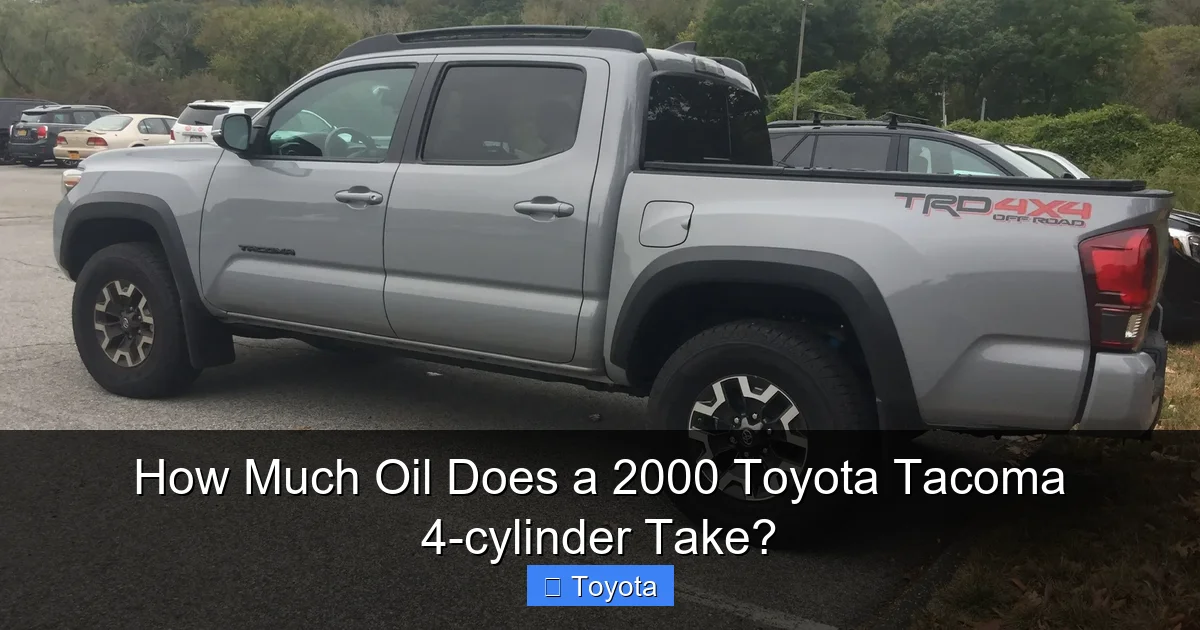
Visual guide about How Much Oil Does a 2000 Toyota Tacoma 4-cylinder Take?
Image source: i2.wp.com
Why “4-Cylinder” and Not “V6”?
It’s critical to confirm your engine. The 2000 Tacoma also came with an optional 3.4-liter V6 (the 5VZ-FE). That engine has a completely different oil capacity—about 4.5 quarts with a filter. If you accidentally use the V6 capacity for your 4-cylinder, you’ll be nearly a quart short, leading to immediate and severe low-oil conditions. Always check your vehicle’s VIN or the engine bay for the 2.4L or 2RZ-FE designation before proceeding.
The Exact Oil Capacity: The Definitive Answer
5.1 Quarts (4.8 Liters) with Filter
Here is the direct answer you’re looking for: A 2000 Toyota Tacoma equipped with the 2.4L 4-cylinder engine requires 5.1 U.S. quarts (4.8 liters) of oil when the oil filter is also being replaced. This figure is not an estimate; it’s the specification from Toyota’s engineering department. It accounts for the total volume of the engine’s oil pan, galleries, and the new filter’s core volume. If you are simply draining the oil pan and reusing the old filter (which is not recommended during a full service), you would need slightly less, approximately 4.6 quarts. However, best practice is always to change the filter and use the full 5.1-quart capacity as your starting point.

Visual guide about How Much Oil Does a 2000 Toyota Tacoma 4-cylinder Take?
Image source: cdn1.mecum.com
Where This Number Comes From
This capacity is verified by multiple authoritative sources: the 2000 Toyota Tacoma Owner’s Manual, the official Toyota Factory Service Manual (FSM) for the 2RZ-FE engine, and decades of consensus from professional mechanics and Tacoma enthusiast communities. It is consistent across all 2000 Tacoma 4-cylinder variants, whether it’s a 2WD or 4WD model, a regular cab, or an extended cab (Xtra Cab). The transmission type does not affect engine oil capacity.
Choosing the Correct Oil: Viscosity and Specifications
Recommended Viscosity: 5W-30
For the 2000 model year, Toyota’s official recommendation was 5W-30 weight oil. The “W” stands for winter, and this multi-grade oil flows like a thin 5-weight oil in cold starts for easy cranking, then thickens to a 30-weight at operating temperature for proper film strength. Using the correct viscosity is crucial for cold-weather starts and for maintaining oil pressure under high-temperature, high-load conditions. Some owners in extremely hot climates sometimes opt for 10W-30, but 5W-30 is the safe, factory-specified choice for all climates.

Visual guide about How Much Oil Does a 2000 Toyota Tacoma 4-cylinder Take?
Image source: toyota-specs.com
API Service Classification: SG or Better
The oil must also meet the American Petroleum Institute’s (API) SG service specification or a newer, superior classification (like SL, SM, SN, etc.). The “S” series is for gasoline engines. For a 2000 vehicle, any modern oil (SN, SP) will far exceed the original SG requirement and provide better protection against wear, deposits, and sludge. You can learn more about the different oil types and what they mean for your Toyota by reading our detailed guide on what kind of oil a Toyota Tacoma takes.
Synthetic vs. Conventional: Can You Upgrade?
Absolutely. The 2RZ-FE engine is fully compatible with synthetic oils. In fact, using a high-quality full synthetic or synthetic blend oil can provide superior protection, especially in extreme temperatures, under heavy loads, or with extended drain intervals. There is no need to “break in” a new or rebuilt engine with conventional oil first; modern synthetics are safe from the start. Just ensure the synthetic oil you choose still meets the 5W-30 viscosity and the appropriate API service category.
The Step-by-Step Oil Change Process (and Where Capacity Fits In)
Preparation is Key
Before you even open the drain plug, gather your supplies: 5.1 quarts of your chosen 5W-30 oil, a high-quality oil filter that fits the 2RZ-FE (like a Toyota Genuine or a reputable brand like Wix, Mobil 1, or Fram), a new drain plug washer (crush washer), a socket and ratchet for the drain plug and filter, an oil drain pan, and gloves. Warm the engine slightly by driving for 5-10 minutes; warm oil flows out faster and carries more contaminants with it.
The Critical Drain and Replace Steps
1. Drain the Oil: Safely lift the vehicle. Place your drain pan under the oil pan. Remove the drain plug and let the oil flow out completely. This takes several minutes. Replace the crush washer and reinstall the drain plug to the proper torque (typically 30 ft-lbs, but verify in your service manual).
2. Remove the Old Filter: Position your drain pan under the oil filter. Use an oil filter wrench to remove the old filter. Be prepared for some residual oil to spill. Before installing the new filter, lightly coat the rubber seal with fresh oil from your new bottle.
3. Install the New Filter: Screw the new filter on by hand until the seal makes contact, then tighten an additional 3/4 of a turn (or per the filter manufacturer’s instructions—some specify 1/2 turn). Do not overtighten.
Filling to the Exact Capacity
This is the step where the 5.1-quart number is applied. Locate the oil fill cap on the valve cover. Using a funnel, slowly pour in approximately 5 quarts of new oil. Wait 2-3 minutes for the oil to settle in the pan. Now, pull the dipstick, wipe it clean, reinsert it fully, and pull it again to check the level. The oil should be between the “F” (Full) and “L” (Low) marks, ideally right on the “F” mark or just below it. If it’s below the “F” mark, add oil in very small increments (a quarter to a half quart at a time), rechecking the dipstick after each addition. The goal is to have the oil level exactly at the “F” mark when the engine is cold and level. It is very common to need to add the final 0.1 to 0.3 quarts after this initial check to hit the mark perfectly.
Common Mistakes and How to Avoid Them
Mistake 1: Blindly Pouring All 5.1 Quarts
This is the most frequent error. Every engine is slightly different. A previous overfill, a slightly different filter, or minor manufacturing tolerances mean you might need slightly less or slightly more than the stated capacity. The dipstick is the only true judge of correct oil level. Always use the 5.1-quart figure as a starting point, not the final instruction.
Mistake 2: Forgetting the Filter
The capacity specification is “with filter.” If you forget to change the filter and reuse the old, oil-filled one, you will overfill the engine by the volume of the old filter’s core (roughly 0.5 quarts). This leads to overfilling. Conversely, if you change the filter but only add the “without filter” capacity, you will be critically low.
Mistake 3: Using the Wrong Oil
Using 10W-40 or a non-detergent oil can harm the emissions system and reduce fuel economy. Using an oil without the correct API specification (like the older “SA” or no specification) lacks the additive packages needed for modern engines. Stick to 5W-30 with the latest API rating you can find.
Mistake 4: Overlooking the Drain Plug Washer
Reusing the old metal crush washer or not using one at all can lead to a slow, steady drip that empties your oil without you noticing until it’s too late. Always use a new soft aluminum washer with every oil change.
Long-Term Maintenance and Best Practices
Establish a Consistent Interval
For normal driving conditions, Toyota’s original recommendation was every 7,500 miles or 12 months. However, for maximum engine life, especially if you do a lot of short trips, towing, or drive in dusty conditions, a 5,000-mile or 6-month interval is a wise conservative choice. If you use full synthetic oil, you may be able to extend this to 7,500-10,000 miles, but never exceed the oil life monitor if your vehicle has one (though 2000 models typically did not). Consistently changing your oil is the single most important thing you can do for your 2RZ-FE’s longevity.
The Dipstick: Your Best Friend
Get in the habit of checking your oil level at least once a month and whenever you suspect a leak or consumption. A properly functioning 2RZ-FE should not consume significant oil between changes (less than a quart every 1,000 miles is considered normal by many manufacturers, but ideally, it uses almost none). If you notice the level dropping between services, investigate for leaks or internal engine issues promptly.
Connecting to Your Entire Vehicle
Proper oil maintenance doesn’t happen in a vacuum. It’s part of a holistic care routine. Just as you need the right oil capacity, you also need the right fluids in the right places. For instance, knowing how much freon a 2009 Toyota Camry takes is specific to that model’s A/C system. Similarly, understanding the weight and load capacity of your Tacoma, which you can compare to models like the Toyota RAV4, helps you use your truck within its safe limits, reducing strain on all components, including the engine.
Conclusion: Precision Leads to Longevity
So, to summarize with absolute clarity: your 2000 Toyota Tacoma 4-cylinder, powered by the 2.4L 2RZ-FE engine, takes 5.1 quarts of 5W-30 oil when changing both the oil and the filter. Memorize that number, but more importantly, internalize the process: start with 5 quarts, then meticulously verify and top up to the exact “F” mark on the dipstick. This simple act of precision is what separates a truck that lasts 300,000 miles from one that fails prematurely. It’s a testament to the Tacoma’s legendary reliability when cared for properly. By following these guidelines, you’re not just performing an oil change; you’re actively preserving a piece of automotive history and ensuring your trusted companion is ready for the next adventure, whatever it may be.
Frequently Asked Questions
Is it 5.1 quarts with or without the oil filter?
The 5.1-quart capacity is specifically with a new oil filter. This is the standard capacity for a full oil and filter change service. If you were to only drain the pan and reuse the old filter, you would need approximately 4.6 quarts.
Can I use 10W-30 oil instead of 5W-30 in my 2000 Tacoma?
While 10W-30 might function in very warm climates, Toyota specified 5W-30 for the 2RZ-FE engine for a reason. 5W-30 provides better cold-start flow, which is crucial for engine wear protection during startup. Sticking with 5W-30 is the safest and most recommended choice for all climates and seasons.
What happens if I accidentally overfill the engine with oil?
Overfilling causes the crankshaft to whip through the oil, creating foam and aeration. This foamy oil cannot lubricate properly, leads to increased oil pressure, can cause seal leaks, and in severe cases, can lead to catastrophic engine failure from lack of lubrication. If you overfill, you must immediately drain the excess to the correct level.
My dipstick shows the oil level is slightly above the “F” mark after adding 5.1 quarts. Is this a problem?
A small amount above the “F” mark (e.g., the first 1/8 inch of the dipstick) is usually not critical but should be corrected. The “F” mark is the maximum safe level when the engine is cold. Oil expands when hot, so being overfull when cold means it will be significantly overfull when at operating temperature, which is dangerous. It’s best to drain a small amount (a quarter quart) to bring it exactly to the “F” mark.
Is it okay to use conventional oil or should I always use synthetic?
Both are acceptable. Conventional oil meeting the 5W-30 SG/SL specification is perfectly fine and meets Toyota’s original requirement. Synthetic oil offers superior protection, especially in extreme temperatures, and allows for longer drain intervals. The choice depends on your budget, driving conditions, and personal preference. For maximum protection, a synthetic blend or full synthetic is an excellent upgrade.
How often should I change the oil in my 2000 Tacoma with 200,000 miles?
For a high-mileage engine, a more conservative interval is wise. If using conventional oil, change it every 5,000 miles or 6 months. If using synthetic oil, a 7,500-mile interval is reasonable. Always check the oil level monthly on high-mileage engines, as they may begin to use a small amount of oil between changes. Also, consider using a high-mileage oil formulation that contains seal conditioners.