
How Much Freon Does a 2009 Toyota Camry Take?

The 2009 Toyota Camry typically requires 1.5 to 2 pounds (24 to 32 ounces) of R-134a refrigerant to properly charge its air conditioning system, depending on the specific model and configuration. Always consult your owner’s manual or a certified technician before adding Freon, as overcharging can damage the system and undercharging reduces cooling efficiency. Proper maintenance ensures optimal AC performance and longevity.
“`html
Key Takeaways
- Check your owner’s manual: Confirm the exact Freon type and capacity for your 2009 Camry.
- Use R-134a refrigerant: This is the correct type for the 2009 Toyota Camry’s AC system.
- Typical charge is 1.5–2.0 lbs: Most systems require this amount for optimal cooling performance.
- Inspect for leaks first: Recharging without fixing leaks wastes refrigerant and damages the environment.
- Use a recharge kit with gauge: Ensures safe, accurate Freon levels without overcharging.
- Consult a professional if unsure: Improper handling can harm the AC system or pose safety risks.
📑 Table of Contents
- How Much Freon Does a 2009 Toyota Camry Take?
- Understanding Freon and Your Camry’s AC System
- How Much Freon Does a 2009 Toyota Camry Hold?
- Signs Your Camry Needs a Freon Recharge
- How to Safely Recharge Your Camry’s AC System
- Common Myths About Freon and AC Recharging
- Maintaining Your Camry’s AC System for Longevity
- Final Thoughts: Keeping Cool in Your 2009 Camry
How Much Freon Does a 2009 Toyota Camry Take?
So, you’re driving your trusty 2009 Toyota Camry, cruising down the highway on a hot summer day, and suddenly—your AC starts blowing warm air. You roll down the windows, but it’s not the same. You start wondering: Is it low on freon? How much freon does a 2009 Toyota Camry actually take? If this sounds familiar, you’re not alone. Many Camry owners face this exact dilemma, especially as their cars age and the air conditioning system begins to show signs of wear.
Let’s be honest—car maintenance can feel overwhelming. Between oil changes, tire rotations, and brake checks, it’s easy to forget about the AC system. But when the heat hits, you quickly remember how important that cool blast of air is. The good news? Understanding your Camry’s freon needs doesn’t have to be complicated. In this guide, we’ll walk you through everything you need to know—from how much freon your 2009 Camry holds, to how to check the levels, and when it’s time to visit a professional. Think of this as your friendly, no-jargon guide to keeping your Camry cool and comfortable, no matter the season.
Understanding Freon and Your Camry’s AC System
Before we dive into the numbers, let’s clear up a common misconception: Freon is actually a brand name for a type of refrigerant, not a generic term. The refrigerant used in your 2009 Toyota Camry is R-134a, which is the standard for vehicles made in that era. It’s important to know this because using the wrong refrigerant can damage your AC system or even void your warranty (if you still have one).

Visual guide about How Much Freon Does a 2009 Toyota Camry Take?
Image source: thecarhow.com
The AC system in your Camry works like a heat pump. It absorbs heat from inside the cabin and releases it outside, leaving you with cool, refreshing air. This process relies on the refrigerant circulating through a closed loop of components: the compressor, condenser, expansion valve, and evaporator. When the system is low on refrigerant, it can’t absorb heat effectively, which is why your AC starts blowing warm air.
Why Refrigerant Levels Matter
You might be thinking, “Can’t I just top it off myself?” Well, not so fast. Unlike engine oil or windshield washer fluid, refrigerant isn’t something you should casually add. The AC system is sealed, and under normal conditions, it shouldn’t lose refrigerant. If your Camry is low on R-134a, it usually means there’s a leak somewhere in the system. Adding more refrigerant without fixing the leak is like putting a bandage on a broken pipe—it might work temporarily, but the problem will come back.
That said, knowing the correct amount of refrigerant your Camry needs is the first step in diagnosing and fixing the issue. It helps you understand whether a shop is charging you fairly or if a DIY recharge kit is appropriate for your situation.
How Much Freon Does a 2009 Toyota Camry Hold?
Here’s the answer you’ve been waiting for: A 2009 Toyota Camry typically holds between 18 and 24 ounces (about 1.125 to 1.5 pounds) of R-134a refrigerant. This range applies to most models, including the base 4-cylinder and the V6 versions. However, the exact amount can vary slightly depending on the specific trim, engine size, and whether your vehicle has rear AC (which is rare on the 2009 Camry).

Visual guide about How Much Freon Does a 2009 Toyota Camry Take?
Image source: appgecet.co.in
To put it in perspective, most DIY recharge cans contain 12 to 14 ounces of refrigerant. That means you’d need roughly one and a half to two cans to fully recharge your system—but only if it’s completely empty (which is rare). In most cases, a partial recharge of 8 to 12 ounces is sufficient to restore cooling performance.
Checking Your Owner’s Manual
If you’re the kind of person who likes to double-check everything (we respect that), your 2009 Toyota Camry owner’s manual is your best friend. Flip to the “Air Conditioning” or “Maintenance” section, and you’ll find the manufacturer’s recommended refrigerant capacity. Toyota specifies the charge amount in grams or ounces, and it’s usually listed under “AC System Specifications.”
For example, the 2009 Camry LE with a 2.4L 4-cylinder engine has a refrigerant capacity of approximately 520 grams, which converts to about 18.3 ounces. The V6 model may hold slightly more—around 550 grams (19.4 ounces)—due to a larger evaporator or additional cooling components. Always refer to your specific model’s manual for the most accurate number.
Signs Your Camry Needs a Freon Recharge
Now that you know how much freon your Camry should have, how do you know when it’s time to add more? Here are the most common signs that your AC system is low on refrigerant:
Visual guide about How Much Freon Does a 2009 Toyota Camry Take?
Image source: acavalanche.com
- Weak or warm airflow: Even with the AC on max, the air coming from the vents isn’t as cold as it used to be.
- Longer cooling times: It takes longer than usual for the cabin to cool down after starting the car.
- Hissing or bubbling sounds: These noises near the AC components could indicate a refrigerant leak.
- Ice buildup on the evaporator: If you see ice on the AC lines or vents, it could mean low refrigerant causing the evaporator to freeze.
- AC compressor cycling frequently: The compressor turns on and off more often than normal, which can strain the system.
Let’s say you’re driving home from work on a 90°F day, and you notice the air from the vents is lukewarm. You turn the AC up, but it doesn’t help. You might think, “Maybe it’s just the weather,” but if this happens consistently, it’s time to investigate. A simple pressure test can confirm whether your system is low on refrigerant.
DIY vs. Professional Diagnosis
Some car owners prefer to handle minor repairs themselves, and checking AC pressure is one of those tasks that can be done at home—if you have the right tools. A basic AC pressure gauge kit costs around $20–$40 and can be found at most auto parts stores. These kits usually include a low-pressure gauge, a hose, and a can tap.
To use it, you’ll connect the gauge to the low-pressure port (usually marked with an “L” and located on the larger aluminum AC line near the firewall). With the engine running and the AC on max, the gauge should read between 25 and 45 psi, depending on ambient temperature. If the pressure is below 25 psi, your system is likely low on refrigerant.
However, here’s the catch: low pressure doesn’t always mean low freon. It could also indicate a faulty compressor, a clogged expansion valve, or a malfunctioning pressure switch. That’s why many mechanics recommend a full system inspection before adding refrigerant. A professional can perform a leak test using UV dye or an electronic detector to pinpoint the source of the problem.
How to Safely Recharge Your Camry’s AC System
If you’ve confirmed that your Camry is low on refrigerant and there’s no major leak, you might be tempted to grab a recharge can and do it yourself. And honestly? It’s not as hard as it sounds—but there are some important safety and procedural steps to follow.
First, make sure you’re using the correct refrigerant: R-134a. Never use R-12 (old freon) or any “alternative” refrigerants—they’re not compatible with your Camry’s system and can cause serious damage. Most recharge kits come with a gauge and a hose that connects to the low-pressure port.
Step-by-Step Recharge Process
- Park on level ground and turn off the engine. Let the car sit for 10–15 minutes to allow the system to equalize.
- Locate the low-pressure port. It’s usually on the passenger side, near the firewall, and has a black or blue cap labeled “L.”
- Attach the recharge hose. Remove the cap, connect the hose, and make sure it’s secure.
- Start the engine and turn the AC to max cool with the fan on high. This ensures the compressor is running and drawing refrigerant into the system.
- Shake the can and open the valve. Hold the can upright and slowly release the refrigerant. Watch the gauge—stop when it reaches the recommended pressure (usually 30–40 psi).
- Disconnect and replace the cap. Turn off the engine and remove the hose. Replace the cap on the port.
Pro tip: Don’t overfill the system. Adding too much refrigerant can increase pressure, reduce cooling efficiency, and even damage the compressor. If you’re unsure, add a little at a time and check the airflow. It’s better to underfill slightly than to overcharge.
When to Call a Professional
While DIY recharging is possible, there are times when it’s best to leave it to the experts. If you notice oil stains around AC components, hear loud grinding noises from the compressor, or if the system doesn’t hold pressure after recharging, there’s likely a leak or mechanical failure. A certified technician can perform a vacuum test, check for leaks, and repair any damaged parts.
Also, keep in mind that refrigerant is a regulated substance. In the U.S., you must be EPA-certified to purchase or handle R-134a in large quantities. While consumers can buy small cans for personal use, improper handling or venting of refrigerant is illegal and harmful to the environment.
Common Myths About Freon and AC Recharging
There’s a lot of misinformation floating around about car AC systems, especially when it comes to freon. Let’s clear up some of the most common myths:
- Myth: “You need to recharge your AC every year.” False. A properly sealed system should hold refrigerant for many years. If you’re recharging annually, there’s likely a leak.
- Myth: “Adding more freon will make the AC colder.” Not necessarily. Overcharging can reduce efficiency and damage components. The system is designed to operate at a specific charge level.
- Myth: “All refrigerants are the same.” Absolutely not. Using the wrong type can destroy your compressor and void warranties.
- Myth: “If the AC blows cold at first, it’s fine.” Intermittent cooling can indicate a failing compressor or low refrigerant. Don’t ignore it.
We’ve all heard stories from friends or seen videos online claiming that a simple recharge fixed their AC “forever.” While that can happen, it’s the exception, not the rule. Most AC issues in older cars like the 2009 Camry are due to aging components—O-rings, seals, or the compressor itself—that degrade over time.
The Truth About “Stop-Leak” Additives
You might come across products that claim to “seal leaks” in your AC system. While some of these additives can temporarily plug small leaks, they’re not a long-term solution. In fact, they can clog the expansion valve or damage the compressor. Most mechanics recommend against using them, especially in modern systems.
Instead, if you suspect a leak, have it properly diagnosed. A professional can use UV dye to trace the leak, then replace the faulty component—whether it’s a hose, seal, or O-ring. It might cost more upfront, but it’s the only way to ensure your AC works reliably for years to come.
Maintaining Your Camry’s AC System for Longevity
Now that you know how much freon your 2009 Toyota Camry takes and how to handle a recharge, let’s talk about prevention. A little maintenance can go a long way in keeping your AC running smoothly.
One of the simplest things you can do is run your AC regularly, even in winter. This keeps the compressor lubricated and the seals from drying out. Aim to use it for at least 10 minutes every couple of weeks, even when it’s cold outside.
You should also replace the cabin air filter every 12,000 to 15,000 miles. A clogged filter restricts airflow, making the AC work harder and reducing cooling efficiency. It’s an easy DIY job—just locate the filter behind the glove box, remove the old one, and install a new one.
Seasonal AC Checkups
Before summer hits, consider scheduling a professional AC inspection. A technician can check refrigerant levels, test the compressor clutch, inspect hoses for cracks, and ensure the system is operating at peak efficiency. It’s a small investment that can prevent a breakdown on a scorching day.
And don’t forget about the condenser. Located in front of the radiator, it can get clogged with dirt, leaves, and bugs. A quick spray with a garden hose (from front to back) can clear debris and improve heat exchange.
Final Thoughts: Keeping Cool in Your 2009 Camry
So, how much freon does a 2009 Toyota Camry take? The answer is between 18 and 24 ounces of R-134a, depending on your model. But knowing the number is only part of the story. What matters most is understanding how your AC system works, recognizing the signs of low refrigerant, and knowing when to DIY versus when to call a pro.
Your Camry has served you well for over a decade—it deserves a little care. Whether you’re recharging the system yourself or scheduling a professional inspection, taking action now can save you time, money, and discomfort down the road. And on those hot summer days? You’ll be glad you did.
Remember, a well-maintained AC system isn’t just about comfort—it’s about safety. Clear visibility, reduced driver fatigue, and a calm, cool cabin all contribute to a better driving experience. So don’t wait until the heatwave hits. Check your freon levels, inspect your system, and keep your 2009 Toyota Camry running cool, year after year.
“`
Frequently Asked Questions
How much freon does a 2009 Toyota Camry take?
A 2009 Toyota Camry typically requires about 24 to 28 ounces (approximately 1.5 to 1.75 pounds) of R-134a refrigerant. This amount can vary slightly depending on the specific model and whether it has a dual-zone climate control system.
Can I check the freon level in my 2009 Toyota Camry myself?
Yes, you can check the freon level using a recharge kit with a pressure gauge, but it’s best to consult a professional for accurate readings. Low pressure may indicate a leak or insufficient refrigerant.
What type of refrigerant does a 2009 Toyota Camry use?
The 2009 Toyota Camry uses R-134a refrigerant, which is standard for vehicles of that era. Always ensure you’re using the correct type to avoid damaging the AC system.
How often should I recharge the freon in my 2009 Toyota Camry?
Freon doesn’t need regular recharging unless there’s a leak or reduced cooling performance. Most Camrys go years without needing a recharge if the system is properly maintained.
Where can I find the recommended freon capacity for my 2009 Camry?
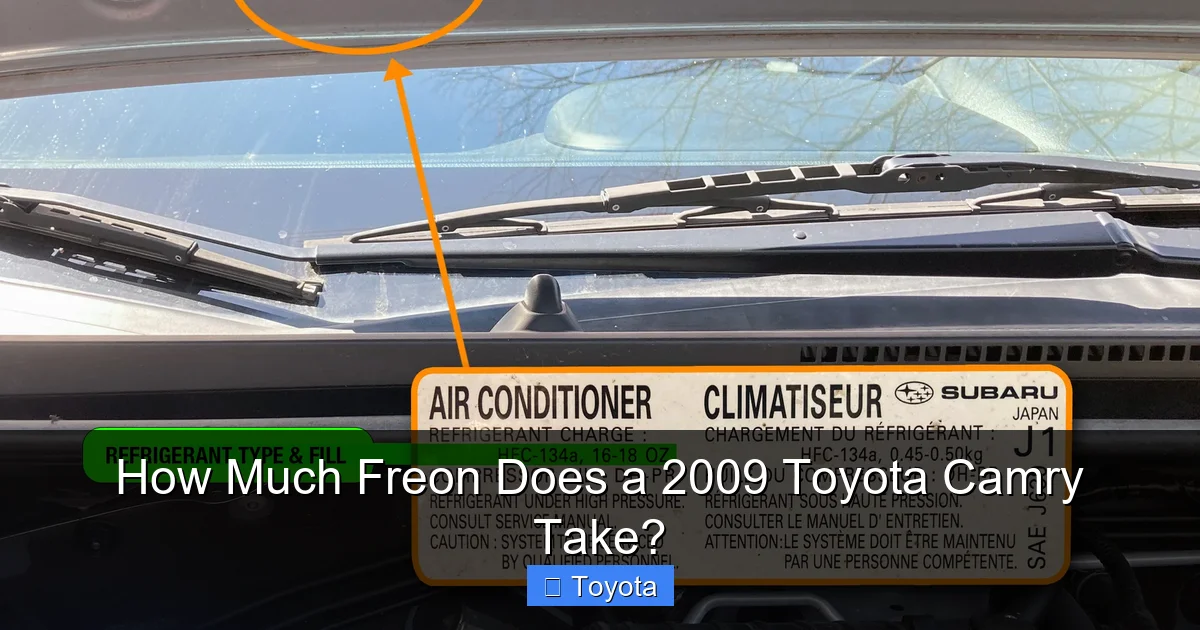
The recommended freon capacity is usually listed on a label under the hood or in the owner’s manual. You can also find it in the service manual or by consulting a Toyota dealership.
Is it safe to overfill the AC system with freon in a 2009 Toyota Camry?
No, overfilling can cause high pressure, leading to compressor damage or system failure. Always follow the specified freon amount to ensure safe and efficient operation.