
How Many Honda Civics Have Been Made

Over 27 million Honda Civics have been produced globally since 1972, making it one of the best-selling cars of all time. This figure spans 11 generations and assembly plants across dozens of countries. The Civic’s unparalleled success stems from its consistent evolution, reliability, and adaptability to diverse global markets. Understanding its production volume reveals insights into manufacturing scale, model longevity, and Honda’s strategic dominance in the compact segment.
Key Takeaways
- Unmatched Production Scale: With over 27 million units built, the Honda Civic is a top-tier global automotive icon, rivaling legends like the Toyota Corolla and Ford F-Series in cumulative sales.
- Generational Diversity Drives Volume: The Civic’s 11 distinct generations, each with multiple body styles (sedan, coupe, hatchback, wagon), allowed Honda to capture a vast array of customer preferences and regional tastes.
- Truly Global Manufacturing: Production isn’t centralized; Civics are built in Japan, the US, Canada, the UK, Brazil, Thailand, China, India, Pakistan, and more, directly serving local markets and optimizing logistics.
- Market-Specific Models Inflate Numbers: Unique models like the Japanese-market Civic Ferio, European Civic Shuttle (wagon), and the performance-oriented Type R contribute separately to the overall production tally.
- Consistent High Volume Per Generation: Unlike many cars that peak and fade, most Civic generations have sold in the millions, demonstrating sustained demand across decades and economic cycles.
- The Future is Electric & Hybrid: As production transitions to include more electrified variants (e.g., Civic e:HEV, potential future EV), the total production number will continue to climb, potentially at an accelerated pace.
📑 Table of Contents
- The Unstoppable Rise: Tracing the Honda Civic’s Production Journey
- Generation by Generation: The Production Milestones
- The Global Factory Network: Where Civics Are Born
- Model Variants: The Secret Sauce of High Volume
- Why Does the Production Number Matter?
- The Future: Electrification and the Next Chapter
- Conclusion: A Number That Tells a Story
The Unstoppable Rise: Tracing the Honda Civic’s Production Journey
When you think of the word “icon” in the automotive world, a few names spring to mind. The Ford Mustang, the Volkswagen Beetle, the Toyota Corolla. And right there, smack in the global top tier, sits the Honda Civic. It’s more than just a car; it’s a cultural touchstone, a commuter’s best friend, and a tuner’s blank canvas. But behind its everyman persona lies a mind-boggling statistic: since its humble beginnings in 1972, well over 27 million Honda Civics have been manufactured and sold across the planet. To put that in perspective, that’s enough vehicles to form a single-file line from New York to Sydney, and back again, with millions to spare. This article isn’t just about quoting a big number. It’s about unpacking how a compact car achieved such monumental production scale, what it says about global manufacturing, and where the iconic nameplate is headed next.
The story of Honda Civic production is a masterclass in strategic product planning. Honda didn’t just build one car for the world; it built a versatile platform that could be tailored, engineered, and marketed for dozens of distinct markets. From the narrow, crowded streets of Tokyo to the sprawling suburbs of California, from the taxis of London to the rally stages of Europe, the Civic has worn many hats. This adaptability is the primary engine behind its colossal production figures. Each generation brought not just an evolution in design and technology, but an expansion in body styles, engine options, and market-specific variants, all contributing to the ever-rising production total. We’ll journey through each generation, examine the global factory network that churns them out, and analyze the model variations that make the “total” such a complex and fascinating figure.
Generation by Generation: The Production Milestones
Breaking down the 27+ million Honda Civics by generation offers a clear view of its sustained popularity. Unlike a flash-in-the-pan hit, the Civic has consistently delivered strong sales volume for over five decades. Each generation built upon the last, refining the formula of efficiency, practicality, and driving enjoyment. The production numbers per generation vary based on lifespan, market expansion, and economic conditions, but the pattern is one of remarkable consistency.
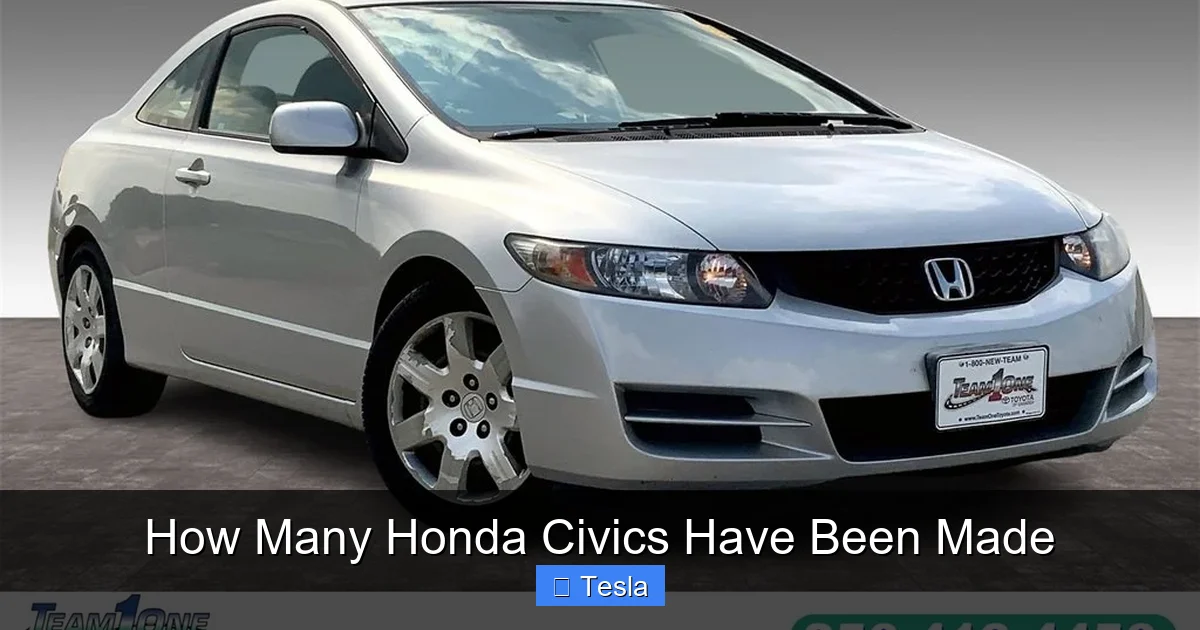
Visual guide about How Many Honda Civics Have Been Made
Image source: carglassadvisor.com
The Foundational First & Second Generations (1972-1983)
The original 1972 Civic arrived as a response to the 1970s oil crisis. It was small, fuel-efficient, and front-wheel drive—a radical departure for Honda. Production for this first generation (1972-1979) and its immediate successor (1979-1983) was primarily centered in Japan (Sayama and Suzuka plants). Combined, these first two generations accounted for approximately 2.5 million units. This may seem small compared to later figures, but it established the core identity: an economical, reliable, and surprisingly fun-to-drive compact. These early models, particularly the hatchback and the later wagon (called the “Wagon” or “Van”), laid the groundwork for the Civic’s multi-body-style strategy that would fuel future production growth. For context on the meticulous engineering that started it all, resources like guides on specific Civic maintenance show how Honda’s attention to detail, even in something as simple as oil capacity, contributed to its legendary reliability reputation.
The Global Explosion: Third to Sixth Generations (1984-2000)
This era marks the point where Civic production truly went global and skyrocketed. The third-generation Civic (1984-1987) introduced the iconic “two-box” design and was the first to be manufactured in the United States at Honda’s Marysville, Ohio plant. This was a pivotal moment, allowing Honda to bypass import tariffs and serve the massive North American market with locally built vehicles. The fourth (1987-1991), fifth (1991-1995), and sixth (1995-2000) generations saw the addition of production facilities in Canada (Alliston, Ontario), the United Kingdom (Swindon), and later, in emerging markets like Brazil and Thailand. These generations perfected the Civic formula: a comfortable, quiet, and refined economy car. The introduction of the VTEC engine in the late 80s also added a performance halo (the Si models) that boosted the Civic’s image. Collectively, generations 3 through 6 likely account for a staggering 8-10 million units. The diversification into sedans, coupes, and the return of the hatchback (in some markets) meant more models, more trims, and more cars rolling off assembly lines worldwide.
The Modern Era: Seventh to Eleventh Generations (2000-Present)
From the seventh generation onward, the Civic entered the modern age of automotive engineering. This period is characterized by a dramatic increase in complexity, safety technology, and powertrain options. The seventh gen (2000-2005) and eighth gen (2005-2011) saw the Civic grow in size and sophistication, aligning with global trends towards larger, more feature-packed compacts. Production expanded further into China and India, two of the world’s largest automotive markets. The ninth generation (2011-2016) faced some criticism for its styling but maintained huge sales volumes due to its fuel efficiency and value. The monumental tenth generation (2016-2021) represented a complete redesign with a more aggressive, lower stance and the controversial “C” shaped tailpipes. It was a massive global success. The current eleventh generation (2022-present) has returned to a more elegant, mature design and introduced a standard hybrid powertrain in many markets, signaling a major shift in the Civic’s identity. These last five generations are likely responsible for another 10-12 million units and counting, as the eleventh generation continues in production. The sheer scale of this modern production run highlights how the Civic remains the absolute cornerstone of Honda’s global passenger car strategy.
The Global Factory Network: Where Civics Are Born
Talking about Honda Civic production numbers is meaningless without understanding the truly global footprint of its manufacturing. Honda operates a “produce where you sell” strategy to minimize shipping costs, avoid tariffs, and adapt vehicles to local regulations and preferences. A Civic bought in Canada is almost certainly built in Canada or the US. One sold in Thailand is built in Thailand. This decentralized model is a key reason for the high total production figure—it removes geographical bottlenecks.
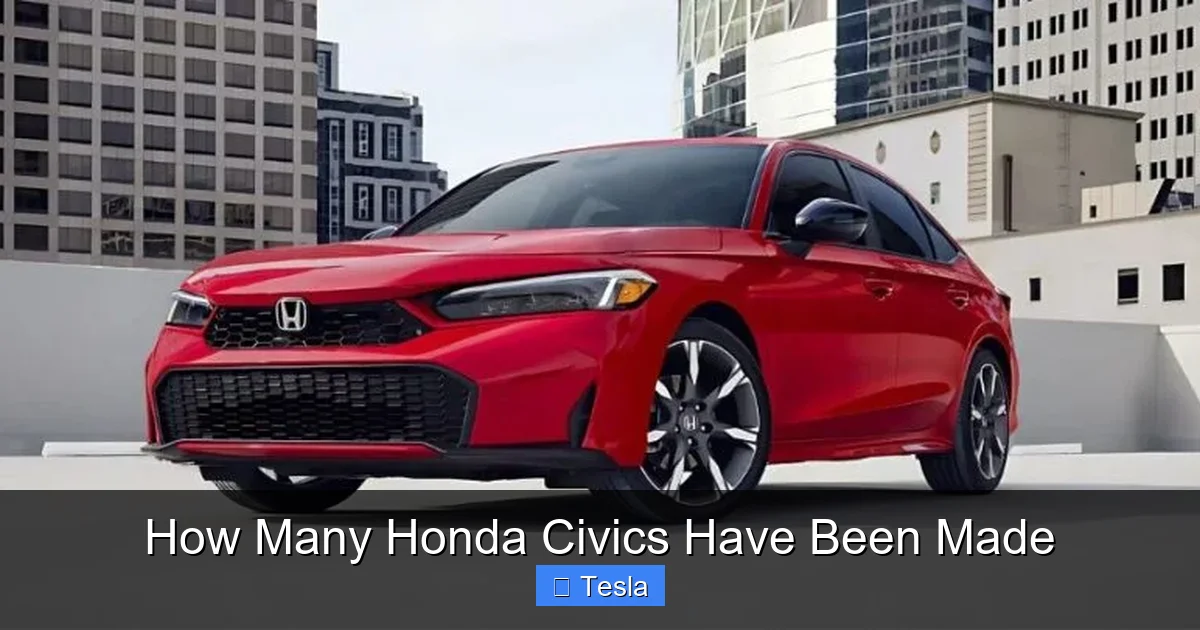
Visual guide about How Many Honda Civics Have Been Made
Image source: buzzlyo.com
The primary Civic manufacturing hubs are in North America: the Marysville Auto Plant (MAP) in Ohio is one of the world’s largest auto plants and has been the core of US Civic production for decades. The Greensburg, Indiana plant (HPM) also produces Civics. In Canada, the Alliston, Ontario plant has long been a key source. Across the Atlantic, the Swindon plant in the UK historically supplied Europe with Civics, though production for that market has now shifted to other locations. In Asia, plants in Thailand, China (Dongfeng Honda and GAC Honda), India (Gurgaon), Pakistan, and Taiwan all produce Civics for their respective regions. Japan’s Sayama plant, the original home, now focuses on other models. This network means that on any given day, hundreds of thousands of Civics are in various stages of assembly across five continents, all contributing to that cumulative 27-million-plus figure. For owners, this global presence also means that finding parts or understanding specific model quirks can vary by region—a resource detailing exact oil capacities for different Civic markets is a perfect example of this regional variation in action.
Model Variants: The Secret Sauce of High Volume
One of the most interesting aspects of calculating total Honda Civic production is that the number isn’t just for “the Civic.” It’s a sum of dozens of distinct model variants. Honda’s genius has been in leveraging a single core platform to spawn an entire family of vehicles. This strategy exponentially increases the potential customer base and, consequently, the total production run.

Visual guide about How Many Honda Civics Have Been Made
Image source: oldest.org
Body Style Bonanza: Sedan, Coupe, Hatchback, Wagon
While the sedan is the perennial best-seller, especially in the US, Honda has consistently offered the Civic as a coupe (until the 2021 model year), a 5-door hatchback (a favorite in Europe and a performance icon in Type R form), and even a station wagon (the Shuttle/Pro in Japan and Europe, the Civic Wagon in the US in the 90s). Each body style has its own production line and sales channels. The hatchback, for instance, shares very little sheet metal with the sedan but uses the same fundamental platform and many mechanicals. This means a single generation’s production total is the sum of all these body styles running concurrently.
The Halo Effect: Performance Models (Si, Type R)
The high-performance variants are a tiny fraction of total volume but are disproportionately important. The Civic Si (Sport injected) has offered a more powerful, driver-focused sedan or coupe since the 80s. The Civic Type R, the ultimate track-focused, turbocharged hatchback, is a limited-production, global phenomenon. While a Type R might sell 20,000-30,000 units globally in a generation, its production is tracked separately and adds to the grand total. These models generate immense buzz and brand loyalty, which feeds sales into the mainstream models, indirectly boosting overall production numbers.
Regional Exclusives and Rebadging
In some markets, the Civic has spawned unique models. In Japan, there was the Civic Ferio (a sedan variant with different styling) and the Civic Orthia (a sportier wagon). In China, the Dongfeng Honda Ciimo was a Civic-based model with distinct exterior styling for that market. These regional variants, while based on the Civic platform, were often counted as separate model lines in production reports, further swelling the cumulative figure. Furthermore, in the past, the Civic platform was sold as the Isuzu Gemini in some markets, adding another layer to the production count.
Why Does the Production Number Matter?
Beyond being a cool trivia fact, the massive Honda Civic production total has real-world implications for consumers, collectors, and the industry.
Parts Availability and Aftermarket Support
With over 27 million units built, the aftermarket for Civics is colossal. Whether you need an oil filter, a suspension component, or a body panel, the sheer volume guarantees that parts are manufactured in huge quantities, keeping costs low and availability high. This is a key reason why Civics are so popular with enthusiasts and mechanics alike. You can almost always find a part, often from multiple suppliers. This ecosystem of support is directly tied to the car’s high production volume.
Resale Value and Longevity
High production volume doesn’t always mean high resale value, but the Civic is an exception. Its reputation for reliability, combined with its massive numbers, creates a robust used car market. There’s always a buyer for a used Civic, and prices remain relatively stable. The “high volume” also means that any single model year or generation is not rare, which keeps prices in check for buyers. For owners, knowing the specifics of their model, like its exact fuel tank capacity, is straightforward because that information is well-documented for such a common vehicle.
Benchmark for the Industry
The Civic’s production success makes it the benchmark against which all other compact cars are measured. Competitors like the Toyota Corolla, Hyundai Elantra, and Mazda3 all aim to match the Civic’s blend of practicality, efficiency, and driving appeal. The fact that Honda has maintained such high production volumes for 50+ years is a testament to its ability to continuously refresh and improve the product, responding to changing consumer demands and regulatory landscapes without losing its core identity.
The Future: Electrification and the Next Chapter
So, what’s next for the Honda Civic production tally? The answer is electrification. The current eleventh-generation Civic is available with a powerful and efficient hybrid powertrain as a standard or optional feature in many markets, including North America. This is a historic shift—the first time a hybrid has been available in the US-market Civic sedan. Honda has announced its intention to make hybrids a core part of its lineup. While a fully electric Civic (BEV) has not been officially announced for the current generation, it is widely expected that future iterations or a dedicated EV model based on the Civic’s architecture will eventually arrive. This transition will not slow production; in fact, as governments push for zero-emission vehicles, electrified models may see even higher demand, potentially pushing the total production number past 30 million and beyond at a faster clip. The Civic’s famous VTEC engine may eventually be retired, replaced by electric motors, but the production philosophy—building a versatile, high-volume global car—will remain unchanged.
Conclusion: A Number That Tells a Story
The statement “over 27 million Honda Civics have been made” is more than a statistic. It’s the culmination of a half-century of automotive evolution, globalization, and unwavering consumer trust. From a tiny, quirky solution to an oil crisis to a sophisticated, globally engineered family car, the Civic’s journey is reflected in its production numbers. The multi-generational consistency, the sprawling international factory network, and the endless model variations all serve a single purpose: to put a Civic on roads everywhere. This volume has created an unparalleled ownership experience—one of low-cost maintenance, ubiquitous parts, and a vibrant community. As the Civic enters its electric future, that production number will continue to climb, adding new chapters to the story of the car that, for millions of people, simply *is* the compact car. Its legacy is written not just in design awards or performance specs, but in the sheer, staggering weight of its own production figures.
Frequently Asked Questions
How many Honda Civics have been made in total?
As of early 2024, cumulative global production of the Honda Civic since its 1972 introduction has surpassed 27 million units. This figure includes all body styles (sedan, coupe, hatchback, wagon) and all regional variants produced across Honda’s worldwide factory network.
Which Honda Civic generation was produced in the highest numbers?
Exact per-generation production figures are closely guarded by Honda, but industry analysts and sales data suggest the seventh (2000-2005), eighth (2005-2011), and tenth (2016-2021) generations are likely the highest-volume producers. Their long model lifespans, massive global reach—especially in North America and emerging markets—and lack of major market missteps contributed to multi-million unit runs each.
Are Honda Civic production numbers the same worldwide?
No. Production numbers vary drastically by region and model year. For example, the sedan dominates sales in the United States, while the hatchback is far more popular in Europe and Japan. Specific models like the Civic Type R are produced in limited numbers at dedicated facilities, primarily in Japan and the UK, and are not included in the mainstream volume totals.
Does the “27 million” include rebadged or derivative models?
It depends on the source and definition. The core 27+ million figure typically counts vehicles sold under the “Civic” badge globally. It may or may not include vehicles that are mechanically identical but sold under different nameplates in specific markets (like the Isuzu Gemini or some China-only variants). It also does not include the closely related, but distinct, Honda Insight, which shared platforms with some Civics.
How can I find out how many of my specific Honda Civic model year were made?
Honda does not publicly release exact production numbers for specific model years and trims. The best estimates come from automotive industry databases, VIN (Vehicle Identification Number) decoding services, and enthusiast clubs that may have compiled data from dealer registrations or Honda internal communications. For common US-market models, production was often in the hundreds of thousands per year.
Will the Civic’s production total keep growing?
Absolutely. The current 11th-generation Civic is in full production, and Honda has committed to offering hybrid powertrains as a core option globally. With the ongoing shift toward electrification and the Civic’s role as a volume cornerstone, it is highly probable that the total production number will continue to climb for the foreseeable future, potentially surpassing 30 million units within the next decade.
