How Many Gallons Does a Jeep Wrangler Hold?

Contents
- 1 Key Takeaways
- 2 📑 Table of Contents
- 3 How Many Gallons Does a Jeep Wrangler Hold? The Complete Guide
- 4 A Breakdown by Generation: From YJ to JL
- 5 Why the Big Difference? The Engineering Behind the Numbers
- 6 Real-World Range: It’s Not Just About the Gallons
- 7 Special Cases and Aftermarket Solutions
- 8 How to Find Your Exact Tank Capacity: A Practical Guide
- 9 Putting It All Together: Your Action Plan
- 10 Frequently Asked Questions

Liquid Car Polish

Tool Roll Bag

Car Storage Net

Parking Sensor Kit
The Jeep Wrangler’s fuel tank capacity varies significantly by model and year. A standard 2-door Wrangler holds 17.4 gallons, while the 4-door Wrangler Unlimited holds 21.5 gallons. Newer models with the optional turbo engine may have slight variations. Understanding your specific tank size is crucial for planning adventures and managing fuel range.
Key Takeaways
- 2-Door vs. 4-Door: The most significant factor is the body style. The 2-door Jeep Wrangler has a 17.4-gallon tank, while the 4-door Wrangler Unlimited has a larger 21.5-gallon tank.
- Model Year Matters: While the 17.4/21.5-gallon standard has been consistent for recent JL and JK generations, earlier TJ models (1997-2006) had a 19-gallon tank, and very early YJ models (1987-1995) held 15 gallons.
- The Spare Tire Well: The fuel tank is positioned in front of the rear axle, and the spare tire sits in a well above it. This iconic design does not reduce tank capacity but dictates its shape and location.
- Range is More Important Than Gallons: A 21.5-gallon tank in a 4-door with a V6 might get 350-400 miles, while the same tank in a heavy, modified Rubicon with large tires might only get 250-300 miles.
- Aftermarket Options Exist: For extreme overlanding, auxiliary fuel tanks or larger replacement tanks are available, but they require professional installation and can affect vehicle weight and emissions legality.
- Always Check Your Manual: For absolute certainty about your specific vehicle’s capacity, the owner’s manual or the fuel filler door sticker is the definitive source.
- Towing Reduces Effective Capacity: Towing a trailer dramatically decreases your fuel range, making the larger 4-door tank a major advantage for those who tow.
📑 Table of Contents
- How Many Gallons Does a Jeep Wrangler Hold? The Complete Guide
- A Breakdown by Generation: From YJ to JL
- Why the Big Difference? The Engineering Behind the Numbers
- Real-World Range: It’s Not Just About the Gallons
- Special Cases and Aftermarket Solutions
- How to Find Your Exact Tank Capacity: A Practical Guide
- Putting It All Together: Your Action Plan
How Many Gallons Does a Jeep Wrangler Hold? The Complete Guide
You’re staring at the fuel gauge. It’s dipping into the red. You’re on a backcountry trail, miles from the nearest pump, with your trusty Jeep Wrangler. That nagging question hits you: how many gallons does a Jeep Wrangler hold? It’s not just trivia. Knowing your exact fuel tank capacity is the first step to mastering your range, planning epic adventures, and avoiding that gut-wrenching feeling of running out of gas in the middle of nowhere. The answer isn’t as simple as one number. It depends on what kind of Wrangler you have. Let’s crack this code wide open.
Think of the Jeep Wrangler’s fuel tank like its adventure stomach. A bigger stomach means longer stretches between refueling stops, which is pure gold for overlanding and remote travel. But size isn’t everything. What you put in that stomach—your driving style, tires, roof load, and whether you’re crawling over rocks or cruising highways—dictates how far you actually go. We’re going to break down the gallons for every Wrangler generation, explain the why behind the numbers, and give you the tools to calculate your real-world range. Whether you own a vintage TJ, a modern JL, or are shopping for your first Wrangler, this guide will fuel your knowledge.
The Short Answer: It’s All About the Door Count
If you want the quick, modern answer, here it is. For the current JL generation (2018-Present) and the previous JK generation (2007-2018), the rule is beautifully simple:
- Jeep Wrangler 2-Door (Sport, Sahara, Rubicon, etc.): 17.4 gallons (approximately 65.9 liters).
- Jeep Wrangler Unlimited 4-Door (Sport, Sahara, Rubicon, etc.): 21.5 gallons (approximately 81.4 liters).
That’s it. A 4-door Wrangler holds about 4 more gallons than its 2-door sibling. That difference translates to a potential 80-120+ miles of extra range, which is a game-changer for long trips. But wait, why is there a difference? And what about older models? Let’s dive deeper.
A Breakdown by Generation: From YJ to JL
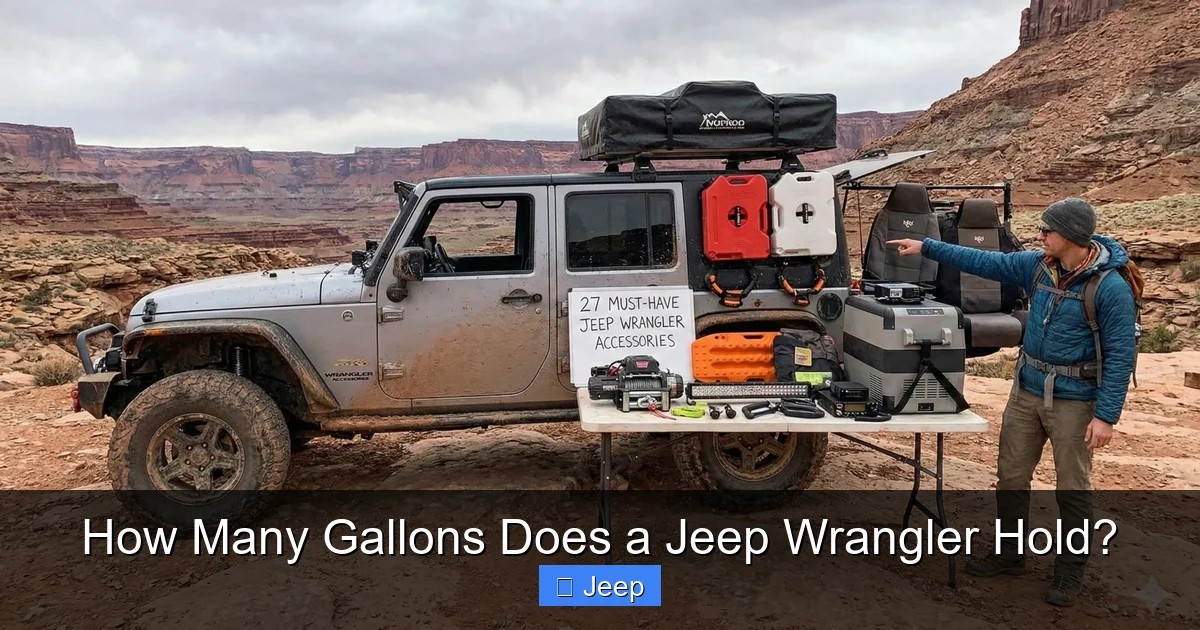
The Wrangler has evolved through four distinct nameplates: YJ, TJ, JK, and JL. The fuel tank size has changed a few times along the way, primarily due to chassis redesigns and emissions equipment packaging.
Visual guide about How Many Gallons Does a Jeep Wrangler Hold?
Image source: adventurejeep.com
The YJ Era (1987-1995): The Original Square-Hood Wrangler
The YJ, famous for its square headlights and Chrysler 2.5L 4-cylinder or 4.0L inline-6 engine, had a fuel tank capacity of 15 gallons (57 liters). This was a compact, utilitarian tank suited for its era. Finding a well-preserved YJ today is a treasure, and knowing its 15-gallon limit is key for any restoration or adventure planning.
The TJ Era (1997-2006): The Round-Hood Classic
The beloved TJ, with its round headlights and coil-spring suspension, saw an increase in tank size. For the vast majority of TJ models, the capacity is 19 gallons (72 liters). This was a significant jump, offering better range for the popular 4.0L inline-6. There were no official factory variations between 2-door and 4-door (the TJ was only a 2-door). Some very early 1997 models might have minor variations, but 19 gallons is the standard you can rely on. If you own a TJ, you have a healthy 19-gallon tank under your rear floor.
The JK Era (2007-2018): The Introduction of the Unlimited
The JK generation brought the revolutionary 4-door Wrangler Unlimited to the market. This is where the now-standard split was born. For the JK:
- JK 2-Door: 17.4 gallons (65.9 L)
- JK Unlimited 4-Door: 21.5 gallons (81.4 L)
The 2-door’s tank was slightly smaller than the TJ’s 19 gallons, a change likely due to the new chassis design and space needed for the expandable rear seat system. The 4-door’s longer wheelbase allowed for a much larger tank, making it the undisputed king of range for this generation. This JK/JL standard has held firm for over 15 years because it works perfectly with the vehicle architecture.
The JL Era (2018-Present): Refinement and the Turbo Option
The current JL generation refined the formula but kept the tank sizes identical to the JK for the most part:
- JL 2-Door: 17.4 gallons (65.9 L)
- JL Unlimited 4-Door: 21.5 gallons (81.4 L)
There is one extremely minor nuance. Some early 2020-2021 JL models equipped with the new 2.0L turbocharged 4-cylinder engine (the “Turbo S” or “EcoDiesel” variants in some markets) were reported to have a capacity of 21.1 gallons in the 4-door, a difference of less than half a gallon due to tank shape modifications for emissions hardware. For all practical purposes, you can consider your 4-door a 21.5-gallon tank and your 2-door a 17.4-gallon tank. The V6 models (3.6L Pentastar) are the overwhelming majority and adhere strictly to the 17.4/21.5 standard.
Why the Big Difference? The Engineering Behind the Numbers
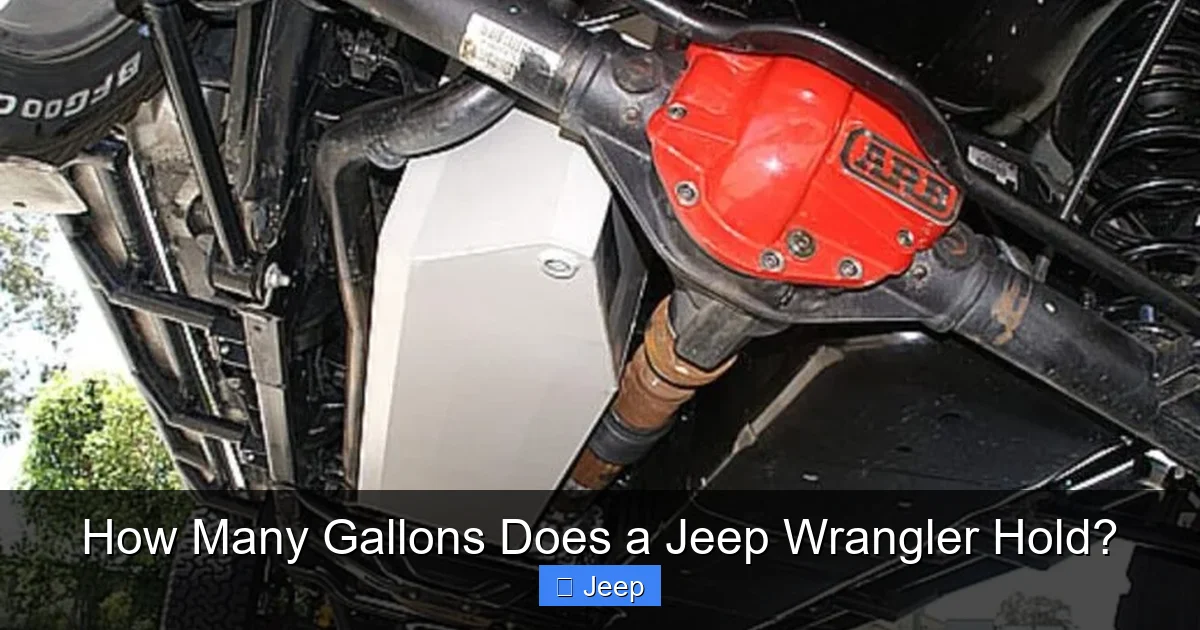
It’s not an arbitrary decision. The 4-gallon jump between 2-door and 4-door is a direct result of the longer wheelbase. The fuel tank is a large, molded plastic or steel container that sits horizontally, ahead of the rear axle, beneath the rear seat area. In the 4-door, the extra length between the rear wheels provides more physical space to fit a wider, longer tank. The 2-door’s shorter rear overhang simply doesn’t have the same real estate. Engineers maximize every cubic inch of available space, but physics is physics. The spare tire, which sits in a well above the tank, is in the same relative position on both models, so it doesn’t create the capacity disparity.
Visual guide about How Many Gallons Does a Jeep Wrangler Hold?
Image source: psychoautos.com
This design is a classic Jeep trade-off. The solid rear axle and sturdy frame are perfect for off-road articulation, but they create a tall “tunnel” for the tank. The tank’s shape is often irregular to clear the driveshaft, exhaust, and suspension components. This is why you’ll sometimes hear about “suck-back” or “fuel starvation” on steep, off-camber hills. The fuel pick-up tube inside the tank can’t reach every corner when the Wrangler is at a severe angle, potentially causing the engine to sputter. This is a known characteristic of the design, not a defect, and is why many serious off-roaders add a swirl pot or fuel cell.
Does a Lift Kit or Bigger Tires Change My Tank Capacity?
Here’s a common myth. A suspension lift (body lift or suspension lift) and larger tires do not change the physical volume of your fuel tank. The tank stays the same size. However, they dramatically affect your effective range and fuel economy. Larger, heavier tires increase rolling resistance and rotational mass. A lift often changes the vehicle’s aerodynamics and may require re-gearing. All of this means your miles per gallon (MPG) will drop. So, while you still have 17.4 gallons in your 2-door, you might only get 200 miles on a tank instead of 250. Your “functional capacity” in terms of distance shrinks. This is a critical consideration when modifying your Wrangler. You can learn more about the costs and implications of modifications in our guide on how much a Jeep lift costs.
Real-World Range: It’s Not Just About the Gallons
Knowing you have 21.5 gallons is step one. Step two is asking: “How far can I actually go?” The EPA provides official MPG ratings, but real-world Wrangler mileage is a spectrum. A stock, highway-driven 4-door V6 might achieve 22-25 MPG, giving it a theoretical range of 470-540 miles on a full tank. But that’s a best-case scenario.
Visual guide about How Many Gallons Does a Jeep Wrangler Hold?
Image source: vehiclefreak.com
For the average owner, a mixed-driving 4-door sees 18-22 MPG. That’s a range of 387-473 miles. Now, add the real-world variables:
- Off-Roading: Low-range crawling can drop MPG to single digits. Your 21.5 gallons might only last 150-200 miles of hard trail use.
- Heavy Loads & Roof Racks: A fully loaded Wrangler with a rooftop tent, bikes, and gear can see a 20-30% drop in efficiency. That 21.5-gallon range could fall below 300 miles.
- Wind & Terrain: Headwinds and mountainous terrain are range killers for any vehicle, especially a boxy one like a Wrangler.
- Tire Size & Pressure: Oversized, mud-terrain tires at low pressure create immense drag. Proper inflation is critical for range.
The takeaway? Your Jeep Wrangler fuel tank capacity sets the upper limit, but your driving context sets the reality. For overlanding, many seasoned Wrangler pilots use the “half-tank rule”: plan your adventures so you never have less than half your tank’s worth of fuel between known stations. For a 4-door, that means planning for no more than 200-250 miles between fill-ups in remote areas.
The Towing Question: How Does a Trailer Affect My Range?
Towing is where the 4-door’s larger tank truly pays off. Towing any significant load (a camper, boat, or utility trailer) can slash your Wrangler’s fuel economy by 30-50% or more. The V6 engine works much harder, constantly downshifting and revving higher. A 2-door with a 17.4-gallon tank might see its highway range drop from 350 miles to under 200 miles when towing. The 4-door’s extra 4 gallons provides a crucial buffer, potentially adding 50-70 miles of towing range before you’re searching for a gas station with a long ramp. If you plan to tow, the 4-door isn’t just more convenient; it’s a practical necessity for longer distances. Always consult your owner’s manual for your specific model’s Gross Combined Weight Rating (GCWR).
Special Cases and Aftermarket Solutions
While the factory numbers are clear, some Wrangler owners need more. Who are they?
Aftermarket Auxiliary and Replacement Tanks
For the hardcore overlander or desert racer, 21.5 gallons isn’t enough. Companies like Trailworthy Fab, Roadhouse Engineering, and Jp Magazine offer solutions:
- Auxiliary Tanks: These are additional tanks mounted in the cargo area, often with a transfer pump. They add 5-15 gallons but eat up precious cargo space.
- Larger Replacement Tanks: Some fabricators build a single, larger tank that replaces the factory unit, sometimes integrating the spare tire well. These can push total capacity to 30+ gallons but are complex, expensive, and may require fuel pump modifications.
Critical Warning: Any fuel system modification must comply with local laws and emissions regulations. In many areas, tampering with the evaporative emissions (EVAP) system is illegal for street-driven vehicles. These are primarily for competition or off-highway use. Installation is also not trivial and should be done by professionals to avoid fire hazards.
What About the Hybrid 4xe?
The plug-in hybrid Wrangler 4xe uses a completely different system. It has a 17.7-gallon gasoline tank (for the 2024+ model) paired with a 17.3 kWh battery. The gasoline tank is slightly smaller than a standard V6 2-door’s 17.4 gallons because of the space taken by the battery pack under the rear seat. However, the 4xe’s total “range” is a combination of electric-only (around 21 miles) and gasoline power. For pure gasoline operation, its tank is very similar to a standard 2-door. The 4xe is only available as a 4-door Unlimited, so its 17.7-gallon tank is smaller than the 21.5-gallon tank in a standard 4-door V6. This is a key trade-off for plug-in hybrid efficiency.
How to Find Your Exact Tank Capacity: A Practical Guide
So you have a Wrangler. How do you confirm its capacity beyond a doubt?
The Definitive Sources
- Owner’s Manual: This is the bible. Look in the “Specifications” or “Fuel” section. It will list “Fuel Tank Capacity” in gallons and liters.
- Fuel Filler Door Sticker: Many Wranglers have a sticker on the fuel filler door that says “Fuel Capacity: XX Gal.” This is the easiest spot to check without opening the manual.
- VIN Decoding: You can use your Vehicle Identification Number (VIN) on sites like Jeep’s official owner portal or third-party decode services. The VIN encodes body style, engine, and other specs that determine your tank size.
- Physical Measurement (The Last Resort): If all else fails, you can run the tank bone-dry (safely, with a jerrycan handy!), then fill it at a gas station. Note the exact gallons pumped. This is the most accurate real-world method but carries the risk of running out of fuel.
Don’t trust random internet forums for your specific VIN. A 2021 Rubicon 4-door and a 2021 Sport 4-door have the same 21.5-gallon tank. The trim level doesn’t matter; the body style and model year do.
Putting It All Together: Your Action Plan
Now you’re armed with the data. Here’s how to use it:
- For New Buyers: If maximum range is a top priority, the 4-door Wrangler Unlimited is the clear winner with its 21.5-gallon tank. The 2-door is fantastic for agile, shorter trips or those who prioritize a smaller footprint.
- For Current Owners: Calculate your real range. Fill up, reset your trip odometer, drive normally until the low-fuel light comes on (don’t run it dry!), then note the miles driven. Divide miles by gallons (17.4 or 21.5) to get your actual MPG. This is your personal baseline for trip planning.
- For Adventure Planners: Never rely on the “miles to empty” readout in your gauge cluster. It’s notoriously optimistic in Wranglers, especially off-road. Use your calculated real-world MPG and subtract a 15-20% safety margin. If your 4-door gets 20 MPG in mixed use, plan on 16 MPG for remote travel. 21.5 gallons / 16 MPG = ~340 miles between fill-ups in ideal conditions. Always have a reliable fuel range planning strategy, similar to what drivers of other SUVs like the Nissan Rogue use.
- For Modifiers: If you’re adding 37-inch tires and a 4-inch lift, assume a 25-30% drop in MPG before you even hit the trail. Your 21.5-gallon tank might feel like 16 gallons in terms of distance. Adjust your expectations and fuel stops accordingly.
Frequently Asked Questions
Does a 2024 Jeep Wrangler have the same gas tank size as a 2020 model?
Yes. For the JL generation (2018-Present), the fuel tank capacity has remained consistent. All 2-door JL Wranglers hold 17.4 gallons, and all 4-door JL Wrangler Unlimiteds hold 21.5 gallons, regardless of year or trim (Sport, Sahara, Rubicon, etc.). The only minor exception is the early 4xe plug-in hybrid model, which has a 17.7-gallon tank.
Why does my 4-door Wrangler have a smaller tank than my friend’s old 4-door?
Your friend likely owns a JK or JL 4-door (21.5 gal). If they have an older model, it might be a TJ, which was only a 2-door (19 gal). There has never been a factory-produced 4-door TJ. If they have a much older vehicle, it could be a YJ (15 gal) or even a CJ-7 (15 gal). The 21.5-gallon tank for the 4-door is a JK/JL innovation made possible by the longer wheelbase of the Unlimited model.
Does adding a lift kit or bigger tires change how many gallons my tank holds?
No. A lift kit and bigger tires do not alter the physical volume of your factory fuel tank. You still have 17.4 or 21.5 gallons of capacity. However, these modifications significantly reduce your fuel economy (miles per gallon), which means you will travel fewer miles on that same amount of fuel. Your effective range decreases, even though the tank size remains constant.
How can I check my specific Jeep Wrangler’s fuel tank capacity?
The most reliable methods are: 1) Check the sticker on your fuel filler door, which usually lists the capacity. 2) Consult your owner’s manual in the specifications section. 3) Use your Vehicle Identification Number (VIN) to decode your vehicle’s specifications on the official Jeep owner’s website. You can also safely determine it by running the tank nearly empty (with a spare gas can handy), then filling it completely and noting the gallons pumped.
Is there an aftermarket way to get more than 21.5 gallons in a 4-door Wrangler?
Yes, but with major caveats. Specialized aftermarket companies offer auxiliary fuel cells or larger replacement tanks that can increase total capacity to 30 gallons or more. However, these are expensive, require professional fabrication and installation, often sacrifice cargo space, and may violate emissions laws (like tampering with the EVAP system) for street use. They are primarily intended for dedicated off-road competition or extreme overlanding vehicles not intended for public roads.
How does towing a trailer affect my Wrangler’s usable fuel range?
Towing a trailer has a severe impact on your Wrangler’s fuel economy, often reducing MPG by 30-50%. This dramatically shortens your range on a full tank. For example, a 4-door with a 21.5-gallon tank that normally gets 400 miles might only get 200-250 miles while towing a moderate-sized camper. The larger 4-door tank provides a crucial buffer for towing, but you must plan fuel stops much more frequently. Always calculate your towing MPG separately before a long trip.