Does Tesla Have a Transmission?

Contents
- 1 Key Takeaways
- 2 📑 Table of Contents
- 3 Does Tesla Have a Transmission? Unpacking the Electric Drivetrain Mystery
- 4 The Short Answer: Yes, But Not in the Way You’re Imagining
- 5 How Tesla’s “Transmission” Actually Works: The Single-Speed Gearbox
- 6 Comparing Tesla to Traditional Automatic Transmissions
- 7 Real-World Implications for Tesla Owners
- 8 The Future: Are Multi-Speed Transmissions Coming to EVs?
- 9 Conclusion: A Transmission Redefined
- 10 Frequently Asked Questions

Car Roof Rack Cross Bars

Rear View Camera

Car GPS Navigator

Car Battery Tester
Tesla vehicles do not have a traditional multi-speed transmission found in gasoline cars. Instead, they rely on a single-speed gearbox that directly connects the electric motor to the wheels, ensuring seamless power delivery and maximizing efficiency for instant acceleration.
Key Takeaways
- Teslas lack traditional multi-speed transmissions. They use a single-speed gearbox instead.
- This single-speed design maximizes electric motor efficiency. It delivers power optimally across all speeds.
- Instant electric torque eliminates the need for gear shifts. Acceleration is smooth and seamless.
- Regenerative braking integrates with the single gear. It slows the car and recaptures energy.
- Fewer moving parts significantly reduce maintenance needs. There are no transmission fluid changes.
- The simplified design enhances reliability and longevity. It removes complex, failure-prone components.
- Efficiency and simplicity are the core advantages. This defines the Tesla drivetrain philosophy.
📑 Table of Contents
- Does Tesla Have a Transmission? Unpacking the Electric Drivetrain Mystery
- The Short Answer: Yes, But Not in the Way You’re Imagining
- How Tesla’s “Transmission” Actually Works: The Single-Speed Gearbox
- Comparing Tesla to Traditional Automatic Transmissions
- Real-World Implications for Tesla Owners
- The Future: Are Multi-Speed Transmissions Coming to EVs?
- Conclusion: A Transmission Redefined
Does Tesla Have a Transmission? Unpacking the Electric Drivetrain Mystery
You’re staring at a sleek Tesla, maybe a Model 3 zooming silently past or a Model X folding its falcon-wing doors. The question pops into your head, simple and direct: does Tesla have a transmission? It’s a fair question! For over a century, the “transmission” has been the heart of how we think about cars changing gears. But what if the very premise of your question is built on an outdated assumption? Buckle up (or don’t, since seatbelts are still very much a thing), because the answer is one of the most elegant and revealing aspects of electric vehicle engineering. It’s a story of simplicity meeting incredible performance, and it might just change how you view every car you see from now on.
Let’s be honest. Most of us grew up with the distinct feel of a car shifting—the slight pause, the change in engine note, the lurch of a torque converter. We learned to drive with a clutch pedal or at least understood that an “automatic” was still doing something complex behind the scenes. So when we hear an electric motor makes all its torque instantly and revs to an astonishingly high speed, our brains short-circuit. Where are the gears? How does it go from slow to fast without shifting? The confusion is totally understandable. It’s like expecting a smartphone to have a rotary dial—the fundamental technology has moved on. In this deep dive, we’ll unravel the truth, compare it to what you know, and explore what this means for you as an owner or potential buyer.
The Short Answer: Yes, But Not in the Way You’re Imagining
Here’s the TL;DR: Yes, every Tesla has a transmission. But before you picture a clunky, multi-speed gearbox with a complex valve body and torque converter, let’s redefine the term. In the broadest engineering sense, a transmission is any system that transfers mechanical power from an engine or motor to the wheels, often changing the speed and torque in the process. By that definition, Tesla absolutely has one. However, it’s a seismic departure from the traditional automatic or manual transmission you’re picturing.
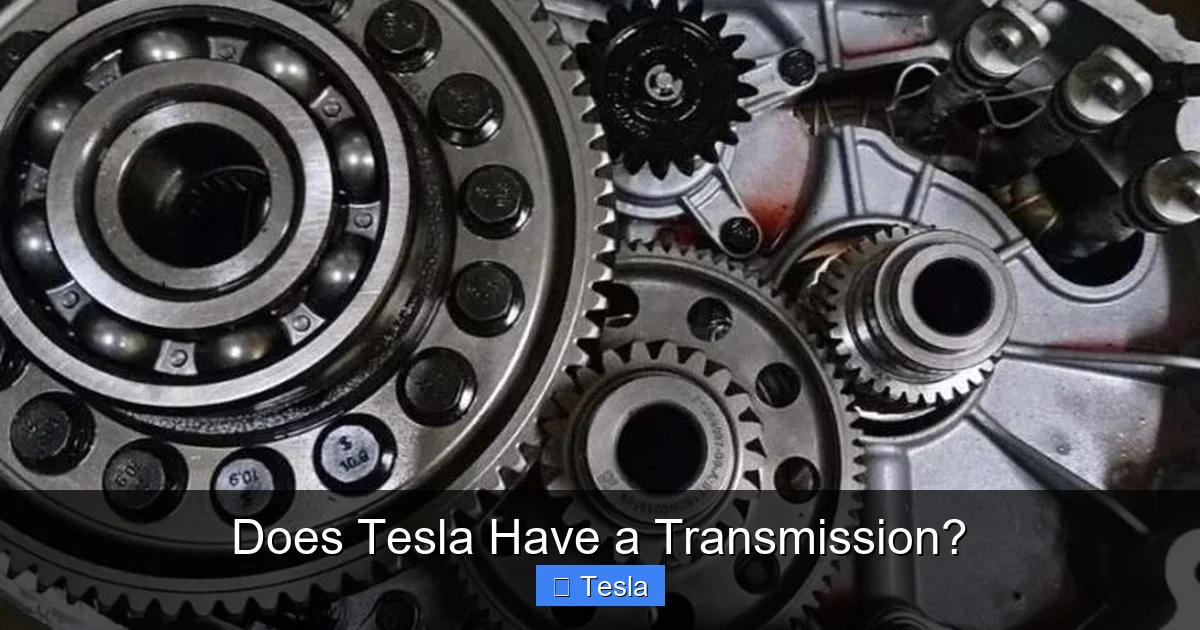
Visual guide about Does Tesla Have a Transmission?
Image source: trucksauthority.com
Defining “Transmission” in the Electric Era
The core of the confusion lies in semantics. When car enthusiasts say “transmission,” they almost always mean a multi-speed gearbox. This is the device with 6, 8, 10, or even more physical gear ratios that an internal combustion engine (ICE) uses to stay within its optimal power band. An electric motor, particularly the AC induction motors and permanent magnet synchronous reluctance motors Tesla uses, has a fundamentally different power delivery characteristic.
- ICE Engines: Have a narrow “power band.” They make peak power and efficiency in a specific, relatively small range of RPMs. They stall at low RPMs and scream at high RPMs. A multi-speed transmission is essential to keep the engine in its happy zone while the car goes from 0 mph to 70+ mph.
- Electric Motors: Have an incredibly wide, flat torque curve. They produce maximum torque from 0 RPM all the way up to their (very high) redline. One gear ratio is often sufficient to cover the entire usable speed range of the vehicle.
So, Tesla’s “transmission” is most accurately called a single-speed reduction gear or a fixed-ratio gearbox. It’s a single, permanently engaged gear set that reduces the incredibly high-speed, lower-torque rotation of the motor (often 10,000+ RPM) down to a usable wheel speed while simultaneously multiplying torque. There are no gear shifts. No torque converter slip. No complex clutch packs. It’s a marvel of mechanical simplicity. To understand the contrast, think about how a Dodge Dakota’s transmission must juggle multiple gears to manage a V6 or V8 engine’s narrow power band—a task a single-speed unit handles effortlessly for an electric motor.
How Tesla’s “Transmission” Actually Works: The Single-Speed Gearbox
Let’s pop the hood (or frunk, in Tesla’s case) and look at the hardware. The Tesla drivetrain is a study in elegant integration. The main components are the electric motor(s), the power electronics (inverter), the reduction gear, and the differential.

Visual guide about Does Tesla Have a Transmission?
Image source: automotiveglory.com
The Key Components: Motor, Gear, Differential
The electric motor spins at an extremely high rate. Directly attached to its output shaft is the reduction gear—essentially a set of gears with a fixed ratio, commonly around 9:1 for many models. This means for every 9 rotations of the motor, the output shaft (which connects to the half-shafts and wheels) turns once. This does two vital things: it brings the motor’s RPM down to a road speed that matches the tire size, and it multiplies the motor’s torque by roughly that same factor (minus mechanical losses).
The differential is still there, just like in any car. Its job is to allow the inside and outside wheels to rotate at different speeds during a turn. In many Tesla models, this differential is integrated into the reduction gear housing, creating a compact, sealed unit often referred to as the “gearbox” or “drive unit.” It’s lubricated with a specific, long-life oil and is designed to be virtually maintenance-free for the life of the vehicle. There are no bands, clutches, or solenoids to wear out. This starkly contrasts with the intricate, fluid-dependent complexity of a traditional automatic transmission found in most ICE vehicles.
Regenerative Braking: The “Engine Braking” of EVs
Here’s where Tesla’s system feels different in daily driving. When you lift off the accelerator, the Tesla’s software commands the motor to become a generator. It uses the magnetic resistance of the motor to slow the car down, converting kinetic energy back into electricity to recharge the battery. This creates a strong deceleration effect, often so strong you can drive using only the accelerator pedal (“one-pedal driving”).
This process is managed entirely by software and power electronics. The single-speed gearbox remains in its fixed ratio. There is no “downshifting” into a lower gear for engine braking; the motor itself provides that resistance across its entire RPM range. This is a key functional difference from an ICE car, where engine braking relies on the vacuum and compression of a specific gear. The Tesla’s regen is smoother, more controllable (via steering wheel paddle settings), and far more efficient at recapturing energy.
Comparing Tesla to Traditional Automatic Transmissions
To truly appreciate Tesla’s approach, let’s put it side-by-side with the conventional automatic transmission. We’ll use a comparison table to highlight the core differences in philosophy and execution.

Visual guide about Does Tesla Have a Transmission?
Image source: roadandgarage.com
| Feature | Tesla Single-Speed Gearbox | Traditional Multi-Speed Automatic (e.g., 8-Speed) |
|---|---|---|
| Number of Gears | 1 (Fixed ratio) | 6 to 10+ forward gears, plus reverse |
| Primary Purpose | Torque multiplication & speed reduction | Keep ICE in optimal power/efficiency RPM band |
| Mechanical Complexity | Very Low (Gear set, bearings, seals) | Very High (Planetary gearsets, clutches, bands, valve body, torque converter) |
| Shifting | None. Smooth, seamless acceleration. | Physical gear changes, managed by hydraulic/electronic controls. Can be smooth or jerky. |
| Efficiency Losses | Minimal (~3-5% in drivetrain) | Significant (~10-20%+ in drivetrain due to torque converter slip, pump drag, shifting losses) |
| Maintenance | Essentially none. Sealed for life. No fluid changes under normal service. | Regular transmission fluid and filter changes (e.g., every 30k-60k miles). Potential for complex, costly repairs. |
| Weight | Lighter (~70-120 lbs for unit) | Heavier (~150-250+ lbs for unit + fluid) |
| Failure Modes | Bearing wear, gear tooth damage (rare). Usually whole-unit replacement. |
The table tells the story. Tesla’s system trades the adaptive flexibility of multiple gears for overwhelming simplicity, efficiency, and reliability. The traditional automatic is a masterpiece of mechanical engineering designed to solve the problem of the ICE’s narrow power band. Tesla’s solution solves a different problem—how to efficiently deliver the electric motor’s vast, instant torque—with far fewer parts. This fundamental difference is why you’ll never experience a “shift shock” in a Tesla and why long-term durability is a major selling point. Speaking of longevity, for context on how different powertrains age, you might wonder how long a Honda Civic’s transmission lasts, a benchmark for ICE reliability that highlights the different stress profiles between traditional and electric drivetrains.
Real-World Implications for Tesla Owners
This isn’t just an engineering footnote; it has a direct, daily impact on the ownership experience. The absence of a traditional transmission shapes everything from driving feel to maintenance costs.
The Driving Experience: Instant, Linear, and Silent
The most immediate effect is the driving sensation. Press the accelerator, and the car surges forward with a smooth, uninterrupted, and silent force. There’s no delay for a downshift, no revving engine climbing through gears, no shift shock. It’s a continuous, linear application of power that feels both incredibly fast and strangely serene. This is the “EV smile” that converts so many drivers. The acceleration is consistent from a stop to highway speeds because the motor is always in its optimal power band—there’s no need to “find the right gear.” The only sound is the faint whine of the motor and wind/road noise. For performance, this means a Model S Plaid can achieve mind-bending 0-60 mph times without a single gear change, a feat impossible for any multi-speed ICE car.
Maintenance and Long-Term Ownership
This is where the single-speed design shines for practicality. One of the most expensive and common failure points in any ICE car is the transmission. Rebuilding or replacing one can cost thousands. In a Tesla, that entire category of repair is virtually eliminated. The drive unit is a sealed unit. Tesla’s official stance is that it requires no scheduled maintenance for the lifetime of the vehicle under normal use. The oil inside is designed to last the life of the unit.
Of course, “virtually no maintenance” doesn’t mean “invincible.” Bearings can wear, seals can leak, and in very rare cases, the gear teeth or motor windings can be damaged (often from extreme abuse or a pre-existing defect). However, the statistical probability of a failure is dramatically lower. This translates to potentially lower lifetime ownership costs and less anxiety. It also means one less complex system for a mechanic to diagnose, which is a double-edged sword—you need a Tesla-certified technician with specific diagnostic tools, which can affect labor rates. You might also consider the cost of other Tesla-specific maintenance, like wrapping a Model 3 or installing a home charger, as part of the broader ownership picture.
Towing and Heavy Loads: A Different Consideration
This is a common point of discussion. A single gear ratio is a compromise. For optimal efficiency and performance in a car’s intended speed range (0-100+ mph), Tesla’s ratio is perfect. But for extreme low-speed, high-torque applications like towing a massive trailer up a long, steep grade at a steady, low speed, the motor will be working at a very high RPM continuously. This is less efficient and can generate more heat than an ICE truck that could simply downshift into a low gear and lug along at a low, efficient RPM.
For the vast majority of owners, this is a non-issue. Teslas have excellent towing capacity ratings for their class (e.g., Model X up to 5,000 lbs, Cybertruck up to 11,000+ lbs). The instant torque makes getting a load moving effortless. However, for constant, heavy-duty towing in mountainous terrain, a traditional truck with a multi-speed transmission and a diesel engine’s low-end grunt might still have an efficiency and thermal advantage. It’s a trade-off of design philosophy.
The Future: Are Multi-Speed Transmissions Coming to EVs?
If one gear is so great, why are some companies exploring two-speed or even more gears for EVs? The answer is that as EVs push into new segments, the single-speed compromise becomes more apparent. For ultra-high-performance hypercars (like the Porsche Taycan’s two-speed front axle gearbox) or heavy-duty commercial trucks, an additional gear can optimize both acceleration and high-speed efficiency or low-speed pulling power.
However, for mainstream Tesla vehicles, the single-speed remains the optimal solution. It aligns perfectly with the brand’s ethos of simplicity, reliability, and cost-effectiveness. The efficiency gains from eliminating a multi-speed transmission’s parasitic losses are significant for maximizing range—a critical factor for every EV buyer. Tesla’s bet is that the motor’s inherent characteristics and the car’s software (managing power delivery and thermal limits) make a complex gearbox unnecessary for 95% of use cases. The remaining challenges are being tackled by improving motor technology (wider high-torque bands) and battery energy density. So, while you may see multi-speed EVs from other manufacturers, don’t expect a traditional “shifting” Tesla anytime soon. The engineering philosophy is too deeply ingrained.
Conclusion: A Transmission Redefined
So, does Tesla have a transmission? The engineering answer is yes, it has a brilliantly simple, single-speed reduction gearbox. The cultural, enthusiast answer is no—it doesn’t have the complex, shifting transmission that has defined car culture for a hundred years. This isn’t a downgrade; it’s an evolution. It’s the removal of an obsolete layer of complexity made possible by a fundamentally different power source.
The takeaway for you, the driver or buyer, is profound. You’re getting a drivetrain with fewer moving parts, potentially lower lifetime maintenance costs, and an unparalleled driving smoothness. The trade-off is a fixed gear ratio that is a perfect, efficient fit for 99% of driving but may show its limits in extreme, niche applications. It represents a shift from mechanical problem-solving (how do we make this narrow-band engine work at all speeds?) to software and integration problem-solving (how do we best manage this wide-band motor’s immense power?).
Next time you see a Tesla glide by, you’ll know the secret behind its silence and seamless power. It’s not magic; it’s a smarter, simpler machine. The transmission, as we knew it, has been quietly retired in the EV revolution, replaced by a single, perfect gear that lets the electric motor do what it does best: deliver thrilling, instant, and efficient motion. Understanding this isn’t just trivia; it’s key to appreciating the monumental shift happening under our hoods—or rather, in our frunks.
Frequently Asked Questions
Do Teslas have transmissions?
Yes, but not in the traditional sense. Tesla vehicles use a single-speed reduction gearbox, which is a type of transmission, but they completely lack the multi-speed gearboxes (like 6-speed or 10-speed) found in gasoline cars.
What type of transmission does a Tesla use?
Teslas use a single-speed fixed-gear transmission, often called a reduction gear. This simple gear set reduces the high-speed rotation of the electric motor to the appropriate speed for the wheels, providing efficient power delivery without the need for shifting gears.
Why don’t Teslas need multi-speed transmissions?
Electric motors produce maximum torque instantly from a standstill and have a very wide, flat power band. This means a single gear ratio is sufficient to cover the entire speed range, from zero to top speed, making complex, multi-speed transmissions unnecessary and inefficient.
Does a Tesla have a reverse gear?
Yes, Tesla’s single-speed transmission includes a reverse gear. However, in many models, “reverse” is achieved electronically by the vehicle’s software simply reversing the direction of the electric motor’s rotation, not by engaging a separate physical reverse gear.
Is a Tesla’s transmission like an automatic?
Functionally, a Tesla drives like an automatic because there are no gears for the driver to shift. However, its underlying single-speed gearbox is mechanically and conceptually simpler than a traditional hydraulic automatic transmission with a torque converter and multiple planetary gearsets.
Will Tesla ever make a multi-speed transmission?
For its current lineup of passenger cars, a multi-speed transmission is unlikely due to the efficiency and simplicity of the single-speed setup. However, for extreme performance vehicles like the upcoming Tesla Roadster or heavy-duty trucks, a multi-speed transmission could potentially be used to optimize for specific, extreme performance targets.