
What Transmission Does a 3.9 Dodge Dakota Have?

The 3.9L V6 Dodge Dakota typically comes equipped with either the A500 or A518 automatic transmission, depending on the model year and drivetrain. These robust transmissions were designed to handle the engine’s torque and are known for reliability when properly maintained.
If you’re driving—or considering buying—a Dodge Dakota with the 3.9L V6 engine, you’re behind the wheel of a workhorse that’s earned its place in mid-size truck history. Known for its balance of power, efficiency, and durability, the 3.9L Magnum V6 powered Dakotas from 1997 through 2004 and became a favorite among DIYers, contractors, and weekend adventurers alike. But while the engine gets a lot of attention, one critical component that often flies under the radar is the transmission. So, what transmission does a 3.9 Dodge Dakota have?
The answer isn’t as simple as “one size fits all,” because Dodge used different automatic transmissions across model years and drivetrain configurations. However, the vast majority of 3.9L V6 Dakotas came equipped with either the A500-series or A518-series automatic transmissions—both built by Chrysler and known for their ruggedness. Understanding which one your Dakota has can help you maintain it better, troubleshoot issues, and even plan for upgrades down the road.
In this guide, we’ll break down everything you need to know about the transmissions used in the 3.9L Dodge Dakota. From identifying your specific unit to understanding its strengths and weaknesses, we’ll cover it all in plain, easy-to-understand language. Whether you’re a first-time owner or a seasoned mechanic, this article will give you the knowledge to keep your Dakota running smoothly for years to come.
Key Takeaways
- Standard Transmission: The 3.9L V6 Dodge Dakota most commonly uses the A500 (42RE/46RE) or A518 (47RE) automatic transmission, depending on the year and configuration.
- Model Year Variations: Earlier models (1997–2000) often feature the A500, while later models (2001–2004) may use the A518, especially in 4WD or heavy-duty trims.
- Torque Capacity: The A500 handles up to 360 lb-ft of torque, making it well-suited for the 3.9L V6’s output of around 225 lb-ft.
- Durability & Reliability: With proper maintenance—like regular fluid changes—these transmissions can last over 200,000 miles.
- Common Issues: Watch for solenoid failures, harsh shifting, or slipping, especially in high-mileage units.
- Upgrade Options: Performance rebuilds or aftermarket kits can improve shift quality and longevity for towing or off-road use.
- DIY Maintenance Tips: Check fluid levels monthly, use Dexron III/Mercon-compatible fluid, and avoid towing beyond rated capacity.
📑 Table of Contents
Understanding the 3.9L V6 Dodge Dakota Platform
Before diving into transmission specifics, it helps to understand the broader context of the 3.9L V6 Dodge Dakota. Introduced in 1997 as part of the second-generation Dakota redesign, this engine replaced the older 3.9L LA-series V6 and brought improved fuel injection, better emissions control, and smoother performance. Producing around 175–185 horsepower and 225 lb-ft of torque, the 3.9L Magnum V6 wasn’t the most powerful engine in its class, but it offered excellent reliability and decent towing capacity—up to 5,000 pounds when properly equipped.
The Dakota itself was a midsize pickup that struck a sweet spot between compact trucks like the Ford Ranger and full-size rigs like the F-150. It appealed to buyers who wanted more cargo space and capability than a small truck but didn’t need the bulk of a full-size. The 3.9L V6 was available in both rear-wheel drive (RWD) and four-wheel drive (4WD) configurations, and it was offered in base, Sport, SLT, and later R/T trim levels.
One of the reasons the 3.9L V6 Dakota remains popular today is its simplicity and serviceability. Unlike modern engines packed with sensors and complex electronics, the Magnum V6 is relatively straightforward—making it ideal for DIY maintenance and repairs. The same philosophy extended to its transmission choices: Dodge opted for proven, durable automatics that could handle daily driving, light towing, and occasional off-roading without breaking the bank.
Primary Transmission Options for the 3.9L V6 Dakota
Visual guide about What Transmission Does a 3.9 Dodge Dakota Have?
Image source: carnewsbox.com
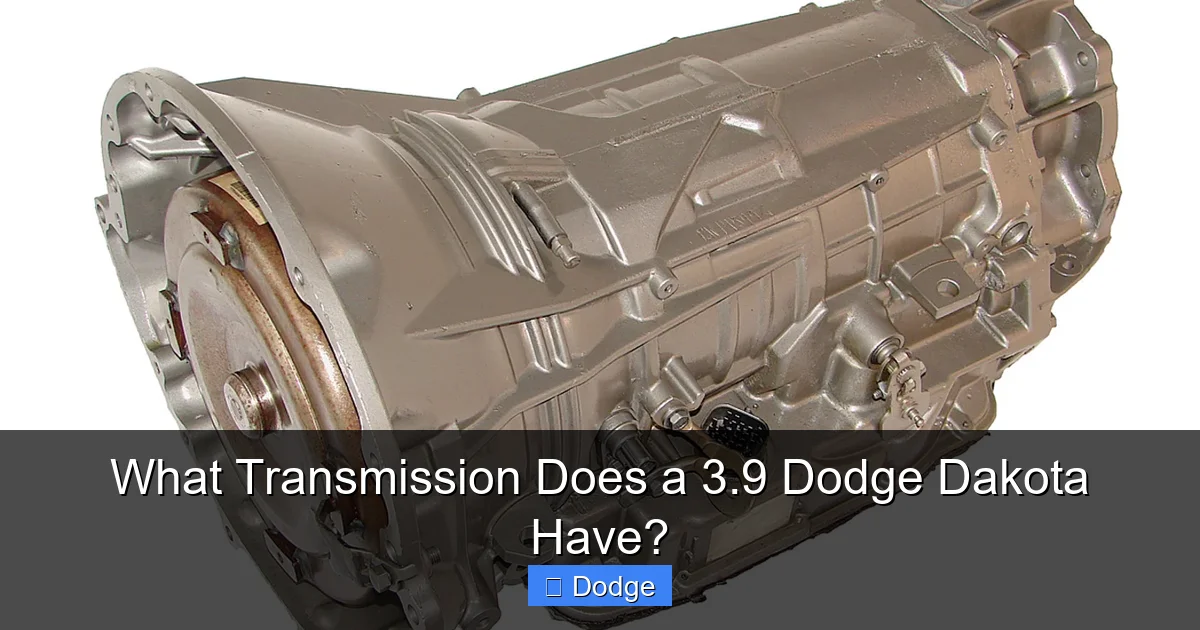
Now, let’s get to the heart of the matter: what transmission does a 3.9 Dodge Dakota have? The short answer is that most were equipped with one of two automatic transmissions—the A500 series or the A518 series—both of which are electronically controlled, four-speed automatics built by Chrysler.
The A500 Series: 42RE and 46RE
The A500 family includes the 42RE (RWD) and 46RE (4WD) transmissions. These units were commonly paired with the 3.9L V6 in earlier model years, typically from 1997 through 2000. The “4” indicates four forward gears, “2” or “6” refers to the torque rating (with 6 being higher), and “RE” stands for Rear-wheel drive, Electronic shift control.
The 42RE was used in rear-wheel-drive Dakotas, while the 46RE was reserved for four-wheel-drive models. Despite the different designations, both share nearly identical internal components and are functionally the same transmission adapted for different drivetrains. They feature a lock-up torque converter, electronic shift solenoids, and a governor valve system that helps regulate shift points based on vehicle speed and throttle input.
These transmissions are known for their smooth operation and decent fuel economy thanks to the overdrive fourth gear, which reduces engine RPM at highway speeds. The A500 series is also relatively compact and lightweight, making it a good match for the Dakota’s unibody frame and V6 powerplant.
The A518 Series: 47RE
As Dodge updated the Dakota platform in the early 2000s, they began phasing in the A518-series transmission, specifically the 47RE. This unit became standard on many 2001–2004 3.9L V6 Dakotas, especially those with 4WD or higher trim levels. The 47RE is essentially a heavier-duty version of the A500, with stronger internals, larger clutches, and improved cooling capacity.
The “7” in 47RE indicates a higher torque rating—up to 470 lb-ft—making it more than capable of handling the 3.9L V6’s output, even under load. It also features upgraded solenoids and a more robust valve body, which helps prevent some of the common failure points found in earlier A500 units. The 47RE retains the same four-speed layout and electronic controls but offers better durability for towing, hauling, or frequent stop-and-go driving.
One key difference is that the 47RE includes a more advanced torque converter with a stronger lock-up clutch, which improves fuel efficiency and reduces heat buildup. It also has a deeper pan and larger fluid capacity, which helps with cooling—a major factor in transmission longevity.
How to Identify Your Dakota’s Transmission
Visual guide about What Transmission Does a 3.9 Dodge Dakota Have?
Image source: wsimgprooh.car-part.com
Not sure which transmission your 3.9L V6 Dakota has? Don’t worry—there are several ways to identify it without tearing anything apart.
Check the Vehicle Identification Number (VIN)
The easiest method is to decode your VIN. The 8th character in the VIN indicates the engine, while the 4th and 5th characters often reveal the transmission code. For example:
– A VIN with “Z” as the 8th character confirms the 3.9L V6.
– Transmission codes like “D5” or “D6” typically point to the A500 (42RE/46RE), while “D7” usually means the A518 (47RE).
You can use free online VIN decoders or consult a Dodge service manual for precise interpretation.
Inspect the Transmission Pan
Another quick way is to look under the truck at the transmission pan. The A500 (42RE/46RE) has a rectangular pan with 14 bolts, while the A518 (47RE) has a larger, square-shaped pan with 16 bolts. The 47RE pan is also noticeably deeper and may have additional cooling line fittings.
Check the Fluid Fill Tube or Dipstick
The location and design of the dipstick can also offer clues. The A500 typically has a dipstick near the back of the transmission, close to the firewall. The A518 often has a shorter dipstick or a fill tube located closer to the front. Some later models may even have a sealed transmission with no dipstick—requiring a scan tool to check fluid levels.
Consult the Door Jamb Sticker
Open the driver’s side door and look for the manufacturer’s sticker on the B-pillar. It lists GVWR, tire size, and sometimes transmission codes. While not always present, this sticker can confirm your truck’s original equipment.
Performance and Reliability of the 3.9L Dakota Transmissions
Visual guide about What Transmission Does a 3.9 Dodge Dakota Have?
Image source: wsimgprooh.car-part.com
So, how do these transmissions hold up in real-world use? Overall, both the A500 and A518 are considered reliable when maintained properly—but they’re not without their quirks.
Strengths of the A500 and A518
Both transmissions are known for their simplicity and durability. They use a traditional hydraulic-mechanical system with electronic controls, which means fewer points of failure compared to modern 6- or 8-speed automatics. The torque converters are robust, and the gear ratios are well-suited for the 3.9L V6’s power band.
The A518, in particular, shines in demanding conditions. Its stronger internals make it a better choice for towing trailers, hauling heavy loads, or driving in mountainous terrain. Many owners report 200,000+ miles with only routine maintenance—proof of its engineering.
Common Issues and Failure Points
Despite their strengths, these transmissions aren’t immune to problems. The most common issues include:
– **Solenoid failures:** The shift solenoids can wear out or get clogged with debris, causing harsh shifts, slipping, or failure to engage gears.
– **Valve body wear:** Over time, the valve body can develop leaks or wear, leading to delayed engagements or erratic shifting.
– **Torque converter shudder:** A failing lock-up clutch in the torque converter can cause a vibration during acceleration, especially around 45–55 mph.
– **Low or degraded fluid:** Neglecting fluid changes is the #1 cause of premature transmission failure. Old, burnt fluid loses its lubricating properties and can damage internal components.
Real-World Example: Towing with a 3.9L Dakota
Let’s say you’re using your Dakota to tow a small camper or utility trailer. With the A518 transmission, you’ll have better heat management and stronger clutches, reducing the risk of overheating on long climbs. However, even with the A500, towing is manageable—as long as you stay within the 5,000-pound limit and use overdrive sparingly when under load.
One owner shared that his 2002 Dakota with the 47RE pulled a 4,200-pound trailer across the Rockies without issue, thanks to regular fluid changes and an auxiliary cooler. That’s a testament to the transmission’s capability when cared for.
Maintenance Tips to Extend Transmission Life
Keeping your Dakota’s transmission in top shape doesn’t require a mechanic’s degree—just consistency and attention to detail.
Fluid and Filter Changes
The golden rule: change the transmission fluid and filter every 30,000 to 50,000 miles, or every 2–3 years. Use only Dexron III or Mercon-compatible fluid—never use generic or universal blends. For the A518, consider a high-mileage fluid with conditioners if your truck has over 100,000 miles.
Check Fluid Levels Regularly
Check the fluid monthly when the engine is warm and the truck is level. The dipstick should show a pink or red color—dark brown or burnt-smelling fluid means it’s time for a change.
Install an Auxiliary Cooler
If you tow, drive in hot climates, or live in hilly areas, an aftermarket transmission cooler is a smart investment. It can lower fluid temperatures by 20–40°F, significantly extending transmission life.
Avoid Overloading and Aggressive Driving
The 3.9L V6 and its transmission aren’t built for drag racing or hauling 6,000-pound loads. Respect the limits, and your Dakota will reward you with years of reliable service.
Listen for Warning Signs
– Slipping gears
– Delayed engagement when shifting from Park to Drive
– Harsh or jerky shifts
– Unusual noises (whining, grinding)
If you notice any of these, don’t wait—have it inspected by a professional.
Upgrades and Rebuild Options
For enthusiasts looking to push their Dakota further, there are several upgrade paths.
Performance Rebuild Kits
Companies like Sonnax and TransGo offer rebuild kits that strengthen the valve body, upgrade solenoids, and improve shift firmness. These kits can turn a stock A500 or A518 into a more responsive, durable unit—ideal for towing or off-roading.
Shift Kits
A shift kit modifies the hydraulic circuits to deliver firmer, quicker shifts. While this improves drivability, it can also increase wear if not done correctly—so follow instructions carefully.
Aftermarket Controllers
For advanced users, programmable transmission controllers (like those from Compushift) allow custom shift maps based on throttle position, load, and speed. This is overkill for most, but great for performance builds.
Conclusion
So, what transmission does a 3.9 Dodge Dakota have? In most cases, it’s either the A500 (42RE/46RE) or the A518 (47RE) automatic transmission—both proven, durable units that were well-matched to the 3.9L V6 engine. While they share many similarities, the A518 offers greater strength and cooling, making it the preferred choice for 4WD and heavy-duty applications.
The key to getting the most out of your Dakota’s transmission is regular maintenance, attentive driving, and addressing issues early. With proper care, these transmissions can easily surpass 200,000 miles and continue serving faithfully for years.
Whether you’re restoring a classic Dakota, using it as a daily driver, or relying on it for weekend projects, understanding your transmission empowers you to make smarter decisions—and keep that V6 purring down the road.
Frequently Asked Questions
What transmission does a 1998 Dodge Dakota 3.9 have?
A 1998 Dodge Dakota with the 3.9L V6 typically comes with the A500-series transmission—either the 42RE (RWD) or 46RE (4WD). These are four-speed automatics known for their reliability and smooth operation.
Can I tow with a 3.9L V6 Dakota?
Yes, the 3.9L V6 Dakota can safely tow up to 5,000 pounds when properly equipped. Use the A518 transmission if possible, and always install an auxiliary cooler for long or heavy tows.
How often should I change the transmission fluid?
Change the fluid and filter every 30,000 to 50,000 miles, or every 2–3 years. Use Dexron III or Mercon-compatible fluid and check levels monthly.
Is the A518 transmission better than the A500?
The A518 (47RE) is stronger and better suited for towing or 4WD use, while the A500 is lighter and sufficient for daily driving. Both are reliable when maintained.
Why is my Dakota shifting hard?
Hard shifting is often caused by worn solenoids, low fluid, or a failing valve body. Have the transmission scanned for codes and check fluid condition immediately.
Can I swap a manual transmission into a 3.9L Dakota?
Yes, but it’s complex and requires custom mounts, a clutch pedal assembly, and a compatible manual transmission (like the NV3500). It’s a project best left to experienced builders.
