Does Tesla Have a Cigarette Lighter?

Contents
- 1 Key Takeaways
- 2 📑 Table of Contents
- 3 The Great Smoke Screen: Unpacking the Tesla Cigarette Lighter Question
- 4 What You Actually Get: Tesla’s 12V Power Setup
- 5 Why Tesla Skipped the Lighter Element: Design, Safety, and Symbolism
- 6 How to Get a Cigarette Lighter in Your Tesla: The Aftermarket Solution
- 7 What About Other Power Options in a Tesla?
- 8 Practical Implications for Tesla Owners: What You Need to Know
- 9 The Future: Will Any EV Bring Back the Lighter?
- 10 Conclusion: A Small Change, Big Meaning
- 11 Frequently Asked Questions

Car Cleaning Brush Set

Pressure Washer for Car

Car Body Cover

Interior Cleaner Spray
No, Tesla vehicles do not come with a traditional built-in cigarette lighter like older cars. However, all Teslas are equipped with a standard 12V auxiliary power outlet (often called a “cigarette lighter socket” by habit) in the center console or trunk. This socket provides DC power for charging devices, but you must purchase a separate aftermarket lighter element if you need an open flame. Tesla’s design omits the lighter as part of its minimalist, tech-forward philosophy and to reduce fire risk.
Key Takeaways
- No Built-In Lighter: Tesla vehicles do not include a traditional cigarette lighter element; the socket is power-only.
- 12V Socket Standard: Every Tesla model provides at least one 12V DC auxiliary outlet for powering accessories.
- Design Philosophy: Omitting the lighter aligns with Tesla’s minimalist interior, safety focus, and push toward electric-only features.
- Universal Compatibility: The 12V socket works with any standard USB adapter, phone charger, or aftermarket cigarette lighter plug you purchase separately.
- Safety First: Removing the open-flame lighter reduces interior fire hazards, a priority for an EV manufacturer.
- Location Varies: The primary 12V socket is usually in the center console; some models also have one in the trunk for added convenience.
- Modern Alternatives: Tesla encourages using built-in USB-C ports, wireless charging pads, or 12V adapters instead of a traditional lighter.
📑 Table of Contents
- The Great Smoke Screen: Unpacking the Tesla Cigarette Lighter Question
- What You Actually Get: Tesla’s 12V Power Setup
- Why Tesla Skipped the Lighter Element: Design, Safety, and Symbolism
- How to Get a Cigarette Lighter in Your Tesla: The Aftermarket Solution
- What About Other Power Options in a Tesla?
- Practical Implications for Tesla Owners: What You Need to Know
- The Future: Will Any EV Bring Back the Lighter?
- Conclusion: A Small Change, Big Meaning
The Great Smoke Screen: Unpacking the Tesla Cigarette Lighter Question
If you’re stepping into a Tesla for the first time after years of driving conventional gas cars, one small detail might leave you scratching your head: where’s the cigarette lighter? That little pop-out compartment with the glowing coil has been a staple of automotive interiors for decades. But open the center console of a Model 3, Model Y, Model S, or Model X, and you’ll find a clean, covered 12V power outlet—no lighter in sight. This isn’t an oversight. It’s a deliberate design choice that speaks volumes about Tesla’s entire philosophy. So, does Tesla have a cigarette lighter? The short answer is no, but the longer answer reveals a lot about how Tesla reimagines even the most mundane car features for the electric age.
Let’s clear the air right away. Every Tesla comes with one or more 12-volt DC auxiliary power sockets. These are the exact same type of sockets that powered cigarette lighters in your old Honda Civic or Dodge Charger. The physical socket is identical. What’s missing is the *lighter element* itself—the heating coil that gets hot enough to ignite a cigarette. Tesla simply doesn’t install that component. You get the power source, but you have to supply the “lighter” part yourself if you really want one. This tiny difference sparks big questions about safety, convenience, and what it means to design a car for a post-combustion future.
A Blast from the Past: The Cigarette Lighter’s Origins
To understand why Tesla ditched it, we need a quick history lesson. The automotive cigarette lighter was invented in the early 1920s by a company called cigarette lighter. It was originally called a “cigarette lighter receptacle” and was marketed as a luxury convenience. By the 1950s and 60s, it was standard in nearly every car. Its primary job was to heat a coil to light tobacco products. But over time, its secondary function—providing DC power for everything from air pumps to phone chargers—became its main purpose. By the 2000s, most drivers used the socket for charging gadgets, not lighting cigarettes. The “lighter” part became almost vestigial, like a appendix in car design.
This history is crucial because it shows the socket and the lighter element are separable. The socket is a power port. The lighter is just one of many accessories that can plug into it. Tesla kept the useful part (the power port) and discarded the less essential, more problematic part (the open-flame heater). It’s a clean, logical separation that other automakers have been slow to adopt due to tradition and consumer expectation.
What You Actually Get: Tesla’s 12V Power Setup
So, what does Tesla provide? Every Tesla vehicle includes one or more 12-volt DC auxiliary outlets. These are not new; they’re a standard automotive feature. But their implementation in a Tesla is slightly different. Let’s break down the locations and specs.

Visual guide about Does Tesla Have a Cigarette Lighter?
Image source: m.media-amazon.com
Socket Locations Across Models
The primary 12V socket is almost always inside the center console storage bin. This is a smart location because it’s hidden, keeping the interior lines clean, yet easily accessible when you open the lid. In the Model 3 and Model Y, you’ll find it under a small rubber flap in the front of the console compartment. In the Model S and Model X, it’s similarly tucked away. Many models, especially the larger Model X and some Model S variants, also include a secondary 12V socket in the trunk. This is fantastic for powering a dash cam, portable fridge, or emergency lights without running cords through the cabin.
For example, a 2022 Model 3 Long Range has one 12V socket in the center console. A 2023 Model X Plaid has two: one in the front console and one in the rear cargo area. The exact number and placement can vary by model year and trim, so it’s always good to check your owner’s manual. But you can be confident that you have at least one 12V power source.
Power Specifications and Capabilities
These sockets are fused and can typically deliver up to 10-15 amps at 12 volts DC, which is about 120-180 watts. That’s plenty for most accessories: phone chargers, tire inflators, vacuum cleaners, portable coolers, and yes, an aftermarket cigarette lighter plug. However, they are not designed for high-draw devices like power tools or large inverters for extended periods. Tesla’s 12V system is primarily for low-power accessories. The car’s main high-voltage battery powers the drive units and climate system; the 12V battery (a small conventional lead-acid or lithium battery) runs the infotainment, lights, and these sockets. It’s a separate system, which is why the 12V socket works even when the main battery is off (until the 12V battery drains).
One practical tip: if you plan to use a high-power device regularly, consider a professional-grade inverter that connects directly to the 12V battery terminals, not the socket, to avoid blowing fuses. But for everyday use—charging your phone, running a GPS, or powering a small air compressor—the socket is perfect.
Why Tesla Skipped the Lighter Element: Design, Safety, and Symbolism
Now, the juicy part: why did Tesla actively choose not to include the lighter element? It wasn’t a cost-saving measure (the part costs pennies). It was a conscious decision rooted in three core principles: minimalist design, safety, and signaling a new era.

Visual guide about Does Tesla Have a Cigarette Lighter?
Image source: automotiveglory.com
The Minimalist Interior Ethos
Step into a Tesla, and the first thing you notice is the lack of buttons. Everything is controlled via the central touchscreen. This isn’t just for looks; it’s about reducing complexity, improving software updates, and creating a serene, uncluttered space. A pop-out cigarette lighter is a physical, mechanical component that doesn’t fit this vision. It’s a small thing, but it’s a relic of the analog dashboard. Tesla’s interior design team, led by the legendary Franz von Holzhausen, treats every element with scrutiny. If a feature can be simplified or removed without sacrificing core utility, it’s gone. The lighter element had zero utility for the majority of drivers in 2023. So, out it went. It’s the same reason there’s no traditional key—just a key card or phone key. Tradition is not a sufficient reason to keep something.
Think about it: when was the last time you used a cigarette lighter in your car? For most people, it’s been years. That little compartment often just holds coins or gum. By removing the lighter, Tesla freed up that space for a cleaner, more integrated power socket cover. The socket itself remains, but it’s presented as a modern power port, not a smoking accessory.
Safety as a Non-Negotiable Priority
Electric vehicles are hyper-aware of fire risk, thanks to media scrutiny and public concern about lithium-ion batteries. While the 12V lighter element has nothing to do with the main battery pack, it’s still an open heating coil that can reach temperatures over 1,000°F (538°C). In a car with lots of flammable materials (seats, carpets, plastics), an unattended lighter is a hazard. Children, pets, or a forgotten lit lighter can cause burns or fires. Tesla’s safety ethos, demonstrated by their industry-leading crash ratings and battery safety systems, extends to the smallest details. Removing a potential ignition source is a no-brainer. It’s a proactive safety feature, not a missing convenience.
Consider this: many modern cars from other brands are also starting to omit the lighter element, offering only the socket. But Tesla was one of the first to do it consistently across all models without even offering it as a paid option. It’s a statement: we prioritize safety over a 20th-century habit.
Symbolic Break from the Past
For Tesla, every design choice is a signal. They’re not just making electric cars; they’re defining what a car *should be* in the 21st century. The absence of a cigarette lighter is a tiny but potent symbol of breaking from the internal combustion era. It says, “We’re not catering to smokers; we’re catering to tech-savvy, health-conscious, forward-thinking drivers.” It’s part of a broader suite of decisions: no exhaust pipes, no fuel filler door, no engine sound (though they added pedestrian sound for safety). The lighter’s removal is consistent with the narrative that Tesla is the future, and the future doesn’t include ashtrays or lighters. It’s a bold move that sometimes confuses traditionalists but reinforces brand identity.
How to Get a Cigarette Lighter in Your Tesla: The Aftermarket Solution
So, you’re a smoker, or you just really want a traditional lighter for some reason (maybe for lighting a campfire stove or candles). Can you add one? Absolutely. Since the socket is there, you simply need to buy an aftermarket cigarette lighter plug.

Visual guide about Does Tesla Have a Cigarette Lighter?
Image source: automotiveglory.com
What to Buy: The Universal Adapter
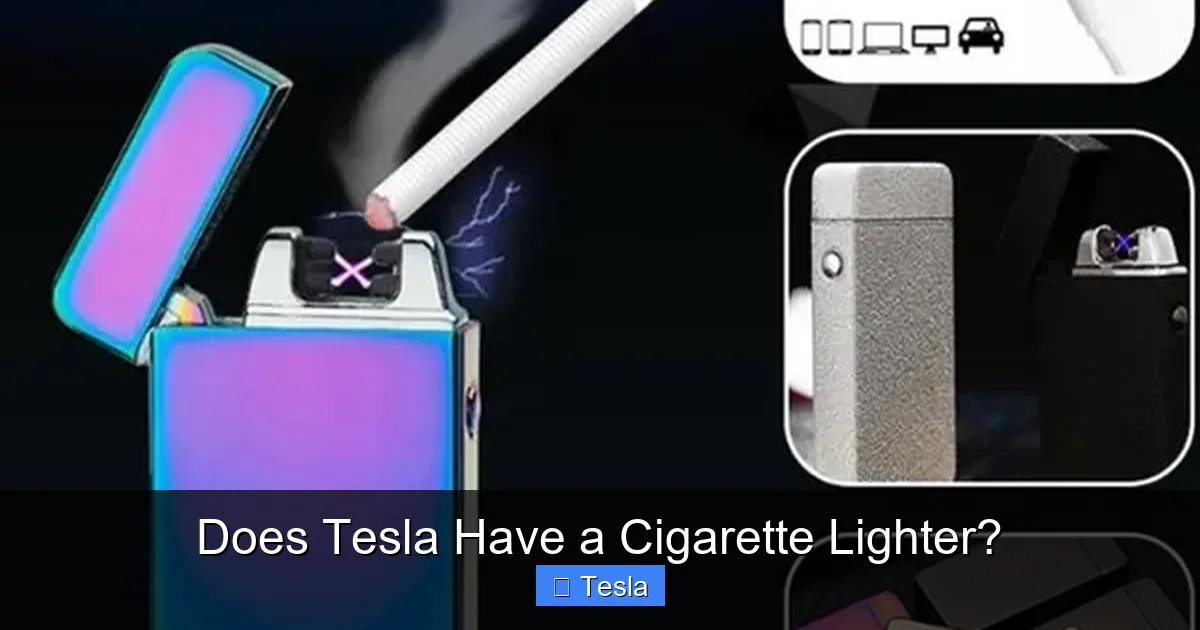
You can purchase a generic “12V cigarette lighter plug” at any auto parts store, Walmart, or online retailer (Amazon, eBay). These are simple devices: a plastic housing with a metal coil element that slides into the 12V socket. When you push it in, the coil heats up. When it pops out (usually after 10-15 seconds), it’s hot enough to light a cigarette. They typically cost between $5 and $15. Some even come with built-in USB ports, combining the lighter function with charging.
Important: Ensure the plug is rated for your Tesla’s 12V socket (12V DC, 10-15A). Most universal ones are. Avoid cheap, no-name brands that might overheat or have poor connections. A reputable brand like Bestek, Anker, or even the auto store’s house brand is fine.
Installation Is Trivial
Installation takes two seconds. Open your center console lid, locate the 12V socket (it might have a rubber cover), plug in the lighter adapter, and you’re done. There’s no wiring, no tools, no permanent modification. It’s completely removable. When you’re not using it, you can store it in the glove compartment. This flexibility is key: you only have the lighter when you need it, avoiding the constant fire hazard and visual clutter.
A practical tip: if you use the lighter frequently, consider getting a model with a longer cord so you can keep it in the cup holder while lighting something. But remember, the socket is live whenever the car’s 12V system is on (usually when the car is “awake” or driving). Don’t leave it plugged in unattended if the coil is hot.
Why Tesla Doesn’t Sell an Official One
You might wonder why Tesla doesn’t offer an official lighter plug as an accessory in their online store. The answer is consistency with their safety and design principles. Selling a lighter would contradict their message about minimizing fire risk and modernizing the cabin. They’d rather you use the socket for charging your phone or powering a dash cam—activities that align with the tech-centric Tesla experience. By not selling one, they gently nudge customers toward safer, more useful uses of the socket. It’s a subtle form of behavioral design.
What About Other Power Options in a Tesla?
The 12V socket isn’t the only way to get power in a Tesla. In fact, for most device charging, you’ll likely use these built-in options instead.
USB Ports: The Primary Charging Solution
Teslas come loaded with USB ports. Typically, there are two USB-A ports in the front center console (for data and charging) and sometimes additional USB-C ports in the rear. These are 5V/3A or higher, perfect for fast charging phones, tablets, and other gadgets. They’re active even when the car is off (for a limited time), and they’re incredibly convenient. No adapter needed—just plug in your cable. For most drivers, these USB ports have completely replaced the 12V socket for everyday charging. The 12V socket is reserved for higher-draw items like tire inflators or coolers.
Note: The USB ports are for charging and data. They don’t provide the higher amperage that some 12V accessories need. But for phones, they’re ideal.
Wireless Charging Pad
Most newer Tesla models (Model 3 refresh, Model Y, Model S/X Plaid) include a built-in wireless charging pad in the center console. This Qi-compatible pad charges compatible phones without any cables. It’s a great example of Tesla’s forward-thinking: they provide a modern, clutter-free charging solution that makes the 12V socket even less necessary for phone charging. If your phone supports wireless charging, you can just drop it on the pad. The pad usually draws power from the 12V system internally, so it’s using the same power source but in a more integrated way.
The Trunk 12V Socket: A Hidden Gem
As mentioned, many Teslas have a second 12V socket in the trunk. This is a fantastic feature that owners often overlook. You can plug in a portable vacuum cleaner to clean the interior, a tire inflator for emergencies, or a small cooler for road trips without any cords running through the cabin. It keeps the cabin tidy and makes trunk-based power tasks much easier. If your Tesla has one, it’s worth exploring its uses. Just remember it’s also on the 12V system, so it will drain the 12V battery if used excessively with the main battery off.
Practical Implications for Tesla Owners: What You Need to Know
Living with a Tesla’s power setup is easy, but there are a few practical considerations every owner (or prospective buyer) should understand.
Jump-Starting Another Car: Yes, You Can!
One of the most common questions: can you use a Tesla’s 12V socket to jump-start a dead gas car? The answer is technically yes, but with major caveats. The 12V socket can power a portable jump-starter box, which then connects to the dead car’s battery. However, you cannot directly jump-start from the Tesla’s 12V socket because it doesn’t provide enough amperage to crank an engine. You’d need a dedicated jump-starter device that you plug into the Tesla’s socket to charge its internal battery first. Then, use that device on the other car. This is possible, but it’s not as straightforward as clamping cables to a traditional car’s battery. Also, be extremely cautious: never try to charge another car’s battery directly from the Tesla’s 12V socket—it could damage the Tesla’s electrical system. Always use a proper jump-starter device as an intermediary.
For more on 12V systems in various cars, you might compare how different models handle auxiliary power. For instance, many conventional cars still include the lighter element, but the underlying 12V socket function is universal.
Powering High-Draw Accessories
If you want to run a powerful inverter (say, 300 watts or more) to power tools or a small microwave, the 12V socket is not suitable. The fuse will likely blow. For such uses, you’d need a hardwired inverter connected directly to the 12V battery terminals, which requires professional installation to avoid electrical issues. Tesla’s 12V system is designed for low-power accessories. Don’t assume it can handle everything a cigarette lighter socket in a truck can. Check your owner’s manual for the exact amperage rating of your 12V socket.
Impact on the 12V Battery and Main Battery
Using the 12V socket when the car is “awake” (driving or sentry mode on) is fine. The car’s DC-DC converter charges the 12V battery from the main battery as needed. However, if you use the 12V socket extensively while the car is *off* (e.g., powering a dash cam for days while parked), you can drain the 12V battery. A drained 12V battery can cause the car to not start (well, not power on, since it’s electric) and may require a jump or service. Tesla’s software manages 12V battery health, but heavy accessory use while parked can still deplete it. So, if you’re using a 12V accessory for long periods while the car is parked, be mindful. Some owners install a larger auxiliary 12V battery in the trunk for such needs, but that’s an advanced modification.
Accessory Shopping: What Works?
Almost any 12V DC accessory designed for cars will work in a Tesla’s socket. This includes:
- Phone chargers (USB-A or USB-C)
- Tire inflators
- Portable vacuum cleaners
- Dash cams (with hardwiring kits for parking mode)
- Heated seat cushions (though Tesla seats are already heated)
- Mini fridges
- Air compressors
- And yes, aftermarket cigarette lighter plugs
Just check the voltage (12V DC) and amperage draw. Stick to reputable brands to avoid electrical gremlins.
The Future: Will Any EV Bring Back the Lighter?
As the industry shifts to electric, what happens to the humble cigarette lighter? Tesla’s approach is becoming the norm. Most new EVs from other manufacturers (Ford Mustang Mach-E, Hyundai Ioniq 5, Rivian R1T) also only provide a 12V socket without the lighter element. It’s a trend. Why? The same reasons: safety, minimalism, and changing habits. Fewer people smoke, and everyone charges devices via USB or wireless. The lighter is an anachronism.
However, the 12V socket itself is safe for now. It serves critical functions beyond personal convenience: it powers essential service tools for mechanics, diagnostic equipment, and emergency devices. Even in a fully electric future, a standard low-voltage DC power outlet is useful. But the open-flame lighter? That’s likely headed for the museum. Some classic car enthusiasts may mourn it, but for the mainstream, it’s a small, sensible step toward a cleaner, safer, and simpler automotive interior.
In fact, we might see the 12V socket itself eventually replaced by higher-power USB-C PD ports or wireless power delivery standards that can handle larger devices. But that’s a decade away. For now, the 12V socket—sans lighter—is the bridge between old and new.
Conclusion: A Small Change, Big Meaning
So, does Tesla have a cigarette lighter? No, but it has the power source that made the lighter possible. This tiny detail encapsulates Tesla’s entire mission: to question every assumption, prioritize safety and simplicity, and build cars for the future, not the past. The absence of the lighter element isn’t a missing feature; it’s a deliberate design statement. It tells you that this car is different—that it’s engineered with intention, from the massive battery pack under the floor to the empty space where a lighter used to be.
For the vast majority of drivers, this change is irrelevant. You’ll use the USB ports or wireless charging. For the few who miss the traditional lighter, the solution is cheap, easy, and removable. Tesla has given you the power, quite literally, to choose. And that’s the point: they provide the essential utility (12V power) without imposing outdated habits (the lighter). It’s a microcosm of electric vehicle adoption—keeping what works, ditching what doesn’t, and always looking forward.
Next time you’re in a Tesla, pop open that center console. Look at that neat, covered 12V socket. It’s not a cigarette lighter port. It’s a power portal. And that’s exactly how Tesla wants you to see it.
Frequently Asked Questions
Does Tesla Model 3 have a cigarette lighter?
No, the Tesla Model 3 does not come with a built-in cigarette lighter element. It has a 12V DC power socket in the center console, but you must buy a separate aftermarket lighter plug if you want one.
Where is the 12V socket in a Tesla?
The primary 12V socket is inside the center console storage bin, usually under a small rubber cover. Some models also have a secondary socket in the trunk for added convenience.
Can I use a regular car cigarette lighter in my Tesla?
Yes, any universal 12V cigarette lighter plug will work in Tesla’s 12V socket. Just plug it in, and it will heat up like a traditional lighter. It’s an aftermarket accessory you purchase separately.
Will using the 12V socket drain my Tesla’s battery?
Using the 12V socket while the car is on or in “Awake” mode is fine. However, using it extensively while the car is completely off can drain the 12V auxiliary battery over time, potentially leaving the car unable to power on.
Can I jump-start another car from my Tesla’s 12V socket?
Not directly. You can plug a portable jump-starter device into Tesla’s 12V socket to charge it, then use that device on the dead car. But you cannot connect jumper cables directly to Tesla’s 12V socket—it lacks the amperage and could damage the car.
Why doesn’t Tesla include a cigarette lighter?
Tesla omits the lighter element to maintain a minimalist interior, reduce fire risk, and signal a break from combustion-era car design. The 12V power socket remains for accessory use, but the open-flame lighter is considered outdated and unnecessary.