
Does Lifting a Jeep Cause Problems?

Lifting a Jeep absolutely can cause problems if not done correctly and with full awareness. Common issues include accelerated suspension component wear, altered drivetrain angles leading to vibration and U-joint failure, changed handling and braking dynamics, and potential electronic sensor errors. These problems are not inevitable but are direct consequences of the physics involved in raising a vehicle’s center of gravity and changing its geometry. Proper planning, quality parts, and professional installation are non-negotiable to mitigate these risks.
Key Takeaways
- Increased Wear & Tear: Lifting changes suspension geometry, putting abnormal stress on ball joints, tie rod ends, and control arm bushings, leading to premature failure.
- Drivetrain Strain is Real: The most common “problem” is driveshaft and U-joint vibration/failure due to altered angles, often requiring a new driveshaft or slip yoke elimination.
- Handling & Braking Change: A lifted Jeep has a higher center of gravity, increasing body roll risk and lengthening braking distances due to weight transfer and altered brake line geometry.
- Electronic & Sensor Issues: Lifts can misalign ABS/ESC sensors, skew speedometer readings, and cause dashboard warning lights, requiring reprogramming or aftermarket modules.
- It’s a System, Not a Part: A lift kit isn’t just spacers. It often necessitates配套 modifications like longer brake lines, adjustable control arms, and regearing to function safely and reliably.
- Cost of Ownership Rises: Beyond the initial lift cost, expect higher expenses for tires, faster-wearing tires, potential regearing, and more frequent suspension maintenance.
- Professional Installation is Key: Improper installation is the #1 cause of post-lift problems. Torque specs, alignment, and component compatibility must be flawless.
📑 Table of Contents
- The Allure and The Reality of a Lifted Jeep
- 1. The Suspension System: Where Wear Accelerates
- 2. The Drivetrain: Angles, Vibration, and Ultimate Stress
- 3. Handling, Braking, and Safety: The Physics of Height
- 4. Electronics, Sensors, and the Modern Jeep
- 5. The Ripple Effect: Tires, Gearing, and Fuel Economy
- 6. Cost: The True Price of a Lift
- Conclusion: Knowledge is the Ultimate Lift Kit
The Allure and The Reality of a Lifted Jeep
Let’s be real for a second. There’s nothing quite like the sight of a Jeep Wrangler or Gladiator towering over traffic, sitting atop massive all-terrain tires, screaming “adventure.” The lifted Jeep is an icon. It promises clearance over rocks, deeper water fordings, and a commanding view of the trail. It’s a modification deeply embedded in Jeep culture. But here’s the crucial question every potential owner must ask before the first spacer is bolted on: Does lifting a Jeep cause problems?
The short, honest answer is yes. It can. And it often does if the lift is treated as a simple cosmetic upgrade rather than a fundamental alteration to the vehicle’s core geometry and engineering. A Jeep from the factory is a finely balanced machine. Its suspension, drivetrain, steering, and electronics are all engineered to work in harmony at a specific ride height. When you lift it, you disrupt that harmony. The goal of this article isn’t to scare you away from lifting your rig. Instead, it’s to arm you with the knowledge of what problems can arise, why they happen, and—most importantly—how to prevent them or fix them when they do.
1. The Suspension System: Where Wear Accelerates
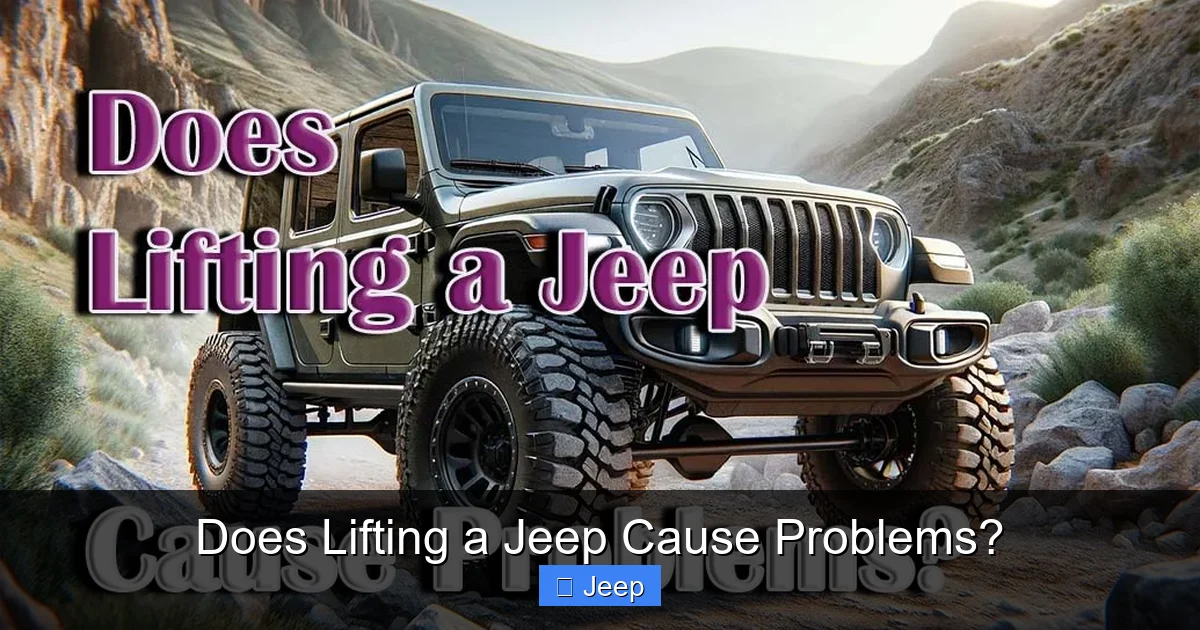
The suspension is the first and most directly affected system. A lift kit, whether it’s a simple spacer lift or a full long-arm system, changes the operating angles and ranges of every single joint and bushing in the front and rear axles.
Visual guide about Does Lifting a Jeep Cause Problems?
Image source: jeepzine.com
The Ball Joint and Tie Rod End Beatdown
On a solid-axle Jeep like a Wrangler, the front axle is held in place by a set of control arms and a track bar. When you lift the vehicle, you effectively lengthen the distance between the axle and the frame at these mounting points. The ball joints (which connect the steering knuckle to the control arms) and the tie rod ends (which connect the steering linkage) now operate at much sharper angles than they were designed for. This increased articulation angle creates point-load stress. Instead of the force being distributed evenly across the joint’s surface, it’s concentrated on a smaller area. The result? These components wear out exponentially faster. You might go from needing to replace ball joints every 80,000 miles to every 30,000 miles. A telltale sign is a clunking noise over bumps or a vague feeling in the steering wheel.
Control Arm Bushings Take the Hit
The rubber or polyurethane bushings in the control arms themselves are also victims. They are compressed and twisted in ways they weren’t meant to be. This leads to cracking, tearing, and eventually, complete failure. Worn bushings cause axle shimmy, poor alignment retention, and a general “sloppy” feel. Many serious lift kits (3.5″ and above) include new, longer adjustable control arms precisely to correct these angles and put the bushings back into their intended operational range, drastically extending their life.
Shocks and Springs: The Limits of Travel
A common misconception is that a lift kit provides more suspension travel. It doesn’t. It provides more *ride height*. The actual length of the shock and the range of the control arms often remain the same. What you gain is more *wheel travel before the tire hits the fender*. But if you use a spacer lift on stock shocks, you can easily over-extend the shock during full compression or droop, causing it to “bottom out” hydraulically or physically bind, destroying the shock internals. This is why lift kits come with specific, longer shocks. Furthermore, the factory springs, especially on the lighter-duty Sport models, may not have the rate or length to safely support a significant lift without sagging or coil binding.
Practical Tip:
When buying a lift, look for a “complete system” from a reputable brand (like Rubicon Express, JKS, MetalCloak, ARB). These include not just the lift components, but also the necessary extended brake lines, new track bar, and often adjustable control arms to correct geometry. Skimping on these supporting parts is a direct path to accelerated wear and failure. If you’re curious about the specific costs involved in a proper lift, we break down the parts and labor in our detailed guide on how much does it cost to get a Jeep lifted.
2. The Drivetrain: Angles, Vibration, and Ultimate Stress
This is arguably the most critical and commonly encountered set of problems after lifting a Jeep. The drivetrain—comprising the transfer case, driveshafts, and axles—is a precision system of rotating shafts that must be perfectly aligned in a straight line to run smoothly.

Visual guide about Does Lifting a Jeep Cause Problems?
Image source: jeepzine.com
The Driveshaft Angle Dilemma
On a stock Jeep, the rear driveshaft (and front, in 4WD) runs from the transfer case output shaft to the rear axle pinion at a very specific, slight angle. Lifting the vehicle changes the vertical relationship between these two points. The angle increases. Universal joints (U-joints) are designed to handle a *small* amount of angle. As the angle increases, the rotational speed of the driveshaft yoke becomes uneven—it speeds up and slows down minutely with each revolution. This is “driveshaft vibration.” At certain speeds, this vibration becomes violent, shaking the entire vehicle and threatening to shake apart components. The first U-joint to fail is usually the one at the axle (pinion), as it now has the steepest angle.
The Slip Yoke and Transfer Case Output Shaft
The front driveshaft connects to the transfer case via a slip yoke. This yoke allows the driveshaft to change length as the axle moves up and down. When you lift a Jeep, you often create a situation where the slip yoke can bottom out or pull out too far, either binding the driveshaft or allowing it to separate completely. This is a catastrophic failure waiting to happen. Solutions include a longer slip yoke, a new driveshaft with a different joint configuration (like a CV joint at the transfer case), or a complete replacement with a stronger, better-balanced shaft.
Axle Shaft and U-Joint Overload
While the driveshaft angles are the primary vibration culprit, the axle shafts themselves (the rods inside the axle tube that turn the wheels) also have U-joints or CV joints at the wheel hub. Lifting often increases the operating angle here as well, especially during articulation. These joints wear faster. Furthermore, if you add larger tires without regearing, you place a much greater torque load on these shafts and joints. The combination of increased angle *and* increased torque is a recipe for broken axle shafts, a very expensive and trail-side-stranding problem.
Practical Example & Fix:
A common scenario: A JK/JLU Wrangler owner installs a 4″ lift with 37″ tires. They immediately experience a violent vibration at 55-65 mph. The cause? The rear driveshaft angle is now too severe for the stock dual-cardan joint. The fix is a new, longer rear driveshaft with a single cardan joint at the axle and a CV joint at the transfer case to accommodate the new angle. This is not an optional upgrade; it’s a necessity. The cost of a quality custom driveshaft can easily be $500-$1,200, but it’s cheaper than a new transfer case or axle.
3. Handling, Braking, and Safety: The Physics of Height
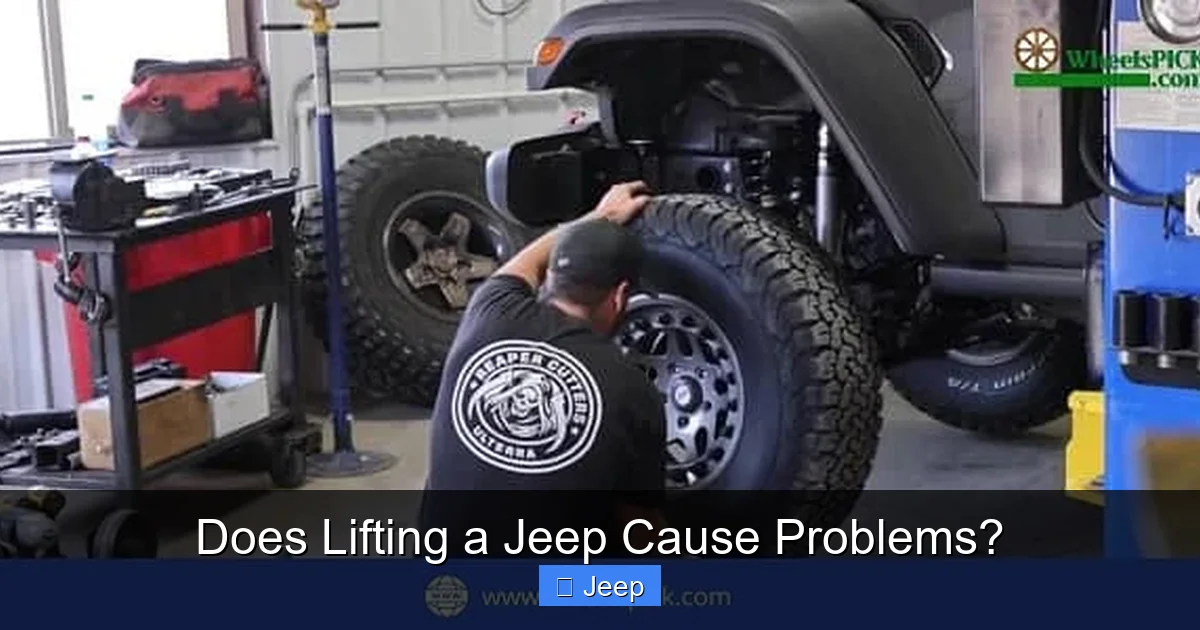
You’re raising the center of gravity. That’s not just a 4×4 talking point; it’s a fundamental law of physics that has real-world consequences for how your Jeep behaves on the road.
Visual guide about Does Lifting a Jeep Cause Problems?
Image source: wheelspick.com
Body Roll and Steering Feel
A higher center of gravity means more weight is positioned above the suspension’s pivot points. This dramatically increases body roll during cornering. Your lifted Jeep will lean more in turns, sometimes dramatically. This not only feels unsettling but also reduces the tire’s contact patch on the outside wheels, decreasing available grip. The steering can also feel less precise, sometimes with increased play or a vague “dead zone” on-center, often exacerbated by the suspension geometry changes mentioned earlier. Anti-roll bars (sway bars) become even more critical. Many off-road enthusiasts disconnect them for articulation, but on-road, a strong aftermarket sway bar can help combat the increased roll.
Braking Distance and Weight Transfer
When you brake, weight transfers forward. In a lifted vehicle, this transfer happens over a longer “lever arm” (the distance from the center of gravity to the ground). The effect is a greater shift of weight onto the front tires and less onto the rear. This can cause the rear brakes to contribute less effectively to stopping the vehicle. Combined with the fact that you’ve likely added significant unsprung weight (larger tires/wheels), your braking distances will increase. It’s not uncommon for a lifted Jeep on 35s or 37s to need 30-50% more distance to stop from highway speed.
Brake Line and ABS Sensor Concerns
The stock brake lines are length-specific. A lift can put them under tension or cause them to rub against tires and suspension components. This can lead to brake line failure—a serious safety hazard. Extended stainless steel braided brake lines are a mandatory safety upgrade for any lift over 2″. Similarly, the wheel-speed sensors for ABS and Stability Control (ESC) are mounted near the wheel hubs. If the axle housing moves significantly relative to the frame (which it does in a lift), these sensors can be pulled out of their connectors or their tone rings can become misaligned, triggering constant ABS/ESC warning lights and disabling these critical safety systems.
Practical Tip:
After any lift, a professional alignment is step zero. But you must also test your brakes in a safe, empty area. Do panic stops from moderate speeds (30-40 mph) to feel for pull, pulsation, or significantly increased stopping distance. Check your brake fluid level regularly as lines stretch. For the electronics, many modern Jeeps (2018+) will throw multiple dashboard warnings after a lift. You’ll likely need a professional to reprogram the vehicle’s computer using a tool like AlfaOBD or a dealership-level scanner to recalibrate the steering angle sensor and wheel speed sensors to their new positions.
4. Electronics, Sensors, and the Modern Jeep
This is a growing headache, especially with 2018+ JLU Wranglers and Gladiators. These vehicles are packed with sensors and software that assume a stock ride height.
Speedometer and Odometer Inaccuracy
Your speedometer reads speed based on the number of rotations of your transmission output shaft or wheel hubs. Larger tires rotate fewer times to cover the same ground. Without correction, your speedometer will read lower than your actual speed. A 35″ tire on a stock JLU can cause a 10-15% error. This means you could be speeding without knowing it, and your odometer will log fewer miles than you actually drive, affecting maintenance intervals and resale. The fix is a programmer or a simple electronic module (like a Procal or Tazer) that tells the computer the new tire size.
Steering Angle Sensor (SAS) Calibration
This sensor tells the computer how far and which direction the steering wheel is turned. It’s crucial for ESC, ESC, and lane assist (if equipped). Lifting and aligning the front end changes the steering linkage geometry. If the SAS isn’t recalibrated after an alignment, the computer gets bad data. The result? A persistent “Service ESC” or “Steering Assist Fault” light, and disabled stability control. The vehicle may also pull to one side. This calibration must be done with a professional scan tool.
Camera and Sensor Interference
If your Jeep has a front or rear camera (like the available front camera on some models), a lift can change its field of view, potentially showing the ground or sky instead of what’s in front. Parking sensors, if equipped, may also have their detection zones altered. There’s often no simple fix for this other than physically relocating the camera, which is complex.
Practical Tip:
Before you even buy a lift for a modern Jeep, research if the manufacturer provides a specific “lift calibration” procedure or if a third-party module (like the best accessories for a Jeep Wrangler list often includes programmer brands) is required. Budget for this electronic reprogramming as part of your lift cost. Ignoring it will leave you with a constantly lit dashboard and disabled safety features.
5. The Ripple Effect: Tires, Gearing, and Fuel Economy
The lift itself is just the first domino. The larger tires you almost certainly add to fill the wheel wells create a cascade of secondary effects.
The Regearing Imperative
Engine RPM = (Vehicle Speed x Tire Revs per Mile x Gear Ratio) / Final Drive Ratio. When you put on much larger tires (say, from 32″ to 37″), the “Tire Revs per Mile” number drops significantly. To maintain the same engine RPM at a given speed, you need to increase the gear ratio numerically (e.g., from 3.73 to 4.88 or 5.13). Without regearing, you get: sluggish acceleration, poor throttle response, increased transmission heat (as it works harder in a lower effective gear), and worse fuel economy because the engine is laboring at lower, less efficient RPMs on the highway. It’s not just about power; it’s about restoring the factory powerband and protecting your transmission. The cost of a gear job, while significant, is an investment in drivetrain longevity and drivability. We have a full explainer on how much does it cost to regear a Jeep.
Fuel Economy Takes a Nose Dive
Expect a major hit. You’re adding hundreds of pounds of rotating mass (tires/wheels), increasing aerodynamic drag, and often running at higher engine RPMs (without regearing). The combination can drop fuel economy by 3-6 MPG or more. A Jeep that got 20 MPG might now struggle to hit 15. This is a permanent increase in your cost of ownership.
Tire Wear Patterns Change
Improper alignment after a lift is the #1 cause of premature and uneven tire wear. The increased weight and size also wear tires faster in absolute miles. You might go from getting 50,000 miles out of a set of All-Terrain tires to 30,000-35,000. Camber and toe must be set perfectly. Often, a lift requires adjustable control arms or a camber/caster kit to achieve proper alignment specs, which adds cost.
Practical Example:
A friend lifted his 2020 Jeep Wrangler Unlimited Sport 4″ and put on 37″ tires. He didn’t regear (stuck with stock 3.73). On the highway at 70 mph, the engine was turning at 2,400 RPM in 8th gear, but it felt like it was in 6th—straining. Passing required downshifting to 5th or 4th. His transmission temperature gauge ran 20-30 degrees hotter than stock. A year later, he spent $2,500 on 5.13 gears. The transformation was night and day. The Jeep felt like its old self again, but now with massive tires. The lesson: budget for gears from day one if going over 35″ tires.
6. Cost: The True Price of a Lift
Sticker shock is real. The $1,200 “lift kit” from a catalog is just the beginning. This is the “Parts Only” price for a basic spacer lift on a Sport model. A responsible, complete lift for a Rubicon is different, but let’s break down the real-world total for a capable, reliable 3.5″-4″ lift on a common JK/JLU Sport/Sahara.
- Lift Kit (Complete System): $1,800 – $3,500. This includes coils/shocks, control arms, track bar, brake line extensions, and hardware.
- Installation Labor: $800 – $1,500. This is 8-12 hours of work for a good shop. They’ll disassemble the front end, remove the axle, etc.
- Alignment: $150 – $250. A must, and must be done by a shop experienced with lifted Jeeps.
- New Driveshaft(s): $500 – $1,200. Often required for lifts over 3″.
- Regearing (Front & Rear): $1,200 – $2,200. Parts + labor. If your Jeep has a limited-slip differential, add $200-400 for new clutch packs or a new Detroit locker/ARB air locker if you want to keep it.
- Extended Brake Lines (if not included): $150 – $300.
- Electronic Reprogramming: $150 – $400. For tire size, SAS, etc.
- New Tires & Wheels: $1,500 – $3,000+ for a set of good 35″ or 37″ AT/MT tires on appropriate wheels.
Grand Total Realistic Range: $6,000 – $12,000+. The lift itself is the entry fee. The supporting modifications are the ongoing cost of ownership. This is why you see so many Jeeps for sale with a lift and big tires but stock gears and a vibrating driveshaft—the owner ran out of money or patience before completing the build. For a truly problem-free (as possible) lift, you must complete the ecosystem. The weight of the vehicle itself also changes, which can affect components like the Jeep Rubicon’s weight and its payload capacity calculations.
Conclusion: Knowledge is the Ultimate Lift Kit
So, does lifting a Jeep cause problems? Yes, it introduces a chain reaction of mechanical and electronic challenges that stem from altering the vehicle’s fundamental design parameters. The lift kit is not a standalone part; it’s the catalyst for a series of necessary upgrades. The problems—premature wear, vibration, handling changes, electronic gremlins—are all predictable and, more importantly, all solvable.
The key is to go in with your eyes wide open. Don’t just buy the tallest lift you can afford. Ask yourself: What is my goal? Daily driving? Occasional trails? Hardcore rock crawling? A 2″ lift with 33″ tires on a daily-driven Sahara might only need an alignment and a minor brake line mod. A 4″ lift with 37s on a dedicated trail rig demands a full drivetrain refresh, regearing, and long-arm suspension. There is no “best” lift, only the “right” lift for your intended use and budget.
Invest in research. Buy from reputable brands that provide complete, well-engineered systems. Budget for the supporting modifications—the driveshaft, the gears, the electronics—from the very beginning. And perhaps most importantly, have the work done by a shop that understands Jeeps, not just general mechanics. A properly executed lift on a Jeep can be incredibly rewarding, delivering the capability and presence you dreamed of. A poorly planned or executed lift will turn your prized possession into a money pit that vibrates, clunks, and scares you on the highway. Choose wisely, plan completely, and your lifted Jeep will be a source of joy, not headaches.
Frequently Asked Questions
Will lifting my Jeep void the warranty?
It potentially can, especially if a failure is directly linked to the modification (e.g., a ball joint failure after a lift). However, under the Magnuson-Moss Warranty Act, the dealer must prove the modification caused the specific failure to deny a claim. A simple lift might not void the entire warranty, but it will almost certainly void coverage on the suspension, drivetrain, and related components. Always check with your dealer and document everything.
What is the maximum lift height I can put on my Jeep without causing major problems?
There’s no magic number, but as a general rule, a lift under 2.5″ on a JL/JK/JT is considered “minor” and often requires minimal supporting mods (maybe just brake lines). Lifts of 3″-4″ almost always require extended driveshafts, adjustable control arms, and a serious alignment. Lifts over 4″ typically require long-arm suspension systems, significant drivetrain work, and major reconfiguring. The higher you go, the more comprehensive and expensive the “supporting cast” of modifications becomes.
Can I install a lift kit myself to save money?
Yes, if you have advanced mechanical skill, the right tools (torque wrenches, spring compressors, welder), and a safe workspace. However, the critical steps—driveshaft balancing, torqueing control arm bolts to spec, setting caster/camber correctly, and performing the final alignment—are where DIY jobs often fail. For a basic spacer lift on an older TJ/JK, it’s more feasible. For anything over 3″ on a JLU, professional installation is highly recommended to avoid dangerous mistakes.
Why does my lifted Jeep vibrate at high speed?
This is almost always a driveshaft angle issue. The lift has increased the operating angle of the rear (and/or front) driveshaft beyond what the universal joints can handle smoothly. The solution is a new, longer driveshaft, often with a different joint configuration (like a CV joint) at the transfer case end to better accommodate the increased angle. Balancing the new shaft perfectly is also critical.
Do I have to regear if I put on bigger tires?
You don’t *have* to, but you absolutely should for tires 35″ and larger. The downsides of not regearing are severe: terrible acceleration, poor throttle response, increased transmission heat and wear, and significantly worse fuel economy. Regearing restores the factory powerband relationship between your engine, transmission, and tire, making the Jeep drive normally again despite the massive tires. It’s one of the most important performance modifications you can make alongside a lift.
My Jeep’s ABS and ESC lights are on after the lift. What’s wrong?
The most common cause is a misaligned or uncalibrated Steering Angle Sensor (SAS). Lifting and aligning the front end changes the steering linkage geometry, and the computer needs to be told the new “straight ahead” position. This requires a professional scan tool to recalibrate. Additionally, the wheel speed sensors may have been disturbed or their tone rings misaligned due to axle movement. A full system scan and calibration are necessary to clear these lights and restore safety system functionality.