Do You Check Toyota Transmission Fluid with the Car Running?

Contents
- 1 Key Takeaways
- 2 📑 Table of Contents
- 3 The Great Debate: Running or Not? Why It’s So Confusing
- 4 The Golden Rule: Your Owner’s Manual is Law
- 5 The General Breakdown: By Transmission Type & Era
- 6 A Step-by-Step Guide for the Most Common Scenarios
- 7 What If There’s No Dipstick? The Sealed Transmission
- 8 Common Mistakes and How to Avoid Them
- 9 Conclusion: Knowledge is Power (and a Healthy Transmission)
- 10 Frequently Asked Questions

Tire Repair Kit
Side Window Sunshade

Car Cup Holder Expander

Tire Shine Spray
The answer to whether you check Toyota transmission fluid with the car running is: it depends entirely on your specific model and year. While many older Toyotas require the engine to be running and warmed up, most modern models, especially those with CVTs, must be checked with the engine off. The ONLY way to know for sure is to consult your owner’s manual. Doing it wrong can lead to severe overfilling or underfilling, causing catastrophic transmission damage.
Key Takeaways
- There is no universal rule: The correct procedure varies by Toyota model, year, and transmission type (traditional automatic vs. CVT).
- Your owner’s manual is the ultimate authority: It provides the definitive, model-specific step-by-step procedure for checking your transmission fluid.
- Engine state matters: Older automatics often require a running, warmed-up engine. Most modern Toyotas, particularly CVTs, require the engine to be off and level.
- Temperature is critical: Fluid expands when hot. Checking when “hot” usually means after a specific drive cycle, not just a short trip.
- Dipstick location and design differ: Some have traditional dipsticks, while others (many CVTs) use a sealed system requiring a professional scan tool.
- Wrong procedure risks damage: Checking with the engine off on a model that requires it running can show a falsely low reading, leading to overfilling. The reverse can cause underfilling.
- When in doubt, seek professional help: If you cannot find the dipstick or the procedure is unclear, a certified Toyota technician can check it correctly and safely.
📑 Table of Contents
- The Great Debate: Running or Not? Why It’s So Confusing
- The Golden Rule: Your Owner’s Manual is Law
- The General Breakdown: By Transmission Type & Era
- A Step-by-Step Guide for the Most Common Scenarios
- What If There’s No Dipstick? The Sealed Transmission
- Common Mistakes and How to Avoid Them
- Conclusion: Knowledge is Power (and a Healthy Transmission)
The Great Debate: Running or Not? Why It’s So Confusing
You’re standing under your Toyota, dipstick in hand, ready to check the transmission fluid. But a simple question stops you cold: should the car be running? It’s a deceptively simple question with a famously complicated answer in the Toyota world. Unlike engine oil, which is almost universally checked with the engine off (though there are nuances, as discussed in our guide on checking oil with car on or off), transmission fluid checks are a model-by-minefield. Getting it wrong isn’t just a minor inconvenience; adding even a quart of excess fluid can cause foaming, erratic shifting, and in the worst case, severe internal damage from hydraulic pressure. Conversely, running low can lead to burned clutches and a very expensive rebuild. So, let’s settle this once and for all for your Toyota.
The confusion stems from two major shifts in automotive technology over the last two decades. First, the widespread adoption of Continuously Variable Transmissions (CVTs) in models like the Corolla, Camry, RAV4, and Highlander. Second, a general trend toward more precise, sealed fluid systems. The old-school rule of thumb—”check all fluids with the engine running”—was largely built for traditional automatic transmissions with a simple dipstick. That rule is now obsolete for many Toyotas. Your 1995 Camry and your 2023 RAV4 Hybrid likely have opposite procedures. This article will be your definitive map through that confusion.
The Golden Rule: Your Owner’s Manual is Law
Before we dive into generalizations, let’s state the absolute, non-negotiable rule: your vehicle’s owner’s manual contains the correct, manufacturer-approved procedure for your specific VIN. No blog post, no well-meaning friend, no generic internet advice can supersede it. The manual will tell you not only whether the engine should be running, but also the exact fluid temperature (e.g., “after driving until the engine reaches normal operating temperature and the transmission fluid is between 140°F and 176°F”), the position of the dipstick, how to read it (some have “Cold” and “Hot” marks), and which exact Toyota-approved fluid to use (e.g., WS, ATF WS, Toyota CVT Fluid FE). Using the wrong fluid or following the wrong procedure is a fast track to a costly mistake.

Visual guide about Do You Check Toyota Transmission Fluid with the Car Running?
Image source: static.wixstatic.com
If you’ve lost your manual, Toyota provides digital copies on their owner’s portal. You can often find physical copies on eBay or at your dealership. A quick online search for “[Your Year, Make, Model, Engine] owner’s manual PDF” will usually yield a result. Invest the five minutes to find it. It will save you from hours of worry and thousands in potential repairs.
Why the Procedure is So Specific
The reason for such precision is that transmission fluid behaves differently at different temperatures and under different pressure conditions. In a traditional automatic, the torque converter and valve body must be filled with fluid and spinning to create normal internal pressure. Checking it with the engine off would show a falsely high level because all the fluid has drained back into the pan. Therefore, the engine must be running, in Park (or Neutral, per manual), to simulate operating pressure.
For a CVT, the system is fundamentally different. The belt or chain and pulleys operate under extreme hydraulic pressure. Many modern CVTs are designed as “sealed for life” systems in the sense that they have no traditional dipstick accessible to the owner. For those that do have a dipstick (often a smaller, yellow-handled one in a different location than an oil dipstick), the manufacturer’s procedure is meticulously designed to avoid air entrapment and ensure a true “static” level check when the system is at a specific thermal state. Checking a CVT with the engine running can be dangerous and will almost certainly give an inaccurate reading.
The General Breakdown: By Transmission Type & Era
While your manual is the final word, we can outline the most common patterns you’ll encounter. This will help you know what to look for before you even pop the hood.
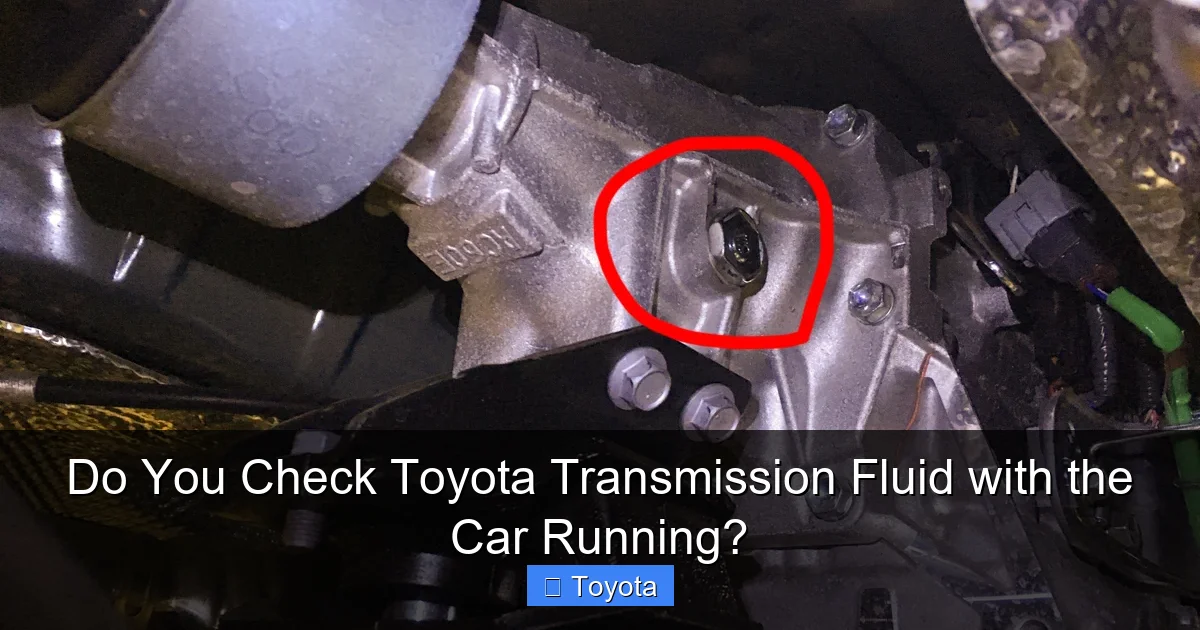
Visual guide about Do You Check Toyota Transmission Fluid with the Car Running?
Image source: c1.staticflickr.com
For Older Toyota Automatics (Pre-~2010, 4-Speed & 5-Speed)
If you own a Toyota from the 1990s or early 2000s with a traditional 4-speed (A340E, etc.) or 5-speed (A750E, etc.) automatic transmission, the overwhelming probability is that you check the fluid with the engine running and warmed up.
- Engine State: Running.
- Gear Position: Park (some specify Neutral—your manual will say).
- Fluid Temp: Usually after a short drive to reach normal operating temperature. The dipstick will have “Hot” marks. Some manuals also give a “Cold” check procedure for initial fill or if you can’t get it hot.
- Process: With engine idling in Park, pull the dipstick, wipe clean, reinsert fully, pull again, and read the level against the “Hot” marks. The fluid should be clean, red (or pink), and smell slightly sweet. If it’s dark, burnt, or smells acrid, it’s overdue for service. This is the classic procedure many of us grew up with.
For Modern Toyota Automatics (6-Speed & 8-Speed, e.g., Aisin-Warner)
This is where it gets trickier. Many modern 6-speed (e.g., in some Tacomas, older RAV4 V6) and 8-speed (e.g., in current Tundras, Sequoias, some Camry V6) automatics still often require a running engine check, but the temperature specifications are stricter. Some newer models are moving toward the CVT-style “engine off” check even for traditional automatics. You must verify. The location of the dipstick is usually on the passenger side near the back of the engine bay, often with a red or black handle.
For Toyota CVTs (The Most Common Modern Powertrain)
This is the critical section for most Toyota shoppers today. The CVT is standard in the Corolla, Camry (4-cylinder), RAV4 (non-hybrid), Prius, and many others. The vast majority of Toyota CVTs MUST be checked with the engine OFF and the vehicle LEVEL. This is a hard and fast rule for these models.
- Engine State: OFF. Completely.
- Vehicle State: Must be parked on a perfectly level surface. This is non-negotiable.
- Fluid Temp: Procedures vary. Some say “check when cold” (after the car has been sitting for hours). More commonly, they specify a “hot” check but with the engine off. This involves driving the car normally for at least 15-20 minutes to fully warm the transmission, then immediately parking on level ground, shutting off the engine, and checking within a very short window (e.g., 1-2 minutes). The fluid must be within a specific temperature range (often 176°F-194°F).
- Dipstick: Often a smaller, yellow-handled dipstick located in a different spot than the oil dipstick. In some newer models (like certain 2023+ RAV4s), the dipstick is eliminated entirely, requiring a dealer visit for level checks. If you can’t find a second dipstick, your car likely has a sealed system. You can learn more about specific models, like the Honda Civic’s procedure, which is similar in its CVT requirements, but always defer to Toyota’s specs.
A Step-by-Step Guide for the Most Common Scenarios
Let’s walk through the two most likely procedures you’ll face.

Visual guide about Do You Check Toyota Transmission Fluid with the Car Running?
Image source: diycarexpert.com
Scenario A: Older Automatic (Engine Running Check)
- Prepare the Car: Drive the vehicle for at least 15-20 minutes to ensure the transmission fluid is at its normal operating temperature (typically 170°F-200°F).
- Park and Idle: Park on level ground, set the parking brake, and leave the engine running. Shift the transmission through all gears, ending in Park (or Neutral if your manual specifies).
- Locate and Clean: Find the transmission dipstick (usually red-handled, on the passenger side). Pull it out, wipe it clean with a lint-free cloth.
- Check Level: Fully reinsert the dipstick, then pull it out again. Read the level against the “Hot” marks. The fluid should be within the cross-hatched area or between the “Full” and “Add” lines.
- Interpret & Act: If low, add the correct Toyota fluid in small increments (a half-quart at a time), rechecking each time. Do not overfill. If the fluid is dark, gritty, or smells burnt, a fluid and filter change is overdue. Consider a transmission fluid change interval guide for your specific model.
Scenario B: Modern CVT (Engine Off, Hot Check)
- Prepare the Car: Drive the vehicle normally for at least 20 minutes to fully warm the transmission. Do not just idle; the fluid needs to be under load.
- Park Level: Immediately after driving, park on a perfectly level surface (a garage floor is best). Engage the parking brake firmly.
- Shut Down: Turn the engine OFF. Do not let it idle.
- Locate and Check Quickly: Find the CVT dipstick (often yellow, may be near the oil dipstick but distinct). Pull it out, wipe clean. Reinsert it fully. Pull it out again and read the level immediately. The manual will specify an exact temperature range (e.g., 176-194°F) and may have a “Hot” mark. Some procedures require you to check within 60-90 seconds of shutting off.
- Interpret & Act: If low, add the specified Toyota CVT fluid (e.g., Toyota CVT Fluid FE) in tiny amounts. Overfilling a CVT is particularly dangerous. If you can’t get a clear reading or the level is borderline, it’s safest to have a professional verify it with a scan tool that reads transmission fluid temperature precisely.
What If There’s No Dipstick? The Sealed Transmission
This is becoming increasingly common. If you search your engine bay and cannot find a second dipstick (distinct from the oil dipstick), your Toyota likely has a sealed transmission. This is typical on many 2020+ models, especially higher-trim vehicles. You cannot check the fluid level yourself. The only way to check and adjust the level is via a special service port on the transmission itself, which requires a scan tool to monitor transmission fluid temperature and a pump to add or remove fluid. This is a professional service procedure. Attempting to guess or add fluid without this equipment is a recipe for disaster. For these vehicles, the best practice is to follow the severe service maintenance schedule in your manual and have the fluid inspected/changed at the recommended intervals (often 60,000-100,000 miles) by a dealer or qualified shop.
Common Mistakes and How to Avoid Them
Even with the right procedure, errors happen. Here’s how to avoid the biggest pitfalls:
- Checking on a Slope: Even a slight incline will give a falsely high reading on a CVT (engine off) check. Always use a level surface.
- Wrong Temperature: Checking a “hot” procedure when the fluid is cold will show low. Checking a “cold” procedure when the fluid is hot will show high. Be precise.
- Dirty Dipstick: Always wipe the dipstick clean before reinserting for the final read. A film of old fluid on the stick will give a false high reading.
- Using the Wrong Fluid: Toyota transmissions are finicky. Never use generic “Dexron” or “Mercon” fluid unless the manual explicitly states it’s acceptable. Use only the specified Toyota fluid. Using the wrong fluid can cause shuddering, slipping, and failure. You can research who manufactures Toyota’s branded fluids, but always buy the Toyota-branded product for guaranteed compatibility.
- Ignoring the Smell and Color: The level is only part of the check. Healthy fluid is typically red or pink and smells slightly sweet. Brown, black, or burnt-smelling fluid indicates overheating and breakdown, requiring immediate service regardless of level.
- Overfilling: It’s better to be slightly low than overfull. Add fluid in half-quart increments and recheck. If you overfill, you must have it professionally drained to the correct level.
Conclusion: Knowledge is Power (and a Healthy Transmission)
So, do you check Toyota transmission fluid with the car running? The only correct answer is: it depends on your specific vehicle. For older automatics, usually yes. For most modern CVTs, almost certainly no. The single most important action you can take is to find and read your owner’s manual. That document holds the key to performing this check correctly, safely, and without damaging one of your car’s most expensive components. If the manual is unclear, or if your vehicle has a sealed system, don’t guess. Consult a Toyota technician. A $100 professional check is infinitely cheaper than a $4,000 transmission rebuild. Treat your transmission fluid check with the seriousness it deserves—it’s the lifeblood of your powertrain.
Frequently Asked Questions
Can I check my Toyota CVT transmission fluid when the engine is running?
No, for virtually all Toyota models equipped with a CVT, the manufacturer’s procedure requires the engine to be completely off. Checking it with the engine running will give an inaccurate reading and can lead to dangerous overfilling. Always follow the specific steps in your owner’s manual.
What happens if I check my automatic transmission fluid when the engine is cold?
If your manual specifies a “hot” check (common for older automatics), checking when cold will show a falsely low level. You might add fluid unnecessarily, leading to overfilling once the fluid expands at operating temperature. Always check at the temperature specified by Toyota for your model.
My Toyota doesn’t have a transmission dipstick. How do I check the fluid?
If you cannot locate a second dipstick distinct from your engine oil dipstick, your transmission is likely a sealed system. You cannot check the level yourself. This requires a professional service technician with a scan tool and a special procedure at the transmission’s service port. Follow your maintenance schedule for fluid changes.
Is it normal for Toyota CVT fluid to smell burnt?
No. A slight, sweet smell is normal. A sharp, acrid, or burnt odor is a major red flag indicating the fluid has overheated and broken down. This is often caused by aggressive driving, towing, or an underlying transmission issue. Have it inspected immediately by a professional.
Can I use any ATF in my Toyota if I’m in a pinch?
Absolutely not. Toyota transmissions are engineered for specific fluid chemistry. Using the wrong fluid (like generic Dexron) can cause poor shifting, slipping, and permanent damage within a short time. Always use the exact Toyota-specified fluid listed in your owner’s manual, such as ATF WS or Toyota CVT Fluid FE.
How often should I check my transmission fluid?
As a general practice, checking your transmission fluid level and condition at least once every 3-6 months or with every oil change is a smart habit. For sealed systems, you won’t check the level yourself, but you should still be aware of any changes in shifting behavior and adhere strictly to the factory-recommended fluid change intervals.